
Engineering a Hydroponic System to Feed a Class!
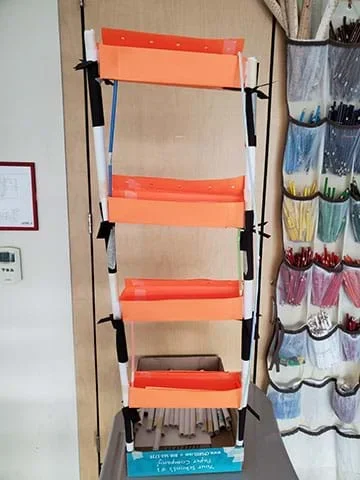 A full-scale model of a student’s hydroponic design.Copyright 2021 University of Pittsburgh RET
The world population will reach 10 billion by the year 2050. As the number of people increase, so does the demand for proper housing and food. Since both demands require land, competition between the two creates a land scarcity. New methods of farming need to be created to alleviate the land scarcity and to increase the current food production. Hydroponics has the potential to reduce land usage and to keep up with the demands of the growing population. In this activity, students will explore what it means to brainstorm and sketch potential models for a hydroponics system for their school. They will explore the usefulness of each prototype and work as a team to come up with a solution to this problem and make sense of the tools engineers use to help mitigate land and water scarcity problems.
Engineers make decisions or influence decisions that impact daily life to what products we use, what products we need and even what we buy at the grocery store. Civil engineering, mechanical engineering and materials science will be used as students address food access and availability facing the world’s increasing population and decreasing lands for traditional farming.
After this activity, students should be able to:
- Predict how human population growth will impact farming and food production for the next generation.
- Investigate and describe existing alternatives to traditional farming.
- Design and build a prototype that may solve the increased demand for food using limited land or space.
- Evaluate the design and iterate based on test results.
- STEL-7AA Illustrate principles, elements, and factors of design.
Grades 9-12
Do you agree with this alignment?
- HS-ETS1-2 Design a solution to a complex real-world problem by breaking it down into smaller, more manageable problems that can be solved through engineering.
Grades 9-12
This resource focuses on the following Three Dimensional Learning aspects of NGSS:
Science & Engineering Practices- Design a solution to a complex real-world problem, based on scientific knowledge, student-generated sources of evidence, prioritized criteria, and tradeoff considerations.Do you agree with this alignment?
Disciplinary Core Ideas- Criteria may need to be broken down into simpler ones that can be approached systematically, and decisions about the priority of certain criteria over others (trade-offs) may be needed.Do you agree with this alignment?
Do you agree with this alignment? - Design a solution to a complex real-world problem, based on scientific knowledge, student-generated sources of evidence, prioritized criteria, and tradeoff considerations.
- HS-LS1-5 Use a model to illustrate how photosynthesis transforms light energy into stored chemical energy.
Grades 9-12
This resource focuses on the following Three Dimensional Learning aspects of NGSS:
Science & Engineering Practices- Use a model based on evidence to illustrate the relationships between systems or between components of a system.Do you agree with this alignment?
Disciplinary Core Ideas- The process of photosynthesis converts light energy to stored chemical energy by converting carbon dioxide plus water into sugars plus released oxygen.Do you agree with this alignment?
Crosscutting Concepts- Models (e.g., physical, mathematical, computer models) can be used to simulate systems and interactions—including energy, matter, and information flows—within and between systems at different scales.Do you agree with this alignment?
Do you agree with this alignment? - Use a model based on evidence to illustrate the relationships between systems or between components of a system.
- HS-LS1-6 Construct and revise an explanation based on evidence for how carbon, hydrogen, and oxygen from sugar molecules may combine with other elements to form amino acids and/or other large carbon-based molecules.
Grades 9-12
This resource focuses on the following Three Dimensional Learning aspects of NGSS:
Science & Engineering Practices- Construct and revise an explanation based on valid and reliable evidence obtained from a variety of sources (including students' own investigations, models, theories, simulations, peer review) and the assumption that theories and laws that describe the natural world operate today as they did in the past and will continue to do so in the future.Do you agree with this alignment?
Disciplinary Core Ideas- The sugar molecules thus formed contain carbon, hydrogen, and oxygen: their hydrocarbon backbones are used to make amino acids and other carbon-based molecules that can be assembled into larger molecules (such as proteins or DNA), used for example to form new cells.Do you agree with this alignment?
- As matter and energy flow through different organizational levels of living systems, chemical elements are recombined in different ways to form different products.Do you agree with this alignment?
Crosscutting Concepts- Changes of energy and matter in a system can be described in terms of energy and matter flows into, out of, and within that system.Do you agree with this alignment?
Do you agree with this alignment? - Construct and revise an explanation based on valid and reliable evidence obtained from a variety of sources (including students' own investigations, models, theories, simulations, peer review) and the assumption that theories and laws that describe the natural world operate today as they did in the past and will continue to do so in the future.
- HS-LS1-7 Use a model to illustrate that cellular respiration is a chemical process whereby the bonds of food molecules and oxygen molecules are broken and the bonds in new compounds are formed resulting in a net transfer of energy.
Grades 9-12
This resource focuses on the following Three Dimensional Learning aspects of NGSS:
Science & Engineering Practices- Use a model based on evidence to illustrate the relationships between systems or between components of a system.Do you agree with this alignment?
Disciplinary Core Ideas- As matter and energy flow through different organizational levels of living systems, chemical elements are recombined in different ways to form different products.Do you agree with this alignment?
- As a result of these chemical reactions, energy is transferred from one system of interacting molecules to another. Cellular respiration is a chemical process in which the bonds of food molecules and oxygen molecules are broken and new compounds are formed that can transport energy to muscles. Cellular respiration also releases the energy needed to maintain body temperature despite ongoing energy transfer to the surrounding environment.Do you agree with this alignment?
Crosscutting Concepts- Energy cannot be created or destroyed—it only moves between one place and another place, between objects and/or fields, or between systems.Do you agree with this alignment?
Do you agree with this alignment? - Use a model based on evidence to illustrate the relationships between systems or between components of a system.
- HS-LS2-7 Design, evaluate, and refine a solution for reducing the impacts of human activities on the environment and biodiversity.
Grades 9-12
This resource focuses on the following Three Dimensional Learning aspects of NGSS:
Science & Engineering Practices- Design, evaluate, and refine a solution to a complex real-world problem, based on scientific knowledge, student-generated sources of evidence, prioritized criteria, and tradeoff considerations.Do you agree with this alignment?
Disciplinary Core Ideas- When evaluating solutions it is important to take into account a range of constraints including cost, safety, reliability and aesthetics and to consider social, cultural and environmental impacts.Do you agree with this alignment?
- Moreover, anthropogenic changes (induced by human activity) in the environment—including habitat destruction, pollution, introduction of invasive species, overexploitation, and climate change—can disrupt an ecosystem and threaten the survival of some species.Do you agree with this alignment?
- Humans depend on the living world for the resources and other benefits provided by biodiversity. But human activity is also having adverse impacts on biodiversity through overpopulation, overexploitation, habitat destruction, pollution, introduction of invasive species, and climate change. Thus sustaining biodiversity so that ecosystem functioning and productivity are maintained is essential to supporting and enhancing life on Earth. Sustaining biodiversity also aids humanity by preserving landscapes of recreational or inspirational value.Do you agree with this alignment?
- Biodiversity is increased by the formation of new species (speciation) and decreased by the loss of species (extinction).Do you agree with this alignment?
Crosscutting Concepts- Much of science deals with constructing explanations of how things change and how they remain stable.Do you agree with this alignment?
Do you agree with this alignment? - Design, evaluate, and refine a solution to a complex real-world problem, based on scientific knowledge, student-generated sources of evidence, prioritized criteria, and tradeoff considerations.
- 3.1.B.A8 Change and Constancy - Recognize that systems within cells and multicellular organisms interact to maintain homeostasis. Patterns - Demonstrate the repeating patterns that occur in biological polymers. Systems - Describe how the unique properties of water support life.
Grades 9-12
Do you agree with this alignment? - 3.4.10.D1 Refine a design by using prototypes and modeling to ensure quality, efficiency, and productivity of a final product.
Grade 10
Do you agree with this alignment?
Each group needs:
- Chromebook or laptop
- water (for testing hydroponic system)
- Brainstorming Worksheet (PDF) and the Poster Rubric (PDF)
Various recycled materials for students to use in their prototyping. Items may include:
- clean and dried plastic food containers (such as yogurt containers or milk jugs).
Various inexpensive materials for students to use in their prototyping. Items may include:
- colanders
- duct tape, masking tape, adhesives
- pipe cleaners
- plastic containers of all shapes and sizes
- tubing
- wooden sticks
- zip ties
For the whole class to share:
- timer (or alarm, watch, cell phone timer)
Scientists and world leaders have identified 2050 as a key moment in history when the world’s population will be nearly 10 billion humans. How old will you be in 2050? What will your life be like?
It is predicted that we will need to grow 60-70% more food than we currently grow today to feed a population of 10 billion on the same amount of land or on less land. How do we accomplish that goal?
As a team, you will design a simple and practical hydroponic growing system for a small space, like a classroom, to grow multiple leafy green vegetables which have a smaller ecological footprint than traditional farming. Your team will build a prototype of the hydroponics system to present to the class for peer review. Once you have feedback, we will expand the designs to be used by the school population eating meals from the cafeteria.
Background
We have all heard the word “sustainability” before, but what exactly is it?
Practicing sustainability means using resources in such a way that they will continue to be available in the future. Examples of ecological sustainability include recycling, upcycling, consuming less, or relying on renewable energy to power our cars and heat or cool our homes. It is important to note that these examples all required a new technology to make it happen. For example, motors needed to be redesigned to create the electric car and a team of mechanical and electrical engineers were needed to design and test electric vehicles.
In this activity, students will be asked to think like an engineer and to collaborate to design a product that addresses food (leafy greens specifically) production and sustainability as the world population continues to increase and the land resources decrease.
Plants require three nutrients to complete photosynthesis – carbon dioxide, water, and light. This process is represented by the equation:
CO2 + H2O + light = C6H12O6 + O2.
Soil is not required for plants to make sugar. Can we grow plants without soil? Yes, that is a hydroponic system. Hydroponic means the process of growing plants in sand, gravel, or liquid. Hydroponic farming s is a type of horticulture and a subset of hydroculture which involves growing plants, usually crops, without soil, by using water-based mineral nutrient solutions in aqueous solvents.
Before the Activity
- Gather materials
- Make one copy for each student of the Brainstorming Worksheet (PDF)
- Make one copy for each group of the Poster Rubric (PDF)
With the Students
Day 1: Pose the problem
- Have students individually read the following article from the World Food Program USA: https://medium.com/@WFPUSA/how-do-you-feed-6-million-people-a-month-73ff5784a448
- Have each student write down three approaches to solving the Syrian food crisis that are being used by the World Food Program.
Day 2: Research hydroponics and hydroponic systems/discuss constraints
- Break students into groups and have them share out approaches to solving the Syrian food crisis.
- Ask each group to contribute one “answer” to the class and the teacher should list these “answers” on the board for the entire class to view.
- As a class, discuss the list. Ask the class: What are the limitations to the solutions? (Answers may include money, materials, water, available land.)
- Bring the discussion home – how would we address a food crisis where we live. Ask students about their homes/apartments/local area – is there a yard or open space nearby? How large is the yard or open space? Challenge students to think about where they could grow a vegetable garden at their house or in their local area that would produce enough food to feed 50 neighbors. (This exercise can also be done using your school’s area. Where could enough food be grown at your school to feed the entire school and their families?) Note: Most students and/or school likely do not have a yard or open space large enough for this, so pivot to the concept of hydroponics.
- Homework - Ask everyone to research and define hydroponics and create an image of a hydroponics system that can be presented to their group during the following class period.
Day 3: Group work and individual design
- Break into groups and set a timer for 3 minutes for each person in the group to share their definition of hydroponics and the image of a hydroponics system they brought in. If working in groups of 4, person one will have 3 minutes to present. Re-set the timer for another 3 minutes so that person two can present and continue to re-set the timer until all students have had a chance to present to the group. No questions should be asked until all group members have presented their definitions and images.
- Give teams time to ask questions within the group. Teacher should visit each group and ask them to create a shared definition of hydroponics and a list of “must-haves” that all the hydroponics images have in common.
- Homework – Have each student think of three new designs for a hydroponics system. Make sure students keep in mind the limitations of land availability (this can be thought of as limited space in our classroom), cost and materials.
Day 4: Sketching and Brainstorming
- Break students into groups of 3-4 students.
- Pass out the Brainstorming Worksheet (PDF); one to each student.
- Give student groups 5 minutes for each student to sketch three new designs for a hydroponics system. (Note: Refer to the Example of student sketches (PDF) if students need help with sketching, although this is optional; students should be able to roughly outline their ideas without a example.)
- After 5 minutes, have students pass (clockwise) their sketches to the next person in their group. Note: each student in the group should get a paper passed to them.
- Give student groups 5 minutes to look at the sketches from another person and have them do one of the following: add to the sketches, take something away from the sketches or create a new sketch.
- After 5 minutes, pass the worksheets again, repeat having the students add, subtract, or edit the new sketches over 5 minutes.
- Continue passing the worksheet until each student has their original sketch returned to them.
- Give student 5-10 minutes to look at the modifications that their group members added and to ask questions about all the group designs.
- As a group, have each student group decide which design should move forward to the prototyping stage - which design best fits the needs of minimal space, minimal cost and easy access to materials.
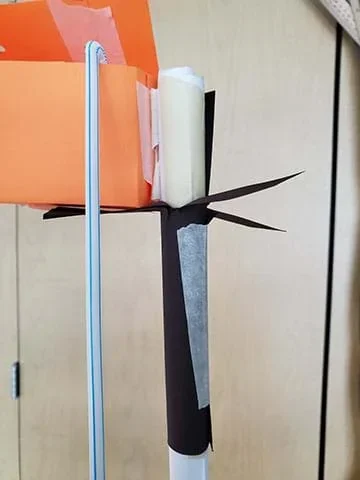 Details of a hydroponics prototype design.Copyright 2021 University of Pittsburgh RET
Days 5-8: Designing, Planning, and Prototyping
- Have each group draw their hydroponics system design on a new (clean) piece of paper. They should label each material that will be used.
- Teacher should meet with each group before they start building to ask questions like why did the group select this design? How does this design have an advantage over an existing hydroponics system? How many plants can be grown in this new design? Are there limitations to this design?
- Once each group has teacher approval, each group should build one prototype using the recycled and/or Dollar Store materials outlined in their drawing.
- Give students time to build their prototype.
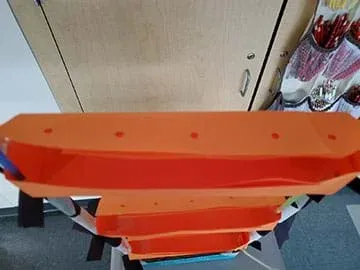 A top-level view of a student prototype.Copyright 2021 University of Pittsburgh RET
Days 9-11: Testing and redesign
- Have students take a video of their hydroponics system prototype to show how it should work. (optional)
- Have each team decided what they will test their prototype for: testing may include waterproofing, weight, mobility of the system, etc.
- Have students test their prototype based on their chosen criteria.
- Encourage groups to take photos as they prototype and test.
- Have students take video of their prototyping testing. (This can be included in the final video.)
- Let students redesign their prototype to improve it based on the testing results.
Days 12-15: Create the Poster and Video
- Groups use one Google Slide (24 inches x 36 inches) to create a scientific poster of this project. Use Google Slides so individual group members can all work on the same slide if the slide is shared.
- Provide each student team the Poster Rubric (PDF) so that each group knows what is expected in their scientific poster, section by section.
- Teacher can also show an example of a completed scientific poster (PDF) to help students before they start to create their own.
- Have students put together a short video showing how their prototype works.
- aqueous
- Containing the properties of water or similar to water.
- ecological footprint
- The impact of a person on the environment, expressed as the amount of land required to sustain the use of natural resources.
- horticulture
- The practice of garden cultivation and management.
- hydroculture
- A type of hydroponics in which plants are grown in a medium that allows the distribution of water and nutrients through capillary action.
- hydroponics
- The process of growing plants in sand, gravel or water with added nutrients but without soil.
- sustainability
- Avoidance of the depletion of natural resources to maintain ecological balance.
Pre-Activity Assessment
Investigate the food crisis in Syria and answer the question – How do you feed six million people per month?
Write down three approaches to solving the Syrian food crisis that are being used by the World Food Program https://medium.com/@WFPUSA/how-do-you-feed-6-million-people-a-month-73ff5784a448
Activity Embedded (Formative) Assessment
Constantly monitor groups as they are brainstorming and prototyping to ensure that one to two students are not taking over the project. Refer to the Example of student sketches (PDF) if students need help with the sketching portion of the activity. Google drive can be used to store files and group work and while also being shared with the teacher. Students can use Google Slides to create the final poster – this allows all group members to work on the same document and the teacher can see which student contributed to the poster.
Post-Activity (Summative) Assessment
Create a scientific poster – one per group that will be graded by the teacher. See an Example of a completed poster (PDF) for guidance and view the Poster Rubric (PDF) for organization and grading. Teacher can adjust the total points.
Explore farming in 2050 further by expanding to include livestock. The hydroponics unit addresses plant growth but does not include how to maintain livestock with decreasing land availability. This unit can also explore the use of recycled materials and biodegradable materials to be used in the building of prototypes.
For upper grades or advanced students, challenge students to include the molecules of photosynthesis (carbo dioxide, water, light, sugar, oxygen) and couple the project with cellular respiration – ask to design “landless” plant farms in cities where fresh oxygen is needed to balance poor air quality.
For lower grades, pre-pack materials to prototype in kits. This will limit materials, but it will also keep students focused on the build.
Each group could submit a video of the hydroponics system over time. Can start with seeds and continue through and plant growth.
Groups can access CAD software and use 3D printers to create parts for the prototypes if the school has access to this equipment.
Contributors
Megan Farren; Mahender Mandala; Mary Goldberg
Supporting Program
Research Experience for Teachers (RET), Human Engineering Research Labs, University of Pittsburgh
Acknowledgements
This curriculum as developed under the National Science Foundation Research Experience for Teachers on Quality of Life Technology from the University of Pittsburgh grant no. 1609566. Any opinions, findings, and conclusions or recommendations expressed in this material are those of the authors and do not necessarily reflect the views of the National Science Foundation.
Copyright
2022 by Regents of the University of Colorado; original © 2019 University of Pittsburgh