
Oil and Water: Washing Up with Surfactants
In a very hands-on activity, students observe and feel the differences between two cleaning methods, with and without hand soap, using coffee grounds to represent "dirt." Most of the dirt and bacteria on our hands is encased in a thin layer of oil, so because of the properties of oil and water, cleaning your hands with water alone has little effect when trying to remove the dirt. This activity demonstrates the importance of using a surfactant, such as hand soap, when washing your hands.
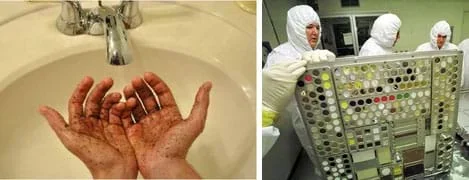 During this activity, students experiment to see how a surfactant helps clean dirty hands covered with cooking oil and coffee grounds. Artificial surfactants are chemically engineered for an uncountable number and variety of household and industrial uses, such as maintaining this clean room for preparing samples for a space experiment.Copyright (left) 2010 Samuel DuPont and Ryan Cates. STARS – University of South Florida, (right) NASA http://www.sti.nasa.gov/tto/spinoff2001/langley.html
Soaps and detergents are commonly used in industrial processes. In order for a process to be reproducible, the materials and/or objects involved in the process must be free from any contamination, such as dirt and oil. Surfactant-based soaps and detergents are commonly used to ensure all components of a process are clean so that the process results in a product of consistent quality every time it is made.
After this activity, students should be able to:
- Identify the purpose of soap when washing your hands and/or other objects and surfaces.
- Identify that washing hands with water alone is not sufficient to remove the oily grime that contains bacteria.
- SC.5.N.1.1 Define a problem, use appropriate reference materials to support scientific understanding, plan and carry out scientific investigations of various types such as: systematic observations, experiments requiring the identification of variables, collecting and organizing data, interpreting data in charts, tables, and graphics, analyze information, make predictions, and defend conclusions.
Grade 5
Do you agree with this alignment? - SC.5.N.1.4 Identify a control group and explain its importance in an experiment.
Grade 5
Do you agree with this alignment? - SC.5.P.8.2 Investigate and identify materials that will dissolve in water and those that will not and identify the conditions that will speed up or slow down the dissolving process.
Grade 5
Do you agree with this alignment? - SC.5.P.8.4 Explore the scientific theory of atoms (also called atomic theory) by recognizing that all matter is composed of parts that are too small to be seen without magnification.
Grade 5
Do you agree with this alignment?
- STEL-1J Develop innovative products and systems that solve problems and extend capabilities based on individual or collective needs and wants.
Grades 6-8
Do you agree with this alignment? - STEL-7K Interpret how good design improves the human condition.
Grades 3-5
Do you agree with this alignment?
- 5-PS1-4 Conduct an investigation to determine whether the mixing of two or more substances results in new substances.
Grade 5
This resource focuses on the following Three Dimensional Learning aspects of NGSS:
Science & Engineering Practices- Conduct an investigation collaboratively to produce data to serve as the basis for evidence, using fair tests in which variables are controlled and the number of trials considered.Do you agree with this alignment?
Disciplinary Core Ideas- When two or more different substances are mixed, a new substance with different properties may be formed.Do you agree with this alignment?
Crosscutting Concepts- Cause and effect relationships are routinely identified, tested, and used to explain change.Do you agree with this alignment?
Do you agree with this alignment? - Conduct an investigation collaboratively to produce data to serve as the basis for evidence, using fair tests in which variables are controlled and the number of trials considered.
Each group needs:
- cooking oil, 2 tablespoons (approximately 30 mL)
- finely ground coffee beans, 2 tablespoons (approximately 30 mL)
- sink with running water
- hand soap
- 4 paper towels
- stopwatch
- smocks
To share with the entire class:
- (optional) microscopes, to closely examine skin
- (optional) computer with Internet access, to show students a YouTube video
An understanding that tiny microscopic bacteria (germs) exist everywhere, including on our hands.
What is the first thing your parents tell you to do after an amazing afternoon of playing outside and getting all dirty? (Listen to student suggestions.)
Well, my parents constantly reminded me to wash my hands or take a bath when I came inside. They probably told me this because after a long hard day of playing outside my hands were covered with dirt and germs. Most importantly, germs, which are tiny little bacteria, some of which could make me sick, have a one-way ticket to get near my mouth because our hands often touch our faces. Bacteria getting into your mouth or eyes just increases your chances to end up visiting the doctor!
The second thing they reminded me to do is to "Use soap!" Can anyone tell me exactly why we use soap to wash our hands? (Listen to student suggestions.)Well, the real reason we use soap when washing our hands, dirty dishes, and even a car, is because of oil.
Can anyone tell me what happens when you try to mix oil and water? That's right; they separate into two areas that we call phases. The oil phase, which is on top, and the water phase, which is on the bottom. The main message here is that oil and water do not mix!
Let's get back to our hands. Everybody, rub your hands together. Can you feel how they are slightly slippery? That is because we have a thin layer of oil on our hands. Did you know that thousands of tiny particles and germs are trapped in that thin slippery layer of oil? So, if water doesn't mix with oil, do you think that washing your hands with water alone will remove that layer of oil and all of the dirt and germs in it? Absolutely not! This is why we use soap.
Soap is a special type of substance that we call a surfactant. A surfactant is a type of substance that helps water and oil to mix. Chemical engineers design many different types of surfactants — soaps and detergents — specifically for different types of cleaning jobs. By using a surfactant on our hands, the water can now "pick up" small chunks of the oil (which has dirt and germs in it) and rinse them away from our hands. Today we are going to perform an experiment to demonstrate how a surfactant helps us keep our hands clean and keep us healthy.
Background
This activity has the potential of making a mess. If possible, carry out this experiment in a non-carpeted room or else lay plastic on the carpet to prevent staining. It is advised that students wear smocks to protect their clothing.
Before the Activity
- Gather materials.
- (optional) Have available microscopes and a computer with Internet access.
- Divide the class into teams of two students each.
- Have student wear smocks to prevent their clothes from getting dirty.
With the Students
- Rinsing our hands with water makes them look clean? Are they really clean? Why do we use soap to wash our hands? Conduct the pre-activity assessment discussion, as described in the Assessment section. Beyond obviously dirty hands, increase students' awareness of the presence of germs and bacteria. Use microscopes if available.
- (optional) Show students a fun 5-minute YouTube video about how easily germs are spread. See the Additional Multimedia Support section.
- Have each group approach the sink, one group at a time.
- Pour approximately 1 tablespoon (15 mL) of oil into each student's right hand followed by approximately 1 tablespoon of finely ground coffee beans.
- Have students shake hands and thoroughly rub the coffee grounds into each other's hands.
- Start the water running at the sink.
- For each pair of students, pour a small amount of soap into one student's hands.
- Allow a little running water to move across each of the student's hands.
- Note that the hand with the soap in it has a clean streak, while the non-soap hand is mostly unaffected by the small stream of water.
- Now have students scrub their hands in the sink for 5 seconds while the teacher is timing with a stopwatch.
- Turn off the water and the student pairs visually compare their hands.
- Expect the hands of the student who had the soap applied to be pretty clean, while the other student probably still has some coffee grounds on his/her hand.
- Have each student use one paper towel and lightly pat dry his/her hands.
- At this point, it is important that students only pat dry their hands lightly.
- Now, using a second, clean paper towel, have each student vigorously wipe his/her hands.
- Have the students compare their paper towels.
- Expect the towel that came from the non-soap hand to have oil stains on it.
- Have students rub their fingers together, noticing that the non-soap hand feels significantly more slippery.
- Finally, have all students wash their hands with soap.
- Recap the findings of the groups and reiterate why soap is necessary to remove all the coffee and oil from the hands, as described in the post-activity assessment in the Assessment section.
- Conclude with a class discussion that extends hand washing with regular soap to the use of antiseptic cleaning products, as described in the Assessment section.
- oil
- A fluid (at room temperature) that is composed of non-polar molecules.
- mixing
- The ability for two fluids to be evenly dispersed in one another.
- surface tension
- A property of the surface of a liquid that causes an attractive or repulsive force between the liquid and another surface.
- surfactant
- A compound that reduces the surface tension between two dissimilar materials. Usually fluid-fluid or fluid-solid.
- water
- A fluid that is composed of polar molecules.
Pre-Activity Assessment
Rinsing Our Hands with Water Makes Them Look Clean; Why Isn't This So?: This would be a great place to talk about the presence of microorganisms that live on our skin and those that are picked up through contact. If microscopes are available in the classroom, have students view their hands under the microscope to observe the minute detail of the skin's surface. Make the point that oils (either naturally produced by the skin or those applied through contact) lodge themselves in the small ridges of the skin, holding bacteria and resisting water. To answer the rinsing misconception, explain that water only removes large globules of oil that are not tightly affixed to the skin.
Why Do We Use Soap to Wash Our Hands?: Surfactants form a link between oil and water, allowing them to mix. In order to remove oil and bacteria encased within it from the skin's topography, surfactants are needed. Furthermore, the time prescribed for thorough washing, ≥ 30 seconds, is to allow for complete mixing of the oil and water to ensure the majority of the bacteria is removed.
Post-Activity Assessment
Water Just Doesn't Cut It!: Recap the findings of the groups with the class and reiterate why soap is necessary to remove all of the coffee and oil from the hands. Also, explain that drying hands on clothing after washing them spreads residue coffee (germs) to the clothes; especially if they are not washed long enough!
Making Soap Better!: Discuss with students that an antiseptic is a substance that is used to kill viruses and bacteria. Have students identify which substances around their homes (other than soap) may be antiseptics. Also discuss with them whether they think that adding antiseptics to soap is necessary to be healthy. This could lead to another experiment, exploring the impact of antiseptic cleaning products; see the Activity Extensions section for details.
Real-World Applications: Surfactants are used in almost every type of liquid, paste and powdered cleaning compound ranging from heavy-duty industrial products to gentle detergents, and for many other purposes and products besides cleaning. Ask students to brainstorm (or research) other home and industrial situations in which introducing a surfactant to reduce the surface tension can be helpful. What products contain surfactants? What types of characteristics can surfactants help create? Examples:
- Example situations: Mechanics to clean hands, restaurants to clean dinnerware and kitchen for safe food preparation, industrial cleaners to remove grease build-up on floors for worker safety in factories, soak tanks for equipment cleaning, laundry and spot removal, car wash and car care, automatic dishwasher and rinse aids, hand dishwashing, floor and carpet care, hard surface cleaning in kitchens and bathrooms, oil well extraction, pipeline drag reducers, medical (opens alveoli in lungs), dry cleaning, paper coatings, de-inking of recycled paper, ceramics, food and dairy process cleaning, clean rooms and electronic and precision cleaning
- Example products: Detergents, fabric softeners, paints, adhesives, inks, ski and snowboard waxes, degreasers, anti-fogging coatings, fire-fighting foams, ink, shampoos, hair conditioners, toothpastes, cosmetics, hand creams, pharmaceuticals, insecticides, rug shampoos, streak-free window cleaners
- Example properties that are designed into specific types of products: wetting, spreading, dispersing, adhesion, low irritancy (baby shampoos), non-streaking, emulsifying (for degreasing), foaming, anti-foaming, viscosity (gels)
- Use of strong detergents combined with the acidic nature of coffee grounds can lead to skin irritation. Follow hand-washing with moisturizer to relieve any skin irritation.
For best results, use cold water. Hot water removes more of the oil from the hands and lessens the visual verification of the experiment.
Have students investigate the role of two new variables in the hand cleaning exercise: temperature and washing duration. Using the same activity procedure, students can test washing in cold and hot water. Additionally, they can repeat the process at different durations of hand washing. In both cases, have them qualitatively assess how clean hands become under each scenario as well as count the number of coffee grains or coffee stains left after each trial. These additional exercises determine if it is soap alone that is important for getting our hands clean.
Incorporate the use of antiseptic cleaning products into the experiment. Obtain some sterile Petri dishes filled with agar (a growth medium for bacteria). Divide the class into groups of three students each. Have the first student touch his/her hands to the agar, the second student wash his/her hands with regular soap (no antiseptic) and touch a different Petri dish, and the third student clean his/her hands with soap containing antiseptic (or mix Listerine, a popular antiseptic, with a non-antiseptic soap) and touch the third Petri dish. Let the dishes incubate for a few days (best at high temperatures of ~35°C [95°F]) and see how many bacteria grow. Important note: Once the Petri dishes have been touched, students should not touch them again because now they are growing bacteria on them that can make them get sick. Also, be aware that you may be growing potentially harmful bacteria, so use caution after "seeding" the Petri dishes.
Use a Glo Germ kit to visually illustrate the importance of soap to eliminate germs.
- For upper grades (grades 6-8), have students also investigate the role of temperature and washing duration in the hand-cleaning exercise, as described in the Activity Extensions section.
Show students a 5-minute video on YouTube of students conducting an experiment with black-light "Glo Germ" powder to show people on how easily germs spread. See the Dragonfly TV Kids Do Science – Glo Germ video at https://www.youtube.com/watch?v=Vjq7pDecKdg.
Dow Surfactants. Printed January 2002. Dow Chemical Company. Accessed July 27, 2011. (Dow makes nearly 200 surfactant products) http://www.dow.com/surfactants/
"Glo Germ: The #1 product for teaching handwashing, isolation & aseptic techniques, and general infection control." N.d. Glo Germ, Moab, UT. August 23, 2010. http://www.glogerm.com/
Surfactants. Last updated July 26, 2011. Wikipedia, The Free Encyclopedia. Accessed July 27, 2011. (Good list of applications) http://en.wikipedia.org/wiki/Surfactant#Applications_and_sources
What is the purpose of surfactant? Posted November 6, 2007. MedExpert, AnswerBag. N.l. Accessed July 27, 2011. http://www.answerbag.com/q_view/466960
What is the role of surfactant in the lungs? N.d. WikiAnswers. N.l. Accessed July 27, 2011. http://wiki.answers.com/Q/What_is_the_role_of_surfactant_in_the_lungs
Contributors
Samuel DuPont; Ryan Cates
Supporting Program
STARS GK-12 Program, College of Engineering, University of South Florida
Acknowledgements
This curriculum was developed by the USF Students, Teachers and Resources in Sciences (STARS) Program under National Science Foundation grant numbers DGE 0139348 and DGE 0638709. However, these contents do not necessarily represent the policies of the NSF, and you should not assume endorsement by the federal government.
Copyright
2013 by Regents of the University of Colorado; original © 2011 College of Engineering, University of South Florida