
Exploring the Integumentary Systems of Animals
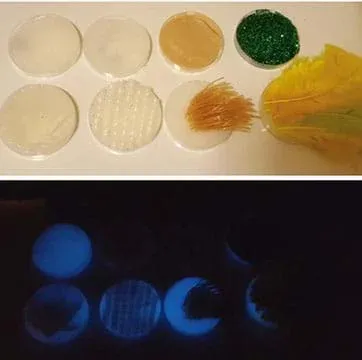 Students test their mimic epidermis samples using UV light and blue phosphorescent powder.Copyright 2017 Jamie Sorrell, RET Program, School of Polymers and High Performance Materials, University of Southern Mississippi
To evaluate the different integumentary systems found in the animal kingdom, students conduct an exploratory research-based lab. During the activity, students create a model epidermis that contains phosphorescent powder and compare the results to a control model. After learning about the variations of integumentary systems—systems that comprise the skin and other appendages that act to protect animal bodies from damage—students act as engineers to mimic animal skin samples. Their goal is to create a skin sample that closely represents the animal they are mimicking while protecting the base ‘epidermis’ from UV light.
There are many biological systems and patterns found only in nature, but from which engineers often draw inspiration through observation and empirical study. Engineers may conceptualize these unique biological constructs in order to design and find solutions to human challenges. This process is called biomimicry—the imitation of the models, systems, and elements of nature for the purpose of solving complex human problems. The field of biomimicry (or biomimetics) has inspired a range of modern applications, most notably flight. Like engineers, students apply the concept of biomimicry by creating the various integumentary systems found in animals.
After this activity, students should be able to:
- Identify controls in an experiment.
- Use engineering skills to build and test a mimic integumentary system.
- Make qualitative and quantitative observations.
- Discuss the outcome of their results.
- Use their own data as well as other students data to compare and contrast the integuments of various animals.
- CCSS.ELA-Literacy.RST.9-10.1 Cite specific textual evidence to support analysis of science and technical texts, attending to the precise details of explanations or descriptions.
Grades 9-10
Do you agree with this alignment? - CCSS.ELA-Literacy.RST.9-10.2 Determine the central ideas or conclusions of a text; trace the text's explanation or depiction of a complex process, phenomenon, or concept; provide an accurate summary of the text.
Grades 9-10
Do you agree with this alignment? - CCSS.ELA-Literacy.RST.9-10.3 Follow precisely a complex multistep procedure when carrying out experiments, taking measurements, or performing technical tasks, attending to special cases or exceptions defined in the text.
Grades 9-10
Do you agree with this alignment? - CCSS.ELA-Literacy.RST.9-10.7 Translate quantitative or technical information expressed in words in a text into visual form (e.g., a table or chart) and translate information expressed visually or mathematically (e.g., in an equation) into words.
Grades 9-10
Do you agree with this alignment? - CCSS.ELA-Literacy.RST.9-10.8 Assess the extent to which the reasoning and evidence in a text support the author's claim or a recommendation for solving a scientific or technical problem.
Grades 9-10
Do you agree with this alignment?
- Students will develop an understanding of the role of troubleshooting, research and development, invention and innovation, and experimentation in problem solving.
Grades K-12
Do you agree with this alignment? - Students will develop an understanding of the relationships among technologies and the connections between technology and other fields of study.
Grades K-12
Do you agree with this alignment?
- DCI.ETS1.B.6-8.8 There are systematic processes for evaluating solutions with respect to how well they meet the criteria and constraints of a problem.
Grades 6-8
Do you agree with this alignment? - SEP.7.9-12.1 Plan and conduct an investigation individually and collaboratively to produce data to serve as the basis for evidence, and in the design: decide on types, how much, and accuracy of data needed to produce reliable measurements and consider limitations on the precision of the data (e.g., number of trials, cost, risk, time), and refine the design accordingly.
Grades 9-12
Do you agree with this alignment? - SEP.6.9-12.1 Communicate scientific and technical information (e.g. about the process of development and the design and performance of a proposed process or system) in multiple formats (including orally, graphically, textually, and mathematically).
Grades 9-12
Do you agree with this alignment?
For Motivation/Introduction Activity:
Each group will need:
- various types of sunscreen; one different type per group (for example: sprays, lotions, organic sunscreen, inorganic metallic sunscreen, zinc, etc.)
To share with the entire class:
- a computer to show the Teacher Guided Presentation Part 1: UV Light (PPTX) and Teacher Guided Presentation Part 2: Integumentary System (PPTX) on PowerPoint
For the Main Activity:
Each group will need:
- Sample Procedures (PDF) worksheet; three copies per student
- Control Lab Procedures (PDF) worksheet; two copies per student
- Testing Apparatus Construction (PPTX) presentation and Data Collection (PDF) worksheet; one copy per group
- Conclusion Poster Layout (PDF) worksheet, one copy per group
- hot plate
- 1000 ml beaker
- two 250 ml beakers (students will use one while the other cools following use on the hot plate)
- 100 ml graduated cylinder
- two 10 ml graduated cylinders (one for measuring vinegar; one for measuring glycerin)
- permanent marker
- silicon spatula, available on Amazon and in other stores
- timer (students may use smartphones)
- electronic balance
- metal spatula (one large enough to measure 10 g of corn starch and other for measuring 0.6 g of glowing powder)
- weighing paper (used in chemistry classrooms)
- weighing boat (used in chemistry classrooms)
- five petri dishes
- ~60 g corn starch
- ~30 ml vinegar
- ~30 ml glycerin
- ~300 ml distilled water (tap water will work for this activity)
- ~3 g red phosphorescent (daytime white-glow) powder, available online
- pipettes (one for vinegar, one for glycerin)
- additional materials needed for different groups; note: all of these items can be purchased in department store craft section, craft store, or online:
- group 1: feathers, ~10 cm in length
- group 2: chocolate protein powder or coffee grounds, ~30 g
- group 3: yellow food coloring, 1 vial
- group 4: acrylic nails, 50 count bag
- group 5: brown plastic lacing thread
- group 6: green glitter, 100 g jar
- group 7: see Student Sample Examples (PDF) and Cuticle Procedures (PDF)
To construct the quantitative testing apparatus; each group will need:
- two ring stands
- two clamps (that will fit a ring stand)
- 1 cardboard box (approximate measure: 29.8 cm x 20.3 cm x 12 cm)
- masking tape
- box cutter
- UV flashlight, available online
- light sensor probe (can be purchased at Vernier; or check with your school’s science department)
- LabQuest Interface or Lab Quest Mini (can be purchased at Vernier; or check with your school’s science department)
- 25 – 50 g bottle of black acrylic paint
For evaluation of the activity, each group will need:
- large dry erase board (60 cm x 80 cm) or poster board
- dry erase markers or regular markers
- meter sticks
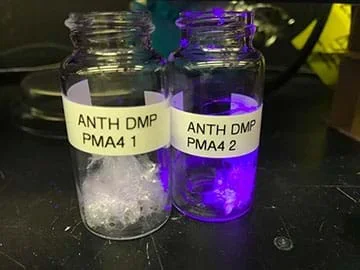 Photograph of two poly(methylacrylate) samples. The left sample is white; the right sample has fluorescent anthracene tag and appears purple.Copyright 2017 Shani Bourn, RET Program, School of Polymers and High Performance Materials, University of Southern Mississippi
- Conclusion Poster Layout (docx)
- Conclusion Poster Layout (pdf)
- Conclusion Presentation Grading Rubric (docx)
- Conclusion Presentation Grading Rubric (pdf)
- Control Lab Procedures (docx)
- Control Lab Procedures (pdf)
- Control Lab Procedures Presentation (pptx)
- Control Lab Procedures Presentation (pdf)
- Cuticle Procedures (docx)
- Cuticle Procedures (pdf)
- Data Collection (docx)
- Data Collection (pdf)
- Grading Rubric (docx)
- Grading Rubric (pdf)
- Sample Procedures (docx)
- Sample Procedures (pdf)
- Sample Procedures Student Example (docx)
- Sample Procedures Student Example (pdf)
- Student Presentation Examples (docx)
- Student Presentation Examples (pdf)
- Student Sample Examples (docx)
- Teacher Guided Presentation Part 1: UV light (pptx)
- Teacher Guided Presentation Part 1: UV light (pdf)
- Teacher Guided Presentation Part 2: Integumentary System (pptx)
- Teacher Guided Presentation Part 2: Integumentary System (pdf)
None, however students should have a knowledge of best practices within a high school science laboratory.
Human skin, cat claws, fish scales, horse hooves, insect exoskeletons, and bird feathers: all of these very different structures found in different species of animals actually have one important thing in common. In each animal, these structures comprise what is commonly known as the integumentary system—complex structures or organs that protect bodies from various kinds of external damage. Integumentary systems are highly evolved and help animals adapt to various kinds of environments. Think of any living organism on our planet, and you can probably determine what serves as its protective covering.
In humans, the integumentary system is composed of the epidermis and dermis. The epidermis is a layer cells that offers the body protection and helps absorb nutrients, while the dermis is composed of connective tissue and provides a site for the ending of blood vessels, nerves, and the base for integumentary structures such as hair or nails. In other animals, the integumentary structures may include pigments and structural coloration.
Understanding biological structures such as the integumentary system can help scientists and engineers research and design applications that may mimic those processes in real life. For example, aircraft wing designs were initially inspired by observing birds in flight, particularly feathers and wing structures. Engineers have studied and tested shark skin in order to design materials that may be more efficient when moving through water. This field is known as biomimicry, or biomimetics—the imitation of the models, systems, and elements of nature to solve complex human problems.
Before we dive further into engineering an integumentary system for ourselves, let us look at one element from which the integumentary systems protects us.
[Lead students through the Teacher Guided Presentation Part 1: UV Light (PPTX); notes are provided below.]
- Divide the students into seven groups.
- Slide 1: Discuss with the students that sunlight has different wavelengths of light: ultraviolet, visible light, and infrared.
- Slide 2: Ask students, “What happens if we overexpose ourselves to sunlight?” Allow students to discuss. (Answer: We get a sunburn.)
- Slide 3: Ask students, “How do you know when you have a sunburn?” (Answer: Your skin turns red and it hurts.)
- Slide 4: Ask students, “Which light waves cause sunburn?” (Answer: ultraviolet.)
- Slide 5: Discuss what each wave contributes to our environment.
- Slide 6: Ask students, “How do we protect ourselves from ultraviolet (UV) light?” (Answer: We use sunscreen).
- Slide 7: Hand each group a different sunscreen (sprays, lotions, organic sunscreen, inorganic metallic sunscreen, zinc, etc.
- Slide 8: “How do we know overexposure to UV light causes sunburns?” (Our skin turns red.) “So, we need to create a material that when stimulated by UV light will have a visible change. Let’s create a biomimetic skin and epidermis sample that is embedded with phosphorescent powder, so when exposed to UV light it will glow.”
- Show the phosphorescent powder to the students and demonstrate how it works by charging the powder with the UV flashlight.
In this activity, each group will create a sample base epidermis that contains phosphorescent powder. As you perform the procedures, you will add an assigned ingredient to your samples to mimic an animal’s integumentary system. Your goal is to create a sample the closely mimics your assigned integumentary system while protecting the epidermis layer from ultraviolet exposure similar to sunscreen.
Background
The three main waves found in electromagnetic radiation are infrared, visible light, and ultraviolet. Ultraviolet waves are unique in that while they help humans synthesize vitamin D, they also cause sunburn and overexposure can lead to skin cancer. Our skin and hair does offer protection from these waves just as the integumentary system of other animals protects them. Animals use skin, hair, feathers, scales, and pigments to protect themselves from many different elements, including UV rays.
The Teacher Guided Presentation Part 1: UV Light (PPTX) includes prompting questions and images that cover the electromagnetic spectrum. Preserved specimens (if available) may also be helpful in discussing major concepts with students during the activity. Specific specimens include birds, sloth, snakeskin, lizard, alligator gar, beetle, butterfly, and crawfish. The students can document the major concepts and observations of the specimens in their notebook.
The integumentary system is an animal’s outer protective covering. It shields the animal from abrasions, punctures, bacterial infections, desiccation and water saturation, and ultraviolet rays. The integumentary system in humans is composed primarily of the skin, which consists of the epidermis and dermis.
Before the Activity
- Make copies of the Sample Procedures Handout (PDF), three per student, and set-up lab stations with materials to create samples.
- Make copies of the Control Lab Procedure (PDF), two copies per student.
- Make copies of the Testing Apparatus Construction (PPTX) and Data Collection (PDF), one per group.
- Print a copy of the Control Lab Procedures Presentation (PPTX) for teacher reference during the activity.
- Make copies of the Conclusion Poster Layout (PDF), one per group.
- Print a copy of the Cuticle Procedures (PDF) specifically for Group 7.
- Divide students into seven groups from the Introduction/Motivation activity. Assign each group one of the following mimic skin samples:
- feathers
- brown melanin
- yellow melanin
- scales
- hair
- structural coloration
- exoskeleton
Note 1: Consider assigning hair and exoskeleton samples to stronger groups as these are more time-consuming.
Note 2: You may consider building the Qualitative Testing Apparatus before starting the activity if you want students to focus solely on the sample design.
With the Students
Day 1: Control Lab
Instruct students to follow the Control Lab Procedure (PDF) along with the teacher-guided Control Lab Procedures Presentation (PPTX) to create a control sample and a sample to test their sunscreen.
Control Lab Procedures:
- Pre-heat hot plate to 400°C.
- Label the top and bottom of a clean petri dish with the word “control” and your group number.
- In a 1000 ml beaker, add 10 g of cornstarch (using weigh paper and balance).
- Add 5 ml of vinegar (using 10 ml graduated cylinder) to the same beaker.
- Add 5 ml of glycerin (using a 10 ml graduated cylinder) to the same beaker.
- Add 60 ml of water (using a 100 ml graduated cylinder) to the same beaker.
- Stir the mixture using a silicon spatula until the cornstarch dissolves and the mixture is thoroughly combined.
- Measure out 60 ml of the mixture (using a 100 ml graduated cylinder) and dispense into a clean 250 ml beaker.
- Add 0.6 grams of the phosphorescent solid to the mixture in the 250 ml beaker from step 8 (using weigh paper and balance).
- Stir mixture using a clean silicon spatula until the phosphorescent solid dissolves.
- Heat the mixture in the 250 ml beaker on a hot plate preheated to 400 °C.
- Continuously stir the mixture while heating using the silicon spatula.
- Continue heating and stirring the mixture for 6 minutes and 30 seconds.
- Transfer the heated mixture into a labeled petri dish using a heat glove and silicon spatula.
- Allow the material to dry and cure overnight. Do not cover with a lid!
Instruct students to move through the control procedures while recording their quantitative and qualitative observations in the observation column on their Control Lab Procedure (PDF). Use the Control Lab Procedures Presentation (PPTX) as a reference to guide student work.
Day 2: Sample Design and Analysis
After allowing at least 24 hours for their samples to cure, explain to the class that they will build a Quantitative Testing Apparatus to gather quantitative and qualitative data on their control samples and subsequent sunscreen samples. Students will use the Testing Apparatus Construction (PPTX) to build the apparatus and guide the testing and the Data Collection (PDF) to document their data.
Show students the Testing Apparatus Construction (PPTX) to lead them in constructing their testing apparatus.
- Procedures for using Quantitative Testing Apparatus:
- Set-up testing apparatus with UV flashlight and light probe with LabQuest.
- Make sure the light probe and LabQuest are turned on.
- Set a timer for two minutes.
- Place the control sample in the testing apparatus under the light probe and close the door.
- Start recording an initial reading on the LabQuest.
- Turn on the UV Flashlight and immediately start the timer.
- After two minutes, immediately turn off the light and write down the first five numbers from the light probe and LabQuest.
- Average the five numbers and make sure to subtract your initial reading from the average. This number will be your quantitative measurement.
- Open the door and record any qualitative observations.
- Give the students the following idea: “If an animal in the wild is exposed to UV rays, how do they protect themselves from UV exposure?” Show students the Teacher Guided Presentation Part 2: Integumentary Systems (PPTX); this covers the different integumentary systems of animals that students will mimic.
- Assign each group a specific integumentary system to mimic:
- Group 1 will use feathers to mimic birds.
- Group 2 will use protein powder to mimic brown melanin.
- Group 3 will use yellow food coloring to mimic yellow food coloring.
- Group 4 will use acrylic nails to mimic scales in reptiles and birds.
- Group 5 will use brown plastic lacing thread to mimic hair in mammals.
- Group 6 will use glitter to mimic structural coloration in beetles and butterflies.
- Group 7 will use the Cuticle Procedures (PDF) to mimic a cuticle in arthropods.
- Instruct each group to create the sample base epidermis embedded with phosphorescent powder using the same procedures used to create the control sample. As they perform the procedures, they will add their assigned ingredient to their sample to mimic their assigned integumentary system.
- Before they conduct their procedures, as a group they will decide: a) how much of their assigned ingredient they will add to their sample, b) where in the procedures they will add their ingredient, and c) how they will add their ingredient to the sample.
- Tell students to document these additions in their procedure handout. The goal is to create a sample that closely mimics their assigned integumentary system while protecting the epidermis layer from harmful UV exposure, similar to what sunscreen does for humans.
- Have students to move through the sample construction while recording their quantitative and qualitative observations in the observation columns on their procedure handout.
Note: Use the Student Sample Examples (PDF) to guide students.
Day 3: Sample Iteration
- After their samples cure, instruct students to use the Quantitative Testing Apparatus to gather quantitative and qualitative data on their control sample and sunscreen sample. Students will use the same Data Collection (PDF) to document this process.
- After students collect qualitative and quantitative data from their samples, instruct groups to share their methods for sample with the class. Have them explain the reasoning behind their sample and include data analysis. This will allow the teacher and peers to provide feedback, so students can determine which direction they will need to move in to create the next two samples. Sample feedback may look like this:
- Students need to consider having only one independent variable when creating their sample.
- Increase or decrease your added material to increase efficiency of masking the “epidermis” from UV light.
- Using the quantitative data of your first sample, how do you think you should prepare your second and third sample? If your first sample was efficient, is it possible to add less extra material and still be efficient?
- Does your method for sample truly represent your assigned integumentary sample?
- Instruct the students to use teacher and peer feedback and data analysis from sample 1 to decide:
- How much of their assigned ingredient they will add to sample 2 and 3.
- Where in the procedures they will add their ingredient.
- How they will add your ingredient to sample before creating their samples.
- Instruct students that their goal is to create a sample the closely mimics their assigned integumentary system while protecting the epidermis layer from UV exposure while increasing the effectiveness and/or with using the optimum amount of assigned ingredient.
- Instruct students to move through the sample construction while recording their quantitative and qualitative observations in the observation columns on their procedure handout as before. Use the Student Sample Examples (PDF) for reference.
Day 4: Evaluation
- After their samples cure, instruct students to use the Quantitative Testing Apparatus again to gather quantitative and qualitative data on their control sample and sunscreen sample and to document their findings.
- Instruct students to create a presentation board that outlines the experiment and documents results. Distribute copies of the Conclusion Poster Layout (PDF) to each group.
- Students’ poster boards should include the following: a title, the major idea, the independent variable, the dependent variable, a brief description of sample prep for each sample (control and samples 1, 2, and 3), quantitative results, and qualitative observations. See the Student Presentation Examples (PDF) for examples.
- Next, instruct students to present their boards and their conclusions through a group verbal presentation. Tell students that everyone must play a role in the verbal presentation. Use the Conclusion Presentation Grading Rubric (PDF) to grade student presentations.
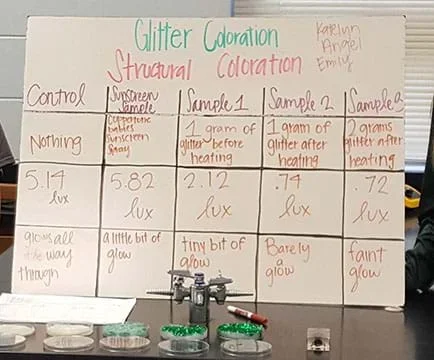 The structural coloration group’s conclusion poster.Copyright 2017 Jamie Sorrell, RET Program, School of Polymers and High Performance Materials, University of Southern Mississippi
- biomimicry
- Imitation of the models, systems, and elements of nature to solve complex human problems.
- dermis
- An inner layer of the skin that contains follicles, sweat glands, nerve and blood vessel endings.
- electromagnetic spectrum
- A visualization of the wavelengths and frequencies of different types of light waves, such as ultraviolet, visible, and infrared light.
- electromagnetic wave
- Electrons in an atom that oscillate back and forth.
- epidermis
- An outer layer of the skin made up of cells that offer the body protection and help absorb nutrients.
- exoskeleton
- An external skeleton that supports and protects an animal’s body; often found in invertebrates like insects and crustaceans.
- feather
- Complex epidermal growths that form the outer covering on birds, and aid in flight, insulation, and waterproofing.
- hair
- A protein filament that grows from follicles found in the dermis; a defining characteristic in mammals.
- infrared light
- Electromagnetic radiation that carries radiant (heat) energy and has longer wavelengths that visible light.
- integumentary system
- A system in most biological organisms that provides protection from abrasions, punctures, invasive bacteria, desiccation, water saturation, and ultraviolet rays.
- melanin
- The most common pigment found in animals; produced by special cells in the epidermis.
- pigment
- A material that changes the color of reflected or transmitted light.
- phosphorescence
- A process in which energy absorbed by a substance is released relatively slowly in the form of light.
- scales
- A small rigid plate that grows out of an animal's skin to provide protection.
- skin
- The key organ of the integumentary system in humans.
- structural coloration
- Production of color by microscopically structured surfaces fine enough to interfere with visible light, sometimes in combination with pigments.
- ultraviolet light
- A band of the electromagnetic spectrum with wavelength shorter than that of visible light but longer than X-rays; plays a role in synthesizing vitamin D in the human body, but can also cause sunburn.
- visible light
- Electromagnetic radiation that is visible to the human eye and is responsible for sense of sight.
Pre-Activity Assessment
Brainstorm: Students develop a strategy for creating their assigned epidermis mimic sample; students can also discuss what they know about UV light based on the questions in the first presentation.
Activity Embedded Assessment
Observations: Students document their observations both quantitative and qualitative on their procedure handout as they move through sample creation. Have students be active participants in sample creation, prep, and testing. Have students participate in a peer review of sample prep; have students provide justification for their plan methodology for creating samples.
Post-Activity Assessment
Presentations: Students create a conclusion poster and a result presentation to share with the class. Students will be assessed using the grading rubrics.
- Students should know and understand lab safety procedures and use caution when working with a hot plate.
Students can make new integumentary systems that combine what was being tested: Such as hair and pigment, scales and pigment, exoskeleton and pigment, structural coloration and exoskeletons. Have students experiment with other integumentary systems other than the one they were assigned.
- For lower grades, use the Testing Apparatus Construction (PPTX) to assemble the testing apparatus before the activity.
Caruso, M. M.; Davis, D.A.; Shen, Q., et al. Mechanically-Induced Chemical Changes in Polymeric Materials. Chemical Reviews. 2009. 109(11), 5755-5798
Hickman, Jr; Roberts, Larry; Larson, Allan. Integrated Principles of Zoology. 11th Edition. New York, NY. McGraw-Hill. 2001
Contributors
Jamie Sorrell; Shani Bourn
Supporting Program
Research Experience for Teachers Program, School of Polymers and High Performance Materials, University of Southern Mississippi
Acknowledgements
This activity was developed under the Research Experiences for Teachers (RET) in Engineering and Computer Science Site for Sustainable Polymer Engineering Research program in the University of Southern Mississippi’s School of Polymers and High Performance Materials, funded by National Science Foundation RET grant no. EEC 1406753. However, these contents do not necessarily represent the policies of the NSF, and you should not assume endorsement by the federal government.
Copyright
2019 by Regents of the University of Colorado; original © 2017 University of Southern Mississippi