
Engineering the Efficiency of Alcoholic Fermentation
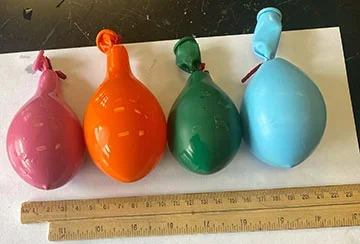 Sucrose samples after producing CO2Copyright 2021 Jamie Sorrell, University of Southern Mississippi RET
In this activity, students conduct a research-based activity to explore, graph, and analyze data, and evaluate the efficiency of alcoholic fermentation via reactant type and reactant concentration. After reviewing the major concepts of balancing a chemical reaction and how this concept relates to alcoholic fermentation, they design and observe experiments in a closed system (a balloon), and measure CO2 production (CO2 Volume) through water displacement. Students analyze their collected data on their assigned reactant by compiling it in a graph.
Microorganisms are often used in industries (such as biotechnology and engineering). Fermentation is a common process we use to engineer and manufacture goods like food or drinks which is known as yellow biotechnology. Yeast’s ability to perform alcoholic fermentation is the chemical process used to manufacture beer and wine. Engineers in yellow biotechnology have developed methods and reactant concentrations that yield high quality and high quantity of product; however, yeast are living cells, so they must be nurtured and maintained to ensure cost efficiency and product production.
After this activity, students should be able to
- Use engineering skills to test the product efficiency of different carbohydrate reactants (nutrient availability) on alcoholic fermentation.
- Identify constants and variables while conducting test/experiment.
- Collect quantitative data.
- Compile their quantitative data in a graph.
- Discuss the outcome of their results through poster presentation and verbal conclusion of findings.
- CCSS.Math.Content.HSS-ID.B Summarize, represent, and interpret data on two categorical and quantitative variables
Grades 9-12
Do you agree with this alignment? - CCSS.Math.Content.HSS-ID.B.6 Represent data on two quantitative variables on a scatter plot, and describe how the variables are related.
Grades 9-12
Do you agree with this alignment?
- Analyze and explain the biochemical process of photosynthesis and cellular respiration and draw conclusions about the roles of the reactant and products in each. (DOK 3)
- Photosynthesis and respiration (reactants and products)
- Light-dependent reactions and light independent reactions in photosynthesis, including requirements and products of each
- Aerobic and anaerobic processes in cellular respiration, including products each and energy differences
Grades 9-12
Do you agree with this alignment?
- HS-LS1-7 Use a model to illustrate that cellular respiration is a chemical process whereby the bonds of food molecules and oxygen molecules are broken and the bonds in new compounds are formed resulting in a net transfer of energy.
Grades 9-12
This resource focuses on the following Three Dimensional Learning aspects of NGSS:
Science & Engineering Practices- Use a model based on evidence to illustrate the relationships between systems or between components of a system.Do you agree with this alignment?
Disciplinary Core Ideas- As matter and energy flow through different organizational levels of living systems, chemical elements are recombined in different ways to form different products.Do you agree with this alignment?
- As a result of these chemical reactions, energy is transferred from one system of interacting molecules to another. Cellular respiration is a chemical process in which the bonds of food molecules and oxygen molecules are broken and new compounds are formed that can transport energy to muscles. Cellular respiration also releases the energy needed to maintain body temperature despite ongoing energy transfer to the surrounding environment.Do you agree with this alignment?
Crosscutting Concepts- Energy cannot be created or destroyed—it only moves between one place and another place, between objects and/or fields, or between systems.Do you agree with this alignment?
Do you agree with this alignment? - Use a model based on evidence to illustrate the relationships between systems or between components of a system.
- HS-LS2-5 Develop a model to illustrate the role of photosynthesis and cellular respiration in the cycling of carbon among the biosphere, atmosphere, hydrosphere, and geosphere.
Grades 9-12
This resource focuses on the following Three Dimensional Learning aspects of NGSS:
Science & Engineering Practices- Use a model based on evidence to illustrate the relationships between systems or between components of a system.Do you agree with this alignment?
Disciplinary Core Ideas- Photosynthesis and cellular respiration are important components of the carbon cycle, in which carbon is exchanged among the biosphere, atmosphere, oceans, and geosphere through chemical, physical, geological, and biological processes.Do you agree with this alignment?
- The main way that solar energy is captured and stored on Earth is through the complex chemical process known as photosynthesis.Do you agree with this alignment?
Crosscutting Concepts- Models (e.g., physical, mathematical, computer models) can be used to simulate systems and interactions—including energy, matter, and information flows—within and between systems at different scales.Do you agree with this alignment?
Do you agree with this alignment? - Use a model based on evidence to illustrate the relationships between systems or between components of a system.
Each group needs:
- 4 water displacement apparatuses (see below)
- 4 ring stands
- 4 ring clamps (4 inches) and support
- 4 100 mL graduated cylinders
- 4 balloons (of different colors red/orange/yellow/green/blue)
- 4 pieces of string, 6 inches in length (yarn will also work)
- 1 or 2 - electronic Balance(s)
- 2 weigh papers (1 for yeast and 1 for reactant)
- 2 spatulas (1 for yeast and 1 for reactant)
- 4 funnels
- poster paper and markers
- Chromebook to access Google Sheets or computer with Microsoft Excel
- copies of the Student Handout (PDF) (one per student)
- timers
To create water displacement apparatus:
Option 1
- traffic cone (12 inches tall, available online)
- 500 mL plastic beaker, available online
- 2 zipties, 37 cm long
- X-Acto (or similar) knife, for teacher use only when assembling water displacement apparatus
- permanent marker
- square resealable plastic bag, snack size
- 250 g of dried rice
- Styrofoam plate, 7 inches in diameter
Option 2
- Funnel, 7.5 inches in diameter, available online
- 500 mL plastic beaker
- spiral hair tie, available online
- square resealable plastic bag, snack size
- 250 g of dried rice
- Styrofoam plate, 7 inches in diameter
To share with the entire class
- 1000 mL of distilled water heated to ~40°C
- 4 oz jar of instant yeast, such as Fleischmann’s Instant Yeast
- ~20 g of sucrose (e.g., from a bag of granulated white sugar)
- ~20 g of corn starch
- ~20 g of lactose, available online
- ~20 g of glucose (or dextrose), available online
- ~20 g of fructose, available online
Students will need a basic understanding of osmosis, a chemical reaction, reactants vs products. They will need an understanding of a balanced reaction/equation.
Did you know that yeast is a domesticated living organism? We use yeast’s ability to perform alcoholic fermentation to produce foods and drinks on a regular basis. Using microorganisms like yeast to engineer and manufacture edible products is known as yellow biotechnology. Let’s watch this YouTube video to have a better understanding of yeast, and how these tiny living organisms contribute to our everyday lives. [Show students the video from Mashed: https://youtu.be/7xiq_dpKkSU. Have students wrote down at least 8 facts from the video. After watching the video, have students compare and share what facts they noted.]
You wouldn’t think when looking at a jar of yeast that it was packed with millions of tiny unicellular living organisms, and if not put under the correct conditions that they could die. It is also hard to believe that these tiny yeasts are essential to the production of our fluffy staple food, bread. Therefore, when manufacturing our products with yeast, it is essential that we engineer the best working conditions but still get the best yield. In other words, give the living yeast the resources to fabricate our goods, but without killing the little guys. Today we are going to be yellow biotechnologists. We are going to work together to determine out of the following carbohydrate reactants: glucose, fructose, lactose, sucrose, and starch, which would be the most efficient reactant for yeast to produce carbon dioxide via alcoholic fermentation. we also want to determine what would be the most efficient concentration of reactant to give our yeast to yield the most product, but not too much. What do you think could happen to our yeast cells if we expose them to too much reactant?
[Draw a picture of simple yeast cell and draw ten hexagons, which will represent monosaccharides, on the outside of the cell.] What will happen to this yeast cell if I overexpose it this concentration of monosaccharides? [Students may access prior knowledge from a previous lesson on osmosis. Possible answers: water inside the cell will move to the high concentration of monosaccharides cause the cell to shrivel up and die.] So too much reactant can kill the yeast. It is important to find the ‘sweet’ spot for your reactant. You want the best concentration of reactant that will produce the most product, but not kill your yeast.
Before we get started let’s investigate some background information. First, let’s observe the reaction for alcoholic fermentation. [On the board, display the visual representation of the alcoholic fermentation reaction scheme from the Student Handout (PDF).]
Notice when you look at the reaction whatever you start with you end with. Let’s look at the reactant, glucose, how many carbon atoms are in glucose? There are 6 carbons. Look at the products. How many carbon atoms are in the products? There are 4 in two molecules of ethanol and there are 2 in the two molecules of carbon dioxide. Therefore, 1 glucose molecule that is 1 ring of 6 carbons will convert into how many carbon dioxide molecules? It will convert into 2 carbon dioxide molecules. Now let’s consider the composition of the other reactants we are going test. How many rings of carbon are in fructose? There is one ring. So how many carbon dioxide molecules will fructose covert into? It will convert into 2 molecules of carbon dioxide molecules. In your groups do the same observations of the other reactants, starch, lactose, and sucrose. How many rings of carbon are in their composition and how many carbon dioxide molecules will they convert into? [Students should respond, “Starch: 3 rings, 6 molecules of carbon dioxide, lactose: 2 rings, 4 molecules of carbon dioxide, sucrose: 2 rings, 4 molecules of carbon dioxide.”
Before the Activity
- Make copies of the Student Handout (PDF), 1 per student.
- Divide students into 5 or 6 groups (~4 students per group).
- Gather materials.
- If using the Water Displacement Apparatus Option 1, assemble an example according to instructions (see Apparatus Assembly Presentation (PDF)).
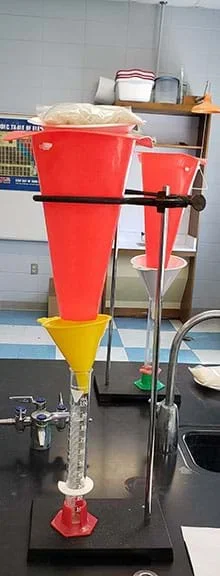 Picture of a complete set up of testing apparatus Option 1.Copyright 2021 Jamie Sorrell, University of Southern Mississippi RET
 - Assemble rice bag weights (place 250 g of dried rice in square re-sealable bag).
- Upload the Microsoft Excel Template (XLSX) to a shared folder (such as Google Drive) so multiple teams can access the file at once.
With the Students
Part 1
- Propose these questions:
- If we changed the reactant from glucose to fructose, what do you think would happen to the products?
- If we increased the concentration of our reactant, what do you think would happen to the products?
- Do you think changing the type of reactant and/or concentration of reactant will affect the efficiency of product production through alcoholic fermentation?
- In groups, students will formulate a hypothesis on how the different reactants will affect product production. They will formulate a second hypothesis predicting how the reactants will perform as they increase reactant concentration. They will write out their hypothesis on the Student Handout (PDF).
- Discuss the set up for the closed system (a balloon) using a visual representation drawing.
- Assign each group a reactant: glucose, fructose, lactose, sucrose, or starch.
- In each group of 4 students, assign each student a concentration amount of their assigned reactant (2 g, 3 g, 4 g, 5 g).
- Walk the students through setting up the water displacement apparatus (see Apparatus Assembly Presentation (PDF)).
- The teacher will walk the students through the procedure of loading their balloons referring to the Student Handouts (PDF) as a guide (directions reproduced below).
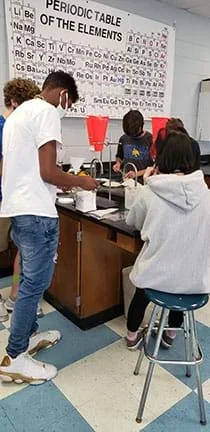 Picture of students working as group loading and setting up samples.Copyright 2021 Jamie Sorrell, University of Southern Mississippi RET
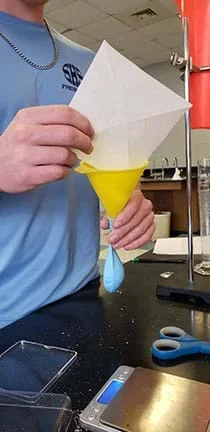 A student loading a balloon sampleCopyright 2021 Jamie Sorrell, University of Southern Mississippi RET
Balloon Procedures: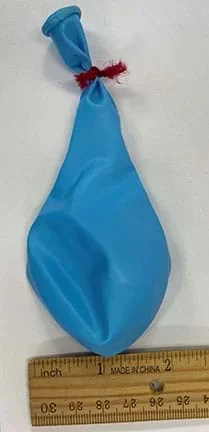 A balloon sample before reactionCopyright 2021 Jamie Sorrell, University of Southern Mississippi RET
- Place your balloon on a funnel.
- Into the balloon, add 2 g of yeast.
- In the same balloon add your assigned amount of reactant.
- Set up your water displacement apparatus according to teacher’s Instructions.
- In the same balloon add 30 mL of 40°C water.
- Carefully remove funnel.
- With help from a partner, stretch the neck of the balloon.
- Close the opening of the stretch balloon with a string tied in a knot.
- Cut the excess string. **Make sure to not pierce the balloon**
- Shake the balloon 10 times.
- Optional: Take a before picture of your balloon.
- Place the balloon in the water displacement apparatus.
- Place the foam plate on top of the balloon in the apparatus and bag of rice on top of the plate. **This will hold the balloon under the water as it expands with CO2**
- Record the Start Volume.
- Record the Balloon’s volume every 2 minutes for 40 minutes.
- Optional: After 40 minutes, remove balloon from the water displacement apparatus and take an after picture.
Part 2
- Have students graph results using the Microsoft Excel Template (XLSX) (OR students may graph data by hand on graph paper). Students follow the directions on the Student Handout (PDF) (reproduced below).
- Click on the tab that is labeled with your reactant name.
- Note: Only type in the yellow portions.
- Type in your name and your classmates’ names in your group in the designated box.
- Type in your reactant name in the designated box.
- Type in collected data from your data table under the designated grams of reactant.
- Scroll down and select the data below in the 2nd color (not yellow), Click on the Insert Tab, Click On the Line Graph Icon, Click on More Line Charts.
- Make sure to select the graph that does not graph time on a separate line.
- Click on the X-box. Make sure the following is selected: Axes, Axis Title, Chart Title, Gridlines, and Legends.
- Select where it says, “Chart Title” and two “Axis Titles,” and give them proper names.
- After students have imported all their data, go to the class data tab on the Microsoft Excel Template (XLSX). Follow the same directions (6-9) but select all data in all colored cells in the last tab to be graphed. Display the class data graph to students. Optional: Print out colored graphs for the groups to put on their poster presentation. Ensure that students have both their specific reactant graph and the group data graph.
- Distribute poster paper and markers. Have students construct their poster and prepare a verbal presentation of their findings. Direct students to the requirements in the Student Handout (PDF) (reproduced below).
A poster should include the following:
- Title
- The reaction scheme **with their specific reactant and products**
- Drawing of their reactant
- Hypothesizes
- Optional before and after visuals of all 4 samples
- Group graph and class graph
A verbal presentation should cover the following and all students must participate in the presentation:
- What is the purpose of the experiment?
- What were your hypotheses and the reasoning behind your hypotheses?
- How were your samples different?
- How were your samples tested?
- What were you testing? What were you measuring and why?
- What are your results of your test as group?
- How do your results compare with the entire class?
- Using the graphs, do you think your hypotheses were correct? Explain.
- If you were given an opportunity to move forward with this experiment, what would you do and why? Explain.
Part 3
- Have students present their work. Students can present in a ‘gallery walk’ style or formal ‘in front of class’ presentation. Grade students’ presentation using the Grading Rubric (PDF).
- alcoholic fermentation
- The process plant cells and fungi cells (yeast) go through to produce ATP. under alcoholic fermentation one molecule of glucose will produce two carbon dioxide molecules, two ethanol molecules, and two ATP molecules.
- anaerobic respiration/fermentation
- The process cells go through to produce ATP without the presence of oxygen.
- cellular respiration
- The process all cells go through to produce ATP from food molecules.
- products
- Materials that come out of a reaction. the materials at the end of a reaction.
- reactants
- Materials that go into a reaction. the materials at the start of a reaction.
- yeast
- Living single-celled fungi.
Pre-Activity Assessment
Background Research: Students will perform brief background research on yeast and their capabilities through a short YouTube Video.
Observations: Students will observe the components of a balanced equation. Students will observe and note the atomic make up and structure of different carbohydrate reactant. The formulate associations between reactants and products.
Hypothesis Construction: Students will use inductive reasoning to formulate the understanding that reactant composition and concentration will affect the amount of product produced in a chemical reaction. The will use this reasoning to construct two hypotheses. One hypothesis on how reactant type affects product production via Alcoholic Fermentation. The second hypothesis how reactant concentration affects product production via Alcoholic Fermentation.
Activity Embedded (Formative) Assessment
Analysis: Students are active participants in the testing of different carbohydrate reactants on product production through Alcoholic Fermentation. Students document their Quantitative data in a data table. Lastly, they perform graphical analysis by compiling their data in an electronic graph.
Post-Activity (Summative) Assessment
Presentation: Students will compile experimental design set up and data analysis on a poster. Lastly, they will present their findings, conclusions, and plans for further investigations through a verbal presentation. During the presentations students must be prepared for investigative questions from the teacher and classmates. The presentations will be graded by the teacher using a Grading Rubric (PDF).
To eliminate confusion, use the same balloon color for all concentrations for the class. For example, use a blue balloon for 2 grams of glucose, fructose, sucrose, starch, and lactose.
Provide two options for the water displacement apparatus just in case the 7.5 diameter funnels were hard to procure for a reasonable price.
The links for the reactants were for bulk purchases, but the excess can be used again in the future for the same lab.
If you upload the Excel Sheet onto your Google Drive, it will be converted into a Google Sheet. This is an option if your school uses Chromebooks and Google Drive.
Here’s Everything You Need to Know About Yeast by Mashed: https://youtu.be/7xiq_dpKkSU.
Laird, Patricia and Jennifer Cosgrove. “’A Swell Lab’ Yeast Fermentation.” Science in the Real World Microbes in Action Program. (1999) https://www.umsl.edu/microbes/Classroom%20Activities/Swell%20Lab.pdf
Doronina, Vicki. Bite Size Bio. August 21, 2020, https://bitesizebio.com/48446/microbes-biotechnology/
Contributors
Jamie Sorrell
Supporting Program
University of Southern Mississippi School of Polymer Science and Engineering
Acknowledgements
This curriculum was developed at The University of Southern Mississippi School of Polymer Science and Engineering based upon work supported by the National Science Foundation under grant no. EEC 1855290— RET Site for Sustainable Polymer Engineering Research in Hattiesburg, MS. Any opinions, findings and conclusions or recommendations expressed in this material are those of the authors and do not necessarily reflect the views of the National Science Foundation or the University of Southern Mississippi.
Copyright
2023 by Regents of the University of Colorado; original © 2021 University of Southern Mississippi