
Designing and Testing Maglev Train Prototypes
Students discover how electric and magnetic fields exert forces on objects by using the engineering design process to design and build a small model maglev train. Students add weight, such as pennies, to test how much their model can hold. Through this hands-on activity, students gain a deeper understanding of magnetic repulsion and attraction. They identify and describe contact and non-contact forces by investigating the properties of magnets and their interactions.
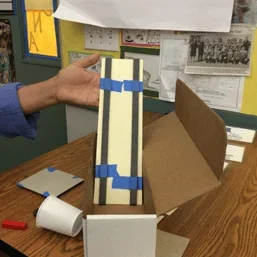 Example of maglev testing track.Copyright Karen Merritt
Maglev trains are related to engineering because their design and operation involve advanced principles of physics, materials science, and technology. Maglev, short for magnetic levitation, uses powerful magnets to lift and propel the train, allowing it to float above the tracks without touching them. This eliminates friction, which allows the trains to travel at very high speeds. Engineers design and build the magnetic systems (using superconducting magnets or electromagnets), control systems for smooth operation, and track infrastructure that supports the magnets' interaction. Additionally, engineers must consider factors such as aerodynamics, safety, energy efficiency, and environmental impact in the development of maglev technology. The innovative use of magnets in maglev trains represents the intersection of mechanical, electrical, and civil engineering.
After this activity, students should be able to:
- Describe how a maglev train works.
- Identify and describe contact and non-contact forces of magnets.
- Use the engineering design process to create and test a maglev prototype by using magnets’ repulsion and attraction properties.
- CCSS.Math.Content.7.RP.A Analyze proportional relationships and use them to solve real-world and mathematical problems.
Grade 7
Do you agree with this alignment? - CCSS.Math.Practice.MP1 Make sense of problems and persevere in solving them.
Grades K-12
Do you agree with this alignment? - CCSS.Math.Practice.MP4 Model with mathematics.
Grades K-12
Do you agree with this alignment? - CCSS.Math.Practice.MP6 Attend to precision.
Grades K-12
Do you agree with this alignment? - CCSS.Math.Practice.MP8 Look for and express regularity in repeated reasoning.
Grades K-12
Do you agree with this alignment?
- MS-ETS1-1 Define the criteria and constraints of a design problem with sufficient precision to ensure a successful solution, taking into account relevant scientific principles and potential impacts on people and the natural environment that may limit possible solutions.
Grades 6-8
This resource focuses on the following Three Dimensional Learning aspects of NGSS:
Science & Engineering Practices- Define a design problem that can be solved through the development of an object, tool, process or system and includes multiple criteria and constraints, including scientific knowledge that may limit possible solutions.Do you agree with this alignment?
Disciplinary Core Ideas- The more precisely a design task's criteria and constraints can be defined, the more likely it is that the designed solution will be successful. Specification of constraints includes consideration of scientific principles and other relevant knowledge that is likely to limit possible solutions.Do you agree with this alignment?
Crosscutting Concepts- The uses of technologies and any limitations on their use are driven by individual or societal needs, desires, and values; by the findings of scientific research; and by differences in such factors as climate, natural resources, and economic conditions.Do you agree with this alignment?
- All human activity draws on natural resources and has both short and long-term consequences, positive as well as negative, for the health of people and the natural environment.Do you agree with this alignment?
Do you agree with this alignment? - Define a design problem that can be solved through the development of an object, tool, process or system and includes multiple criteria and constraints, including scientific knowledge that may limit possible solutions.
- MS-ETS1-2 Evaluate competing design solutions using a systematic process to determine how well they meet the criteria and constraints of the problem.
Grades 6-8
This resource focuses on the following Three Dimensional Learning aspects of NGSS:
Science & Engineering Practices- Evaluate competing design solutions based on jointly developed and agreed-upon design criteria.Do you agree with this alignment?
Disciplinary Core Ideas- There are systematic processes for evaluating solutions with respect to how well they meet the criteria and constraints of a problem.Do you agree with this alignment?
Do you agree with this alignment? - Evaluate competing design solutions based on jointly developed and agreed-upon design criteria.
- MS-ETS1-4 Develop a model to generate data for iterative testing and modification of a proposed object, tool, or process such that an optimal design can be achieved.
Grades 6-8
This resource focuses on the following Three Dimensional Learning aspects of NGSS:
Science & Engineering Practices- Develop a model to generate data to test ideas about designed systems, including those representing inputs and outputs.Do you agree with this alignment?
Disciplinary Core Ideas- Models of all kinds are important for testing solutions.Do you agree with this alignment?
- The iterative process of testing the most promising solutions and modifying what is proposed on the basis of the test results leads to greater refinement and ultimately to an optimal solution.Do you agree with this alignment?
Do you agree with this alignment? - Develop a model to generate data to test ideas about designed systems, including those representing inputs and outputs.
- MS-PS2-3 Ask questions about data to determine the factors that affect the strength of electric and magnetic forces.
Grades 6-8
This resource focuses on the following Three Dimensional Learning aspects of NGSS:
Science & Engineering Practices- Ask questions that can be investigated within the scope of the classroom, outdoor environment, and museums and other public facilities with available resources and, when appropriate, frame a hypothesis based on observations and scientific principles.Do you agree with this alignment?
Disciplinary Core Ideas- Electric and magnetic (electromagnetic) forces can be attractive or repulsive, and their sizes depend on the magnitudes of the charges, currents, or magnetic strengths involved and on the distances between the interacting objects.Do you agree with this alignment?
Crosscutting Concepts- Cause and effect relationships may be used to predict phenomena in natural or designed systems.Do you agree with this alignment?
Do you agree with this alignment? - Ask questions that can be investigated within the scope of the classroom, outdoor environment, and museums and other public facilities with available resources and, when appropriate, frame a hypothesis based on observations and scientific principles.
- MS-PS2-5 Conduct an investigation and evaluate the experimental design to provide evidence that fields exist between objects exerting forces on each other even though the objects are not in contact.
Grades 6-8
This resource focuses on the following Three Dimensional Learning aspects of NGSS:
Science & Engineering Practices- Conduct an investigation and evaluate the experimental design to produce data to serve as the basis for evidence that can meet the goals of the investigation.Do you agree with this alignment?
Disciplinary Core Ideas- Forces that act at a distance (electric, magnetic, and gravitational) can be explained by fields that extend through space and can be mapped by their effect on a test object (a charged object, or a ball, respectively).Do you agree with this alignment?
Crosscutting Concepts- Cause and effect relationships may be used to predict phenomena in natural or designed systems.Do you agree with this alignment?
Do you agree with this alignment? - Conduct an investigation and evaluate the experimental design to produce data to serve as the basis for evidence that can meet the goals of the investigation.
For the entire class:
- 1 laptop and projector (to show videos and images)
Each pair needs:
- 1 pencil
- 2 ring magnets
Each group needs:
- 1 piece of cardboard or cardstock (size depends on how large you want each train car to be AND how long your track is)
- 1 pair of scissors
- 4-6 pencils
- 5-7 pennies (or glass beads)
- 1 bar magnet with “North” and “South” labeled
- 5-7 disk magnets
- 2-4 ring magnets
- ½” or ¾” wide flexible magnet strips (Note: Make sure you get monopolar magnetic tape—that means only one side is N or S). 100 feet is how long the standard roll is cut into the lengths you want for your groups. If you have 1st hour, make the track the same, and then you can use the same track for all the rest of your classes. You could make enough for the number of groups yourself (8 if fewer than 32 students).
- 1 roll of masking tape or blue painter’s tape
- 1 Dixie-sized or smaller paper cup (~3 ounces)
- Maglev Engineering Design Worksheet (PDF)(1 per student)
- Post-Assessment (PDF)(1 per student)
- Optional: rulers (if you want to create guard rails for the train)
Students should:
- Be familiar with the concept of force.
- Understand that one end of a magnet is north, and the other end is south.
- Recognize that the force between north and south poles attract, whereas the force between like poles repels.
What kinds of trains have you seen? (You may want to show pictures of different trains or have students find pictures to share with the class.) How fast do you think different trains can go? (Be sure to compare the speed of a freight train to that of a maglev train.) Who has been on a fast ride at Disneyland or another theme park? (Allow students to share their experiences.) Has anyone been on Disneyland’s Monorail ride? (This is not a high-speed maglev train, but it operates on a similar principle.)
Let’s watch a short video. (Show students the video About SCMAGLEV [48 seconds, without narration].)
As of June 26, 2024, six commercial maglev systems are operational worldwide: one in Japan, two in South Korea, and three in China. In the United States, a project is underway to build the first maglev train, aiming to connect Washington, D.C., New York City, Philadelphia, and Baltimore. This Japan-led effort uses SCMAGLEV technology with superconducting propulsion, enabling speeds of up to 311 miles per hour. Trains could run every 10 minutes, reducing travel time between Washington, D.C., and Baltimore to 15 minutes, and between Washington, D.C., and New York City to one hour. Despite its promise, the project faces significant challenges, including high construction costs (up to $15 billion in initial investment), regulatory hurdles, safety standards, and investor concerns.
Maglev trains, short for magnetic levitation trains, use powerful magnets to make the train float above the tracks instead of using wheels. This helps the train move really fast, because there’s no friction from wheels rubbing on the track. The magnets push the train up so it floats, or levitates, and then other magnets pull the train forward, making it move smoothly.
The way it works is pretty cool: There are magnets on both the train and the tracks. Some magnets push the train away, and others pull it forward, creating a smooth and fast ride. Because the train does not touch the tracks, it can go much faster than regular trains and makes less noise. Plus, because it does not need wheels, it does not wear down the tracks, which means fewer repairs and less maintenance are needed. Maglev trains are also better for the environment, because they do not create pollution or damage the land.
We are interested in maglev trains for several reasons, primarily related to their potential to revolutionize transportation. Maglev trains offer faster, more efficient, and more environmentally friendly travel. Their ability to reach high speeds—significantly faster than traditional trains—can make them a more competitive option for long-distance travel, potentially reducing the need for short-haul flights, which contribute heavily to carbon emissions. By using magnetic levitation, these trains eliminate the friction between the wheels and the track, leading to smoother rides, reduced maintenance costs, and better energy efficiency.
Background
A maglev train, short for magnetic levitation train, is a type of transportation that uses powerful magnets to lift the train above the track, allowing it to float with minimal friction. Unlike traditional trains that rely on wheels and tracks for movement, maglev trains hover over a guideway using magnetic forces, which results in smoother and quieter rides. This innovative technology allows maglev trains to achieve remarkably high speeds while also reducing wear and tear on the system due to the lack of physical contact between the train and track.
Maglev trains operate by using magnetic fields generated by electromagnets or superconducting magnets on both the train and the track. These magnets create forces of attraction or repulsion that lift and propel the train. For levitation, magnets on the train are positioned in such a way that they repel the magnets on the track, causing the train to float above the guideway. Propulsion is achieved through a system of linear motors or electromagnets placed along the track, which continuously change polarity to push and pull the train forward. Guidance magnets ensure the train stays centered and stable as it moves, even at high speeds, while minimizing friction and energy consumption.
We are interested in maglev trains for several compelling reasons, primarily related to their potential to revolutionize transportation. Maglev trains offer the promise of faster, more efficient, and environmentally friendly travel. Their ability to reach high speeds—significantly higher than traditional trains—can make them a more competitive option for long-distance travel, potentially reducing the need for short-haul flights, which contribute heavily to carbon emissions. By using magnetic levitation, these trains eliminate the friction between the wheels and the track, leading to smoother rides, reduced maintenance costs, and better energy efficiency.
Additionally, maglev trains can help address environmental concerns by reducing reliance on fossil fuels. As the world seeks cleaner transportation options, maglev technology presents an opportunity to shift to renewable energy sources while minimizing pollution, noise, and land use compared to other modes of transport. They also have the potential to ease traffic congestion in densely populated areas and reduce carbon emissions, making them a key part of sustainable infrastructure planning. For these reasons, maglev trains are of great interest as a future solution for high-speed, low-emission transportation.
By completing this activity, students should gain an understanding of the fundamental principles of magnetic levitation (maglev) and how it is applied in engineering. They will learn how to create a levitation effect by manipulating magnets' poles to achieve repulsion, which allows the magnets to float above one another. Students also explore the engineering design process by working in teams to create a functioning maglev train that can levitate and move along a track. They experiment with various designs, test their prototypes, and refine their designs based on their observations and results.
You can find great background information in Kevin Bonsor’s “How Maglev Trains Work” 13 October 2000. (Stop reading before Maglev Accidents, as the rest gets into more information than needed for middle school science).
Before the Activity
- Make copies of the Maglev Engineering Design Worksheet (PDF)(1 per student).
- Make copies of the Post-Assessment (PDF) (1 per student).
- Gather the supplies needed for each group.
- Optional: Build a maglev testing track, using about 12 inches of flexible magnet strips running parallel to each other. Alternatively, you can choose to have each group build their own testing track.
- Optional: Show students a junkyard electromagnet and/or an electromagnet crane car for them to better understand what an electromagnet is, if they have not yet discussed electromagnets.
- Optional: Have students investigate the following simulations for patterns: simple electric motor and simple generator.
During the Activity
Part 1: Introduction (10 minutes)
- Ask the class the following questions and let students offer answers:
- How is it possible for objects to float? (Answers: magnets, strings, magic)
- What forces might be needed to make an object float? (Answers: gravity, friction, magnetism, etc.)
- Do you think you would be able to make something levitate? (Answers will vary.)
- Tell students:
- Contact forces are forces that occur when objects physically touch each other.
- Non-contact forces are forces that act at a distance, without physical contact between objects.
- Group students into pairs.
- Distribute one pencil and two ring magnets to each pair of students.
- Ask students to show attraction and repulsion with their pencil and magnets.
- Ask students:
- How can we get the magnets to repel? (Answer: To make magnets repel, the magnets need to be positioned with their like poles [i.e., north-north or south-south] facing each other.)
- What do you need to do to get the ring magnets to levitate? (Answer: To make the ring magnets levitate, (1) determine the poles of each magnet, (2) slide one ring magnet onto the pencil toward the bottom, (3) place the second magnet above it with like poles (e.g., north facing north) aligned. The magnetic repulsion between the like poles will cause the second magnet to hover above the first, creating a levitation effect. Ensure the pencil is held vertically to provide stability and prevent the magnets from sliding sideways.)
Part 2: Maglev Engineering Design Challenge (50 minutes)
- Give each student a Maglev Engineering Design Worksheet (PDF).
- Divide students into groups of 3-4 students.
- Read the “Introduction” section of the Maglev Engineering Design Worksheet (PDF).
- Review the engineering design process.
- Ask (5 minutes):
- State the engineering challenge:
- Each group will make a “train” car levitate above a magnet strip “track” so that it can freely move back and forth above the track.
- The train will float above the track once everything (i.e., the magnets) is lined up and no one can touch it.
- Each group will try to hold most weight (e.g., number of pennies or glass beads) on their train.
- Optional: Discuss the constraints of the challenge, or have student brainstorm the challenge constraints with their groups. (Potential answers: time, types of supplies provided, number of supplies available, etc.)
- Remind students that attention to detail and perseverance are needed for this activity. Students will need to be patient and to keep trying ideas until they get a working model of their maglev train. Let students know that failure is not bad.
- Research (15 minutes):
- As a class, watch the following video about the fastest train ever built: The fastest train ever built | The complete physics of it (11:33 minutes). (Note: You don’t need to watch the entire video.)
- Have students take notes on what they observe in the “Research” section of their Maglev Engineering Design Worksheet (PDF).
- Imagine (5 minutes):
- Give students time to brainstorm and sketch ideas.
- Plan (5 minutes):
- Instruct students to pick one design they will create as a group.
- Have each group member draw the team’s design in the “Plan” section of their Maglev Engineering Design Worksheet (PDF).
- Remind students to label parts and indicate which materials will be used.
- Optional: Depending on the level of your students, you may want them to arrange the magnets such that they can hold a piece of paper in between them before letting them move on to building their design on the project. This extra step will just check that they understand the idea of repulsion and levitation.
- Create (10 minutes):
- Give students time to build their maglev train prototype.
- As students build, visit each group and review what they are doing. You may help as needed, but make sure the students are making the discovery of how to get the prototype to levitate and without you “giving it away.” Allow students to struggle within reason. Let the mistakes happen and avoid offering solutions, but encourage students to keep trying and discover on their own.
- If students struggle to get their maglev train prototype to work, have them try out different formations of the disk magnets, e.g., 4 in a square, 5 in a circle, etc.
- Optional: Have students use rulers to create “guard rails” to keep their prototypes in place.
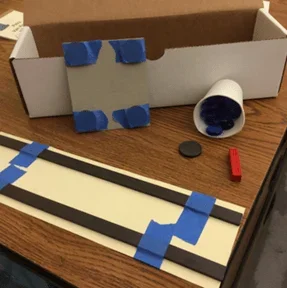 Student-created maglev train model and maglev testing track.Copyright Karen MerrittExample of maglev testing track.Copyright Karen Merritt
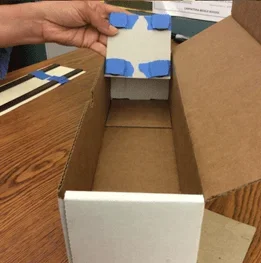 Example of maglev train device.Copyright Karen Merritt
- Test (5 minutes):
- Once students have built their maglev train prototype, have them attach a small cup to it and slowly add pennies (or glass beads) to see how many it can hold. This would represent people the maglev train could hold.
- Remind students that they may use their hands to start the prototype, but then the prototype should be able to move on its own.
- Have students answer the questions in the “Create and Test” section of their Maglev Engineering Design Worksheet (PDF).
- Improve (5 minutes):
- Give students time to improve their design.
- Once students improve their design, let them test their updated maglev train prototype on the maglev testing track.
- Have students answer the questions in the “Improve” section of their Maglev Engineering Design Worksheet (PDF).
Part 3: Conclusion (40 minutes)
- Presentations (20 minutes):
- Have each group share their maglev system with the class. This could be done as a gallery walk, where groups move to other groups and one person stays with the group to explain it to each new group. Or you can go from group to group around the room, having each group share while the rest of the students remain in their seats.
- Discuss which groups’ system held the most weight for the longest, and what patterns that they noticed.
- Summary/Reflection (10 minutes):
- Have students answer the questions in the “Summary” and “Conclusion” sections of the Maglev Engineering Design Worksheet (PDF).
- Post-Assessment (10 minutes):
- Give students time to complete the Post-Assessment (PDF).
- electromagnet
- A soft metal core made into a magnet by the passage of electric current through a coil surrounding it.
- force
- Push or pull on an object.
- maglev train
- A type of high-speed rail that uses magnetic fields to move the train above the tracks.
- magnet
- A piece of metal with a strong attraction to another metal object (made of iron, nickel and cobalt).
- levitate
- To rise or cause to rise and hover in the air (float).
- prototype
- An early or initial model of a product, system, or idea that is created to test and evaluate its design, functionality, or features before it is finalized or mass-produced.
Pre-Activity Assessment
Class questions and discussion: Students answer and discuss the following questions.
- How is it possible for objects to float? (Answers: magnets, strings, magic)
- What forces might be needed? (Answers: gravity, friction, magnetism, etc.)
- Do you think you would be able to make something levitate? (Answers will vary.)
Student Pair Magnet Demo: In Part 1 of the activity, students show that magnets can float or levitate using two ring magnets and a pencil. Students show proficiency if they can understand that the same poles would repel each other and not stick together. This is needed for understanding how a maglev train floats (levitates) above the track.
Activity Embedded (Formative) Assessment
Maglev Engineering Design Worksheet: During Part 2 of the activity (the “Build,” “Test,” and “Improve” sections of the Maglev Engineering Design Worksheet (PDF)), students demonstrate proficiency when they make their train float above the track. You can grade the worksheet to provide a graded assessment score, if needed.
Post-Activity (Summative) Assessment
Maglev Engineering Design Worksheet: Students answer the “Summary” and “Conclusion” questions in the Maglev Engineering Design Workshee (PDF)t, pulling together everything they learned during the activity and engineering design process.
Post-Assessment: Students complete the Post-Assessment (PDF), summarizing what they learned during the activity.
Enrichment: Have students watch the IMAX movie Dream Big: Engineering Our World (the trailer is less than 2 minutes). If you can watch the whole movie, it is a great engineering video!
Extension: Have students design and create a physical prototype model of a maglev vehicle. They will race it against another student (similar to a pinewood derby type of race), two students/teams race at a time. Students will use the engineering model of asking a question, imagining what they can do, planning to create a maglev vehicle, creating and testing their model, and then making any improvements to make their model better.
Extension Materials: The Pitsco Education Maglev Vehicles Teacher’s Guide that goes with their maglev track, available for purchase on their site. You will need a maglev track to do this activity (which they also have on their site - Maglev II Track). You can also purchase levitator maglev vehicle cutouts.
Pictures taken https://scsp.chem.ucsb.edu/sites/secure.lsit.ucsb.edu.chem.d7_scsp/files/sitefiles/lessons/Maglev%20Train%20Lesson%20Plan.pdf
Contributors
Karen Merritt (Spring Creek Middle School, Cache District, Utah); Rachel Kenning (Advisor); Hillary Swanson (Advisor); Idris Solola (Advisor)
Supporting Program
Engineering Research Center for Advancing Sustainability through Powered Infrastructure for Roadway Electrification (ASPIRE), Utah State University
Acknowledgements
This material was developed based upon work supported by the National Science Foundation under grant no. EEC 1941524—Engineering Research Center for Advancing Sustainability through Powered Infrastructure for Roadway Electrification (ASPIRE) in the College of Engineering, Utah State University. Any opinions, findings, and conclusions or recommendations expressed in this material are those of the authors and do not necessarily reflect the views of the National Science Foundation.
Copyright
2025 by Regents of the University of Colorado; original © 2024 Utah State University