
Engineering Ethics: Evaluating Popular Inventions
Students analyze an assortment of popular inventions to determine whom they are intended to benefit, who has access to them, who might be harmed by them, and who is profiting by them. Then they re-imagine the devices in a way that they believe would do more good for humanity. During the first 90-minute class period, they evaluate and discuss designs in small groups and as a class, examining their decision-making criteria. Collectively, they decide upon a definition of "ethical" that they use going forward. During the second period, students apply their new point-of-view to redesign popular inventions (on paper) and persuasively present them to the class, explaining how they meet the class standards for ethical designs. Two PowerPoint® presentations, a worksheet and grading rubric are provided.
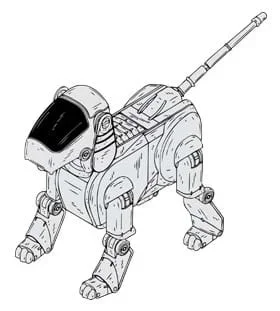 A robotic dog from a U.S. patent drawing—a luxury pet or bomb-detecting life saver?Copyright 2006 johnny_automatic, Open Clipart https://openclipart.org/detail/1667/robot-dog
In the pursuit of engineering solutions, so many factors must be considered and through this activity, students experience that process. In order to achieve the best designs, engineers must identify the needs and purposes of devices. Because engineering solutions have a vital impact on the quality of life, it is important for engineers to adhere to a code of ethics that includes the protection of public health, safety and welfare as well as respectable conduct. At all stages of the design process, the best designs take into consideration their impact on humanity and the natural environment. Engineers routinely consider trade-offs between profit and accessibility to a wider audience. Engineering students who learn how to critically evaluate their own and others' designs must consider these trade-offs. This activity demonstrates to students many key considerations engineers must keep in mind.
After this activity, students should be able to:
- Evaluate designs based on their environmental and societal impacts.
- Determine the population a design is intended to benefit.
- Identify populations who are excluded from these benefits.
- Develop solutions to make designs more equitable and accessible to all.
- Students will develop an understanding of the role of society in the development and use of technology.
Grades K-12
Do you agree with this alignment? - Students will develop abilities to assess the impact of products and systems.
Grades K-12
Do you agree with this alignment? - Students will develop an understanding of the characteristics and scope of technology.
Grades K-12
Do you agree with this alignment? - Students will develop an understanding of the core concepts of technology.
Grades K-12
Do you agree with this alignment? - STEL-4P Evaluate ways that technology can impact individuals, society, and the environment.
Grades 9-12
Do you agree with this alignment?
- HS-ETS1-1 Analyze a major global challenge to specify qualitative and quantitative criteria and constraints for solutions that account for societal needs and wants.
Grades 9-12
This resource focuses on the following Three Dimensional Learning aspects of NGSS:
Science & Engineering Practices- Analyze complex real-world problems by specifying criteria and constraints for successful solutions.Do you agree with this alignment?
Disciplinary Core Ideas- Criteria and constraints also include satisfying any requirements set by society, such as taking issues of risk mitigation into account, and they should be quantified to the extent possible and stated in such a way that one can tell if a given design meets them.Do you agree with this alignment?
- Humanity faces major global challenges today, such as the need for supplies of clean water and food or for energy sources that minimize pollution, which can be addressed through engineering. These global challenges also may have manifestations in local communities.Do you agree with this alignment?
Crosscutting Concepts- New technologies can have deep impacts on society and the environment, including some that were not anticipated. Analysis of costs and benefits is a critical aspect of decisions about technology.Do you agree with this alignment?
Do you agree with this alignment? - Analyze complex real-world problems by specifying criteria and constraints for successful solutions.
- HS-ETS1-3 Evaluate a solution to a complex real-world problem based on prioritized criteria and trade-offs that account for a range of constraints, including cost, safety, reliability, and aesthetics, as well as possible social, cultural, and environmental impacts.
Grades 9-12
This resource focuses on the following Three Dimensional Learning aspects of NGSS:
Science & Engineering Practices- Evaluate a solution to a complex real-world problem, based on scientific knowledge, student-generated sources of evidence, prioritized criteria, and tradeoff considerations.Do you agree with this alignment?
Disciplinary Core Ideas- When evaluating solutions it is important to take into account a range of constraints including cost, safety, reliability and aesthetics and to consider social, cultural and environmental impacts.Do you agree with this alignment?
Crosscutting Concepts- New technologies can have deep impacts on society and the environment, including some that were not anticipated. Analysis of costs and benefits is a critical aspect of decisions about technology.Do you agree with this alignment?
Do you agree with this alignment? - Evaluate a solution to a complex real-world problem, based on scientific knowledge, student-generated sources of evidence, prioritized criteria, and tradeoff considerations.
- Accept responsibility for actively helping to resolve social, ethical and ecological problems related to science and technology.
Grades 9-12
Do you agree with this alignment? - Cite examples of how science affects human life.
Grades 9-12
Do you agree with this alignment? - Give instances of how technological advances have influenced the progress of science and how science has influenced advances in technology.
Grades 9-12
Do you agree with this alignment?
Each group needs:
- set of 16 "best inventions of the year," such as from Time Magazine's annual ranking at https://time.com/collection/best-inventions-2020/#design; also provided in Top Inventions of the Year Set (PDF) for easier printing; print one invention (picture and description) per page; alternatively, find a more current selection of "inventions of the year" on the Internet
- 2 stickers per student, such as two colors of post-it notes, to designate first and second choices
- Activity Worksheet (PDF), one per student
- Code of Ethics for Engineers (PDF); reprinted by permission of the National Society of Professional Engineers (NSPE) www.nspe.org
- printout of the "Car Mechanic Dreams up a Tool to Ease Births" New York Times article at https://www.nytimes.com/2013/11/14/health/new-tool-to-ease-difficult-births-a-plastic-bag.html?_r=0, one per student; also provided in this reading document (PDF) for easier printing
To share with the entire class:
- an extra printout of the group set of 16 "best inventions of the year" (pictures and descriptions) to post around the classroom in a gallery-walk style
- Ethics in Engineering Day 1 Presentation (PPTX), a PowerPoint® file
- Ethics in Engineering Day 2 Presentation (PPTX), a PowerPoint® file
- computer and projector, to show the slide presentations to the class
- Ethics in Engineering Day 1 Presentation (pptx)
- Ethics in Engineering Day 1 Presentation (pdf)
- Ethics in Engineering Day 2 Presentation (pptx)
- Ethics in Engineering Day 2 Presentation (pdf)
- Top Inventions of the Year Set (docx)
- Top Inventions of the Year Set (pdf)
- Activity Worksheet (docx)
- Activity Worksheet (pdf)
- Worksheet Alternate Design Example Answers (docx)
- Worksheet Alternate Design Example Answers (pdf)
- Code of Ethics for Engineers (pdf)
- Car Mechanic Dreams up a Tool to Ease Births Reading (docx)
- Car Mechanic Dreams up a Tool to Ease Births Reading (pdf)
- Student Presentation Rubric (docx)
- Student Presentation Rubric (pdf)
A basic understanding of engineering design.
What kinds of problems do engineers solve? What are some of your favorite new inventions from the last year? Have you ever stopped to think about for whom those inventions are intended? What about whom they exclude? Over the next two days, we will slow down to consider just that.
Before the Activity
- Make copies of the Activity Worksheet (PDF) and the New York Times (car mechanic) article, one each per student, and the Code of Ethics for Engineers (PDF), one per group.
- Print out for each group a set of 16 inventions (PDF) that provides a picture and brief description of each invention; use the same set for each group of three or four students. Print another copy of the same 16 inventions and post them on the classroom walls, "gallery-walk" style. For the invention set, either use the online source of inventions suggested in the Materials List, which were new when this activity was first classroom tested, or find a more current list of "best inventions of the year" from which to select 16 inventions to feature, although having the newest inventions is not critical to the activity and inventions from the suggested set are incorporated as examples in the presentations and worksheet example answers. Possible sources include Time Magazine, Popular Science and Dyson's list at Gizmodo.
- Review the Ethics in Engineering Day 1 Presentation (PPTX) and Ethics in Engineering Day 2 Presentation (PPTX). These slide presentations provide students with written instructions, visual aids and example answers for modeling. They also guide the instructor through the activities described in the Procedure section. Some slides also include clarification notes. Feel free to tailor the presentations to your liking by adding, removing or editing sections.
- Read the "Labs Are Told to Start Including a Neglected Variable: Females" New York Times article at: https://www.nytimes.com/2014/05/15/health/nih-tells-researchers-to-end-sex-bias-in-early-studies.html?_r=0 about routine gender bias in basic research and testing in preparation for discussing its main points with students. It is not necessary that students read the entire article; a recap is provided in the Procedure section, below, that you can read aloud.
- Prepare a computer and projector to show students the slide presentations.
With the Students—Day 1: Activities & Suggestions for Guided Discussion
- Through an informal discussion, determine what students already know and believe about engineering ethics.
- Proceed to show students the 16-slide Day 1 presentation. Slide 1 shows a few familiar engineering inventions (atomic bomb, telephone and iPhone). Slide 2 recaps the goals for Day 1: explore some new innovations; evaluate invention designs; identify intended consumer demographics and populations; as a class, define "ethics"; and consider the impacts of testing.
- Divide the class into groups of three or four students each.
- Hand out the worksheets and an invention set to each team.
- (slide 3) Direct the teams to each sort the 16 inventions (PDF) into like groups and label them. For instance, they might form a "recreation group" versus a "work group," an "expensive group" versus an "inexpensive group," a "digital group" versus a "non-digital group," and so forth. After teams have finished, take a moment to engage students in a class discussion to reflect upon the ways in which they chose to create groups. Among the many possible sorting options (some possible criteria are listed on the slide), expect students to observe that many of the inventions are designed for affluent people (people with more money to spend) and many are geared towards recreation (for "wants" rather than "needs.")
- (slide 4) Ask students to imagine that they are the editors of Time Magazine, given the task to choose just ONE design for the "Invention of the Year," plus one runner up. Have them first discuss their ideas in partners and then document their individual responses in the worksheet's "Part 1: Personal Evaluation" section, including explanations of how they decided upon first and second place.
- (slide 5) Provide every student with two types of stickers, one to designate first choice and the other to designate runner up. Direct students to make a brief "gallery walk" in which they visit the inventions posted around the room and place stickers on their choices for the first and second place designs—the ones they think are most deserving of recognition.
- (slide 6) Lead a class discussion to analyze the class' winning choices for best inventions, guided by the questions provided on the slide. Which inventions received the most stickers? Why? As students discuss the choices they made, list their decision-making criteria on the classroom board. Expect possible criteria to include: creativity, helping specific populations, helping the most people, environmental impact, etc.
- If teams have not already done so, have them group their invention sets into "designs that help the middle class" versus "designs that help the poor." This sorting helps students to realize that many designs remain inaccessible to people, depending on their income.
- (slide 7) Refer to students' groupings as you ask: For whom does engineering make the world a better place? In what ways does engineering make a difference? Point out how many of the groupings are altruistic in nature.
- (slide 8) Have students work in their teams to fill out the worksheet's "Part 2: Critical Evaluation" section for the top two designs the class selected as first and second place "winners" from the gallery walk. Slides 9 and 10 provide example answers to the Part 2 questions, based on the disposable pill packets invention; Show these answers to students in order to model the kind of answers expected from them. Give students 10 minutes to answer the worksheet questions.
- (slide 11) Hand out to each team a copy of the National Society of Professional Engineers' Code of Ethics for Engineers. Give students a few minutes to review and discuss it. Then work together to create a class definition of "ethics" by agreeing on five most-important principles. Bring into the discussion the criteria that students used earlier to choose the best inventions. Incorporate the questions and perspective presented in the Investigating Questions section. Have students document the definition on their worksheets in "Part 3: Class Definition of Ethics." Optionally, post the agreed-upon definition somewhere in the classroom so it is visible during the activity for students to refer to when they need to define "ethics."
- After students have finished writing their answers, ask a few students to share their answers and brainstorm further criteria that engineers might consider in order to ensure their designs are ethical. Posit the Hemopurifier invention (a blood filter that fights Ebola) as an example: It could be used to help people in Africa with Ebola, right? How does this design stand up to our definition of being ethical? What else might engineers consider in order to be ethical?"
- (slide 12) Review with students the implications of the "Labs Are Told to Start Including a Neglected Variable: Females" New York Times article. Just discuss the main points; it is not necessary that students read the entire article. It may suffice to read aloud the following recap. Then ask: How does who the product has been tested on fit into our definition of ethics?
For decades, researchers have achieved medical breakthroughs by first experimenting on laboratory animals. Whether mice or rats, pigs or dogs, they were usually male test subjects: Researchers avoided using female animals for fear that their reproductive cycles and hormone fluctuations would confound the results of delicately calibrated experiments. But, this laboratory tradition has had enormous consequences for women because female bodies do not necessarily respond the same way as male bodies (not to mention the mass differential). Name a new drug or treatment, and odds are researchers know far more about its effect on men than on women. From sleeping pills to statins as well as medical devices and automobile crash tests, women have been blindsided by side effects, dosage miscalculations and equipment design issues that were not discovered until after the products hit the market. Some researchers view the inclusion of female subjects in their testing protocols as an inconvenience, but serious consequences may result from the misinformation that may otherwise be provided to the public.
- (slide 13) Continue talking about the ethical considerations of who products are tested on. The slide shows pictures of Josef Mengele and Jonas Salk as examples for discussion. Some researchers conduct tests on subjects who are unable to consent. Do the benefits of such research outweigh the rights of the subjects?
- (slide 14) Have students reflect on the diagram on the slide, which provides four considerations that add up to "doing good for people." The considerations are: How is the product tested? How is the product made? Who benefits from this product and who does not? How does this product help or hurt people and the environment? Then ask: Based on your class definition of ethics, is there anything you would add or change?
- (slide 15) Have students read the article, "Car Mechanic Dreams up a Tool to Ease Births," and write at least five questions in the worksheet's "Part 4: Jorge Odón's Invention" section. Direct students to come up with a question relating to manufacturing, testing, availability and impact of the Odón Device; and a fifth question on a topic their choice. Show students some example questions (on slide 16, about a different invention) to model the kinds of questions expected from them.
- Have students get into small groups to discuss their questions about the Odón Device. Then ask each team to pose its question to the class for discussion. What are the ethical issues?
- (optional) If time remains (or as a homework assignment), assign students to each write a brief letter to the inventor Jorge Odón as if they were representing the World Health Organization—as described in the Activity Extensions section.
- Collect each group's set of invention sheets and save for use on Day 2. Make sure students save their worksheets for continued use on Day 2.
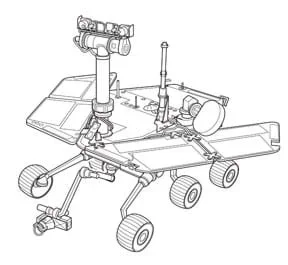 A Mars Exploration Rover drawing—a mobile geological laboratory—and an amazing engineering invention.Copyright 2004 press kit cover page drawing, NASA http://mars.nasa.gov/mer/newsroom/merlandings.pdf
With the Students—Day 2: Redesigning an Invention
- Proceed to show students the seven-slide Day 2 presentation. Slide 1 shows the same title slide as the Day 1 presentation, a few well-known engineering inventions. Slide 2 recaps the goals for Day 2: review main ethical evaluation ideas, develop an alternative design based on one of the inventions in the set, and present your new and improved alternate design to the class.
- (slide 3) Guide students to ask the following questions of some new innovations to give them practice in honing their critical eyes: Who does the product really benefit? How does it benefit them? Apply the questions to three new innovations (substitute any inventions you like) shown on the slide: Ringly, Coolest Cooler, Superbananas.
- (slide 4) Remind students of the complicated ethical issues surrounding product testing and production. How are the products developed and tested? Who makes the products? Examples for discussion: Unethical medical experiments, such as those conducted by Josef Mengele, experimenting and collecting data from those who cannot give consent. Sweatshops: People (and children) working to fabricate products for slave wages. Remind students to keep these questions in mind during the redesign process.
- (slide 5) Redistribute the invention sheet sets to each team. Present the challenge: It is your turn to innovate! Imagine you are engineers who will pitch your design to a charitable foundation that is looking for new projects to fund. Your job is to encourage and persuade the foundation to invest in your design.
- Then direct students to each choose ONE design and redesign it to create an alternative design. The purpose of the re-imagined alternative products is to make them as ethical as possible—so modify the design so it does more good for more people and the environment, or less harm to people and the environment. Direct students to answer the eight questions on the worksheet's "Part 5: Make Your Own Alternative Design" section to guide them through how they would modify the design; solve problems with the design; identify who would benefit from the new design; test, market and distribute the design; consider any design drawbacks; and make a detailed sketch. Keep this slide up while students are working on worksheet Parts 5 and 6.
- (slides 6 and 7) Before giving students time to create an alternative design, quickly show them an example alternative design to model the kinds of answers you expect from them. For this example, the "Blue Room" invention—a prison room to helps inmates relax—was modified into a product called "Vista" to improve hospice care. Slide 6 provides example answers to three of the eight questions students are asked on the worksheet. Example answers to all eight questions are provided in the Alternative Design Example Answers (PDF) document. Slide 7 shows some graphic and a marketing tag line created to promote the alternative product. Teachers: Feel free to replace this alternative design example with your own example!
- Give students most of the class period (about 45 minutes) to redesign their inventions and write the process on their worksheets, including a sketch of the revised design. This includes preparing for the presentation by completing the worksheet's "Part 6: Alternative Design Presentation" section. Remind students to make connections between the design changes and the class definition of "ethics," and include the following key terms as they apply to the invention: altruism, production, testing, availability and impact.
- Have students share their alternative designs with the class in the form of persuasive presentations, as if they were requesting funding from a charitable organization such as the Bill and Melinda Gates Foundation. Refer to the provided rubric to guide your assessment.
- Wrap up by pointing out that the same processes that students went through today are what they would do as engineers—considering how inventions might be made more widely available to people or how to increase the safety and welfare of others.
- (optional) If time permits and to balance the 16 popular inventions featured and discussed in this activity, consider showing students examples of the inspirational alternative and more altruistic design ideas at the Cooper-Hewitt National Design Museum's "Design for the Other 90%" website. The 60 featured projects, proposals and solutions address the complex issues in emerging and developing economies in the areas of urban planning, affordable housing, entrepreneurship, informal education, public health and more. Students usually respond positively to the inventions and designs that make a big difference in people's lives.
- (optional) If time remains (or as homework assignments), assign students the tasks described in the Activity Extensions section.
- accessible
- Readily obtainable or attainable.
- altruism
- Selfless concern for the well-being of others.
- availability
- Readily obtainable or accessible.
- equitable
- Characterized by equity or fairness; just and right; reasonable.
- ethical
- Behaving and making decisions in accordance with a culture or profession's concepts and standards of right and wrong.
- ethics
- A system of moral principles. A system of values and behavior relating to human conduct with respect to the rightness and wrongness of certain actions and their motives and consequences.
- impact
- To have a strong effect or influence on someone or something.
- production
- The act of making, fabricating or manufacturing.
- testing
- Taking measures to ensure the functionality, quality and/or reliability of a design before putting it into widespread use.
Pre-Activity Assessment
Concept Check: Through an informal class discussion, determine what students already know and believe about engineering ethics. If they know very little or have no strong opinions on the topic, they may need more guidance while (later) developing a class definition of "ethics."
Activity Embedded Assessment
Gallery Walk & Discussion: In order to assess students' understanding of engineering ethics, observe and listen to students, perhaps informally while walking around the room to check on progress. Take the opportunity to guide students who respond with superficial or tenuous answers towards a deeper understanding.
Worksheet: During the course of the activity, have students individually complete the five-page Activity Worksheet (PDF), which asks them to decide and explain their own votes for best invention of the year, critically evaluate two inventions, document the class's definition of "ethics," write questions that occur to them while reading about an invention, re-imagine and describe their own alternative designs, and write the text for a short persuasive presentation to pitch their alternative designs to a funding group. Review their answers to gauge their engagement and depth of thought about the topics.
Post-Activity Assessment
Day 2 Presentations: Students' alternate design presentations serve as the culminating activity and illustrate what they have taken away from the entire experience. Refer to the Student Presentation Rubric (PDF) for how student work might be evaluated.
If time remains during Day 1 (or as a homework assignment), ask students to put themselves in the position of the World Health Organization and write a brief letter to Jorge Odón evaluating his product (the device that helps baby delivery). In this letter, praise Jorge for what he has done well and give him advice on what he could do in the future in order to ensure that his design is as ethical as possible.
If time remains during Day 2, as a class, ask students to reconsider the NSPE Code of Ethics for Engineers and suggest how they would modify it based on what they learned during the activity.
If time remains during Day 2 (or as a homework assignment), ask students to reflect upon the impact of engineering designs they observe in their communities. Write a paragraph explaining how particular designs have helped or hurt people in their communities and ideas they have for improved designs.
"THE BEST INVENTIONS OF 2020," Time Magazine: https://time.com/collection/best-inventions-2020/#design
"Car Mechanic Dreams up a Tool to Ease Births," The New York Times: https://www.nytimes.com/2013/11/14/health/new-tool-to-ease-difficult-births-a-plastic-bag.html?_r=0
"Labs Are Told to Start Including a Neglected Variable: Females," The New York Times: http://www.nytimes.com/2014/05/15/health/nih-tells-researchers-to-end-sex-bias-in-early-studies.html?_r=0
Show students some inspirational alternative design ideas at the Cooper-Hewitt National Design Museum's "Design for the Other 90%" website: http://www.designother90.org/solutions/?exhibition=12
National Society of Professional Engineers. Code of Ethics for Engineers. Published July 2007. Accessed November 18, 2015. (Includes a link to a two-page PDF, which is also attached to this activity, reprinted by permission of the NSPE, www.nspe.org) http://www.nspe.org/resources/ethics/code-ethics
Riley, Donna. Engineering and Social Justice: Synthesis Lectures on Engineers, Technology and Society. Published 2008. San Rafael, CA: Morgan and Claypool Publishers. Accessed July 2015. http://www.morganclaypool.com/doi/abs/10.2200/S00117ED1V01Y200805ETS007
Contributors
Amy A. Wilson; Christina Sias; Alex Mejia
Supporting Program
NSF DRK-12 Project, College of Engineering, Utah State University
Acknowledgements
This material was developed based upon work supported by the National Science Foundation under grant no. DRL 1222566—the Community-Based Engineering Design Challenges for Adolescent English Learners DRK-12 project in the Mechanical and Aerospace Engineering Department, College of Engineering, Utah State University. Any opinions, findings, and conclusions or recommendations expressed in this material are those of the authors and do not necessarily reflect the views of the National Science Foundation.
Copyright
2015 by Regents of the University of Colorado; original © 2014 Utah State University