
Whatever Floats Your Boat!
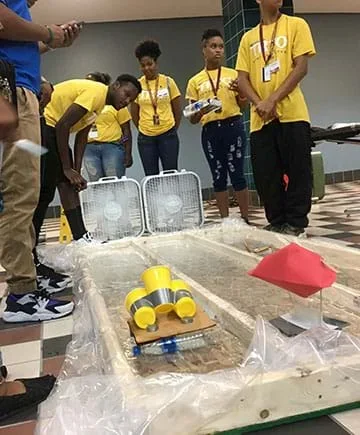 Student-designed boats race down two water channels.Copyright 2018 Natalie Bowen, College of Engineering and Technology, Central Michigan University
For this challenge, students use a variety of common office and household supplies to design a boat. Their goal: to not only have the fastest boat, but to also take into account how much mass (or “cargo”) the boat can carry, the stability of the boat in the water, the total mass of the boat, boat aesthetics, and how much it “costs” to construct. A fan supplies wind and propels each boat down the lane of a small pool. Students work through the engineering design process as they brainstorm ideas with their teams, design and test their boats, redesign, and then retest to make the boats as efficient as possible.
- assortment of building supplies such Styrofoam bowls and plates, aluminum foil, paper, saran wrap, plastic bottles, cardboard, construction paper, straws, bubble wrap, rubber bands, string, paper/binder clips, notecards, tacks, pipe cleaners, clothes/safety pin, popsicle sticks, skewers, plastic silverware, plastic cups, paper plates, paint sticks, cardboard tubes, toothpicks and yard sticks (see the Materials and Pricing List (PDF) for more ideas)
- assortment of adhesives and tools such as staplers, duct tape, packing tape, white glue, cement glue, hot glue, tape, box cutters, scissors, markers and colored pencils, rulers, and protractors
- pool to hold water; consider using a kiddie pool, an indoor pool, or building one out of PVC pipes or wood and tarps)
- electric fans to provide “wind” for boats; supply two fans if students race their boats in two lanes
- digital scale to weigh boats and the cargo
- metal washers, coins, or something with mass to use as cargo
- Materials and Pricing List (PDF)
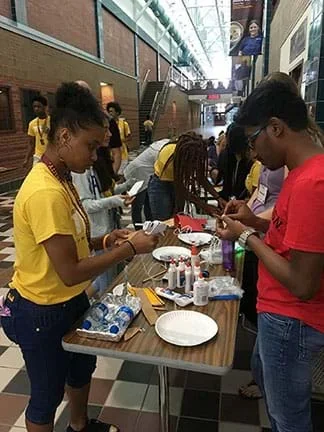 Students work on designing their boats in class.Copyright 2018 Natalie Bowen, College of Engineering and Technology, Central Michigan University
Contributors
Zachary Bates; Natalie Bowen
Supporting Program
Research Experience for Teachers Program, Central Michigan University
Acknowledgements
This curriculum was based upon work supported by the National Science Foundation under RET grant no. EEC 1542368— Research Experience for Teachers through Central Michigan University. Any opinions, findings, and conclusions or recommendations expressed in this material are those of the authors and do not necessarily reflect the views of the National Science Foundation.
Copyright
2019 by Regents of the University of Colorado; original © 2018 Central Michigan University