
Rock Solutions: A Solid Underground CO2 Storage Engineering Challenge
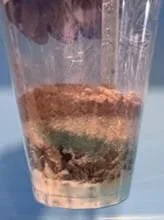 An example of layering gravel, sand, and clay to prevent CO₂ from leaking.Copyright Mila Taylor, Seven Lakes High School, Katy ISD, Texas
Students explore how environmental engineers design underground systems to store carbon dioxide (CO₂) as part of climate change mitigation efforts. Working in teams, students build and test a physical model representing subsurface rock layers using sand, gravel, and clay. A baking soda and vinegar reaction generates carbon dioxide gas to simulate the movement and potential leakage of stored CO₂ within the system. After collecting quantitative data on leakage, students analyze the effectiveness of their designs and iteratively improve their models using the engineering design process. Through this activity, students investigate how properties such as porosity, permeability, and cap rock integrity influence the success of geological carbon storage.
Environmental engineers design carbon capture and storage (CCS) systems to reduce atmospheric CO₂ emissions. These systems inject CO₂ deep underground into porous rock formations, where it is trapped beneath impermeable cap rock layers. Engineers must carefully evaluate the porosity and permeability of underground rock formations, as well as the integrity of the cap rock, to ensure the CO₂ remains safely contained over long periods of time. By studying geology, fluid movement, and monitoring technologies, engineers can design storage systems that help mitigate climate change while protecting groundwater and surrounding ecosystems.
After this activity, students should be able to:
- Describe how porous and impermeable materials affect fluid and gas movement.
- Explain the role of cap rock in trapping gases underground.
- Collect and analyze quantitative data from a physical model.
- Apply the engineering design process to improve system performance.
- Evaluate trade-offs between storage capacity and leakage.
STEL-7Q Apply the technology and engineering design process.
Grades 6-8
Do you agree with this alignment?STEL-7R Refine design solutions to address criteria and constraints.
Grades 6-8
Do you agree with this alignment?STEL-7T Assess design quality based upon established principles and elements of design.
Grades 6-8
Do you agree with this alignment?
MS-ESS3-3 Apply scientific principles to design a method for monitoring and minimizing a human impact on the environment.
Grades 6-8
This resource focuses on the following Three Dimensional Learning aspects of NGSS:
Science & Engineering Practices- Apply scientific principles to design an object, tool, process or system.Do you agree with this alignment?
Disciplinary Core Ideas- Human activities have significantly altered the biosphere, sometimes damaging or destroying natural habitats and causing the extinction of other species. But changes to Earth's environments can have different impacts (negative and positive) for different living things.Do you agree with this alignment?
Crosscutting Concepts- The uses of technologies and any limitations on their use are driven by individual or societal needs, desires, and values; by the findings of scientific research; and by differences in such factors as climate, natural resources, and economic conditions. Thus technology use varies from region to region and over time.Do you agree with this alignment?
- Relationships can be classified as causal or correlational, and correlation does not necessarily imply causation.Do you agree with this alignment?
Do you agree with this alignment?- Apply scientific principles to design an object, tool, process or system.
MS-ETS1-1 Define the criteria and constraints of a design problem with sufficient precision to ensure a successful solution, taking into account relevant scientific principles and potential impacts on people and the natural environment that may limit possible solutions.
Grades 6-8
This resource focuses on the following Three Dimensional Learning aspects of NGSS:
Science & Engineering Practices- Define a design problem that can be solved through the development of an object, tool, process or system and includes multiple criteria and constraints, including scientific knowledge that may limit possible solutions.Do you agree with this alignment?
Disciplinary Core Ideas- The more precisely a design task's criteria and constraints can be defined, the more likely it is that the designed solution will be successful. Specification of constraints includes consideration of scientific principles and other relevant knowledge that is likely to limit possible solutions.Do you agree with this alignment?
Crosscutting Concepts- The uses of technologies and any limitations on their use are driven by individual or societal needs, desires, and values; by the findings of scientific research; and by differences in such factors as climate, natural resources, and economic conditions.Do you agree with this alignment?
- All human activity draws on natural resources and has both short and long-term consequences, positive as well as negative, for the health of people and the natural environment.Do you agree with this alignment?
Do you agree with this alignment?- Define a design problem that can be solved through the development of an object, tool, process or system and includes multiple criteria and constraints, including scientific knowledge that may limit possible solutions.
MS-ETS1-2 Evaluate competing design solutions using a systematic process to determine how well they meet the criteria and constraints of the problem.
Grades 6-8
This resource focuses on the following Three Dimensional Learning aspects of NGSS:
Science & Engineering Practices- Evaluate competing design solutions based on jointly developed and agreed-upon design criteria.Do you agree with this alignment?
Disciplinary Core Ideas- There are systematic processes for evaluating solutions with respect to how well they meet the criteria and constraints of a problem.Do you agree with this alignment?
Do you agree with this alignment?- Evaluate competing design solutions based on jointly developed and agreed-upon design criteria.
MS-ETS1-3 Analyze data from tests to determine similarities and differences among several design solutions to identify the best characteristics of each that can be combined into a new solution to better meet the criteria for success.
Grades 6-8
This resource focuses on the following Three Dimensional Learning aspects of NGSS:
Science & Engineering Practices- Analyze and interpret data to determine similarities and differences in findings.Do you agree with this alignment?
Disciplinary Core Ideas- There are systematic processes for evaluating solutions with respect to how well they meet the criteria and constraints of a problem.Do you agree with this alignment?
- Sometimes parts of different solutions can be combined to create a solution that is better than any of its predecessors.Do you agree with this alignment?
- Although one design may not perform the best across all tests, identifying the characteristics of the design that performed the best in each test can provide useful information for the redesign process—that is, some of the characteristics may be incorporated into the new design.Do you agree with this alignment?
Do you agree with this alignment?- Analyze and interpret data to determine similarities and differences in findings.
Each group needs the following:
- 1 clear plastic cup
- 50 mL sand
- 50 mL gravel
- 50 mL clay
- 2–3 tablespoons baking soda
- 20 mL vinegar + 3 drops food coloring
- 1 plastic dropper/pipette
- 1 ruler (cm)
- 1 stopwatch/timer
- 1 spoon
- 1 Design Sheet (PDF)per student
- 1 pair of nitrile gloves per student
- 1 pair of safety goggles per student
- paper towels
Students should be familiar with:
- States of matter (solid, liquid, gas).
- Basic measurements (length, time).
- Simple data recording.
Let’s start with a big question: What happens to carbon dioxide (CO₂) after it’s released into the atmosphere? (Let students answer. Potential answers: It stays in the atmosphere; plants absorb some of it; oceans absorb some of it; it traps heat; it contributes to climate change.)
That’s right. While plants and oceans absorb some CO₂, much of it remains in the atmosphere, where it acts as a greenhouse gas. As CO₂ levels increase, more heat is trapped, contributing to climate change. Scientists and engineers are asking an important question: What if we could store some of that CO₂ somewhere else—like underground? Where do you think it could be stored? (Let students answer. Potential answers: In rocks; in underground rock layers; beneath Earth's surface.)
Exactly. This process is called carbon capture and storage (CCS). Engineers capture CO₂ before it enters the atmosphere and inject it deep underground into suitable rock formations. But here's the challenge: If we inject CO₂ underground, what might go wrong? (Let students answer. Potential answers: It could leak; it could escape to the surface; it could move into other rock layers.)
Yes, preventing leaks is critical. Whether CO₂ stays underground depends on the properties of the rocks. Some rocks are porous, meaning they contain tiny spaces, or pores, that can hold gases. If those pores are connected, the rock is permeable, allowing gases to move through it.
So, which type of rock is better for storing CO₂—porous or non-porous rock? (Let students answer. Answer: Porous rock, because it has spaces that can hold the gas.)
Correct—but a porous storage rock alone isn't enough. Engineers also need a cap rock, a layer of rock with very low permeability that traps the CO₂ and prevents it from escaping. Do you think a thicker cap rock is always better? (Let students offer answers. Potential answers: Maybe; it might reduce leaks; it could have trade-offs, such as reducing storage space or increasing cost.)
Exactly! Engineers must balance storage capacity, safety, and the potential for leakage when designing carbon storage systems.
Today, you'll act as an environmental engineer. You'll design a layered underground system using sand, gravel, and clay to model rock formations that store CO₂ while preventing leaks. You'll test your design, collect data, and improve it using the engineering design process. If your design leaks, is that a failure? (Let students answer. Answer: No—it provides data that can be used to improve the design.)
Let's start designing!
Background
Carbon Capture and Storage (CCS)
Carbon capture and storage (CCS) is a technology used to reduce carbon dioxide (CO₂) emissions that contribute to climate change. Instead of releasing CO₂ into the atmosphere, the gas is captured from sources such as power plants and industrial facilities, compressed, and injected deep underground into suitable rock formations for long-term storage.
For underground storage to be successful, engineers must identify rock formations that can safely contain the CO₂ for hundreds or even thousands of years. Selecting an appropriate storage site requires an understanding of geology, rock properties, and fluid movement underground.
Porosity and Permeability
Two important properties determine whether a rock is suitable for storing carbon dioxide:
- Porosity is the amount of empty space (pores) within a rock. Rocks with high porosity can store larger amounts of fluids or gases.
- Permeability describes how well those pore spaces are connected, allowing fluids or gases to move through the rock.
A rock can be highly porous but have low permeability if its pores are not well connected.
Reservoir Rocks and Cap Rocks
Successful carbon storage relies on two types of rock layers:
- Reservoir rocks are porous and permeable, allowing injected CO₂ to enter and be stored within the pore spaces. Sandstone is a common example.
- Cap rocks are dense, nonporous, and have very low permeability. They act as a seal that prevents CO₂ from escaping to the surface. Shale is a common natural cap rock.
In this activity:
- Sand and gravel model reservoir rocks because they contain connected spaces that allow fluids and gases to move.
- Clay models a cap rock because it is much less permeable and slows or prevents leakage.
Modeling Carbon Storage
Students construct a simplified model of an underground storage system using layers of sand, gravel, and clay. Colored vinegar represents injected CO₂, while the baking soda produces carbon dioxide gas during the chemical reaction. Although this model does not perfectly replicate underground conditions, it allows students to observe how different layer arrangements affect fluid and gas movement and the ability of a cap rock to contain the simulated CO₂.
Remember that this investigation is a model of underground carbon storage and has several limitations.
- The materials do not perfectly represent real rocks.
- The reaction between vinegar and baking soda produces carbon dioxide quickly, unlike industrial injection processes.
- Real underground storage occurs thousands of feet below Earth's surface under high pressure and temperature.
- Engineers use extensive geological surveys, computer modeling, and long-term monitoring before selecting a storage site.
Despite these limitations, the model demonstrates the importance of reservoir rocks, cap rocks, and engineering design in reducing the risk of CO₂ leakage.
Before the Activity
- Gather the materials needed by each group.
- Make copies of the Design Sheet (PDF)(1 per student).
During the Activity
Part 1: Ask, Research, Imagine, Plan (25 minutes)
- Divide students into teams of 2-4.
- Present the design challenge: Your team will design a layered underground system using sand, gravel, and clay to model rock formations that can store carbon dioxide (CO₂) while preventing leaks.
- Introduce the available materials.
- Explain the design constraints:
- All three materials must be used.
- The cap rock layer must be 1–3 cm.
- The maximum injection volume is 20 mL.
- The completed model must fit within the provided cup.
- Explain how models will be tested:
- Students will inject a measured volume of colored vinegar into the baking soda at the bottom of their model while timing the reaction.
- As the reaction occurs, students will observe how the liquid and gas move through the model and record when and where any leaks occur.
- Describe the measurements to be recorded:
- Leak Time (s): Time until the first visible leak occurs.
- Leak Height (cm): Vertical distance the liquid or gas travels from the bottom of the model before leaking.
- Spread Width (cm): Horizontal distance the leaked liquid spreads.
- Allow students to ask clarifying questions about the design challenge, testing procedure, and measurements.
- Optional: Review the characteristics of the rock layers used in carbon storage (e.g., porous layers, cap rock, sand, gravel, clay, etc.).
- Distribute one Design Sheet (PDF) to each student.
- Give students 10 minutes to complete Part 1 of the Design Sheet (PDF)by answering the questions and sketching a layered model design.
- Remind students that their sketches should:
- Identify the materials to be used.
- Label the porous layer(s) (sand and/or gravel).
- Label the cap rock layer (clay is recommended).
- Record the planned cap rock thickness (1-3 cm).
- Record the planned injection volume (20 mL or less).
- Have students complete the Design Decision section of their Design Sheet (PDF).
Part 2: Build and Test (25 minutes)
- Distribute materials to each group, or have groups collect the materials they need from a common area.
- Have each group add a 1–2 cm layer of baking soda to the bottom of their cup. (See Image 1.)
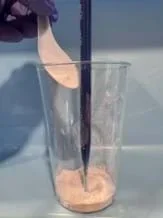 Baking soda at the bottom of the cup and colored vinegar in the dropper setup.Copyright Mila Taylor, Seven Lakes High School, Katy ISD, Texas
- Ensure each group positions the dropper tip so that it reaches the baking soda layer.
- Instruct teams to build their models according to the sketches they completed in Part 1.
- Once each team has completed their model, have them measure and record the actual cap rock thickness for Trial 1 in Part 2 of the Design Sheet (PDF).
- Optional: Review the testing procedure. (See Part 1.)
- Optional: Review the measurements to be recorded. (See Part 1.)
- Give teams time to test their model by:
- Filling their dropper with colored vinegar (record volume).
- Starting the timer when injection begins.
- Slowly injecting vinegar into the baking soda.
- Observing the movement of liquid and gas.
- Have students record their Trial 1 results in Part 2 of the Design Sheet (PDF).
An example of layering gravel, sand, and clay to prevent CO₂ from leaking.Copyright Mila Taylor, Seven Lakes High School, Katy ISD, Texas
Part 3: Analyze (10 minutes)
- Have each team review the results from Trial 1 recorded on their Design Sheet (PDF).
- Ask teams to analyze the performance of their model by considering questions such as the following:
- Did the model successfully contain the liquid and gas?
- Where did leaks occur?
- Which layer(s) performed well?
- Which layer(s) may have contributed to the leak?
- Explain that they will answer the questions in Part 3 of the Design Sheet (PDF).
Part 4: Redesign (15 minutes)
- Instruct each team to identify one aspect of their design to improve. Explain that, to conduct a fair test, teams may modify only one design variable while keeping all other variables the same.
- Have each team select one of the following variables to modify:
- Cap thickness
- Material type
- Layer arrangement
- Injection volume (20 mL or less)
- Have students record their planned design change and explain why they believe it will improve their model in Part 4 of the Design Sheet (PDF).
- Instruct teams to rebuild their model using the revised design.
- Have students measure and record the actual cap rock thickness for Trial 2.
- Give teams time to test their redesigned model using the same testing procedure described in Part 2.
- Have students record their Trial 2 results in Part 2 of the Design Sheet (PDF).
- Optional: If time allows, let teams analyze their redesigned results and complete additional redesign iterations.
Part 5: Analysis and Discussion (10 minutes)
- Give students time to complete the reflection questions in Part 5 of the Design Sheet (PDF).
- Facilitate a brief discussion by asking teams to compare the results of Trial 1 and Trial 2 and determine whether their design modification improved the model's ability to contain the simulated CO₂. Guide students to analyze:
- Which design had the longest leak time?
- Which design minimized leakage?
- How did cap thickness affect results?
- Which materials worked best?
- porosity
- The measure of empty spaces in a rock that can hold fluids.
- permeability
- The ability of a rock to allow fluids to pass through.
- cap rock
- An impermeable layer that traps fluids underground.
- leakage
- Refers to the escape of stored fluids from a designated underground geological formation through permeable rocks.
Pre-Activity Assessment
Predict and Discuss: Students offer answers to the questions in the Introduction/Motivation section:
- What happens to carbon dioxide (CO₂) after it’s released into the atmosphere? (Potential answers: It stays in the atmosphere; plants absorb some of it; oceans absorb some of it; it traps heat; it contributes to climate change.)
- What if we could store some of that CO₂ somewhere else—like underground? Where do you think it could be stored? (Let students answer. Potential answers: In rocks; in underground rock layers; beneath Earth's surface.)
- If we inject CO₂ underground, what might go wrong? (Potential answers: It could leak; it could escape to the surface; it could move into other rock layers.)
- So, which type of rock is better for storing CO₂—porous or non-porous rock? (Answer: Porous rock, because it has spaces that can hold the gas.)
- Do you think a thicker cap rock is always better? (Potential answers: Maybe; it might reduce leaks; it could have trade-offs, such as reducing storage space or increasing cost.)
Activity Embedded (Formative) Assessment
Imagine and Plan: Students imagine, plan, and then sketch a layered model design in their Design Sheet (PDF). Check sketches to ensure they all contain the following:
- Bottom: baking soda (gas source)
- Middle: porous layer (sand/gravel)
- Top: cap rock (clay)
- Injection point reaching bottom layer
Data Collection: Students collect data from their model and record it in Part 2 of their Design Sheet (PDF). Upon completion, have them compare their data with another group.
Post-Activity (Summative) Assessment
Reflection Questions: Students answer reflection questions in their Design Sheet (PDF).
- What trade-offs exist between storage capacity and leak prevention? (Potential answers: More porous materials like gravel allowed for more gas storage, but it also caused faster and wider leakage. Thicker or less permeable caps slowed leakage but limited how quickly the gas could be injected or distributed.)
- What are two limitations of this model compared to real systems? (Potential answers: The model does not simulate the high pressures and temperatures found deep underground; the model cannot replicate long-term behavior such as rock fractures, chemical reactions, or supercritical CO₂ flow.)
- How might engineers monitor underground leaks? (Answer: Engineers could monitor leaks using pressure sensors, soil or air gas detectors, seismic monitoring, or satellite and remote sensing technologies to detect gas escaping from storage sites.)
Class discussion: Students participate in a class discussion analyzing the following questions:
- Which design had the longest leak time?
- Which design minimized leakage?
- How did cap thickness affect results?
- Which materials worked best?
Investigating Cap Rock Thickness
Challenge students to investigate how cap rock thickness affects carbon dioxide containment. Have each team build multiple models that differ only in cap rock thickness (e.g., 1 cm, 2 cm, and 3 cm) while keeping all other design variables constant. Students should test each model, record the leak time, leak height, and spread width, and compare the results.
For younger students:
- Provide a partially completed Design Sheet with guiding questions.
- Demonstrate how to build one example model before students begin.
- Conduct the first trial as a whole-class demonstration.
- Limit redesign choices to only cap rock thickness.
- Focus discussion on identifying leaks rather than quantitative measurements.
For older students:
- Allow students to determine their own design constraints.
- Require students to justify their design decisions using principles of porosity, permeability, and cap rock integrity.
- Introduce concepts such as reservoir pressure, geologic formations, fault zones, and carbon sequestration.
- Have students go beyond basic observations by:
- Calculating averages across multiple trials.
- Graphing relationships (e.g., leak time vs. cap rock thickness or injection volume vs. spread width).
- Identifying trends in the data and using evidence to justify their conclusions.
- Have students calculate the percentage improvement between Trial 1 and Trial 2.
- Require students to prepare an engineering report or presentation summarizing their design process, data analysis, redesign decisions, and conclusions.
Contributors
Mila Taylor
Supporting Program
Research Experience for Teachers, Rice University
Acknowledgements
This curriculum was developed under National Science Foundation - The Nanotechnology Research Experience for Teachers at Rice University Grant Number NSF EEC-2302127. Any opinions, findings, and conclusions or recommendations expressed in this material are those of the authors and do not necessarily reflect the views of the National Science Foundation.
Copyright
2026 by Regents of the University of Colorado; original © 2025 Rice University