
Water Filtration Project: Make Your Own Water Filters
Students are asked to design methods to filter water using ordinary materials, while also considering their designs' material and cost efficiencies. They learn about the importance of water and its role in our everyday lives. They come to understand what must occur each day so that they can have clean water.
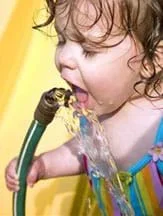 Students create water filtersCopyright 2004 Microsoft Corporation, One Microsoft Way, Redmond, WA 98052-6399 USA. All rights reserved. http://office.microsoft.com/en-us/images/results.aspx?qu=water&ex=1#ai:MP900448383|mt:2|
Clean water is not available in all parts of the world. Many people live with polluted water that is unhealthy to drink and bathe in. Civil, environmental , materials and mechanical engineers all contribute to developing technologies and systems to purify unclean water. Purifying water can be done easily if it is a small amount that is fairly clean, but larger amounts that are very polluted are much more complicated. Typical steps for full water treatment include aeration, coagulation, sedimentation, filtration and disinfection.
After this activity, students should be able to:
- Understand how filtration works.
- Create creative design methods.
- Problem solve given a design challenge.
- Apply mathematics (multiplication) reinforcement.
- Engage in teamwork to solve a challenge.
- CCSS.Math.Content.5.NBT.B.5 Fluently multiply multi-digit whole numbers using the standard algorithm.
Grade 5
Do you agree with this alignment?
- Students will develop an understanding of the attributes of design.
Grades K-12
Do you agree with this alignment? - Students will develop an understanding of engineering design.
Grades K-12
Do you agree with this alignment? - STEL-1H Design solutions by safely using tools, materials, and skills.
Grades 3-5
Do you agree with this alignment? - STEL-7H Illustrate that there are multiple approaches to design.
Grades 3-5
Do you agree with this alignment? - STEL-7I Apply the technology and engineering design process.
Grades 3-5
Do you agree with this alignment? - STEL-7J Evaluate designs based on criteria, constraints, and standards.
Grades 3-5
Do you agree with this alignment? - STEL-7K Interpret how good design improves the human condition.
Grades 3-5
Do you agree with this alignment?
- 5.NBT.B Perform operations with multi-digit whole numbers and with decimals to hundredths.
Grade 5
Do you agree with this alignment?
- Identify materials used to accomplish a design task based on a specific property, e.g., strength, hardness, and flexibility.
Grades 3-5
Do you agree with this alignment? - Identify a problem that reflects the need for shelter, storage, or convenience.
Grades 3-5
Do you agree with this alignment? - Identify relevant design features (e.g., size, shape, weight) for building a prototype of a solution to a given problem.
Grades 3-5
Do you agree with this alignment?
- 3-5-ETS1-1 Define a simple design problem reflecting a need or a want that includes specified criteria for success and constraints on materials, time, or cost.
Grades 3-5
This resource focuses on the following Three Dimensional Learning aspects of NGSS:
Science & Engineering Practices- Define a simple design problem that can be solved through the development of an object, tool, process, or system and includes several criteria for success and constraints on materials, time, or cost.Do you agree with this alignment?
Disciplinary Core Ideas- Possible solutions to a problem are limited by available materials and resources (constraints). The success of a designed solution is determined by considering the desired features of a solution (criteria). Different proposals for solutions can be compared on the basis of how well each one meets the specified criteria for success or how well each takes the constraints into account.Do you agree with this alignment?
Crosscutting Concepts- People's needs and wants change over time, as do their demands for new and improved technologies.Do you agree with this alignment?
Do you agree with this alignment? - Define a simple design problem that can be solved through the development of an object, tool, process, or system and includes several criteria for success and constraints on materials, time, or cost.
- 1 liter of water prepared in advance with soil and sand in it until it is thin but relatively opaque
- 3 test tubes prepared with the water standards "A," "B" and "C" (C is filtered through some grass, B is filtered through a coffee filter, and A is filtered through 2 coffee filters with a paper towel in the middle)
- cotton balls
- gauze squares
- tulle/netting
- tissue
- paper towels
- coffee filters
- gravel (aquarium gravel works great)
- sand
- 3 test tubes per student
- test tube racks
- graduated cylinders
- Design Components Worksheet (PDF)
One of our most valuable and often overlooked resources is water. We can survive for a few weeks without food, but only a few days without water. Having clean water to drink is a luxury. The water that eventually comes out of our faucets sometimes does not start off being safe to drink. In most cases, it has gone through a water treatment plant designed by engineers prior to reaching our faucets.
Background
This is a great activity for students to experience some "real-life" engineering.
Most any materials in a typical classroom can be adapted as filtration materials.
Water from lakes and rivers often has contaminants that make it unfit for drinking. The water may contain dirt, rocks and other objects that can be easily identified. Water may also contain bacteria and other microscopic organisms that cannot be seen easily. For these reasons, water that is delivered to our homes must go through a water treatment process. This is typically a five-part process that consists of aeration, coagulation, sedimentation, filtration and disinfection. This activity is only concerned with filtration, which removes most but not all of the impurities from the water. Make sure students know that in this activity the filtered water is still unfit to drink.
Recommended Resources:
Information on the water treatment process and drinking water standards: https://www.epa.gov/ground-water-and-drinking-water.
Information on different types of filters and filtration processes: https://www.thoughtco.com/filtration-definition-4144961.
Before the Activity
- Gather materials and make copies of the Design Components Worksheet (PDF).
- Make the liter of dirty water and the "A," "B" and "C" tubes.
With the Students
- Engineering Challenge: Tell the students they have been hired by (your last name) Water Supply Company. With the ongoing drought, not enough water is available for all the things we need to supply – people, animals and plants. Tell them that they will each be given a sample of the dirty water they have remaining, and show them the tubes "A," "B" and "C." A is nearly ready for human use, B is nearly ready for animal use, and C is nearly ready to feed the plants. Remind them that no one must taste anything in the lab. They will be paid for their supply of filtered water: A gets $10 per ml, B gets $5 per ml, and C gets $1 per ml.
- Have students complete the worksheet to make sure they understand the activity purpose, and to help them think about the components of engineering design.
- Put trays of materials in front of the students. Let them decide in teams what materials they would like to use to filter their water. To challenge students, include one of the following constraints:
- Limit the amount of materials allowed for the design.
- Assign a price per unit of material and give students a budget to work within.
- Have students draw schematics of the layers. Once completed, give each team 25 ml of the dirty water to begin to filter in their test tubes.
- Once filtering is complete, have them bring the test tubes to you for observation. Decide if the water is A, B or C grade and help them measure their sample in a graduated cylinder. They must return to their desks and do the math to come up with their $ value. Have students put their $ values on the board.
Activity Embedded Assessment
Have students complete the Design Components Worksheet (PDF) to assess their understanding of the activity and to encourage them to consider the design components involved in design a water filtration system. Sample answers are provided on the Design Components Worksheet Answer Key (PDF).
Post-Activity Assessment
Use the attached Rubric for Performance Assessment (PDF) to evaluate students' design projects using criteria for the final filtering system and teamwork effort.
Make sure students know that in this activity the filtered water is still unfit to drink.
Contributors
Erin Santini; Erik Rushton
Supporting Program
Center for Engineering Educational Outreach, Tufts University
Copyright
2013 by Regents of the University of Colorado; original © 2004 Worcester Polytechnic Institute