
Amusement Park Ride: Ups and Downs in Design
Students design, build and test model roller coasters using foam tubing, toothpicks and masking tape. As if they are engineers, teams compete to create the winning design based on costs and aesthetics. Guided by three worksheets, students prototype, test, evaluate and finalize their ideas, all while integrating energy concepts. The goal is to understand the basics of engineering design associated with kinetic and potential energy to create optimal roller coasters. The marble (roller coaster car) starts with potential energy that is converted to kinetic energy as it moves along the track. The diameter of the loops that the marble traverses without falling out depends on the kinetic energy obtained by the marble.
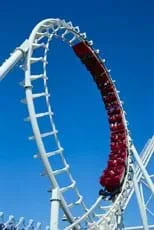 Students design, build and test model roller coasters.Copyright Microsoft Corporation, 1983-2001
Mechanical and civil engineers are involved in the design of roller coasters. Engineers must understand how the basic physics concepts of energy apply to successful roller coasters. The challenge is to make the roller coasters fast and fun, without compromising structural integrity, which is critical for ride safety.
After this activity, students should be able to:
- Identify situations in which kinetic energy is transformed into potential energy and vice versa.
- Identify key steps in the engineering design process.
- Model, test, evaluate and modify a design.
- Invent a product to meet a need.
- Create a prototype and final model, taking design criteria into consideration.
- Use science, math, and engineering principles to design and optimize a product.
- CCSS.Math.Content.6.NS.B.2 Fluently divide multi-digit numbers using the standard algorithm.
Grade 6
Do you agree with this alignment? - CCSS.Math.Content.6.NS.B.3 Fluently add, subtract, multiply, and divide multi-digit decimals using the standard algorithm for each operation.
Grade 6
Do you agree with this alignment? - CCSS.Math.Content.6.RP.A.1 Understand the concept of a ratio and use ratio language to describe a ratio relationship between two quantities.
Grade 6
Do you agree with this alignment? - CCSS.Math.Content.8.SP.A.1 Construct and interpret scatter plots for bivariate measurement data to investigate patterns of association between two quantities. Describe patterns such as clustering, outliers, positive or negative association, linear association, and nonlinear association.
Grade 8
Do you agree with this alignment? - CCSS.Math.Practice.MP2 Reason abstractly and quantitatively.
Grades K-12
Do you agree with this alignment?
- Students will develop an understanding of the attributes of design.
Grades K-12
Do you agree with this alignment? - Students will develop an understanding of engineering design.
Grades K-12
Do you agree with this alignment? - Students will develop an understanding of the role of troubleshooting, research and development, invention and innovation, and experimentation in problem solving.
Grades K-12
Do you agree with this alignment? - Students will develop abilities to apply the design process.
Grades K-12
Do you agree with this alignment? - Students will develop an understanding of the relationships among technologies and the connections between technology and other fields of study.
Grades K-12
Do you agree with this alignment? - STEL-7Q Apply the technology and engineering design process.
Grades 6-8
Do you agree with this alignment?
- 6.NS.2 Fluently divide multi-digit numbers using the standard algorithm.
Grade 6
Do you agree with this alignment? - 6.NS.3 Fluently add, subtract, multiply, and divide multi-digit decimals using the standard algorithm for each operation.
Grade 6
Do you agree with this alignment? - 6.RP.1 Understand the concept of a ratio and use ratio language to describe a ratio relationship between two quantities.
Grade 6
Do you agree with this alignment? - 8.SP.1 Construct and interpret scatter plots for bivariate measurement data to investigate patterns of association between two quantities. Describe patterns such as clustering, outliers, positive or negative association, linear association, and nonlinear association.
Grade 8
Do you agree with this alignment? - MP.2 Reason abstractly and quantitatively.
Grades K-12
Do you agree with this alignment?
- Differentiate between potential and kinetic energy. Identify situations where kinetic energy is transformed into potential energy and vice versa.
Grades 6-8
Do you agree with this alignment? - Identify and explain the steps of the engineering design process, i.e., identify the need or problem, research the problem, develop possible solutions, select the best possible solution(s), construct a prototype, test and evaluate, communicate the solution(s), and redesign.
Grades 6-8
Do you agree with this alignment? - Describe and explain the purpose of a given prototype.
Grades 6-8
Do you agree with this alignment?
- MS-ETS1-1 Define the criteria and constraints of a design problem with sufficient precision to ensure a successful solution, taking into account relevant scientific principles and potential impacts on people and the natural environment that may limit possible solutions.
Grades 6-8
This resource focuses on the following Three Dimensional Learning aspects of NGSS:
Science & Engineering Practices- Define a design problem that can be solved through the development of an object, tool, process or system and includes multiple criteria and constraints, including scientific knowledge that may limit possible solutions.Do you agree with this alignment?
Disciplinary Core Ideas- The more precisely a design task's criteria and constraints can be defined, the more likely it is that the designed solution will be successful. Specification of constraints includes consideration of scientific principles and other relevant knowledge that is likely to limit possible solutions.Do you agree with this alignment?
Crosscutting Concepts- The uses of technologies and any limitations on their use are driven by individual or societal needs, desires, and values; by the findings of scientific research; and by differences in such factors as climate, natural resources, and economic conditions.Do you agree with this alignment?
- All human activity draws on natural resources and has both short and long-term consequences, positive as well as negative, for the health of people and the natural environment.Do you agree with this alignment?
Do you agree with this alignment? - Define a design problem that can be solved through the development of an object, tool, process or system and includes multiple criteria and constraints, including scientific knowledge that may limit possible solutions.
- MS-ETS1-4 Develop a model to generate data for iterative testing and modification of a proposed object, tool, or process such that an optimal design can be achieved.
Grades 6-8
This resource focuses on the following Three Dimensional Learning aspects of NGSS:
Science & Engineering Practices- Develop a model to generate data to test ideas about designed systems, including those representing inputs and outputs.Do you agree with this alignment?
Disciplinary Core Ideas- Models of all kinds are important for testing solutions.Do you agree with this alignment?
- The iterative process of testing the most promising solutions and modifying what is proposed on the basis of the test results leads to greater refinement and ultimately to an optimal solution.Do you agree with this alignment?
Do you agree with this alignment? - Develop a model to generate data to test ideas about designed systems, including those representing inputs and outputs.
- MS-PS3-2 Develop a model to describe that when the arrangement of objects interacting at a distance changes, different amounts of potential energy are stored in the system.
Grades 6-8
This resource focuses on the following Three Dimensional Learning aspects of NGSS:
Science & Engineering Practices- Develop a model to describe unobservable mechanisms.Do you agree with this alignment?
Disciplinary Core Ideas- A system of objects may also contain stored (potential) energy, depending on their relative positions.Do you agree with this alignment?
- When two objects interact, each one exerts a force on the other that can cause energy to be transferred to or from the object.Do you agree with this alignment?
Crosscutting Concepts- Models can be used to represent systems and their interactions—such as inputs, processes and outputs—and energy and matter flows within systems.Do you agree with this alignment?
Do you agree with this alignment? - Develop a model to describe unobservable mechanisms.
- MS-PS3-5 Construct, use, and present arguments to support the claim that when the kinetic energy of an object changes, energy is transferred to or from the object.
Grades 6-8
This resource focuses on the following Three Dimensional Learning aspects of NGSS:
Science & Engineering Practices- Construct, use, and present oral and written arguments supported by empirical evidence and scientific reasoning to support or refute an explanation or a model for a phenomenon.Do you agree with this alignment?
- Science knowledge is based upon logical and conceptual connections between evidence and explanations.Do you agree with this alignment?
Disciplinary Core Ideas- When the motion energy of an object changes, there is inevitably some other change in energy at the same time.Do you agree with this alignment?
Crosscutting Concepts- Energy may take different forms (e.g. energy in fields, thermal energy, energy of motion).Do you agree with this alignment?
Do you agree with this alignment? - Construct, use, and present oral and written arguments supported by empirical evidence and scientific reasoning to support or refute an explanation or a model for a phenomenon.
To share with the entire class:
- 5-7 6-foot lengths of foam pipe insulation tubing, cut in half lengthwise per group
- 2 rolls masking tape
- 2 boxes round toothpicks (~20 per group)
- 16 mm marbles (5 per group)
Each group needs:
- container to catch marbles
- flexible tape measure
- scissors and ruler
- 2 different-colored stickers, one marked "P," the other "K"
- Worksheet 1: Reference Diagram (PDF)
- Worksheet 2: Design and Building Guidelines (PDF)
- Worksheet 3: Cost and Evaluation Sheet (PDF)
- Worksheet 1: Reference Diagram (pdf)
- Worksheet 1: Reference Diagram (docx)
- Worksheet 2: Design and Building Guidelines (pdf)
- Worksheet 2: Design and Building Guidelines (docx)
- Worksheet 3: Cost and Evaluation Sheet (pdf)
- Worksheet 3: Cost and Evaluation Sheet (docx)
- Making Sense Assessment (docx)
- Making Sense Assessment (pdf)
The city of Wahoo wants to build a new roller coaster ride on their town common as part of the celebration of their 300th year. For consistency with the round number, they want a design to be as "loopy" as possible while keeping cost to a minimum. They are looking for engineering designs that optimize the ratio (material costs/inches of loop diameter) and are aesthetically pleasing (look good!). Every section of a roller coaster has different characteristics. Some portions have very light turns while others have more gentle curves and turns. Each scenario has its limits for whether or not it will work.
Background
Roller coasters at amusement parks utilize potential energy and kinetic energy. Typically, a motor pulls up the roller coaster car to gain its initial potential energy. Once at the peak point, no motors are connected to the car in any way. The car begins its winding and looping decent along a track that has been designed to safely convert potential energy into kinetic energy while making it a thrilling ride.
If the car goes through a loop-de-loop and does not have enough kinetic energy, it will not stay on the track as it reaches the peak of the loop. Kinetic energy is measured as KE=(mv2)/2, where m is the mass of the object and v is the velocity. Potential energy is measured as PE=mgh, where m is the mass, g is the gravitational force, and h is the distance above the reference point where the mass starts.
Ideally, all the potential energy is converted to kinetic energy, but in reality, this never holds true, since some of the energy is lost to friction. Because of the loss of energy, the peak of the loops must be lower than the initial starting point of the car. See Worksheet 3 for a reference diagram.
With the Students
Part 1: Preliminary Design and Testing
- Show Worksheet 1: Reference Diagram (PDF) as an overhead transparency OR make copies and distribute as a student handout. Discuss the energy concepts illustrated on the worksheet.
- Hand out Worksheet 2: Design and Building Guidelines (PDF) to all students. Review the task, design criteria and scoring.
- Discuss the engineering design process (refer to the figure below) and how engineers use it to design structures like roller coasters.
- Divide the class into groups of three students each.
- Give each group 1 marble, a container to catch the marble, 1 foam piece, 1 toothpick, and a one-foot piece of masking tape.
- Have each team design and test a preliminary prototype using the provided materials.
- As they test, advise the groups to plan their final designs and the amount of materials that they will need. Have them sketch their ideas on paper and fill in quantities of materials on Worksheet 3: Cost and Evaluation Sheet (PDF).
- After 20 minutes, have students return the materials from the preliminary prototypes and obtain the materials they listed on Worksheet 3 from the "store." If this is done at two separate class times, the materials can be ready for students when they arrive for the second meeting.
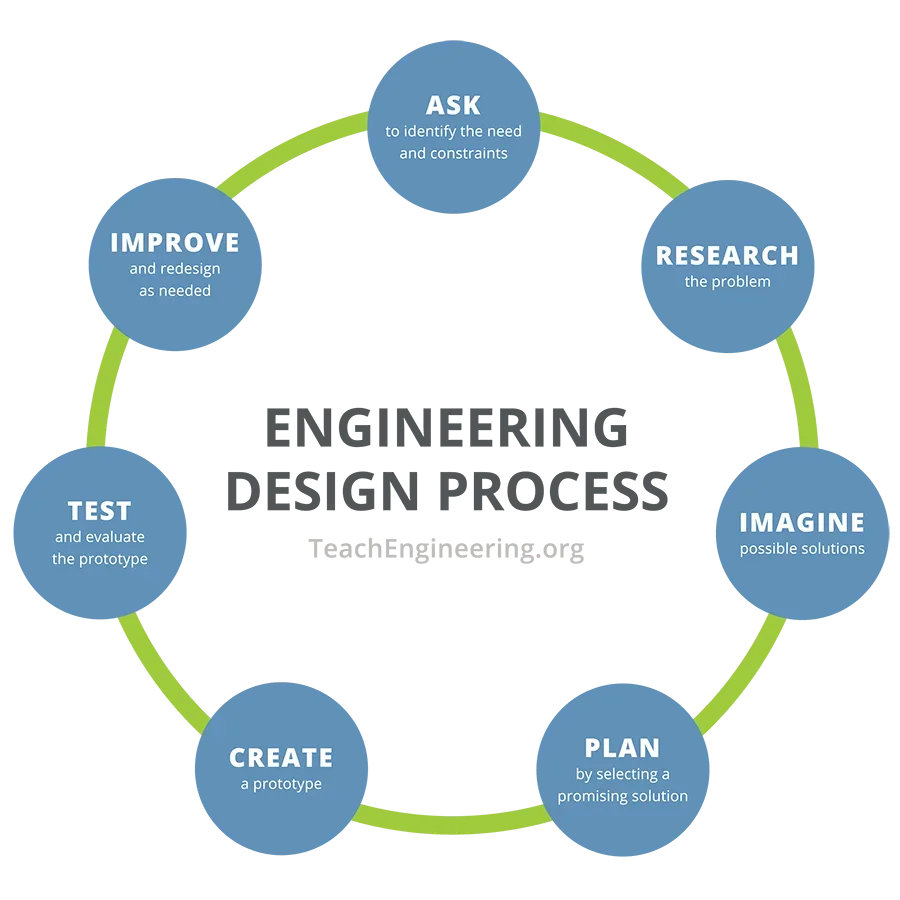 The steps of the engineering design process.Copyright 2019 TeachEngineering.org. All rights reserved.
Part 2: Final Design and Testing
- Permit additional materials to be purchased during the first phase of design and testing, about 30 minutes. Once materials have been obtained from the store, they may not be returned or exchanged.
- Give teams 10 minutes to finalize their designs. Give each group 1 "P" sticker and 1 "K" sticker. Remind groups to use the stickers to mark the places on their roller coasters that have the greatest kinetic and potential energy.
- When time is up, have groups step back from their roller coasters. Test each roller coaster individually by having a team member release the marble to run through it. Remember, each roller coaster must be able to stand alone and the marble must travel completely from start to finish. Permit at least two tries per coaster, though more testing can be done if time allows.
- Identify an "aesthetic rating." Have each group look at all of the roller coaster designs and come up with an aesthetic rating, such as 1-6 if six groups, with 1 being the best. Based on the group responses, the leader announces the ratings.
- Have groups measure the diameter of each loop in the roller coaster and total the cost of purchased materials in Worksheet 3.
- Have students compute the loop diameter to cost ratio, then add the aesthetic ranking.
- After all groups have completed the tests, come to a consensus as a class about the results. Lead a discussion on observations about effective and non-effective solutions. Was there a stronger design/construction that seemed to work? How did potential and kinetic energy play a role? Along with justifying the best design, did your group consider structural integrity? Is the ride safe?
- kinetic energy
- Energy associated with motion of an object.
- potential energy
- Energy an object has because of its relative location.
- gravitational force
- Force exerted between the Earth and an object that attracts the object toward the Earth.
Pre-Activity Assessment
Discussion: Observe student participation in class discussion on potential and kinetic energy.
Activity Embedded Assessment
Observation: Observe student participation and contribution within groups during the preliminary and final design stages.
Circumferece: Have students calculate the circumference of the loops (assuming they are true circles) using the measured diameter.
Post-Activity Assessment
Estimating Velocity: Have students estimate the velocity at the point where the kinetic energy is the highest (the lowest point of the track). Start by estimating the potential energy at the start (PE = m*g*h ) and then assume that all of this energy is converted to kinetic energy. Solve the equation KE = (1/2)mv2 for the velocity. Note: if you set the two equal (m*g*h = (1/2) mv2), you do not need to measure the mass of the ball!
Graph: As a class, create a scatter plot of the maximum height of each track vs. calculated theoretical velocity. Discuss the relationship between the variables.
Recap: Assign students to individually describe their roller coaster designs with sketches, explaining what worked and what did not work. Review their recaps to gauge their depth of comprehension.
Making Sense: Have students reflect about the science phenomena they explored and/or the science and engineering skills they used by completing the Making Sense Assessment (PDF).
Have students research either the history or safety of roller coasters. When was the first loop-de-loop introduced?
Have students calculate the potential energy of the marble at several locations along their tracks.
For upper-level students, assign the activity extensions. Also, have them compete for the fastest ride compared to the coaster length.
Marden, Duane. Roller Coaster Database. A comprehensive, searchable database with information and statistics on 5,000+ roller coasters throughout the world. http://www.rcdb.com/
Contributors
Marthy Cyr; C. Shade
Supporting Program
Making the Connection, Women in Engineering Programs and Advocates Network (WEPAN)
Acknowledgements
Project funded by Lucent Technologies Foundation.
Copyright
2013 by Regents of the University of Colorado; original © 2001 WEPAN/Worcester Polytechnic Institute