
Off-Road Wheelchair Challenge
Students further their understanding of the engineering design process (EDP) while being introduced to assistive technology devices and biomedical engineering. They are given a fictional client statement and are tasked to follow the steps of the EDP to design and build small-scale, off-road wheelchair prototypes. As part of the EDP, students identify appropriate materials and demonstrate two methods of representing solutions to their design problem (scale drawings and simple scale models). They test the scale model off-road wheelchairs using spring scales to pull the prototypes across three different simulated off-road surfaces.
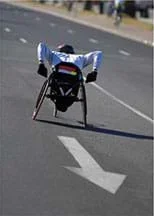 Engineering solutions can help people with physical disabilities to take on physical challenges.Copyright 2004 Microsoft Corporation, One Microsoft Way, Redmond, WA 98052-6399 USA. All rights reserved.
Engineers follow the engineering design process as they create solutions that improve the lives of many people through the development of assistive technology devices. For example, advancements in wheelchairs, prosthetics, and hearing and visual aid devices illustrate the humanitarian aspect of engineering.
After this activity, students should be able to:
- Identify and describe the steps of the engineering design process.
- Describe how to use the engineering design process to develop solutions to problems.
- Explain the reasons for their selected designs and material choices.
- CCSS.Math.Content.6.SP.B.5 Summarize numerical data sets in relation to their context, such as by:
Grade 6
Do you agree with this alignment? - CCSS.Math.Content.6.SP.B.5a Reporting the number of observations.
Grade 6
Do you agree with this alignment? - CCSS.Math.Content.8.SP.A.1 Construct and interpret scatter plots for bivariate measurement data to investigate patterns of association between two quantities. Describe patterns such as clustering, outliers, positive or negative association, linear association, and nonlinear association.
Grade 8
Do you agree with this alignment?
- Students will develop an understanding of the attributes of design.
Grades K-12
Do you agree with this alignment? - Students will develop an understanding of engineering design.
Grades K-12
Do you agree with this alignment? - Students will develop abilities to apply the design process.
Grades K-12
Do you agree with this alignment? - Design involves a set of steps, which can be performed in different sequences and repeated as needed.
Grades 6-8
Do you agree with this alignment? - STEL-7J Evaluate designs based on criteria, constraints, and standards.
Grades 3-5
Do you agree with this alignment?
- 6.SP.B.5 Summarize numerical data sets in relation to their context, such as by:
Grade 6
Do you agree with this alignment? - 6.SP.B.5.a Reporting the number of observations.
Grade 6
Do you agree with this alignment? - 8.SP.A.1 Construct and interpret scatter plots for bivariate measurement data to investigate patterns of association between two quantities. Describe patterns such as clustering, outliers, positive or negative association, linear association, and nonlinear association.
Grade 8
Do you agree with this alignment?
- Identify and explain the steps of the engineering design process, i.e., identify the need or problem, research the problem, develop possible solutions, select the best possible solution(s), construct a prototype, test and evaluate, communicate the solution(s), and redesign.
Grades 6-8
Do you agree with this alignment? - Demonstrate methods of representing solutions to a design problem, e.g., sketches, orthographic projections, multiview drawings.
Grades 6-8
Do you agree with this alignment? - Explain examples of adaptive or assistive devices, e.g., prosthetic devices, wheelchairs, eyeglasses, grab bars, hearing aids, lifts, braces.
Grades 6-8
Do you agree with this alignment?
- MS-ETS1-1 Define the criteria and constraints of a design problem with sufficient precision to ensure a successful solution, taking into account relevant scientific principles and potential impacts on people and the natural environment that may limit possible solutions.
Grades 6-8
This resource focuses on the following Three Dimensional Learning aspects of NGSS:
Science & Engineering Practices- Define a design problem that can be solved through the development of an object, tool, process or system and includes multiple criteria and constraints, including scientific knowledge that may limit possible solutions.Do you agree with this alignment?
Disciplinary Core Ideas- The more precisely a design task's criteria and constraints can be defined, the more likely it is that the designed solution will be successful. Specification of constraints includes consideration of scientific principles and other relevant knowledge that is likely to limit possible solutions.Do you agree with this alignment?
Crosscutting Concepts- The uses of technologies and any limitations on their use are driven by individual or societal needs, desires, and values; by the findings of scientific research; and by differences in such factors as climate, natural resources, and economic conditions.Do you agree with this alignment?
- All human activity draws on natural resources and has both short and long-term consequences, positive as well as negative, for the health of people and the natural environment.Do you agree with this alignment?
Do you agree with this alignment? - Define a design problem that can be solved through the development of an object, tool, process or system and includes multiple criteria and constraints, including scientific knowledge that may limit possible solutions.
- MS-ETS1-2 Evaluate competing design solutions using a systematic process to determine how well they meet the criteria and constraints of the problem.
Grades 6-8
This resource focuses on the following Three Dimensional Learning aspects of NGSS:
Science & Engineering Practices- Evaluate competing design solutions based on jointly developed and agreed-upon design criteria.Do you agree with this alignment?
Disciplinary Core Ideas- There are systematic processes for evaluating solutions with respect to how well they meet the criteria and constraints of a problem.Do you agree with this alignment?
Do you agree with this alignment? - Evaluate competing design solutions based on jointly developed and agreed-upon design criteria.
- MS-ETS1-4 Develop a model to generate data for iterative testing and modification of a proposed object, tool, or process such that an optimal design can be achieved.
Grades 6-8
This resource focuses on the following Three Dimensional Learning aspects of NGSS:
Science & Engineering Practices- Develop a model to generate data to test ideas about designed systems, including those representing inputs and outputs.Do you agree with this alignment?
Disciplinary Core Ideas- Models of all kinds are important for testing solutions.Do you agree with this alignment?
- The iterative process of testing the most promising solutions and modifying what is proposed on the basis of the test results leads to greater refinement and ultimately to an optimal solution.Do you agree with this alignment?
Do you agree with this alignment? - Develop a model to generate data to test ideas about designed systems, including those representing inputs and outputs.
Each group needs:
- cardstock strips
- cardboard strips
- plastic drinking straws
- plastic coffee stirrers
- hot glue gun with hot glue sticks
- scissors
- 3 rulers, one per student
- measuring tape
- graph paper and pencils
- client model, such as a doll or an action figure (or any object to represent a person that students can measure to gain dimensions for the wheelchair prototype and that could ride in the wheelchair during testing)
- Off-Road Wheelchair Packet (PDF), one per student
- computers, for internet research
To share with the entire class (for testing):
- simulated grassy field surface made from a cardboard box cover base (12 x 19 in [~30 x 50 cm) lined with a piece of high-pile carpet
- simulated sandy beach surface made from a cardboard box cover base (12 x 19 in [~30 x 50 cm) lined with sand and fish tank gravel
- simulated wooded trail surface made from a cardboard box cover base (12 x 19 in [~30 x 50 cm) lined with randomly placed straw and cardboard scraps
- 3 spring scales
A familiarity with the engineering design process and recognition that the process works in a cyclical fashion rather than a linear process with a beginning and an end.
 Engineers who design assistive technology offer people with physical disabilities more in life than a reserved parking spot.Copyright 2004 Microsoft Corporation, One Microsoft Way, Redmond, WA 98052-6399 USA. All rights reserved.
(optional; If time permits, show students a movie or film that shows people overcoming disabilities through the help of engineered technology. See suggestions in the Additional Multimedia Support section.)
People with physical disabilities are faced with many challenges. Not only must they overcome the physical challenges presented by their disabilities, but they also must deal with the perception of "being different." The engineering community has developed many assistive devices to help people with disabilities live a life that is as independent and as "normal" as possible.
What is an assistive technology device? (Listen to student ideas.) An assistive device is a device that is designed (or sometimes a device that is adapted) to assist a person with a disability to carry out a task. Can you think of some examples? (Listen to student ideas. Possible answers: Canes, crutches, wheelchairs, walkers, eye glasses, prosthetics, and replacement body parts.) Whether the assistive device is very advanced, such as a prosthetic foot for running, or very basic, such as a grab-bar in the shower, does not matter. All these devices were designed by engineers to help all members of our community feel as capable and independent as possible.
Background
Our society's technological knowledge base is increasing at an astonishing rate. With this increase in knowledge comes an increase in the quality, design and access to assistive devices. As the number of injured soldiers has increased, the government has invested more resources into the development of assistive devices designed to help them. For example, Dean Kamen, who is known for the development of the Segway, was funded by the U.S. government to create a new prosthetic arm to people who have lost arms. Kamen's Luke Arm is leaps and bounds ahead of its predecessors. (As time permits, shows students videos on this topic; see suggestions in the Additional Multimedia Support section.)
Even with the recent advancements in assistive device technology, low-tech solutions continue to meet the needs of end-users. For example, the Rough Rider wheelchair, by Whirlwind International, combines many existing technologies, such as mountain bike tires for the main wheels and shopping cart wheels for the front wheels, to produce an inexpensive wheelchair that is capable of handling the everyday surfaces encountered by people with disabilities. It is especially designed to handle rugged terrain easily and has been proven in more than 25 countries with thousands of riders in the worst of conditions.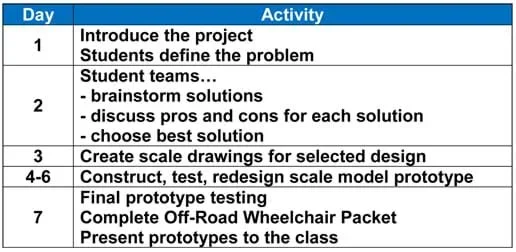 Suggested seven-day project schedule for the activity.Copyright 2011 Jared Quinn, WPI
Before the Activity
- Gather and prepare supplies for the student groups.
- Make copies of the Off-Road Wheelchair Packet (PDF).
- Prepare three simulated off-road surfaces for prototype testing. See the Materials Lists for materials to line or fill the bases of three cardboard box covers.
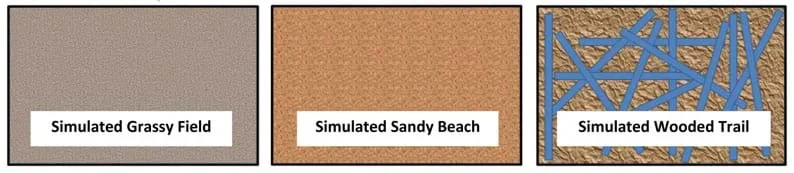 Test student prototypes on three types of surfaces to represent a grassy field (plush carpeting), sandy beach (sand and fish tank gravel), and wooded trail (straw and cardboard scraps).Copyright 2011 Jared Quinn, WPI
With the Students
- As a class, discuss the idea of a physical disability and assistive devices.
- Have students describe in detail their favorite physical activities.
- Ask: How would you feel if you could no longer physically do those activities?
- Ask: What if technology could help you to continue to do your favorite activities?
- Introduce students to the off-road wheelchair challenge project.
- Describe a fictitious 18-year-old competitive mountain biker who was injured and is now confined to a wheelchair. This athlete is the end-user (client) for the design project.
- Hand out the packets to students.
- Read aloud the project introduction and client statement from the packet.
- Divide the class into groups of three students each.
- Direct the groups to follow the steps of the engineering design process to design and build a scale model prototype of an off-road wheelchair for the client. Use the model client for measurements. Have them complete the packet as they go along, and use it as a guide for each step of the process.
- As students move through the process, have them conference with the teacher at the following points before moving ahead.
- Identify the need (problem statement, function, constraint, objective)
- Research
- Develop possible solutions (minimum of three)
- Select the best solution
- Blueprint and prototype
- Test and evaluate
- Communicate solutions
- Redesign (future recommendations)
- Have groups begin by completing the definitions for mechanical engineering, bioengineering and biomedical engineering on page 1 of the packet. If they are unsure of any definition, have them use the internet to research that field.
- Identify the need: Have students write problem statements, considering information provided in the introduction and the client statement in the packet. Have them write paragraphs for each of the following:
- How the wheelchair functions (what it does)
- The objectives for the wheelchair (what it is)
- The constraints (include materials, timeframe, etc.)
- Research: Have students use the internet to research past and present wheelchair designs, off-road bikes and mountain bikes, as well as why people need wheelchairs. Have them keep records of all relevant information found, as well as website sources.
- Develop possible solutions: Require each group to develop at least three possible designs for their off-road wheelchairs, documenting them in the packet. Suggest group brainstorming to come up with designs together and/or have students individually draw their own ideas to share with the group.
- Select the best solution: Together as a group, discuss the pros and cons of each design and decide which of the possible designs (or a combination of more than one design) is the most promising design solution to meet the objectives and constraints. Remind students to be prepared to explain to the teacher the reasons for their decisions.
- Blueprint and prototype: Have students complete final design drawings that include labeled dimensions and materials. Make the drawings clear enough that another person could readily learn what is needed and how to create the prototypes. Once the final design is complete, use the provided materials to construct the prototype.
- Test and evaluate: Once student groups have finished building their wheelchair prototypes, have them test them on the three simulated off-road surfaces. Do this by attaching a spring scale to the prototype wheelchair and pulling it across the length of the surface. Direct students to notice on the spring scale how much force is being applied to pull the wheelchair and record the maximum force. Complete three trials on each surface and record data in the table in the packet. Also describe each trial in words below the table, as well an evaluation that explains whether the design was effective, and provide reasons.
- Communicate Solutions: When groups are ready, have students present their prototypes to the class. Include in the presentation descriptions of how they developed the designs, how the tests went, and prototype evaluations. Have the rest of the class ask questions and offer comments.
- Redesign (future recommendations): Have students finish their packets by writing recommendations on ideas for further research, and what they would improve in a redesign.
- Have students turn in their completed packets for grading.
- As time permits, lead a class discussion to compare results and conclusions.
- assistive device
- A device designed and constructed to assist people in carrying out tasks. Also called assistive technology devices.
- bioengineering
- A field of engineering that solves problems related to life sciences by the application of physics, chemistry and mathematics concepts, as well as the engineering design process.
- biomedical engineering
- A field of engineering that collaborates with doctors, surgeons and other medical professionals to produce technology to promote the lives of patients.
- engineering design process
- The iterative process through which engineers develop solutions to meet an objective. The steps of the process include: identifying a problem, brainstorming, designing, constructing, testing, analysis and evaluation, redesigning, retesting, and sharing a solution. Science, mathematics and engineering science concepts are applied throughout the process to optimize the solution.
- mechanical engineering
- A field of engineering based on designing and constructing mechanical systems through the application of physics, mathematics and material science concepts, as well as the engineering design process.
Pre-Activity Assessment
Class Discussion: Informally evaluate students' prior knowledge about engineering and the engineering design process, assistive technologies and disabilities.
Activity Embedded Assessment
As We Work: During the course of the activity, students work on the Off-Road Wheelchair Packet (PDF), which serves as formative assessment of their abilities to follow the engineering design process while creating and testing off-road wheelchair prototypes.
Design Drawing and Prototype: Examine students' drawings and prototypes to gauge their abilities to demonstrate methods of representing solutions to design problems.
Post-Activity Assessment
Final Documentation: Evaluate students' completed Off-Road Wheelchair Packets (PDF) as summative assessment of their abilities to accurately use the engineering design process to create and test wheelchair design prototypes. Evaluate their vocabulary word definitions and answers to other questions to gauge their comprehension of the process and project components. Example answers:
- Problem Statement: An 18-year old competitive mountain biker is injured and now confined to a wheelchair. To remain active and enjoy traveling across terrain that is inaccessible by a conventional wheelchair, this athlete needs an all-terrain wheelchair to improve his/her quality of life. We will approach solving this problem by creating a small-scale prototype for the all-terrain wheelchair.
- Function: The all-terrain wheelchair should allow the client to access and travel across terrain that is inaccessible by a conventional wheelchair.
- Objective: The all-terrain wheelchair prototype should be able to roll across the three simulated surfaces: a grassy field, a sandy beach, and a wooded trail. We also aim for our prototype to use minimal force to roll across these surfaces.
- Constraints: Construct the all-terrain wheelchair prototype with the provided materials and within the seven class periods provided.
Final Prototype: Examine students' completed drawings and wheelchair design prototypes to gauge their abilities to demonstrate methods of representing solutions to design problems.
Graphing the Results: Using the data from the test results, graph the amount of force applied for the three types of surfaces. Students can find the average of the force amongst the three trials and use that as the maximum force applied for each surface. Discuss final results and determine which surface resulted in the highest force.
Show students a movie or film that shows people overcoming disabilities through the help of engineered technology. Suggestions: Kiss My Wheels by Miguel Grunstein and Dale Kruzic (56 minutes), Not on the Sidelines: Living and Playing with a Disability by Ben Achtenberg and Karen McMillan (Fanlight Production, http://www.fanlght.com; 26 minutes).
Watch Dean Kamen's Prosthetic "Luke Arm" Be Awesome at the Grocery Store (Gizmodo; 1:25 minutes): http://gizmodo.com/5670842/watch-dean-kamens-prosthetic-luke-arm-be-awesome-at-the-grocery-store
Dean Kamen: The Emotion behind Invention (TED talk; 19:33 minutes): http://www.ted.com/talks/dean_kamen_the_emotion_behind_invention.html
Wheel chair back-flip (YouTube; 3:36 minutes): http://www.youtube.com/watch?v=7NJvgT60-mk
Off- road chair for yard work, hunting and fishing (YouTube; 8:23 minute): http://www.youtube.com/watch?v=sPSf517GVd0
Katie bot III, extreme mobility wheelchair (YouTube; 1:58 minutes): http://www.youtube.com/watch?v=yr8d9QAc5RQ
Four-wheel drive wheelchair on different surfaces (YouTube; 3:05 minutes): http://www.youtube.com/watch?v=wThIIpmvCPg
Track drive wheelchair goes to the beach (YouTube; 4:05 minutes): http://www.youtube.com/watch?v=7I0ThOC3VAA
Adee, Sarah. "Dean Kamen's 'Luke Arm' Prosthesis Readies for Clinical Trials." IEEE Spectrum. February 2008. Accessed November 28, 2012. http://spectrum.ieee.org/biomedical/bionics/dean-kamens-luke-arm-prosthesis-readies-for-clinical-trials
Assistive Device (definition). 1998. MedicineNet.com, MedicineNet, Inc. Accessed July 19, 2010. http://www.medterms.com/script/main/art.asp?articlekey=2372
Bellis, Mary. Inventors: History of the Wheelchair: The first dedicated wheelchair was made for Phillip II of Spain. About.com, New York Times Company. Accessed November 28, 2012. http://inventors.about.com/od/wstartinventions/a/wheelchair.htm
Kaye, H. Stephen, Kang, Taewoon, and LaPlante, Mitchell. Wheelchair Use in the United States, Disability Statistics Center, Abstract 23. May 2002. University of California-San Francisco. Accessed November 28, 2012. http://dsc.ucsf.edu/publication.php
Magar, Prashant. History of Assistive Technology. Buzzle.com. Accessed July 21, 2010. http://www.buzzle.com/articles/history-of-assistive-technology.html
Reinhart, Kevin A. The History of Assistive Technology. 2010. eHow-Health, Demand Media Inc. Accessed March 29, 2011. http://www.ehow.com/about_6802248_history-assistive-technology.html
What Is Assistive Technology? The National Center on Accessible Information Technology in Education. University of Washington. Accessed July 22, 2010. http://www.washington.edu/accessit/articles?109
Whirlwind Wheelchair (description and photos). 2012. Whirlwind International. Accessed November 28, 2012. http://www.whirlwindwheelchair.org/roughrider/
Contributors
Jared R. Quinn; Kristen Billiar; Terri Camesano
Supporting Program
Inquiry-Based Bioengineering Research and Design Experiences for Middle-School Teachers RET Program, Department of Biomedical Engineering, Worcester Polytechnic Institute
Acknowledgements
Developed by the Inquiry-Based Bioengineering Research and Design Experiences for Middle-School Teachers RET Program under National Science Foundation Research Experiences for Teachers grant no. EEC 0743037, and collaboration with Overlook Middle School, Ashburnham-Westminster Regional School District, Ashburnham, MA. However, these contents do not necessarily represent the policies of the National Science Foundation, and you should not assume endorsement by the federal government.
Copyright
2013 by Regents of the University of Colorado; original © 2011 Worcester Polytechnic Institute