
Future Hospitals: Robotics and Automated Patient Care Engineering
Legacy Curriculum
Hey there! This curriculum is no longer being curated or supported. It may contain materials that are no longer available or outdated information. Please use this document for reference.
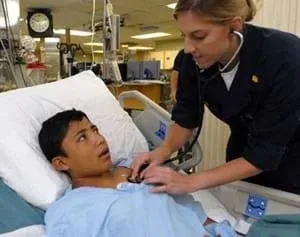 Copyright 2007 Kelly E. Barnes, U.S. Navy, Wikimedia Commons http://commons.wikimedia.org/wiki/File:US_Navy_070731-N-4238B-007_Lt._Megan_Zeller,_an_intensive_care_unit_nurse,_checks_the_vital_signs_of_patient,_while_he_recovers_after_surgery_aboard_the_hospital_ship_USNS_Comfort_(T-AH_20).jpg
Students further their understanding of the engineering design process while combining mechanical engineering and bioengineering to create an automated medical device. During the activity, students are given a fictional client statement and are required to follow the steps of the design process to create medical devices that help reduce the workload for hospital workers and increase the quality of patient care.
The engineering design process (EDP) is a widely accepted way of arriving at an optimized solution to an identified problem. This activity guides students through the EDP as they apply basic engineering concepts to design automated medical devices. Medical devices are health care products used to diagnose, care for, treat or prevent medical conditions. Examples of medical devices include pacemakers, heart monitors, dialysis machines and physical therapy devices. This project's real-world problem is to design an automated medical device for the hospital of the future. By combining mechanical engineering and bioengineering, students design and construct classroom prototypes of their medical devices.
After this activity, students should be able to:
- Utilize the engineering design process to develop a solution to a given problem.
- Explain the reasons for their selected design.
- Summarize the problem, solution and future recommendations in an oral presentation.
- Students will develop an understanding of the attributes of design.
Grades K-12
Do you agree with this alignment? - Students will develop an understanding of engineering design.
Grades K-12
Do you agree with this alignment? - Students will develop abilities to apply the design process.
Grades K-12
Do you agree with this alignment? - There is no perfect design.
Grades 6-8
Do you agree with this alignment? - Requirements for design are made up of criteria and constraints.
Grades 6-8
Do you agree with this alignment? - Design involves a set of steps, which can be performed in different sequences and repeated as needed.
Grades 6-8
Do you agree with this alignment? - Brainstorming is a group problem-solving design process in which each person in the group presents his or her ideas in an open forum.
Grades 6-8
Do you agree with this alignment? - Modeling, testing, evaluating, and modifying are used to transform ideas into practical solutions.
Grades 6-8
Do you agree with this alignment? - STEL-1J Develop innovative products and systems that solve problems and extend capabilities based on individual or collective needs and wants.
Grades 6-8
Do you agree with this alignment? - STEL-7J Evaluate designs based on criteria, constraints, and standards.
Grades 3-5
Do you agree with this alignment? - STEL-7S Create solutions to problems by identifying and applying human factors in design.
Grades 6-8
Do you agree with this alignment?
- 6.MS-ETS1-1 Define the criteria and constraints of a design problem with sufficient precision to ensure a successful solution. Include potential impacts on people and the natural environment that may limit possible solutions.
Grade 6
Do you agree with this alignment? - 6.MS-ETS1-5(MA) Create visual representations of solutions to a design problem. Accurately interpret and apply scale and proportion to visual representations.
Grade 6
Do you agree with this alignment? - 6.MS-ETS1-6(MA) Communicate a design solution to an intended user, including design features and limitations of the solution.
Grade 6
Do you agree with this alignment? - 7.MS-ETS1-4 Generate and analyze data from iterative testing and modification of a proposed object, tool, or process to optimize the object, tool, or process for its intended purpose.
Grade 7
Do you agree with this alignment? - 7.MS-ETS1-7(MA) Construct a prototype of a solution to a given design problem.
Grade 7
Do you agree with this alignment? - Identify and explain the steps of the engineering design process, i.e., identify the need or problem, research the problem, develop possible solutions, select the best possible solution(s), construct a prototype, test and evaluate, communicate the solution(s), and redesign.
Grades 6-8
Do you agree with this alignment? - Demonstrate methods of representing solutions to a design problem, e.g., sketches, orthographic projections, multiview drawings.
Grades 6-8
Do you agree with this alignment? - Explain examples of adaptive or assistive devices, e.g., prosthetic devices, wheelchairs, eyeglasses, grab bars, hearing aids, lifts, braces.
Grades 6-8
Do you agree with this alignment?
- MS-ETS1-1 Define the criteria and constraints of a design problem with sufficient precision to ensure a successful solution, taking into account relevant scientific principles and potential impacts on people and the natural environment that may limit possible solutions.
Grades 6-8
This resource focuses on the following Three Dimensional Learning aspects of NGSS:
Science & Engineering Practices- Define a design problem that can be solved through the development of an object, tool, process or system and includes multiple criteria and constraints, including scientific knowledge that may limit possible solutions.Do you agree with this alignment?
Disciplinary Core Ideas- The more precisely a design task's criteria and constraints can be defined, the more likely it is that the designed solution will be successful. Specification of constraints includes consideration of scientific principles and other relevant knowledge that is likely to limit possible solutions.Do you agree with this alignment?
Crosscutting Concepts- The uses of technologies and any limitations on their use are driven by individual or societal needs, desires, and values; by the findings of scientific research; and by differences in such factors as climate, natural resources, and economic conditions.Do you agree with this alignment?
- All human activity draws on natural resources and has both short and long-term consequences, positive as well as negative, for the health of people and the natural environment.Do you agree with this alignment?
Do you agree with this alignment? - Define a design problem that can be solved through the development of an object, tool, process or system and includes multiple criteria and constraints, including scientific knowledge that may limit possible solutions.
- MS-ETS1-2 Evaluate competing design solutions using a systematic process to determine how well they meet the criteria and constraints of the problem.
Grades 6-8
This resource focuses on the following Three Dimensional Learning aspects of NGSS:
Science & Engineering Practices- Evaluate competing design solutions based on jointly developed and agreed-upon design criteria.Do you agree with this alignment?
Disciplinary Core Ideas- There are systematic processes for evaluating solutions with respect to how well they meet the criteria and constraints of a problem.Do you agree with this alignment?
Do you agree with this alignment? - Evaluate competing design solutions based on jointly developed and agreed-upon design criteria.
- MS-ETS1-4 Develop a model to generate data for iterative testing and modification of a proposed object, tool, or process such that an optimal design can be achieved.
Grades 6-8
This resource focuses on the following Three Dimensional Learning aspects of NGSS:
Science & Engineering Practices- Develop a model to generate data to test ideas about designed systems, including those representing inputs and outputs.Do you agree with this alignment?
Disciplinary Core Ideas- Models of all kinds are important for testing solutions.Do you agree with this alignment?
- The iterative process of testing the most promising solutions and modifying what is proposed on the basis of the test results leads to greater refinement and ultimately to an optimal solution.Do you agree with this alignment?
Do you agree with this alignment? - Develop a model to generate data to test ideas about designed systems, including those representing inputs and outputs.
Each group needs:
- EDP Pre-Activity Test (PDF) and EDP Post-Activity Test (PDF), one each per student
- Guided Research Packet (PDF), one per student
- Engineering Design Project Packet (PDF), one per student
- LEGO MINDSTORMS EV3 robot, such as EV3 Core Set at https://education.lego.com/en-us/products/lego-mindstorms-education-ev3-core-set/5003400#lego-mindstorms-education-ev3
- LEGO MINDSTORMS Education EV3 Software 1.2.1, free online, you have to register a LEGO account first; at https://www.lego.com/en-us/mindstorms/downloads/download-software
- WeDo Resource Set, available at https://education.lego.com/en-us/products/lego-education-wedo-2-0-core-set/45300#wedo-20
- computer, loaded with EV3 1.2.1 software, Bluetooth or USB port, and Internet access for research
- articulated human model (manikin), such as an 8-inch art drawing manikin at https://www.amazon.com/US-Art-Supply-Articulated-Mannequin/dp/B00LBDR1WU/ref=sr_1_3?keywords=8-inch+art+drawing+manikin&qid=1692158372&sr=8-3
- ruler
- graph paper and pencils
Note: This activity can also be conducted with the older (and no longer sold) LEGO MINDSTORMS NXT set instead of EV3; see below for those supplies:
- LEGO MINDSTORMS NXT robot, such as the NXT Base Set
- computer loaded with the NXT 2.1 software
To share with the entire class:
- extra LEGO parts (bricks, beams, bars, etc.), as available
- Hospital of the Future Guided Research Packet (docx)
- Hospital of the Future Guided Research Packet (pdf)
- Hospital of the Future Guided Research Packet Answer Key (docx)
- Hospital of the Future Guided Research Packet Answer Key (pdf)
- Engineering Design Project Packet (docx)
- Engineering Design Project Packet (pdf)
- Engineering Design Project Packet Answer Key- NXT version (docx)
- Engineering Design Project Packet Answer Key- NXT version (pdf)
- EDP Pre-Activity Test (docx)
- EDP Pre-Activity Test (pdf)
- EDP Post-Activity Test (docx)
- EDP Post-Activity Test (pdf)
- EDP Pre-/Post-Activity Test Answer Key (docx)
- EDP Pre-/Post-Activity Test Answer Key (pdf)
- Engineering Design Project Packet Answer Key- EV3 version (docx)
- Engineering Design Project Packet Answer Key- EV3 version (pdf)
Prior to the start of the activity, students should have been introduced to the steps of the engineering design process and recognize that the process works in a circular fashion, rather than a linear process with a beginning and an end. Students should be familiar with the creation of multi-view drawings.
Students should also have a working knowledge of programming with the LEGO MINDSTORMS robot kit. Students who are not familiar with programming LEGO can build prototypes without the robotic components or learn the program as they go. See https://education.lego.com/en-us/lessons/ev3-tutorials for good quality EV3 tutorial videos for students.
Client Statement for Students
Hello fellow engineers and welcome to the annual DaVinci Engineering team meeting. Due to recent events, the board of directors has decided to change the direction of our company. We are no longer in the business of food processing; instead, we will focus on developing automated medical devices. Together, we will create the hospital of the future!
The board of directors has identified two medical devices that, if automated, would help increase the quality of treatment for hospital patients. Many patients in today's hospitals are confined to hospital beds or wheelchairs. When patients spend extended amounts of time in one position, certain health conditions may develop, with deep vein thrombosis and pressure ulcers being the most common. Currently, prevention is the best treatment for these conditions. Unfortunately preventing these health issues from occurring is very time consuming and labor intensive for healthcare workers.
How can we help? If healthcare facilities had robotic wheelchairs and hospital beds that would automatically reposition the patients, healthcare workers would be able to dedicate more time to other pressing issues and the quality of healthcare would be improved. As a member of our elite engineering team, your challenge is to design and build the first-generation prototype for either an automated wheelchair or an automated hospital bed.
Background
Bioengineering is the systematic application of the engineering design process to the fields of medicine and biology. A bioengineer must have a solid understanding of biology as well as the ability to draw upon electrical, chemical, mechanical and other engineering disciplines. Bioengineers work in a wide range of areas, including medical instrument design, pharmaceutical delivery systems and medical procedure design and, as demonstrated in this activity, the design of medical devices.
A medical device is a device specifically designed to help diagnose, care for, treat or prevent a disease or a condition in a patient. These devices fall into one of three classifications: Class I is the least dangerous and Class III is the most dangerous.
Class I devices require the least amount of regulatory control, such as tongue depressors, arm slings and hand-held surgical instruments. Class II devices must comply with special control procedures. X-ray systems, gas analyzers and surgical drapes are examples of Class II medical devices. Class III medical devices have the highest level of regulatory controls. Replacement heart valves, pacemakers and breast implants are considered Class III devices.
The field of robotics has the potential to revolutionize the medical field. Currently, robots have been integrated into the medical world in limited areas. Robots are currently used for remote control surgery as well as drug delivery systems. This limited implementation is just the beginning of unlimited possibilities. Medical staff eagerly await further implementation because robots are very precise and do not tire, which has the potential to alleviate many of the monotonous and time consuming tasks that healthcare workers deal with daily.
Bedsores, also known as pressure sores or pressure ulcers, are caused when pressure is applied to localized regions of the skin for extended periods of time. Pressure ulcers often form on skin that cover bony regions of the body, such as elbows, ankles and hips. Pressure ulcers can be very problematic for people who have a medical condition that requires the extended use of a wheelchair or restricts the patient to a bed. Pressure ulcers can develop quickly and are often difficult to treat. Preventing the formation of pressure ulcers is difficult and requires a great deal of time and effort from healthcare workers to move the patient's body position every two hours. To do this, a patient needs to be physically moved in order to change their position on the bed or in the wheelchair.
Deep vein thrombosis (DVT) is another serious medical condition associated with a lack of movement. With this condition, blood pools in the patient's veins and begins to clot. The clots can break free and travel to the lungs where they can cause a pulmonary embolism. To prevent deep vein thrombosis, doctors often prescribe pharmaceutical treatments to thin the blood. Unfortunately blood thinners have unwanted side effects, such as excessive bleeding.
Both pressure ulcers and deep vein thrombosis are conditions that are preventable by limiting a patient's time in any one position. Unfortunately, this is a very laborious task for healthcare workers. In both hospitals and nursing homes, both of these conditions are far more common than desired. Robots have the potential to provide an ideal solution for both health issues. By developing a robotic medical device that can reposition the patient automatically every two hours, healthcare workers become available to address other concerns while the patient is receiving the regular movements necessary to avoid the formation of DVT and pressure ulcers.
Before the Activity
- Gather materials and make copies of the Hospital of the Future Guided Research Packet (PDF), Engineering Design Project Packet (PDF), EDP Pre-Activity Test (PDF) and EDP Post-Activity Test (PDF), one each per student.
- If desired, make a PowerPoint® template for students to use for their Day 10 design presentations.
Activity Schedule
Day 1: Administer pre-activity test, introduce the project and complete guided background research.
Day 2: Define the problem, further background research and develop possible solutions.
Day 3: Discuss possible solutions, complete pro/con list for each design, and select best possible solution.
Days 4-8: Create multi-view drawings of the selected design, construct classroom prototype.
Day 9: Evaluate designs, complete EDP packet and organize presentation.
Day 10: Student groups develop design presentations.
Day 11: Group presentation, class debriefing, administer post-activity test.
With the Students
Day 1
- Before beginning the activity, administer the pre-activity test.
- As a class, discuss medical devices and the ways in which robots could be used as medical devices.
- Define a medical device as: A device that is designed to help diagnose, care for, treat or prevent a disease or a condition in a patient.
- Define a robot as: An automated device capable of carrying out complex and/or repetitive tasks.
- Discuss different robotic devices that are used in hospitals today and provide the following examples: robotic disinfection systems for highly contagious germs, robotic avatars for specialists in distant locations and drug delivery robots.
- Students discuss some of the difficulties for people confined to beds and wheelchairs.
- As a class, discuss how robots could help people confined to beds and wheelchairs.
- Introduce students to the Hospital of the Future project.
- Introduce pressure ulcers and deep vein thrombosis to students.
- Instill a sense of importance to the project by emphasizing its real-world impact.
- Divide the class into groups of two students each.
- Direct students to use the internet to complete the Hospital of the Future Guided Research Packet (PDF).
Day 2
- Students start to work on the design project by defining the problem. The EDP packet guides them to define the problem based on the provided client statement. They they identify the functions, objectives and constraints of a successful solution.
- Read to the class the project introduction and client statement from the EDP packet.
- Add any additional limitations or requirements for the design teams to address that are beyond those included in the client statement.
- Each group chooses either a wheelchair or a hospital bed as its project.
- Groups conduct additional research into the selected condition and medical device.
Day 3
- Student groups brainstorm a minimum of three possible solutions to the problem. They sketch their ideas in the Design Solutions table in the packet. Require the sketches to be detailed enough to get their ideas across to their partners.
- Student groups select the best solution.
- Group members share their ideas with each other.
- The group identifies which functions, objectives and constraints each design solution meets. Record this information in the Design Solutions table. The team identifies the best solution—the one that meets the functions, objectives and constraints most effectively.
Days 4-8
- Students create multi-view drawings for their group's selected design. Multi-view drawings are drawn on graph paper using a ruler and a consistent scale. Require each set of drawings to include at least three different views.
- Following the creation of the multi-view drawings, teams construct their prototypes from the provided EV3 kits. Students may use extra LEGO pieces if available.
Day 9
- Each group develops four survey questions that are used to evaluate the hospital bed or wheelchair design. Evaluate each team's design by no fewer than five students. Use the data collected to determine the success of the design.
- Students evaluate the success of their designs based on the test results. Record the evaluation in the EDP packet and shared it in the design presentations at project end.
- In the Future Recommendations portion of the EDP packet, students explain any potential changes to their designs that would help improve the success of the prototypes. Require a detailed sketch of the improved design.
Day 10
- Students turn in the completed packet, along with the unselected design solution, which serve as an instructor assessment tool.
- Give teams time to prepare design presentations about their design projects. Require them to discuss the design solutions, any challenges encountered, constraints, future improvement ideas, etc. If desired, provide a PowerPoint template for students to use. The presentation serves as one post-activity assessment tool for the design projects.
Day 11
- Students present their design, test results, evaluation of the results and future recommendations to the class during a brief design presentation.
- Administer the post-activity test.
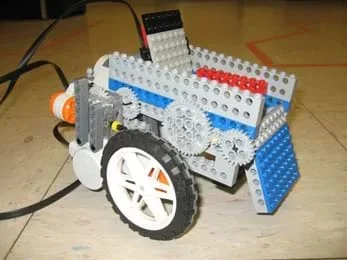 Figure 1. A student-made robotic wheelchair designed to prevent DVT in hospital patients.Copyright 2015 Jared R. Quinn, Worcester Polytechnic Institute
- bioengineering
- The application of engineering skills to solve problems in the life science fields.
- biomedical engineering
- The application of engineering skills to solve problems in the medical field.
- constraints
- The aspects of the design that must be met to be determined successful.
- engineering design process
- An iterative decision making process to optimize resources in meeting stated objectives. The major elements of the engineering design process are; identify the problem, research the problem, develop possible solutions, select the best solution, create a prototype, test and evaluate, communicate the solution, and redesign.
- functions
- What the design/product will do regardless of the chosen solution.
- mechanical engineering
- The application of engineering, physics and material science to the design of a mechanical system.
- medical device
- A device designed to help diagnose, care for, treat or prevent a disease or a condition in a patient.
- objectives
- What the design/product will "be" regardless of the chosen solution.
- problem statement
- A detailed description of the needs that will be met.
- prototype
- A first attempt or early model of a new product or creation. May be revised many times.
- robot
- An automated device capable of carrying out complex and/or repetitive tasks.
Pre-Activity Assessment
Quick Test: Before beginning the activity, administer the seven-question EDP Pre-Activity Test (PDF) to evaluate students' base understanding of the engineering design process.
Activity Embedded Assessment
EDP Packet: Completion of the Hospital of the Future EDP Packet (PDF) serves as a formative assessment for each student's ability to follow the engineering design process while creating a prototype medical device.
Drawings/Prototypes: Students create multi-view drawings and prototypes of their wheelchair or hospital bed designs. Review their drawings and prototypes to assess their ability to demonstrate methods of representing solutions to a design problem.
Post-Activity Assessment
Student Design Presentations: Following the completion of the EDP packet, each team is responsible for sharing its project with the class. Limit presentations to 3-5 minutes and require them to focus on the students' work within the design process. Also make sure students include their own evaluations of the test results and at least one future recommendation to improve their medical device designs. Assess students on their ability to follow the steps of design process and clearly communicate their design logic and concepts.
Quick Re-Test: Administer the EDP Post-Activity Test (PDF), which is the same as the pre-test, to evaluate students' growth in their understanding of the engineering design process.
To prepare the EV3 robot for the activity, follow the Five Minute Bot Building Instructions online tutorial, which provides excellent guidance through the building process due to its many images: https://www.youtube.com/watch?v=Dhe2jXi3Fc4.
If you prepare and purchase an Arduino kit in order to ready the robot, make use of a great tutorial guide at https://makezine.com/projects/build-your-own-arduino-controlled-robot/. Additionally, Maker Shed sells all the parts listed throughout the steps (although finding some on alternative sites such as Amazon or www.Sparkfun.com may be less expensive). For example, the 4WD platform they use is listed at https://www.makershed.com/collections/arduino. Maker Shed sells the other integrated circuits needed, and the Arduino Uno can be purchased directly from the company at https://store-usa.arduino.cc/products/arduino-uno-rev3/?selectedStore=us or from SparkFun Electronics at https://www.sparkfun.com/.
Bioengineering. Encyclopedia Britanica Online Academic Edition. Accessed July 1, 2014. http://www.britannica.com/EBchecked/topic/65846/bioengineering
Diseases and Conditions: Bedsores. Mayo Foundation for Medical Education and Research. Accessed July 2, 2014. http://www.mayoclinic.org/diseases-conditions/bedsores/basics/definition/con-20030848
FDA Device Classification. 2008-04. LEEDer Group, Inc. Accessed July 1, 2014. http://leedergroup.com/bulletins/fda-device-classification
Mechanical Engineering. 2014. Merriam-Webster Inc. Accessed July 1, 2014. http://www.merriam-webster.com/dictionary/mechanical%20engineering
Medical Device. McGraw-Hill Concise Dictionary of Modern Medicine, The Free Dictionary. Accessed June 1, 2014. http://medical-dictionary.thefreedictionary.com/medical+device
Your Guide to Preventing and Treating Blood Clots. Agency for Healthcare Research and Quality. Accessed July 2, 2014. http://www.ahrq.gov/patients-consumers/prevention/disease/bloodclots.html
Contributors
Jared R. Quinn; Kristen Billiar; Terri Camesano; Jeanne Hubelbank
Supporting Program
Inquiry-Based Bioengineering Research and Design Experiences for Middle-School Teachers RET Program, Department of Biomedical Engineering, Worcester Polytechnic Institute
Acknowledgements
This activity was developed under National Science Foundation RET grant no. EEC 1132628. However, these contents do not necessarily represent the policies of the National Science Foundation, and you should not assume endorsement by the federal government.
Copyright
2015 by Regents of the University of Colorado; original © 2014 Worcester Polytechnic Institute