
Build and Play the Electrical Circuit Wire Maze
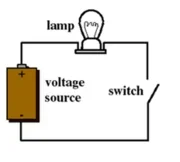 Students explore electrical circuitsCopyright Wikimedia Commons http://upload.wikimedia.org/wikipedia/commons/1/19/Simple_electric_circuit.png
Students gain a basic understanding of electrical circuits. They build wire circuits and pass paperclips through the mazes, trying not to touch the wires. Touching a wire with a paperclip causes the circuit to close, which activates an indicator.
We use circuits every day in household appliances from computers and radios to ovens and refrigerators. One of the most important circuits we use each day is that of a light bulb. Understanding electrical circuits is the basis of electrical engineering.
To understand how electrical circuits work
- There is no perfect design.
Grades 6-8
Do you agree with this alignment? - STEL-3F Apply a product, system, or process developed for one setting to another setting.
Grades 6-8
Do you agree with this alignment?
- Given a design task, identify appropriate materials (e.g., wood, paper, plastic, aggregates, ceramics, metals, solvents, adhesives) based on specific properties and characteristics (e.g., strength, hardness, and flexibility).
Grades 6-8
Do you agree with this alignment?
- 5 m stripped wire
- 1 pair wire cutters
- 1 battery
- 1 noise maker or light
- 1 metal paper clip
Electrical engineers work with anything that carries electricity. Computers are primarily designed by electrical engineers. In this activity, we will explore the concept of closed circuits. We will use the materials given to design a maze. The object is to not touch the wire with the paper clip as you pass it over the maze. When you touch the maze with the paperclip a sound (or light) signals that the circuit has been closed.
- Assemble the wire in the desired shape leaving a strand of wire on each end of the maze.
- Take one end of the wire from the maze and connect it to the battery.
- Take the other end and thread the paperclip onto the wire and then connect with wire to the noise maker or light.
- Connect the battery to the noise maker or light.
- Move the paper clip around the wire, trying not to touch the wire.
Investigating Questions Homework: Ask students the Investigating Questions and ask them to write up possible options/solutions as homework.
Supporting Program
K-12 Outreach Office, Worcester Polytechnic Institute
Copyright
2013 by Regents of the University of Colorado; original © 2005 Worcester Polytechnic Institute