
Ohm's Law 2
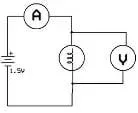 Students continue their investigation of Ohm's law.
In this extension to the Ohm's Law I activity, students observe just how much time it takes to use up the "juice" in a battery, and if it is better to use batteries in series or parallel. This extension is suitable as a teacher demonstration and may be started before students begin work on the Ohm's Law I activity.
Ohm's law is the basis of all electrical systems. Electrical engineers use this equation to guide the design of electrical systems. Students need a strong foundation in Ohm's law while designing circuits on their own.
Application of the following:
- Ohm's law
- series/parallel circuits (ways to connect them and have an effect on V and I)
- circuit components
- power
- devices that can be used to measure voltage and current
- Energy cannot be created nor destroyed; however, it can be converted from one form to another.
Grades 9-12
Do you agree with this alignment?
- Explain how to measure and calculate voltage, current, resistance, and power consumption in a series circuit and in a parallel circuit. Identify the instruments used to measure voltage, current, power consumption, and resistance.
Grades 9-12
Do you agree with this alignment? - Identify and explain the components of a circuit, including sources, conductors, circuit breakers, fuses, controllers, and loads. Examples of some controllers are switches, relays, diodes, and variable resistors.
Grades 9-12
Do you agree with this alignment? - Explain the relationships among voltage, current, and resistance in a simple circuit, using Ohm's law.
Grades 9-12
Do you agree with this alignment?
We suggest the following materials be bought in bulk and used yearly:
- 4 AAA general purpose (C-Zn) batteries
- 2.47 V, 300 mA light bulbs
- 10-12 alligator clips and wires
- stopwatch
Recommended:
- 4 single battery holders
- 2 double battery holders
- 6 lamp holders
Question:
We have three light bulbs arranged in a parallel circuit. If the batteries used to power them are also arranged in parallel, will they last longer than batteries arranged in a series?
Explanation:
A battery company wants to know how long its batteries will last for consumers. Voltage is very easy to measure, however finding the current is much harder. So, let's set up an experiment to time the battery life according to series and parallel circuits.
The batteries in a series give off a brighter light; however they last about half the time of batteries in parallel.
Batteries set up in a parallel circuit give a less intense light, but last twice the length of batteries in series.
- Build a circuit with 3 bulbs wired in parallel to 2 batteries wired in parallel as shown in Figure 1.
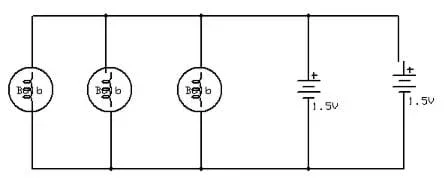 Figure 1
 - Build a circuit with 3 bulbs wired in parallel to 2 batteries wired in series as shown in Figure 2.
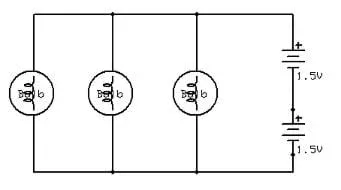 Figure 2
 - Have students guess how long each circuit will last.
- Measure the total current flowing through each circuit.
- Time how long it takes for the bulbs to stop giving off light.
Results in Testing
- Time for series: ~20 minutes
- Time for parallel: ~ 40 minutes
Homework or Quiz: Assign students to answer the seven questions in the Questions for Students Handout (PDF). Review their answers to gauge their depth of comprehension.
Conduct Ohm's Law 1, an activity in which students work to increase the intensity of a light bulb by testing batteries in series and parallel circuits.
Contributors
Ozan Baskan
Supporting Program
K-12 Outreach Office, Worcester Polytechnic Institute
Acknowledgements
Creation of this activity was funded by Pratt & Whitney.
Copyright
2013 by Regents of the University of Colorado; original © 2005 Worcester Polytechnic Institute