
Wristwatch Design for the Visually Impaired
Students further their understanding of the engineering design process while combining mechanical engineering and bio-engineering to create assistive devices. During this extended activity (seven class periods), students are given a fictional client statement and required to follow the steps of the engineering design process (EDP) to design a new wristwatch face for a visually impaired student at their school. Student groups share their designs with the class through design presentations. A successful design meets all of the student-generated design requirements, including the development of a new method of representing time that does not require the sense of sight. Through this activity, students design, construct, and iterate classroom prototypes of their watch designs.
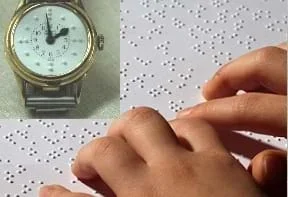 Engineers create new technologies to help those with disabilities, such as people who are visually impaired.Copyright 2010 Washington State Department of Services for the Blind (braille tablet/hands) http://www.dsb.wa.gov/ and 2006 F16, Wikimedia Commons (braille watch) http://commons.wikimedia.org/wiki/File:Watch_for_the_blind2.jpg
The engineering design process (EDP) is a widely accepted way of arriving at an optimized solution to an identified problem. This activity guides students through the EDP as they apply basic engineering concepts to create an assistive device—or, a device that is created or adapted to assist a person to complete a life activity. This project has the real-world design challenge of designing a wristwatch for a person with severe visual impairment. Mechanical engineers, who focus on the application of mechanics and the production of tools, machinery and their products, and bio-engineers, who apply engineering knowledge to the fields of medicine and biology, are often involved early on in the creation of new technologies to assist people with disabilities. Their understanding of the engineering design process is a crucial component to successfully solving the challenges that help people in our communities.
After this activity, students should be able to:
- Utilize the engineering design process to develop a solution to a given problem.
- Explain the reasons for their selected designs and material choices.
- Make future recommendations based on the results of their prototype testing.
- Summarize the problem, solution and future recommendations in an oral presentation.
- Requirements for design are made up of criteria and constraints.
Grades 6-8
Do you agree with this alignment? - Design involves a set of steps, which can be performed in different sequences and repeated as needed.
Grades 6-8
Do you agree with this alignment? - Brainstorming is a group problem-solving design process in which each person in the group presents his or her ideas in an open forum.
Grades 6-8
Do you agree with this alignment? - STEL-1J Develop innovative products and systems that solve problems and extend capabilities based on individual or collective needs and wants.
Grades 6-8
Do you agree with this alignment? - STEL-4Q Critue whether existing and proposed technologies use resources sustainably.
Grades 9-12
Do you agree with this alignment? - STEL-7Q Apply the technology and engineering design process.
Grades 6-8
Do you agree with this alignment? - STEL-7S Create solutions to problems by identifying and applying human factors in design.
Grades 6-8
Do you agree with this alignment? - STEL-7X Document trade-offs in the technology and engineering design process to produce the optimal design.
Grades 9-12
Do you agree with this alignment?
- Identify and explain the steps of the engineering design process, i.e., identify the need or problem, research the problem, develop possible solutions, select the best possible solution(s), construct a prototype, test and evaluate, communicate the solution(s), and redesign.
Grades 6-8
Do you agree with this alignment? - Demonstrate methods of representing solutions to a design problem, e.g., sketches, orthographic projections, multiview drawings.
Grades 6-8
Do you agree with this alignment? - Explain examples of adaptive or assistive devices, e.g., prosthetic devices, wheelchairs, eyeglasses, grab bars, hearing aids, lifts, braces.
Grades 6-8
Do you agree with this alignment?
- MS-ETS1-1 Define the criteria and constraints of a design problem with sufficient precision to ensure a successful solution, taking into account relevant scientific principles and potential impacts on people and the natural environment that may limit possible solutions.
Grades 6-8
This resource focuses on the following Three Dimensional Learning aspects of NGSS:
Science & Engineering Practices- Define a design problem that can be solved through the development of an object, tool, process or system and includes multiple criteria and constraints, including scientific knowledge that may limit possible solutions.Do you agree with this alignment?
Disciplinary Core Ideas- The more precisely a design task's criteria and constraints can be defined, the more likely it is that the designed solution will be successful. Specification of constraints includes consideration of scientific principles and other relevant knowledge that is likely to limit possible solutions.Do you agree with this alignment?
Crosscutting Concepts- The uses of technologies and any limitations on their use are driven by individual or societal needs, desires, and values; by the findings of scientific research; and by differences in such factors as climate, natural resources, and economic conditions.Do you agree with this alignment?
- All human activity draws on natural resources and has both short and long-term consequences, positive as well as negative, for the health of people and the natural environment.Do you agree with this alignment?
Do you agree with this alignment? - Define a design problem that can be solved through the development of an object, tool, process or system and includes multiple criteria and constraints, including scientific knowledge that may limit possible solutions.
- MS-ETS1-2 Evaluate competing design solutions using a systematic process to determine how well they meet the criteria and constraints of the problem.
Grades 6-8
This resource focuses on the following Three Dimensional Learning aspects of NGSS:
Science & Engineering Practices- Evaluate competing design solutions based on jointly developed and agreed-upon design criteria.Do you agree with this alignment?
Disciplinary Core Ideas- There are systematic processes for evaluating solutions with respect to how well they meet the criteria and constraints of a problem.Do you agree with this alignment?
Do you agree with this alignment? - Evaluate competing design solutions based on jointly developed and agreed-upon design criteria.
Each group needs:
- Guided Research (PDF), one per student
- Engineering Design Project Packet (DOCX), one per student
- Wristwatch Project Description (PDF), one per student
- Engineering Design Pre-Test (PDF), one per student
- Engineering Design Post-Test (PDF), one per student
- scissors
- ruler, one per student
- pencil, one per student
To share with the entire class:
- colored pencils or markers
- graph paper
- drawing paper (enough for the prototype and the final project)
- masking tape (enough for the prototype and the final project)
- clear tape (enough for the prototype and the final project)
- hot glue gun(s) and glue (enough for the prototype and the final project)
- assorted cardboard, foam-core board, matting board and cardstock (enough for the prototype and the final project)
- assorted lengths of string, ribbon, etc. (enough for the prototype and the final project)
- box cutters
- tin snips or heavy-duty scissors
- Engineering Design Process Pre-Test (docx)
- Engineering Design Process Pre-Test (pdf)
- Engineering Design Process Pre-Test – Answer Key (docx)
- Engineering Design Process Pre-Test – Answer Key (pdf)
- Engineering Design Process Post-Test (docx)
- Engineering Design Process Post-Test (pdf)
- Engineering Design Process Post-Test – Answer Key (docx)
- Engineering Design Process Post-Test – Answer Key (pdf)
- Guided Research (docx)
- Guided Research (pdf)
- Guided Research – Answer Key (docx)
- Guided Research – Answer Key (pdf)
- Engineering Design Process Packet (docx)
- Engineering Design Process Packet (pdf)
- Engineering Design Process Packet – Answer Key (docx)
- Engineering Design Process Packet – Answer Key (pdf)
- Wristwatch Project Description (docx)
- Wristwatch Project Description (pdf)
Students should be familiar with the engineering design process and recognize that the process works in a circular, iterative fashion, rather than a strict linear process.
(Introduce the following client statement to students)
Time Incorporated, a leading watch manufacturing company in New England whose target audience is the young adult consumer (11-19-years old), has hired you, the engineers of Rising Star Academy. A recent development in the school of the owner's children has given her the idea to develop a new wristwatch: a watch designed to help people with severe visual impairment.
Your engineering challenge is to develop a new wristwatch that fits the average 11-19-year old person, looks good, and is easy to understand. The number one goal of this product is to help young adults with visual impairment feel more independent.
Background
Bio-engineering is the application of the engineering design process to the fields of medicine and biology. Bio-engineers must have a solid understanding of biology, as well as the ability to draw upon electrical, chemical, mechanical and other engineering disciplines to create well-rounded solutions to challenges. They may work in a wide range of areas, including medical instrument design, pharmaceutical delivery systems, medical procedure design, and as demonstrated in this activity, the design of assistive devices.
Assistive devices such as wheelchairs, crutches and canes are known as ambulatory devices. These devices are designed to help physically disabled persons move around independently or with little assistance. Devices such as hearing aids, glasses, large utensil handles and computer hardware and software are known as ADL (activities of daily living) devices. Regardless of the classification of the assistive device, they are designed to help increase accessibility of the world around us for people with physical or cognitive disabilities. By improving access, these assistive devices help people with physical and cognitive disabilities to be more independent.
Activity Schedule
Day 1: Pre-test and guided background research.
Day 2: Introduce the project, define the problem, background research and develop possible solutions.
Day 3: Discuss possible solutions, complete pro/con list for each design and select best possible solution.
Day 4-5: Create formal designs and construct classroom prototype.
Day 6: Evaluate designs, complete EDP packet, and organize presentation.
Day 7: Student design presentations and post-test.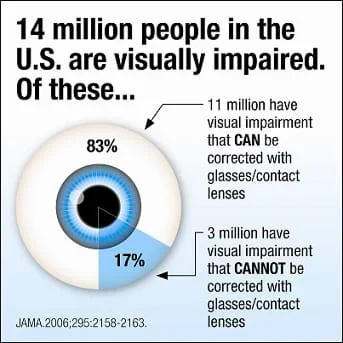 In the U.S., 14 million people are affected by visual impairment. 83% of them can improve their vision with glasses; 17% of them cannot.Copyright National Eye Institute, NIH http://www.nei.nih.gov/CanWeSee/images/NEI_Chart_300dpi.JPG
Before the Activity
- Make copies of the Engineering Design Pre-Test (PDF), Engineering Design Post-Test (PDF), Guided Research (PDF) and the Wristwatch for the Visually Impaired Engineering Design Process Packet (PDF), one per student.
- Make copies of the Wristwatch Project Description (PDF), one per group.
- Gather the necessary materials for the activity.
With the Students
- Discuss the idea of an assistive device using information provided in the Background section. Have students identify some of the difficulties faced by people who are visually impaired.
- Show students the Helen Keller Speaks Out video clip: https://www.youtube.com/watch?v=8ch_H8pt9M8. Discuss with students how Helen Keller overcame some of the challenges in her life.
- Direct students to use the internet to complete the Guided Research (PDF) handout.
- Introduce students to the Wristwatch for the Visually Impaired project using the Wristwatch Project Description (PDF) and the Engineering Design Process Packet (PDF). Have the class brainstorm 10 possible challenges for people with visual impairments.
- Read to the class the project introduction and client statement from the EDP Packet.
- Divide the class into groups of three students each. Direct groups to follow the engineering design process to complete the project. As students move through the process, have them confer with the teacher at the following points, before moving ahead (see Engineering Design Process Packet (PDF)):
- EDP Step 1: Identify the need (problem statement, function, constraint, objective): In the Wristwatch for the Visually Impaired EDP Packet, have students clearly define the problem based on the client statement provided. Have them identify the functions, objectives and constraints of a successful solution.
- EDP Step 2: Research: Have students use the internet to research existing solutions for the problem, as well as other topics that relate to the problem such as how people without sight read or write.
- EDP Step 3: Imagine possible solutions: Have students sketch three (minimum) or more solutions to the design problem. Sketches must be detailed enough to get their idea across to their group members.
- EDP Step 4: Select the best solution: As group members share their three or more ideas, the group creates a pros/cons T-chart for each design. Then the groups use the T-charts to help select the best design solution to create as a group.
- EDP Step 5: Create a prototype: Each member of the group creates a multi-view drawing for the selected design, drawn on graph paper using a ruler and a consistent scale. Require each set of drawings to include at least three different views. After creating the multi-view drawings, students construct their prototypes.
- EDP Step 6: Test and evaluate: Each group needs to develop three to four survey questions to be used to evaluate the wristwatch designs. Have students choose five other students to evaluate their design. Ensure that all students are involved in evaluating another team's design; students may evaluate two designs, if necessary. The data collected helps determine the success of the student design.
- Communicate solutions: Have students evaluate the success of their designs based on test results, and share these evaluations in the design presentations at project end.
- EDP Step 7: Redesign (future recommendations): In the Future Recommendations portion of the Wristwatch for the Visually Impaired EDP Packet, have students explain any changes to their designs that would help improve the success of their prototypes. Include a detailed sketch of the improved design.
- Direct students to turn in their completed packets, including the guided background research papers and the design solutions that they did not select, as an assessment tool.
- Have each group present its design, test results, results evaluation and future recommendations to the class during a brief design presentation. Be sure that students explain how their watch designs will affect the daily lives of people with severe visual impairment. This presentation serves as one of the post -assessment tools for this project. See some examples of student-generated wristwatch designs in Figure 1.
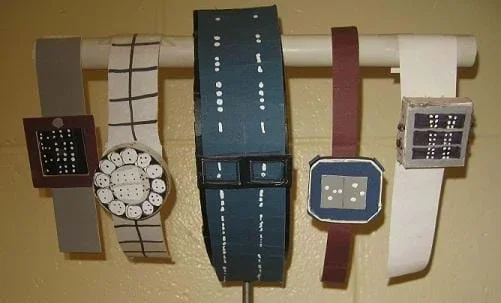 Figure 1. Many design solutions are possible for the wristwatch design projectCopyright 2013 Jared Quinn, Worcester Polytechnic Institute
- assistive device
- A device that is designed to help a person carry-out a given task.
- bioengineering
- The application of engineering skills to solve problems in the fields of life science.
- biomedical engineering
- The application of engineering skills to solve problems in the medical field.
- constraints
- The aspects of the design that must be met to be determined successful.
- engineering design process
- An iterative decision-making process to optimize resources in meeting stated objectives. The main elements of the engineering design process are: identify the problem, research the problem, imagine possible solutions, plan by selecting the best solution, create a prototype, test and evaluate, and redesign.
- function
- What the design/product will do regardless of the chosen solution.
- objective
- What the design/product will "be" regardless of the chosen solution.
- problem statement
- A detailed description of the needs that will be met.
Pre-Activity Assessment
Engineering Design Pre-Test: Have students complete the Engineering Design Pre-Test (PDF) to help evaluate their understanding of the engineering design process prior to the activity.
Activity Embedded Assessment
Engineering Design Process Packet: As students work through the activity, they complete the Engineering Design Process Packet (PDF), which functions as a formative assessment for students' abilities to follow the engineering design process.
Drawing & Prototype: Students' abilities to visually demonstrate solutions to design problems are assessed as they create drawings and prototypes of wristwatch designs.
Post-Activity Assessment
Student Design Presentations: Following the completion of the design packet, each group shares its project with the class. Limit presentations to ~5 minutes in length. Require that presentations focus on students' work within the design process and include test results and at least one future recommendation to improve their wristwatch designs. Assess students on their abilities to follow the design process and whether they were able to clearly describe their design concepts to others.
Engineering Design Post-Test: Direct students to complete the Engineering Design Post-Test (PDF) to help evaluate the growth in their understanding of the engineering design process.
- Alert students to be cautious when using the glue gun, which poses a safety hazard of skin burns.
- Box cutters are very effective for cutting corrugated cardboard, but they can cause serious injury. Tin snips are able to cut the cardboard with minimal effort while posing only a limited safety hazard.
Extraordinary People - The boy who sees without eyes: https://www.youtube.com/watch?v=qLziFMF4DHA
Helen Keller Speaks Out video clip: https://www.youtube.com/watch?v=8ch_H8pt9M8.
How a Blind Person Tells Money Apart video clip: https://www.youtube.com/watch?v=6U__YAwfXvM
How Blind People Use Twitter & YouTube on the iPhone 4S: https://www.youtube.com/watch?v=c0nvdiRdehw
Assistive Devices/Technologies. Disabilitie and Rehabilation, World Health Organization. Accessed July 15, 2013. http://www.who.int/disabilities/technology/en/
"Bioengineering." Encyclopedia Britannica Academic Edition. Accessed July 3, 2013. http://www.britannica.com/EBchecked/topic/65846/bioengineering
Girifalco, Louis A. et al. "Materials Science." Encyclopedia Britannica Academic Edition. Accessed July 3, 2013. http://www.britannica.com/EBchecked/topic/369081/materials-science
Kedlaya, Divakara. Assistive Devices to Improve Independence. Updated June 11, 2013. Medscape, WebMD LLC. Accessed July 15, 2013. http://emedicine.medscape.com/article/325247-overview
Massachusetts Science and Technology/Engineering Curriculum Framework. October 2006. Massachusetts Department of Elementary and Secondary Education. Accessed July 8, 2012. http://www.doe.mass.edu/frameworks/scitech/1006.doc
"Mechanical engineering." 2013. Merriam-Webster, Incorporated. Accessed July 10, 2013. http://www.merriam-webster.com/dictionary/mechanical%20engineering
Contributors
Jared Quinn; Kristen Billiar; Terri Camesano; Jeanne Hubelbank
Supporting Program
RET Program, Department of Biomedical Engineering, Worcester Polytechnic Institute
Acknowledgements
This activity was developed under National Science Foundation grant no. EEC 1132628. However, these contents do not necessarily represent the policies of the National Science Foundation, and you should not assume endorsement by the federal government.
Copyright
2014 by Regents of the University of Colorado; original © 2012 Worcester Polytechnic Institute