
Natural Frequency and Buildings
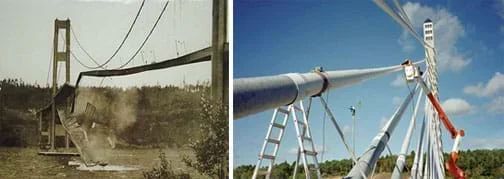 The Tacoma Narrows Suspension Bridge dramatically collapsed in 1940 due to wind-induced vibrations. (left). Today, engineers conduct laboratory research and field studies to reduce vibration on bridges, skyscrapers and other building structures. (right)Copyright Federal Highway Administration, US Department of Transportation http://www.fhwa.dot.gov/publications/publicroads/11janfeb/03.cfm
Students learn about frequency and period, particularly natural frequency using springs. They learn that the natural frequency of a system depends on two things: the stiffness and mass of the system. Students see how the natural frequency of a structure plays a big role in the building surviving an earthquake or high winds.
In order to design buildings (and other human-made structures) to be able to withstand the forces of earthquakes and windstorms, structural engineers compute the natural frequency of buildings. For example, if the frequency of the seismic waves matches the natural frequency of a building, resonance occurs and structure fails. Engineers conduct research and field studies to learn how various structural designs and materials perform under anticipated hazardous conditions, so they can design the safest structures possible. They also design real-time wind and earthquake monitoring systems that include wind, vibration and ground motion sensors to provide early warning of failure.
After this activity, students should be able to:
- Calculate either the frequency or period of a vibration or wave.
- Perform data collection and compare results for the natural frequency of the different systems.
- Describe how resonance and natural frequency can damage buildings and bridges and how technology can be used to avoid this.
- CCSS.Math.Content.6.NS.B.2 Fluently divide multi-digit numbers using the standard algorithm.
Grade 6
Do you agree with this alignment? - CCSS.Math.Content.6.SP.B.4 Display numerical data in plots on a number line, including dot plots, histograms, and box plots.
Grade 6
Do you agree with this alignment? - CCSS.Math.Content.6.SP.B.5 Summarize numerical data sets in relation to their context, such as by:
Grade 6
Do you agree with this alignment? - CCSS.Math.Content.6.SP.B.5a Reporting the number of observations.
Grade 6
Do you agree with this alignment? - CCSS.Math.Content.6.SP.B.5b Describing the nature of the attribute under investigation, including how it was measured and its units of measurement.
Grade 6
Do you agree with this alignment? - CCSS.Math.Content.6.SP.B.5c Giving quantitative measures of center (median and/or mean) and variability (interquartile range and/or mean absolute deviation), as well as describing any overall pattern and any striking deviations from the overall pattern with reference to the context in which the data were gathered.
Grade 6
Do you agree with this alignment? - CCSS.Math.Content.6.SP.B.5d Relating the choice of measures of center and variability to the shape of the data distribution and the context in which the data were gathered.
Grade 6
Do you agree with this alignment? - CCSS.Math.Content.8.SP.A.1 Construct and interpret scatter plots for bivariate measurement data to investigate patterns of association between two quantities. Describe patterns such as clustering, outliers, positive or negative association, linear association, and nonlinear association.
Grade 8
Do you agree with this alignment?
- The selection of designs for structures is based on factors such as building laws and codes, style, convenience, cost, climate, and function.
Grades 6-8
Do you agree with this alignment?
- CCSS.Math.Content.6.NS.B.2 Fluently divide multi-digit numbers using the standard algorithm.
Grade 6
Do you agree with this alignment? - CCSS.Math.Content.6.SP.B.4 Display numerical data in plots on a number line, including dot plots, histograms, and box plots.
Grade 6
Do you agree with this alignment? - CCSS.Math.Content.6.SP.B.5 Summarize numerical data sets in relation to their context, such as by:
Grade 6
Do you agree with this alignment? - CCSS.Math.Content.8.SP.A.1 Construct and interpret scatter plots for bivariate measurement data to investigate patterns of association between two quantities. Describe patterns such as clustering, outliers, positive or negative association, linear association, and nonlinear association.
Grade 8
Do you agree with this alignment?
- Use quantitative and qualitative data as support for reasonable explanations (conclusions)
Grade 8
Do you agree with this alignment?
Each group needs:
- 2 helical springs with different stiffnesses
- 2 different masses
- stopwatch
- Frequency and Period Experiment Worksheet (PDF), one per student
To share with the entire class:
- computer/projector to show students a 1:17-minute video on the Internet
- computer/projector to show students the Frequency and Period Presentation (PPT)(PowerPoint)
- 2 AAA batteries
- Styrofoam, solid chunk to use as a base (see Figure 1)
- 2 balsa wood sticks (6.35 mm x 3.175 mm size), 25 cm and 35 cm long
- masking tape
Basic understanding of earthquakes, seismic waves, and their affect on buildings. Ability to calculate averages.
(Show the class the video of the Tacoma Narrow Bridge Collapse; see the Additional Multimedia Support section for details. Hand out the worksheets. Then show the attached six-slide PowerPoint presentation.)
The violent swaying of the Tacoma Narrows Suspension Bridge that caused it to collapse is an example of resonance. What caused the bridge to sway back and forth like that? The answer is wind. We will find out why the wind caused the bridge to collapse at the end of this activity.
To understand how the bridge collapsed, we need to talk about frequency. Can anyone give me a general definition of frequency? (Listen to student answers and put up slide #3) We want to focus on vibrations, so the frequency is often how a vibration occurs. The unit of measurement for frequency is hertz (Hz). One hertz is 1 cycle per second. If the frequency is 4 Hz, how many cycles occur in one second? (Answer: 4 cycles) If the frequency is 6 Hz, how many cycle occur in one second? (Answer: 6 cycles)
The next concept we need to understand is the period of a vibration (show slide #4). The period is the time it takes for one full cycle to occur. The period is related to the frequency. The period is equal to 1 divided by the frequency. What is the unit of measurement for the period? (Answer: Time) So, if the frequency is 4 Hz, what is the period? And what is the unit of measure? (Listen to student answers. Answer: 0.25 seconds) If the frequency is 2 Hz, what is the period? (Answer: 0.5 seconds)
Let's take a look at question #2 on your worksheets. If one cycle lasts 2 seconds, what is the frequency? If the cycle lasts 2 seconds that means the period is two seconds. Try and solve for the frequency. (Give students several minutes and then work out the problem on the board.)
Now that we know what the frequency and period is, we need to talk about the natural frequency of a system (show slide #5). The natural frequency of a system is the frequency at which a system naturally vibrates once it has been set into motion. The natural frequency depends on two things: the stiffness and mass of the system. In our experiment today, we will learn how to calculate the natural frequency of a spring-mass system.
Before the Activity
- Gather materials and make copies of the Frequency and Period Experiment Worksheet (PDF).
- Prepare the two balsa towers by taping a battery to each stick end and placing them in a Styrofoam base, as shown in Figure 1.
With the Students
- Show students the video of the Tacoma Narrows Bridge Collapse and ask them what they think caused the bridge to fail.
- Explain the concepts of frequency and period (Introduction/Motivation section). Go through the PowerPoint presentation. Pass out the worksheets. Explain what the natural frequency of a system is and what affects the natural frequency: mass and stiffness.
- Divide the class into groups of four students each. Pass out springs and masses to the groups. Have students use the worksheets for instructions and data collection.
- Assign jobs for students: one holds the spring, one drops the mass, one times the period, one records the data.
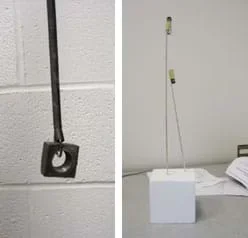 Figure 1. A helical spring with a mass attached. Simple building models with masses at their tops.Copyright 2011 Jake Moravec, School of Engineering and Applied Science, Washington University in St. Louis
 - Attach mass #1 to spring #1.
- Release the mass (letting it vibrate freely) and time how long it takes for one cycle to occur (time it takes for the mass to return to the top after it is released). Do this three times and average the period. Record measurements and calculations in the worksheet data table.
- Repeat step 6 for the other three combinations: mass #2 and spring #1, mass #1 and spring #2, mass #2 and spring #2.
- Calculate the natural frequency for each system and compare the results (the frequency should be different for each). Answer the worksheet data analysis questions.
- Explain the concept of resonance to the class (show slide #6). Resonance is the tendency of a system to oscillate or vibrate with larger amplitudes when it is excited at the natural frequency of the system. Tap the batteries attached to each balsa wood stick and explain that they vibrate at their natural frequencies after they have been tapped. Ask the students why the natural frequency of the two systems is different. The mass is the same but the stiffness is different.
- Ask the students: What do you expect to happen if we excite or vibrate the Styrofoam base at the natural frequency of the taller balsa "tower." Move the Styrofoam back and forth so that the taller stick oscillates with a large amplitude. Explain that this is resonance. The smaller tower should not move at all because it has a different natural frequency. Repeat this for the smaller balsa wood "tower."
- Explain to the class that structural engineers need to calculate the natural frequency of buildings so that the seismic waves produced during earthquakes do not match the natural frequencies of buildings. This design guarantees that resonance will not occur.
- Explain to the students that the Tacoma Narrows Bridge collapsed because the wind blowing against the bridge caused resonance.
- Have students complete the follow-up questions on the worksheets and turn them in for grading.
- frequency
- How often a vibration occurs.
- natural frequency
- The frequency at which a system naturally vibrates once it has been set into motion.
- period
- The time it takes for one full cycle to occur.
- resonance
- The tendency of a system to oscillate with larger amplitude when it is excited at the natural frequency of the system.
Pre-Activity Assessment
Critical Thinking: After showing the Tacoma Narrows Bridge Collapse video, ask students:
- What caused the bridge to collapse? (Answer: The wind was blowing the bridge deck at a frequency that caused resonance—oscillations with large amplitude.)
Activity Embedded Assessment
Data Collection: Following instructions on the Frequency and Period Experiment Worksheet (PDF), have students conduct the experiment by collecting data, making calculations and answering questions, such as the following. Review their worksheets to gauge their comprehension of the material covered:
- Did changing the stiffness of the spring change the natural frequency of the system? (Answer: Yes)
- Did changing the mass of the system change the natural frequency of the system? (Answer: Yes)
Post-Activity Assessment
Real World Application: For a quick activity wrap-up, ask the students and discuss as a class:
- What can engineers do to change the natural frequency of a building, bridge or other structure? (Answer: Engineers can use different building materials and structural designs to adjust both the weight and stiffness of the building.)
Be sure to choose springs and masses that have long periods (at least 1 second). Otherwise, students may have trouble timing the period with a stopwatch. Or, if one cycle happens too quickly, permit students to time three or four cycles and divide the time by the number of cycles.
To introduce students to the topic, show them video of the Tacoma Narrows Suspension Bridge Collapse due to wind-induced vibrations on November 7, 1940. Just search for "tacoma narrows bridge collapse" on YouTube.com and a number of options are available.
Bosch, Harold R. "Winds, Windstorms and Hurricanes." January/February 2011; last updated April 4, 2011. Public Roads, Vol. 74, No. 4, Federal Highway Administration, US Department of Transportation. Accessed December 27, 2011. (Photos of Tacoma Narrows bridge in 1940 and today, and good information on FHWA's Aerodynamics Laboratory's research and monitoring to make bridges more resilient and safer.) http://www.fhwa.dot.gov/publications/publicroads/11janfeb/03.cfm
Huston, Dryver R. and Harold R. Bosch. "Aerodynamic Design of Highway Structures." Winter 1996; last updated April 8, 2011. Public Roads, Vol. 59, No. 3, Federal Highway Administration, US Department of Transportation. Accessed December 27, 2011. (Discussion and photos of wind damage that destroys structures, wind tunnel studies, modeling, etc.) http://www.fhwa.dot.gov/publications/publicroads/96winter/p96wi46.cfm
Contributors
Jake Moravec
Supporting Program
GK-12 Program, School of Engineering and Applied Science, Washington University in St. Louis
Acknowledgements
This curriculum was developed with support from National Science Foundation GK-12 grant number DGE 0538541. However, these contents do not necessarily represent the policies of the NSF, and you should not assume endorsement by the federal government.
Copyright
2013 by Regents of the University of Colorado; original © 2011 Washington University in St. Louis