
Introduction to Circuits and Ohm's Law
Students explore the basics of DC circuits, analyzing the light from light bulbs when connected in series and parallel circuits. Ohm's law and the equation for power dissipated by a circuit are the two primary equations used to explore circuits connected in series and parallel. Students measure and see the effect of power dissipation from the light bulbs. Kirchhoff's voltage law is used to show how two resistor elements add in series, while Kirchhoff's current law is used to explain how two resistor elements add when in parallel. Students also learn how electrical engineers apply this knowledge to solve problems. Power dissipation is particularly important with the introduction of LED bulbs and claims of energy efficiency, and understanding how power dissipation is calculated helps when evaluating these types of claims. This activity is designed to introduce students to the concepts needed to understand how circuits can be reduced algebraically.
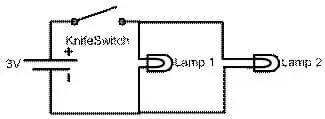 Students explore circuits and Ohm's lawCopyright 2009 Washington State University
Ohm's law (V=IR) is a key equation in the analysis of electrical circuits since it relates the voltage (V) to the current (I) scaled by the resistance (R). So the resistance, R, is a measure of the potential difference V divided by the flow of charge or current I. It is important to remember that the resistance is typically a function of the temperature. Electrical engineers use this equation constantly to guide the design of electrical systems. Students need a strong foundation in Ohm's law while designing circuits on their own.
After this activity, students should be able to:
- Measure the DC current in a circuit (DC stands for direct current, the type of current supplied by batteries).
- Measure the DC voltage across an electrical component.
- Calculate the power dissipated by a DC electrical component.
- Describe the difference between a series and parallel connection.
- Provide at least two examples of how electrical engineers use these concepts.
- CCSS.Math.Content.HSA-CED.A.4 Rearrange formulas to highlight a quantity of interest, using the same reasoning as in solving equations.
Grades 9-12
Do you agree with this alignment? - CCSS.Math.Content.HSA-REI.B.3 Solve linear equations and inequalities in one variable, including equations with coefficients represented by letters.
Grades 9-12
Do you agree with this alignment? - CCSS.Math.Content.HSA-SSE.A.1 Interpret expressions that represent a quantity in terms of its context
Grades 9-12
Do you agree with this alignment? - CCSS.Math.Content.HSN-Q.A.1 Use units as a way to understand problems and to guide the solution of multi-step problems; choose and interpret units consistently in formulas; choose and interpret the scale and the origin in graphs and data displays.
Grades 9-12
Do you agree with this alignment?
- Power systems must have a source of energy, a process, and loads.
Grades 9-12
Do you agree with this alignment?
- HS-PS3-5 Develop and use a model of two objects interacting through electric or magnetic fields to illustrate the forces between objects and the changes in energy of the objects due to the interaction.
Grades 9-12
This resource focuses on the following Three Dimensional Learning aspects of NGSS:
Science & Engineering Practices- Develop and use a model based on evidence to illustrate the relationships between systems or between components of a system.Do you agree with this alignment?
Disciplinary Core Ideas- When two objects interacting through a field change relative position, the energy stored in the field is changed.Do you agree with this alignment?
Crosscutting Concepts- Cause and effect relationships can be suggested and predicted for complex natural and human designed systems by examining what is known about smaller scale mechanisms within the system.Do you agree with this alignment?
Do you agree with this alignment? - Develop and use a model based on evidence to illustrate the relationships between systems or between components of a system.
Each group needs:
- 1 multimeter
- 1 knife switch
- 6 jumper wires
- 1 battery pack
- 2 light bulbs with bases
- Ohm's Law Worksheet (PDF), one per student
This activity is meant to introduce the students to the basics of circuit analysis. It is geared for students who have never had any exposure to circuit analysis. However, students need to know how to measure current and voltage.
Where would we be today without electricity? Though we may not think about it often, our lives revolve around electricity. For what purposes in our lives do we use electricity? (Listen to student answers.) Yes, we depend upon electricity for light, heat, communication, entertainment and even medical care.
This power can not only be derived from fossil fuels or renewable energy sources and then distributed through power lines to our homes, schools and places of work—but also through self-contained chemical power sources such as batteries.
It is important to realize that we use electricity in every aspect of life, from power lines, computers, Earth's magnetic field, to lighting. Since batteries are only able to provide a set amount of voltage, (for example, a AA battery is 1.5 volts) how do you make devices with a higher voltage requirement work without increasing the voltage of the battery?
Today you will be introduced to some of the basics of electricity. We will explore concepts like current, voltage and resistance while you learn how to use basic test equipment. Learning these concepts will prepare you to understand how circuits can be reduced algebraically.
Background
Ohm's law states the relationship between voltage, current and resistance: V = I x R, where V is the voltage, R is the resistance and I is the current. Each of the components is described in detail in the Vocabulary/Definitions section. Given that the resistance (R) of a device, in this case the light bulb, is relatively constant (may change slightly with temperature), if we change the current or voltage being provided to the device, the voltage or current would scale according to Ohm's law. It is important to realize that you cannot completely specify the variables in Ohm's law; only two of the three can be specified; the third variable must be computed using Ohm's law.
Power is a function of the voltage and current: P = V x I, where P is the power, V is the voltage, and I is the current. By increasing the voltage or current supplied to a circuit, we can increase the power, and therefore increase the intensity of the light. We are going to assume that light bulbs are efficient at converting electrical energy to light and that negligible amounts of energy are converted to heat. This, of course, is not entirely true, but for the case of comparing the different circuit configurations with the brightness and power output, we will not worry about heat dissipation.
Batteries are voltage sources. It is important to note that batteries are voltage sources that try to maintain a voltage of 1.5V. This means that if the battery is shorted (the positive side is connected with a wire to the negative side), the battery gets hot trying to keep 1.5V across the wire. Shorting batteries ruins them in some cases, and may also render them unstable and pose a health hazard. Do not let the students short the batteries.
Before the Activity
- Gather materials and make copies of the 15-page worksheet. The worksheet guides student groups to work independently through the activity.
- Examine the multimeter: 1) What is the resistance when the probes touch? (It should be zero.) 2) Note that the multimeters automatically turn off. If a multimeter is off, simply change the setting and then turn it back to the desired location.
- Identify the two equations being used and what the symbols mean.
- Make sure all batteries are correctly installed in the battery packs.
- Review the worksheet to become familiar with the activity and places where class discussion may be necessary.
With the Students
Divide the class into groups of four students each. While the worksheets enable groups to work independently, gather the groups together to address common questions that arise and at the end of pages 8,10 and 11. During the rest of the activity, circulate around the room and solicit student responses to leading questions to informally assess their understanding of the material. Use the provided Investigating Questions.
- Begin by handing out worksheet 1. Note that the first two pages are reference material including a symbol guide and information about the equations students will use. Let students know that these two pages are meant for reference and to refer to them as needed.
- Page 3 is the first activity for students and is an important introduction to the equipment and how to build circuits. Students are asked to build circuits that light the two bulbs and find the brightest configuration possible. This section is meant to give students a chance to play with the equipment and learn what everything does and how things work. Expect students to conclude that building a circuit with the lamps in parallel to the batteries in a 3V configuration is the brightest. This circuit will be revisited toward the end of the activity.
- Pages 4-8 introduce students to lamps in series and how to measure the current and voltage. On page 8, students are asked to compare the computed resistance with a measured resistance. Expect them to find that they are not consistent. This is a good time to bring groups together for a discussion. As the instructor, you know that lamps are not resistors and that resistance changes with temperature. The measured resistance should be much lower than the computed resistance because the computed resistance is the resistance with the bulb and is very hot and so the resistance is much higher. Another small factor that may come into play is the fact that the batteries are not perfect voltage supplies and the voltage will drop when a load is place on them. For example, in one test, with two batteries the voltage would drop from ~3.03V to ~2.8V when two lamps in series were applied as a load. If you want, show this to the class and then if you use more than two batteries in parallel you will maintain 3 volts even when a load is applied because the needed current is available.
- Page 9 introduces lamps in parallel and the hope is that this should be familiar and similar to the circuit students came up with at the beginning of the lesson. It is also assumed that students now know how to measure the current and voltage and are simply asked to get that data after they predict the current and power dissipated by the lamps when in parallel. Predicting the current may be a leap for some students, but the less input the better for this task. The goal is to have them predict and then compare. The resistance that a student chooses to use is a key component as well as the voltage. The instructions state to use the voltage from the previous page, but both the measured and computed resistances are on that page. From item 3 you know that the computed is the better choice since that would be consistent with the resistance when the lamp(s) are lit and consistent with computing the power dissipated.
- Page 11 compares the series circuit and the parallel circuit. The goal is to show that the power dissipated corresponds at least qualitatively to the brightness of the lamps. The last part asks student to find the ideal power factor between the parallel and series circuits. The Ohm's Law Worksheet Key shows the algebraic steps to compute the factor; simply put, it should be 4 and can be found by creating a ratio of the power dissipation of the two circuits and then substituting Ohm's law to remove the current. Using the equivalent resistance for the lamps and assuming that the lamps resistance is nearly the same results in all variables canceling, leaving only a 4.
- Pages 12-13 introduce students to the idea and show the need for equivalent circuits and resistance. This is when page 2, the reference sheet of equations comes in handy.
- Pages 14-15 introduce the use of Kirchhoff's voltage law and how circuits can be solved using systems of equations. This is most useful for students who have had some introduction to matrices. Although the currents could be solved by hand, this approach is not appropriate if the idea of linear algebra causes anxiety in students. However, the principle is straight forward: you just take "walks around the circuit" and sum up the voltages, knowing that they must be equal to zero if you stop in the same place you started.
- ammeter
- A device that measures current flowing through a circuit.
- alternating current
- Current that reverses direction at a regular rate. Abbreviated as AC.
- current
- The flow of electrons. Current is read by opening the circuit and connecting the meter in series. The unit for current is ampere, which is typically shortened to amp. Ampere is named after Andrè-Marie Ampère (1775-1836). Abbreviated as l.
- direct current
- An electric current that flows in only one direction. The positive and negative terminals of a battery are always, respectively, positive and negative. The current always flows in the same direction between those two terminals. Abbreviated as DC.
- light intensity
- The amount of light given off by a source such as a light bulb.
- load
- A device that consumes energy or power.
- multimeter
- A device that measures the current, voltage and resistance.
- parallel circuit
- A circuit that has two or more branches for separate currents from one voltage source.
- potential
- Electrical pressure, also called voltage.
- power
- The rate at which energy is delivered to something. (quantity / time). Measured in watts.
- resistance
- The opposition of a body or substance to current passing through it, resulting in a change of electrical energy into heat, light, or another form of energy. Resistance is measured in Ohms. An ohm is named after Georg Simon Ohm (1789-1854). The resistance of a device is always the same (constant).
- series circuit
- A circuit that only has one path for the electrons to flow.
- voltmeter
- A device that measures the force with which electrons are flowing.
- voltage
- The force that moves electrons. Voltage is read using a meter connected in parallel. The unit for voltage is volts, which gets its name from Alessandro Volta (1745-1827). Abbreviated as V.
- watt
- The power expended when one ampere of direct current flows through a resistance of 1 Ohm.
- kirchhoff's current law
- The current into a node must be equal to the amount of current out of a node.
- kirchhoff's voltage law
- The sum of the voltages in any closed loop must be equal to zero.
Questions: During the activity, informally assess students' understanding of the material by circulating around the room and soliciting responses to leading questions, such as those provided in the Investigating Questions section.
Worksheets: At activity end, review and grade students' Ohm's Law Worksheets to gauge their mastery of the concepts.
- In terms of electrical safety, there is no danger of electrocution or risk of high currents.
- The multimeter probes are pointed at their ends and could break the skin if not used appropriately.
- Shorting the batteries heats them up and could cause them to be unstable.
When making measurements with the multimeter, make sure that the probes are connected to the correct ports for what you are measuring. The red wire goes in a different port for measuring current as opposed to the port used to measure voltage and resistance.
Have students design and build a circuit using three lamps such that two lamps are in series and while the third lamp is in parallel. Have the student calculate the power dissipated by each lamp.
- For lower grades, omit worksheet pages 14 and 15, which deal with systems of equations.
- For higher grades, especially grade 12, include worksheet pages 14 and 15 to add depth to the activity by showing students how to solve for current using systems of equations.
Baskan, Ozan. Published 2004. Ohm's Law 1. Worcester Polytechnic Institute, Teach Engineering Digital Library Collection. Accessed July 7, 2009. https://www.teachengineering.org/view_activity.php?url=collection/wpi_/activities/wpi_ohm_1/ohm1_act_joy.xml
Contributors
Erik Wemlinger
Supporting Program
CREAM GK-12 Program, Engineering Education Research Center, College of Engineering and Architecture, Washington State University
Acknowledgements
This content was developed by the Culturally Relevant Engineering Application in Mathematics (CREAM) Program in the Engineering Education Research Center, College of Engineering and Architecture at Washington State University under National Science Foundation GK-12 grant no. DGE 0538652. However, these contents do not necessarily represent the policies of the NSF, and you should not assume endorsement by the federal government.
Copyright
2013 by Regents of the University of Colorado; original © 2009 Board of Regents, Washington State University