
Concentrate This! Sugar or Salt...
Students investigate the property dependence between concentrations and boiling point. In section 1, students first investigate the boiling point of various liquid solutions. In section 2, they analyze data collected by the entire class to generate two boiling point curves, one for salt solutions and one for sugar solutions. Finally, in section 3, students use the data they have analyzed to determine how to create a solution that has a particular boiling point and is a cost-effective design.
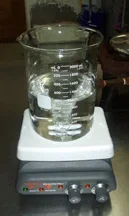 A beaker on a hotplate.Copyright 2010 Courtney Herring, Washington State University
In the field of chemical engineering, it is important to understand the dependency of concentration on the physical properties of a liquid. Small changes (intentional and unintentional) in the composition of a liquid mixture can make dramatic changes to the liquid's boiling, melting or freezing point, density, viscosity or surface tension. Chemical engineers must understand how these changes can impact the function of a substance so they can account for, and design, new substances. For example, small changes can make the difference between your car starting in the winter or not, depending on whether or not the correct chemical composition of anti-freeze or motor oil was used.
After this activity, students should be able to:
- Follow step by step procedures to conduct an experiment.
- Apply the concept of concentration changes to alter boiling point.
- Correctly use units of concentration.
- Calculate solute mass from a known concentration and solvent mass.
- Determine when boiling occurs and measure a liquid's boiling point.
- Apply the understanding of boiling points and altering boiling points to a real-life engineering situation.
GOALS:
- Math competency: Skills and appreciation for data collection used in real life.
- Quantitative literacy: Ability to follow procedures and provide recommendations.
- Engineering applications: Engineering design process, material selection and cost considerations.
- Cultural relevancy: How to follow procedures, collaborative work in small groups and hands-on activities.
- CCSS.Math.Content.HSA-CED.A.4 Rearrange formulas to highlight a quantity of interest, using the same reasoning as in solving equations.
Grades 9-12
Do you agree with this alignment? - CCSS.Math.Content.HSA-REI.B.3 Solve linear equations and inequalities in one variable, including equations with coefficients represented by letters.
Grades 9-12
Do you agree with this alignment? - CCSS.Math.Content.HSA-SSE.A.1 Interpret expressions that represent a quantity in terms of its context
Grades 9-12
Do you agree with this alignment? - CCSS.Math.Content.HSN-Q.A.1 Use units as a way to understand problems and to guide the solution of multi-step problems; choose and interpret units consistently in formulas; choose and interpret the scale and the origin in graphs and data displays.
Grades 9-12
Do you agree with this alignment? - CCSS.Math.Content.HSS-ID.B.6a Fit a function to the data; use functions fitted to data to solve problems in the context of the data.
Grades 9-12
Do you agree with this alignment? - CCSS.Math.Practice.MP2 Reason abstractly and quantitatively.
Grades K-12
Do you agree with this alignment? - CCSS.Math.Practice.MP4 Model with mathematics.
Grades K-12
Do you agree with this alignment?
- Students will develop an understanding of the role of troubleshooting, research and development, invention and innovation, and experimentation in problem solving.
Grades K-12
Do you agree with this alignment? - Students will develop an understanding of the relationships among technologies and the connections between technology and other fields of study.
Grades K-12
Do you agree with this alignment?
- HS-PS1-3 Plan and conduct an investigation to gather evidence to compare the structure of substances at the bulk scale to infer the strength of electrical forces between particles.
Grades 9-12
This resource focuses on the following Three Dimensional Learning aspects of NGSS:
Science & Engineering Practices- Plan and conduct an investigation individually and collaboratively to produce data to serve as the basis for evidence, and in the design: decide on types, how much, and accuracy of data needed to produce reliable measurements and consider limitations on the precision of the data (e.g., number of trials, cost, risk, time), and refine the design accordingly.Do you agree with this alignment?
- Use mathematical representations of phenomena or design solutions to describe and/or support claims and/or explanations.Do you agree with this alignment?
- Analyze data using tools, technologies, and/or models (e.g., computational, mathematical) in order to make valid and reliable scientific claims or determine an optimal design solution.Do you agree with this alignment?
Disciplinary Core Ideas- The structure and interactions of matter at the bulk scale are determined by electrical forces within and between atoms.Do you agree with this alignment?
Crosscutting Concepts- Investigating or designing new systems or structures requires a detailed examination of the properties of different materials, the structures of different components, and connections of components to reveal its function and/or solve a problem.Do you agree with this alignment?
Do you agree with this alignment? - Plan and conduct an investigation individually and collaboratively to produce data to serve as the basis for evidence, and in the design: decide on types, how much, and accuracy of data needed to produce reliable measurements and consider limitations on the precision of the data (e.g., number of trials, cost, risk, time), and refine the design accordingly.
- CCSS.Math.Content.HSA-CED.A.4 Rearrange formulas to highlight a quantity of interest, using the same reasoning as in solving equations.
Grades 9-12
Do you agree with this alignment? - CCSS.Math.Content.HSA-REI.B.3 Solve linear equations and inequalities in one variable, including equations with coefficients represented by letters.
Grades 9-12
Do you agree with this alignment? - CCSS.Math.Content.HSA-SSE.A.1 Interpret expressions that represent a quantity in terms of its context
Grades 9-12
Do you agree with this alignment? - CCSS.Math.Content.HSN-Q.A.1 Use units as a way to understand problems and to guide the solution of multi-step problems; choose and interpret units consistently in formulas; choose and interpret the scale and the origin in graphs and data displays.
Grades 9-12
Do you agree with this alignment? - CCSS.Math.Content.HSS-ID.B.6a Fit a function to the data; use functions fitted to data to solve problems in the context of the data.
Grades 9-12
Do you agree with this alignment? - CCSS.Math.Practice.MP2 Reason abstractly and quantitatively.
Grades K-12
Do you agree with this alignment? - CCSS.Math.Practice.MP4 Model with mathematics.
Grades K-12
Do you agree with this alignment?
- HS-PS1-3 Plan and conduct an investigation to gather evidence to compare the structure of substances at the bulk scale to infer the strength of electrical forces between particles.
Grades 9-12
Do you agree with this alignment?
Section 1- Boiling Point Data
Each group needs:
- beaker tongs or hot gloves
- calculator
- 300 ml beaker
- thermometer
- burner or hotplate
- 200 ml water
- Section 1 Worksheet (PDF)
- graduated cylinder
- glass stir rod
- aluminum foil (4" x 4" piece) used to form a lid over beaker during boiling
To share with the entire class:
- electronic balance (capable of weighing 200 ml water plus beaker weight)
- salt, approximately 250 g for every other group (each group only tests one solute)
- sugar, approximately 540 g for every other group (each group only tests one solute)
Section 2 - Data Analysis
Each group needs:
- Section 2 Worksheet (PDF)
- calculator
- ruler
Section 3 - Design
Each group needs:
- beaker tongs or hot gloves
- calculator
- 300 ml beaker
- thermometer
- burner or hotplate
- 200 ml water
- Section 3 Worksheet (PDF)
- graduated cylinder
- glass stir rod
- aluminum foil (4" x 4" piece) used to form a lid over beaker during boiling
To share with the entire class:
- electronic balance (capable of weighing 200 ml water plus beaker weight)
- salt, approximately 100 g per group
- sugar, approximately 180 g per group
Students should be familiar with:
- Math concepts: line graphs and fractions.
- Science concepts: concentration, mass, weighing practices, boiling point.
However, this activity could be used as a means of introducing some or all these concepts.
(The motivation for this activity is to familiarize students with concentrations by providing opportunities for them to first create solutions and calculate the concentration based on solute mass, test solutions for boiling point, then predict performance of other concentration based on data analysis, and then finally to calculate solute mass based on the needed concentration, and verify their prediction through testing boiling point of the new solution. Students also will understand the importance of determining the cost of a solution and relate this cost analysis to the engineering design process; engineers must optimize cost of materials in designs.)
How do chemical engineers design new materials and products in the lab? The method of test, analyze and validation is common practice in engineering. Today you will be doing the same thing. This gives you the opportunity to explore and understand data analysis in true lab situations where you must try to control as many variables as possible to produce the most accurate results.
What is the connection between chemistry and chemical engineering? (Listen to student ideas.) Chemical engineering is the application of a person's knowledge of chemicals, mixtures and solutions to solve real-world problems. What might be some examples? (Listen to student ideas.) There are so many examples. One example is that chemical engineers design specific anti-freeze and motor oil chemical solutions to help your car work more efficiently and effectively in specific conditions.
Before the Activity
- Gather materials.
- Make copies of Section 1 Worksheet (PDF), Section 2 Worksheet (PDF) and Section 3 Worksheet. (PDF)
- Test the salt and sugar concentrations to confirm the boiling point curves. Be sure to include the boiling point of the pure water sample.
With the Students
Before start of the lab:
Introduction to Solutions
- Discuss what makes a solution: a solvent plus a solute.
- Give examples of solutions and have students come up with their own examples (use Worksheet 1 to help guide this).
- Describe concentration as a means of describing (defining) a solution. Concentration is a measure of how much of some substance is contained in a mixture.
- Introduce units and decide which ones will be used in the labs.
- Introduce equation to calculate concentration based on masses of solute and solvent (use Worksheet 1 to help guide this).
- Discuss why concentration might be an important property of a mixture and how concentration may change other known properties (density, viscosity, surface tension, boiling point, freezing point). Specifically, use this information to introduce the concept of chemical engineering.
- Salt water fish tanks.
- Saline solutions used in hospitals.
- Why salt is put down on roads in the winter or why we make homemade ice cream by spreading salt on the ice. This is an example of engineering the defined environment- applying what engineers know about melting points and solutions to fix a real-world problem.
- Discuss how to use lab equipment.
- Review how to use and read a thermometer.
- Review how to use a balance and tare weights if necessary (ensure they are familiar with grams as opposed to ounces which sometimes appear on electronic balances).
- Introduce the definition of chemical engineering and describe real-life problems that chemical engineers might try to solve. Refer to the Introduction and Motivation section as an example.
Day 1: Section 1
- Hand out Section 1 Worksheet (PDF).
- Introduce the activity, engineering connection, and strategy for the four-day lab:
Day 1: Section 1 Worksheet (definitions and determining boiling point of various solutions).
Day 2: Section 2 Worksheet (data analysis and determining the best line of fit on a graph for various concentrations of salt and sugar).
Day 3 and 4: Section 3 Worksheet (design and test a solution to have a specific boiling point based on previous calculations; connect this "design criteria" to what engineers must do, that is, meet specifications).
- Discuss results (if time at the end of class, once everyone is done).
Day 2: Section 2
- Hand out Section 2 Worksheet (PDF).
- Discuss results (if time at the end of class, once everyone is done).
Day 3: Section 3
- Hand out Section 3 Worksheet (PDF).
- Discuss how students can calculate the solute mass necessary to achieve the required boiling point.
- Have students design their solutions and begin conducting the tests.
Day 4: Section 3 (continued)
- Report results and check solutions.
- boiling point
- The point at which one can see a steady/continuous/rapid boiling of a liquid. This point is also characterized by a constant temperature, as long as the concentration is not being changed.
- concentration
- A measure of how much of some substance is contained in a mixture.
- solute
- The material being dissolved in a solution, typically the material present in a lesser mass, and the material that is changing state. In this activity example, the salt and sugar are the solutes.
- solution
- A mixture of two or more substances. In this activity, salt water solution or sugar water solution.
- solvent
- The liquid substance able to dissolve other substances. In this activity, water is the solvent. The solvent does not change its state when forming a solution.
At activity end, review and grade completed student worksheets to gauge their mastery of the concepts.
- Students should not drink any chemicals even those labeled water or soda because contamination is always possible.
- Students should always use safe lab practices especially when working with heat. Use tongs when handling hot containers and wear lab goggles to protect eyes.
Be sure to test the boiling point of the water that will be used. A deviation of a few degrees in boiling point may exist, depending on elevation and water supply.
Ensure that the thermometers being used are accurate and precise enough to capture half-degree changes in temperature. One option is to use digital thermometers. Also, ensure that the thermometer range covers the range of boiling points possible with the solutions (~212 °F to 240 °F).
During boiling, if water vapor (steam) is escaping from the beakers, it means the concentration inside the beaker is increasing due to a loss in solvent mass. To ensure the least error, encourage students to keep beakers completely covered. If possible, use rubber bands to secure the foil lids on the beakers.
To reinforce students' understanding of concentration, provide them with two or three unknown solutions for which they must determine the concentrations. Then, as an added challenge, challenge students to develop a method to determine if the unknown is a salt or sugar solution. This would be based on the mass of the solution as long as they are given the mass of the solvent.
Ask students to create concentration curves based on other measurable properties such as density. They could then compare to see if one measurement is a better predictor for determining an unknown.
Have students perform cost analysis of their solutions for section 3, comparing their group results to other group results.
- For lower grades, minimize testing to only one solute (salt) then have students collect data as a class. During section 3, have students calculate the cost to create the required boiling point solution.
- For upper grades, have students determine the effect each solute has on the boiling point error. For example, for a one-degree boiling point increase, it requires more sugar than salt. Therefore, the same precision of weighing results in a lower error associated with the sugar solution than the salt solution. Have students come up with methods to minimize these measurement errors. In addition, have students come up with an equation to determine the boiling point of a solution containing water + salt + sugar.
Contributors
Courtney Herring (Gene and Linda Voiland School of Chemical Engineering and Bioengineering, Washington State University)
Supporting Program
CREAM GK-12 Program, Engineering Education Research Center, College of Engineering and Architecture, Washington State University
Acknowledgements
This content was developed by the Culturally Relevant Engineering Application in Mathematics (CREAM) Program in the Engineering Education Research Center, College of Engineering and Architecture at Washington State University under National Science Foundation GK-12 grant no. DGE 0538652. However, these contents do not necessarily represent the policies of the NSF, and you should not assume endorsement by the federal government.
Copyright
2013 by Regents of the University of Colorado; original © 2010 Board of Regents, Washington State University