
Eureka! Or Buoyancy and Archimedes' Principle
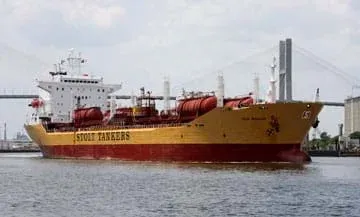 Tanker ship Stolt Emerald on the Savannah River in Georgia.Copyright 2008 Ianare' Sevi, Wikimedia Commons {PD} http://commons.wikimedia.org/wiki/File:Tanker_Stolt_Emerald.jpg
Students explore material properties in hands-on and visually evident ways via the Archimedes' principle. First, they design and conduct an experiment to calculate densities of various materials and present their findings to the class. Using this information, they identify an unknown material based on its density. Then, groups explore buoyant forces. They measure displacement needed for various materials to float on water and construct the equation for buoyancy. Using this equation, they calculate the numerical solution for a boat hull using given design parameters.
Engineers apply mathematical equations to determine materials properties. For example, understanding buoyancy is important for determining how objects behave in a fluid (liquid or gas). Differences in densities determine whether objects sink or float in liquids, or how much liquid objects displace when floating. Engineers consider material densities and the resulting buoyant forces when designing boats, submarines, underwater pipelines and cables, and aircraft. Buoyant forces also need to be understood to study and control influence dispersion of pollutants in air or water, or the separation of impurities from molten metals.
After this activity, students should be able to:
- Measure masses and volumes of known and unknown substances.
- Calculate density using given measurements.
- Predict physical behaviors by employing a numerical model.
- Apply predictions to an engineering design challenge.
Goals: This project is designed to connect experimentation with mathematical modeling and demonstrate the power of mathematical models. This project is designed to connect with students across many cultures and different socioeconomic strata. Water and watercraft are used throughout the world. This project provides insights to one aspect of engineering. Students discover how engineers use mathematics to design a boat within desired operating conditions.
- CCSS.Math.Content.HSA-REI.B.3 Solve linear equations and inequalities in one variable, including equations with coefficients represented by letters.
Grades 9-12
Do you agree with this alignment? - CCSS.Math.Content.HSG-GMD.A.3 Use volume formulas for cylinders, pyramids, cones, and spheres to solve problems.
Grades 9-12
Do you agree with this alignment? - CCSS.Math.Content.HSN-Q.A.1 Use units as a way to understand problems and to guide the solution of multi-step problems; choose and interpret units consistently in formulas; choose and interpret the scale and the origin in graphs and data displays.
Grades 9-12
Do you agree with this alignment?
- STEL-7CC Apply a broad range of design skills to their design process.
Grades 9-12
Do you agree with this alignment?
- recognize and apply mathematics in contexts outside of mathematics
Grades -1-12
Do you agree with this alignment? - make decisions about units and scales that are appropriate for problem situations involving measurement
Grades 9-12
Do you agree with this alignment? - Analyze characteristics and properties of two- and three-dimensional geometric shapes and develop mathematical arguments about geometric relationships
Grades -1-12
Do you agree with this alignment?
- CCSS.Math.Content.HSA-REI.B.3 Solve linear equations and inequalities in one variable, including equations with coefficients represented by letters.
Grades 9-12
Do you agree with this alignment? - CCSS.Math.Content.HSG-GMD.A.3 Use volume formulas for cylinders, pyramids, cones, and spheres to solve problems.
Grades 9-12
Do you agree with this alignment? - CCSS.Math.Content.HSN-Q.A.1 Use units as a way to understand problems and to guide the solution of multi-step problems; choose and interpret units consistently in formulas; choose and interpret the scale and the origin in graphs and data displays.
Grades 9-12
Do you agree with this alignment?
Each group needs:
- ruler
- graduated cylinder marked in milliliters (alternatively, provide a 2-liter bottle with the top cut off and a ruler so students can measure displacement in cm and calculate volume)
- scale (can be digital), to measure mass in grams
- known objects of a variety of materials, such as wood, steel, aluminum, plastic, glass, Styrofoam, water and oil; these objects can be found (glass marbles, steel marbles, wood blocks, etc.) or cut to appropriate size; find items in your home, school shop or hardware store
- irregularly shaped "mystery object" of unknown material; make it the same material as one of the known objects, but irregular in shape and masked with paint or tape to conceal its identity
- 4 plastic 500-ml drinking bottles
- aluminum foil, 1 sheet
- Eureka - Archimedes Principle Worksheet 1 (PDF), one per student
- Eureka - Archimedes Principle Worksheet 2 (PDF), one per student
Competancy with basic measurements involving distance, area and volume, units of measure and calculations involving single and multi-step equations.
Most of us know that steel feels heavier than plastic, but why? How do we know what an object is made of? How do large ships made of metal float on water? How are these two questions related? And why do engineers care about the properties of materials? Let's start with the first question.
(Tell the following story of Archimedes and the king's crown.)
A long time ago in ancient Greece, a man named Archimedes was trying to solve a problem. He wanted to know how to tell if a crown was made of real gold. You might know that different materials have different densities (mass per volume). Archimedes reasoned that if he could figure out the density of the crown, he could determine whether it was gold or not. Density = mass / volume, so if you had a regular shape like a cube, it would be easy to measure and calculate the volume. But how could he calculate the volume of the crown? He decided to have a nice bath to think about this. When he got into the bath, the water level rose, and he realized that he could measure the volume of water displaced by the crown, and so discover the volume of the crown, then calculate the density of the crown. Eureka!
Do you know why large ships made of steel can float on water? It is related to what Archimedes noticed when he got in the bath. The displacement of water is what keeps ships afloat and we call it the buoyancy effect. In order for a ship to float on water, it needs to displace its own weight in water. This might be hard to understand right now, but we will do some experiments to prove that this is true.
So, why is this important to engineers? Engineers apply mathematical equations to determine the properties of materials. By predicting how a material will behave in a certain situation, under certain constraints, engineers can determine which material to choose for a given design project. For example, in order to design a boat that will float, engineers must understand buoyancy to determine how objects behave in a fluid (liquid or gas). Differences in densities determine whether an object sinks or floats in a liquid, or how much liquid the object displaces when floating. Engineers must consider material densities and the resulting buoyant forces when designing boats, submarines, underwater pipelines and cables, and aircraft.
Before the Activity
- Gather materials and make copies of the two worksheets: Eureka - Archimedes Principle Worksheet 1 (PDF) and Eureka - Archimedes Principle Worksheet 2 (PDF).
- Read all materials and do the experiment and worksheets in advance to understand the activity and be aware of any challenges students might encounter.
- Instead of graduated cylinders, you can cut the tops off 2-liter bottles so students can measure displacement in cm and calculate volume.
- The known objects can be found or cut to appropriate sizes. Many are household items, or available in school shop classes or hardware stores.
- Make the mystery object of the same material as one of the known objects, but irregular in shape. Mask its identity with paint or tape.
With the Students
- Review fractions and how to calculate the volume of cubes, spheres and cylinders. Provide sample problems that include measuring using a ruler.
- Divide the class into groups of three or four student each. Give each team a set of equipment.
- The group is responsible for working together and completing the activity together. Each student is responsible to fill out his/her own worksheet to be handed in.
- The group presents its findings to the class (see below).
- Day 1: Hand out worksheet 1. Students measure the mass and dimensions of known materials and calculate the density of each.
- Each team records its findings on the board and the class discusses the findings, including sources of error and possible variations in density results for different samples.
- The teams measure and calculate the density for the mystery object and determine what material the "mystery" object is, based on a comparison of this material and the list of known densities, those already calculated.
- The class comes together again to compare each group's results for the mystery object and assess what the groups have discovered.
- Day 2: Hand out worksheet 2. Students experiment with boats (plastic bottles) filled with various materials to determine an equation for the buoyant force. They then apply this equation to a real-life engineering problem outlined in the worksheet.
- After worksheets are completed, bring the class together to discuss these findings.
- The force supporting the floating object is known as the buoyant force. When an object is floating on water, the force of gravity on that object is equal to the buoyant force of the water.
- Buoyant force of water = density * displacement, which is equal to the force (due to gravity) of the boat = weight.
- The height above or below the water may change with the boat's orientation, but the volume above and below the water does not change.
- Day 3: For the final engineering challenge, each group designs a boat hull based on what they know about densities and buoyant force.
- Each group uses a numerical model to calculate the dimensions of the hull with given design parameters, as outlined in the worksheet.
- Each group reports its findings to the class, as directed by the teacher.
- Explain how this activity relates to the engineering design process.
- The following is an example of the design project: Some of the largest oil supertankers are designed to carry 500,000 GWT (gross weight tons). This is 500,000,000 kg. It would require 500,000 liters of water to be displaced or 500,000 m3! The hull for these ships can be 400 m (1312 ft) long and 60 m (197 ft) wide, giving a draft (submerged depth) of 20.8 m (68 ft)!
More specificss can be found at:
- weight
- How heavy an object is. What a scale reads when it is weighed in a given setting. Note that an object's weight would be different on the moon than on Earth.
- mass
- The property of an object that gives it weight. We will be using metric unit of gram (g) as the unit of mass and equating it to the weight measured by a scale under classroom conditions.
- volume
- The space an object takes up. We will use both the metric unit cubic centimeter (cm3) for solids and milliliters (mL) for liquids. It is convenient that 1 cm3 = 1 ml.
- density
- The ratio of mass per volume of a material. Mass is an intensive property (as opposed to extensive), which means that it is a characteristic of the material and independent of the size of the object. Density of water is 1 g/cm3. density = mass / volume.
- displacement
- The volume of water that is moved away or replaced by an object. This is viewed as a change in apparent volume and we measure it in milliliters (ml).
- buoyant force
- The force exerted by water due to displacement of the water. Because water has a density of 1 g/cm3, for each cubic centimeter (or milliliter) displaced, 1 g of water has been displaced. This means that by measuring the change in volume in milliliters, we have found the mass of the object in grams.
- volume equations
- Volume of a block = l * w * h or length * width * height; volume of a sphere = 4/3 * π * r3, where r is the radius; volume of a cylinder = h * π * r2, where h is the height.
Activity Embedded Assessment
Worksheets: Have students complete the two attached worksheets to guide them through the activity. Review their answers to gauge their comprehension.
Post-Activity Assessment
Meet the Standards: Review students' worksheet answers or administer a separate test to verify that they are able to perform the following NCTM geometry and measurement standards:
- Find conversion factors and do all calculations independently.
- Analyze any geometric shape and complete the task independently.
- Apply the mathematics to the experimental results.
Student Reflection: Ask students to think back on the project and write answers to the following questions:
- What was something that was really good about this project? It could be something you were proud of accomplishing or something that went well in the activity. Explain why this was important.
- What is something you would do differently if you did this activity again or something (a skill or a process) you would like to work on after this activity? State how you would do this.
- What is something significant that you learned from this activity? This could be something you never noticed before or a light bulb (aha) moment.
Buoyancy. Last revised 26 March 2013. Wikipedia, The Free Encyclopedia. Accessed 28 March 2013. http://en.wikipedia.org/wiki/Buoyancy
Nave, C.R. Buoyancy. Hyperphysics. Department of Physics and Astronomy, Georgia State University. Accessed 28 March, 2013. http://hyperphysics.phy-astr.gsu.edu/hbase/pbuoy.html#buoy
Contributors
Andy Wekin
Supporting Program
CREAM GK-12 Program, Engineering Education Research Center, College of Engineering and Architecture, Washington State University
Acknowledgements
This content was developed by the Culturally Relevant Engineering Application in Mathematics (CREAM) Program in the Engineering Education Research Center, College of Engineering and Architecture at Washington State University under National Science Foundation GK-12 grant no. DGE 0538652. However, these contents do not necessarily represent the policies of the NSF, and you should not assume endorsement by the federal government.
Copyright
2010 by Regents of the University of Colorado; original © 2010 Board of Regents, Washington State University