
Mixtures and Solutions
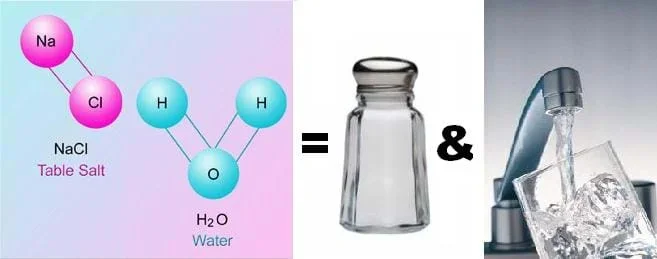 Students explore mixtures and solutions.Copyright (atom) U.S. Department of Energy, Office of Civilian Radioactive Waste Management http://www.ocrwm.doe.gov/curriculum/unit2/lesson1reading.shtml; (salt shaker) U.S. National Library of Medicine and the National Institutes of Health http://www.nlm.nih.gov/medlineplus/dietarysodium.html; (faucet) U.S. Bureau of Reclamation http://www.usbr.gov/lc/socal/wtrcons.html
Through three lessons and their four associated activities, students are introduced to concepts related to mixtures and solutions. Students consider how mixtures and solutions—and atoms and molecules—can influence new technologies developed by engineers.
Engineers apply their understanding of the properties of matter to decide what materials to use when creating and designing new things. And, they use their knowledge of mixtures and solutions when designing new synthetic materials for a multitude of purposes. Imagination has no bounds, and as technology advances and researchers learn more about the building blocks of matter, innovative technologies move from imagination to reality.
Engineers understand the properties of metals, whether they may bend or not bend, expand, contract, or withstand forces under certain circumstances—all important factors to consider when designing and creating the devices, structures and human-made objects we depend upon. Furthermore, engineers take advantage of the chemical properties of different elements as they develop mixtures and substances for medicines, materials and cleaning solutions, among the thousands upon thousands of other products that we use in our lives every day.
- 5-PS1-4 Conduct an investigation to determine whether the mixing of two or more substances results in new substances.
Grade 5
This resource focuses on the following Three Dimensional Learning aspects of NGSS:
Science & Engineering Practices- Conduct an investigation collaboratively to produce data to serve as the basis for evidence, using fair tests in which variables are controlled and the number of trials considered.Do you agree with this alignment?
Disciplinary Core Ideas- When two or more different substances are mixed, a new substance with different properties may be formed.Do you agree with this alignment?
Crosscutting Concepts- Cause and effect relationships are routinely identified, tested, and used to explain change.Do you agree with this alignment?
Do you agree with this alignment? - Conduct an investigation collaboratively to produce data to serve as the basis for evidence, using fair tests in which variables are controlled and the number of trials considered.
- MS-PS1-1 Develop models to describe the atomic composition of simple molecules and extended structures.
Grades 6-8
This resource focuses on the following Three Dimensional Learning aspects of NGSS:
Science & Engineering Practices- Develop a model to predict and/or describe phenomena.Do you agree with this alignment?
Disciplinary Core Ideas- Substances are made from different types of atoms, which combine with one another in various ways. Atoms form molecules that range in size from two to thousands of atoms.Do you agree with this alignment?
- Solids may be formed from molecules, or they may be extended structures with repeating subunitsDo you agree with this alignment?
Crosscutting Concepts- Time, space, and energy phenomena can be observed at various scales using models to study systems that are too large or too small.Do you agree with this alignment?
Do you agree with this alignment? - Develop a model to predict and/or describe phenomena.
- Day 1: The Building Blocks of Matter lesson
- Day 2: Gumdrop Atoms activity
- Day 3: Understanding Elements lesson
- Day 4: Engineering and the Periodic Table activity
- Day 5: Properties of Mixtures vs. Solutions: Mix It Up! lesson and Messin' with Mixtures activity
Supporting Program
Integrated Teaching and Learning Program, College of Engineering and Applied Science, University of Colorado Boulder
Acknowledgements
The contents of these digital library curricula were developed under grants from the Fund for the Improvement of Postsecondary Education (FIPSE), U.S. Department of Education, and the National Science Foundation (GK-12 grant no. 0338326). However, these contents do not necessarily represent the policies of the U.S. Department of Education or National Science Foundation, and you should not assume endorsement by the federal government.
Copyright
2009 by Regents of the University of Colorado