
Building towards the Future
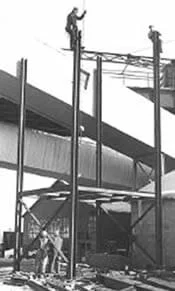 Ironworkers building a tower.Copyright http://www.eiu.edu/~insight/labor_day/ironworkers2.jpg
Lesson 1, The Next Dimension: Students are introduced to the concept of 3-D coordinate systems and graphing, which are essential to civil engineering work. In an associated activity, A Place in Space, students practice finding points in space and describing the location of given points in space.
Lesson 2, Skyscrapers: Engineering Up!: Students are presented with a history of skyscrapers and their unnique structural engineering design principles. In an associated activity, Newspaper Towers, students compete to build newspaper towers of maximum height and ability to withstand wind forces. In a second associated activity, Balsa Towers, student groups use balsa wood and epoxy glue to build structurally sound towers with favorable strength-to-weight ratios.
The ability to visualize in three dimensions is imperative to civil engineers. Engineers use a coordinate system whenever they create engineering drawings of structures, usually the Cartesian coordinate system. To build the tallest structures in the world, engineers must understand the importance of adequate foundations and redundancy in design to ensure safety and stability. To meet the challenge, engineers have devised and implemented many other creative designs and material uses so that their structures are able to withstand great forces. Students get a taste of these concepts and then apply what they have learned to create towers to meet specific objectives, as if they were civil engineers.
- CCSS.Math.Content.6.NS.C.6c Find and position integers and other rational numbers on a horizontal or vertical number line diagram; find and position pairs of integers and other rational numbers on a coordinate plane.
Grade 6
Do you agree with this alignment?
- MS-ETS1-1 Define the criteria and constraints of a design problem with sufficient precision to ensure a successful solution, taking into account relevant scientific principles and potential impacts on people and the natural environment that may limit possible solutions.
Grades 6-8
This resource focuses on the following Three Dimensional Learning aspects of NGSS:
Science & Engineering Practices- Define a design problem that can be solved through the development of an object, tool, process or system and includes multiple criteria and constraints, including scientific knowledge that may limit possible solutions.Do you agree with this alignment?
Disciplinary Core Ideas- The more precisely a design task's criteria and constraints can be defined, the more likely it is that the designed solution will be successful. Specification of constraints includes consideration of scientific principles and other relevant knowledge that is likely to limit possible solutions.Do you agree with this alignment?
Crosscutting Concepts- The uses of technologies and any limitations on their use are driven by individual or societal needs, desires, and values; by the findings of scientific research; and by differences in such factors as climate, natural resources, and economic conditions.Do you agree with this alignment?
- All human activity draws on natural resources and has both short and long-term consequences, positive as well as negative, for the health of people and the natural environment.Do you agree with this alignment?
Do you agree with this alignment? - Define a design problem that can be solved through the development of an object, tool, process or system and includes multiple criteria and constraints, including scientific knowledge that may limit possible solutions.
- Day 1: 3-D Coordinate System to Map Galaxies: The Next Dimension lesson
- Day 2: A Place in Space activity
- Day 3-4: Skyscrapers: Engineering Up! lesson
- Day 4-5: Newspaper Tower activity
- Day 5-7: Balsa Towers activity
Contributors
Kelly Devereaux; Ben Burnham
Supporting Program
Techtronics Program, Pratt School of Engineering, Duke University
Acknowledgements
This content was developed by the MUSIC (Math Understanding through Science Integrated with Curriculum) Program in the Pratt School of Engineering at Duke University under National Science Foundation GK-12 grant no. DGE 0338262. However, these contents do not necessarily represent the policies of the NSF, and you should not assume endorsement by the federal government.
Copyright
2013 by Regents of the University of Colorado; original © 2004 Duke University