
Forces All Around
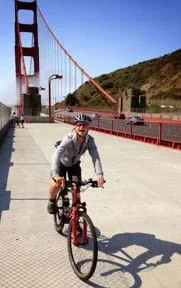 Whether designing bicycles or bridges, engineers consider the impact of forces at play in our world.Copyright 2013 Charles M. Carlson. Used with permission.
Through a series of three lessons, each with its own hands-on activity, students are introduced to 1) forces, loads and stress, 2) tensile loads and failure, and 3) torsion on structures—fundamental physics concepts that are critical to understanding the built world. The associated activities engage students through experimenting with hot glue gun sticks to experience tension, compression and torsion; the design of plastic chair webbing strips; and problem-solving to reinforce foam insulation "antenna towers" to withstand specified bending and twisting.
Flexing, deforming, twisting—what happens to materials when forces are applied? Consideration of compression, tension, shear, bending and torsion figures into the design of all the physical objects and structures that engineers create—everything from skyscrapers and bicycles to keyboards, bridge cables, medical implants and snow shovels. To make the designs function as intended, and perform reliably and safely, engineers must apply a thorough understanding of forces and their effects. Engineers are involved in choosing suitable materials and designing new materials such as composites with specific characteristics capable of responding to forces in a desired way.
- Students will develop abilities to apply the design process.
Grades K-12
Do you agree with this alignment? - Students will develop abilities to assess the impact of products and systems.
Grades K-12
Do you agree with this alignment?
- Construction Technologies
Grades 6-8
Do you agree with this alignment?
Suggested order to conduct the lessons and hands-on activities:
- Lesson 1: Fairly Fundamental Facts about Forces and Structures
- Lesson 1's activity: Forces in Structures: Glue Sticks Bend & Twist
- Lesson 2: Exploring the Forces of Tension
- Lesson 2's activity: Stop the Stretching
- Lesson 3: Investigating Torque
- Lesson 3's activity: Wimpy Radar Antenna: Reinforced Tower Test, Analyze & Improve
Supporting Program
K-12 Outreach Office, Worcester Polytechnic Institute
Acknowledgements
This unit includes curricula created and tested at the K-12 Outreach Office, Worcester Polytechnic Institute, and the Center for Engineering Educational Outreach, Tufts University.
Copyright
2016 by Regents of the University of Colorado; original © 2005 Worcester Polytechnic Institute