
Flow Rates of Faucets and Rivers
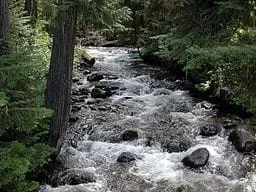 Students determine the flow rate of a river.Copyright Wikimedia Commons http://upload.wikimedia.org/wikipedia/commons/5/5e/WaltonCreekLochsa.jpg
Students are given background information to prepare them to conduct two associated activities in which they conduct hands-on experiments with a common faucet and then work with real-world USGS streamflow data to gain a better understanding of flow rate and how it pertains to engineering and applied science. From their experiment calculations, they hypothesize about the flow rate in a nearby river, and then use USGS streamflow data to check their hypotheses. For this lesson to be effective, make sure students obtain a visual feel for the flow in a nearby river.
Civil engineers are responsible for designing the systems that bring water from a natural setting such as a river or lake to the towns and cities where that water is needed. Civil engineers also manage natural system for flood control and drought mitigation. Students who complete this acitivty will have a greater understanding for what civil engineers who design water systems do and what skills they use in their careers.
After this lesson, students should be able to:
- Conduct a scientific investigation.
- Collect, interpret and analyze data in an organized way.
- Calculate the flow rate of a faucet.
- Estimate the flow rate of a river or stream based on visual observation.
- Use the Internet to collect real-time data.
- 6.1.2.b Fluently add, subtract, multiply, and divide multidigit decimals using standard algorithms for each operation.
Grade 6
Do you agree with this alignment? - 7.1.2.c Solve real-world and mathematical problems involving the four operations with rational numbers.
Grade 7
Do you agree with this alignment? - 6.1.1.c.iv Find a percent of a quantity as a rate per 100.
Grade 6
Do you agree with this alignment? - 8.2.1.b Graph proportional relationships, interpreting the unit rate as the slope of the graph.
Grade 8
Do you agree with this alignment? - 8.3.1.a Construct and interpret scatter plots for bivariate measurement data to investigate patterns of association between two quantities.
Grade 8
Do you agree with this alignment?
- Identify evidence that suggests there is a fundamental building block of matter
Grade 6
Do you agree with this alignment? - Use tools to gather, view, analyze, and report results for scientific investigations about the relationships among mass, weight, volume, and density
Grade 6
Do you agree with this alignment?
- CCSS.Math.Content.6.RP.A.2 Understand the concept of a unit rate a/b associated with a ratio a:b with b ≠ 0, and use rate language in the context of a ratio relationship.
Grade 6
Do you agree with this alignment? - CCSS.Math.Content.8.G.C.9 Know the formulas for the volumes of cones, cylinders, and spheres and use them to solve real-world and mathematical problems.
Grade 8
Do you agree with this alignment?
- STEL-7Q Apply the technology and engineering design process.
Grades 6-8
Do you agree with this alignment?
Flow Rate: Flow rate is the volume of water passing a point in a fixed period of time. Flow rate is usually measured in cubic feet per second (cfs or ft³/sec) but could also be measured in gallons or liters per minute or second. For example, if a running faucet took one minute to fill a gallon container, its flow rate would be 1 gallon per minute. Water flow in a stream, river or pipe also has a flow rate. The flow rate in a river, stream or pipe can be determined by multiplying water velocity by the cross-sectional area. For example, if water was flowing through a 1 foot diameter pipe (area = 0.8 ft2) at 5 feet per second, the flow rate would be 0.8 ft2 x 5 ft/sec = 4 ft3/sec. Refer to the Faucet Flow Rate activity for a hands-on investigation of this concept.
Teachers need to have a fair working knowledge of the USGS website, specifically USGS Current Water Data for the Nation (accessible at http://waterdata.usgs.gov/nwis/rt) before implementing this lesson in the classroom. The online User Guide goes into great detail about how to access the various kinds of available data. We recommended that you work through the User Guide and this activity before implementing in your class. Note that the River Flow Rate activity asks students to estimate the flow rate of a nearby river – one that they are presumably familiar with. Before implementing the Flow Rate lesson, determine the flow rate in this river within the USGS website.
Introduction
The U.S. Geological Survey (USGS) has thousands of stream flow monitoring stations throughout all 50 states; the amount of data available is astounding. Teachers have endless creative possibilities when working with this data in their classroom, but unless students understand what stream flow is, and have a good concept of the magnitude of a given flow rate (often just a number on a computer screen), they will not get the maximum benefit from the unit. This Flow Rate Experiment helps ensure that students have good conceptual understandings of flow rate, as well as helps them become more familiar with the USGS website and online data searching.
Engineering Relevance
The rate at which water flows is critical to many engineering situations. For example, civil engineers design stormwater drainage systems and canals based on a critical flow rate condition. For example, in an extreme storm event, water must flow in large quantities away from the storm area to prevent flooding, so civil engineers design drainage systems for extreme storm flow rates. As another example, fire fighters require a certain flow rate and water pressure to put out fires. So mechanical engineers design pump and delivery systems capable of providing the necessary flow rates and water pressures.
At the end of this lesson, students should communicate differences between their hypothesis and the actual USGS data related to their understanding of flow rate.
The goal of the Flow Rate Experiment is to help students gain a better understanding of flow rate, and to help them obtain a sense of scale for the flow rate in a river. The degree to which this is accomplished can be gauged by how well students are able to explain differences between their hypothesis and the USGS data.
Have students determine flow rates of faucets, shower heads and garden hoses used in their homes or school.
In the Faucet Flow Rate activity, student teams analyzed their own data. Collect the data tables from all teams and have each student or team compare their results with those of other teams. Comparison analysis will vary if faucets were different. However, if faucets were similar, discrepancies in data results could be due to operator variance.
- Flow Rates of Faucets and Rivers
Contributors
Bobby Rinehart; Karen Johnson; Mike Mooney
Supporting Program
Civil and Environmental Engineering Department, Colorado School of Mines
Acknowledgements
This curriculum was created with support from the National Science Foundation. However, these contents do not necessarily represent the policies of the National Science Foundation, and you should not assume endorsement by the federal government.
Copyright
2013 by Regents of the University of Colorado; original © 2005 Colorado School of Mines