
History and Geometry of Roman Aqueducts
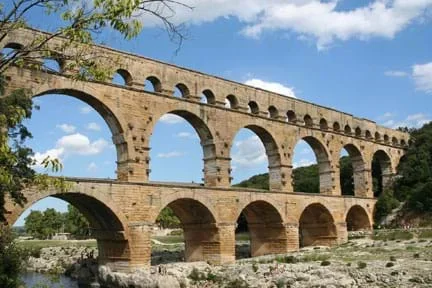 Aqueducts are massive and long water channels built by the Romans to transfer water over long distances.Copyright Izaz Krakowa, Pixabay (CC0 public domain) https://pixabay.com/en/aqueduct-water-the-stones-holidays-979211/
Students see that geometric shapes can be found in all sorts of structures as they explore the history of the Roman Empire with a focus on how engineers 2000 years ago laid the groundwork for many structures seen today. Through a short online video, brief lecture material and their own online research directed by worksheet questions, students discover how the Romans invented a structure known today as the Roman arch that enabled them to build architecture never before seen by humankind, including the amazing aqueducts. Students calculate the slope and its total drop and angle over its entire distance for an example aqueduct. Completing this lesson prepares students for the associated activity in which teams build and test model aqueducts that meet specific constraints. This lesson serves as an introduction to many other geometry—and engineering-related lessons—including statics and trusses, scale modeling, and trigonometry.
The geometry and engineering employed by the Romans enabled them to create structures never before possible. The invention of the Roman arch gave them the capability to build larger and heavier structures than any other civilization up to that point. These arches were designed in such a way that the force applied down on them was directed horizontally instead of vertically. This meant that they could place larger weight on these structures without sacrificing safety. At the time, Roman engineers incorporated these arches in almost every structure they built, including the Colosseum and water aqueducts. These methods however were not only employed by the ancient Romans, but are still used today in modern structures such as bridges.
After this lesson, students should be able to:
- Explain how Roman aqueducts worked, what they were used for, and why they were so innovative and necessary for the time.
- Describe tools and processes used by Roman engineers to build aqueducts over long distances.
- Solve simple calculations using the Pythagorean Theorem to find the slope of an aqueduct over a long distance.
- HS.4.5.a.i Use geometric shapes, their measures, and their properties to describe objects.
Grades 9-12
Do you agree with this alignment?
- Students will develop an understanding of engineering design.
Grades K-12
Do you agree with this alignment?
Students must know the Pythagorean Theorem and how to solve for the length of sides of right triangles.
The arch most commonly used by the Romans in their architecture is called the round or semicircle arch. Roman arches are built by using a support bridge to hold up the stones until the final stone, the keystone, is placed. The keystone spreads the downwards force and enables the arch to support large weights. The semicircle arch is built so that the arch height is exactly half of the arch width. Material must be placed on the sides of the arches because the force acting vertically is redirected horizontally by the arch.
Although these arches were invented and used during Roman times, they still have relevance today. The arch was such a hugely innovative way to build stronger structures using less material that they are often used in modern designs. Arches not only add style to structures, but they also enable structures to support far more weight than other shapes.
(Be ready to show the class an online 10-minute video, Roman Engineering-Aqueducts. Queue up the video to start at minute 6:30; showing the first part of the video is optional. Make copies of the Arch Research Worksheet (PDF), one per student. Also have available computers with Internet access for student pairs to conduct research. Kick off the lesson by telling students the following information.)
Geometry contributes greatly to the world of engineering. Nearly every human-made structure includes geometric shapes that compose its form. Think about it—it is difficult to find a structure without a shape! Every building structure incorporates geometrical shapes ranging from circles to complex polygons. These shapes can be found in all structures because they are fundamental to the architecture. In the rare cases when buildings are made strictly from curved features with no particular geometric shape whatsoever (maybe caves or hobbit houses!), you can imagine that it would be difficult to verify that the structure is safe to use or occupy since it would be challenging to analyze the structure from an engineering point of view.
Geometry is a tool that can be used in many different applications and has been used to build structures for thousands of years. It has an important and impressive history.
Continuing Teacher Instructions
Next, show the class the last three minutes of the online video. Start at minute 6:30; the key information for this lesson begins at minute 7:00. Pause the video at 7:38 and ask students to work with one other person to calculate the slope of the aqueduct mentioned in the video. Student answers will vary, given the approximation provided by the video. If students need help, remind them that the video mentioned that the aqueduct dropped just “several inches every 100 feet,” which is about 1 meter per 1 kilometer (1 meter = 3.28 feet; 1 kilometer = 3280 feet). Thus, prompt students to convert the meter and kilometer units into feet to yield a simplified fraction with a rise of -1 foot. (Answer: rise = -1 foot; run = 1000 feet) Lead a short discussion with the class and ask a few students to share their answers; check to make sure the rest of the class arrived at the same answer. Then continue watching the video until the end.
After students have finished watching the video, go back to the example that they solved previously about the slope of the aqueduct. Direct students to get back with their partners and calculate the total drop of the longest aqueduct built (approximately 53 miles, 5280 feet = 1 mile) and ask them to calculate the angle in degrees of the aqueducts relative to flat ground. (Answers: drop = 279.84 feet; angle = .057 degrees) After students have completed their calculations, lead a short discussion to review the logic of the calculations like before, to make sure all students obtained the correct answer.
Next, direct students to do some Internet research on Roman arches. Have students work with the same partner as before. Hand out the worksheets. Suggest they search using keywords such as Roman arch, Roman aqueduct, Roman engineering. Direct them to investigate to find out the following two pieces of information and complete worksheet questions 1 and 2.
- Determine the version of the Roman arch that was used to build the aqueducts. (A good resource for the names of arch types is https://en.wikipedia.org/wiki/Arch.)
- Identify the device the Romans used to make sure the aqueducts ran at a steady slope across the entire length. (A useful website is http://www.romanaqueducts.info/picturedictionary/pd_onderwerpen/tools.htm.)
After 10 minutes, lead a class discussion about the types of arches students found. If anyone uncovered different answers, ask them to explain why they chose that arch version. Example questions: What types of arches did you find? Did anyone find different arches? Why did you choose that arch type?
Also discuss the device(s) the Romans used to measure slope and see if anyone was able to find the name(s) of it/them (chorobate, dioptra, groma, libella, etc.) and the similar device that is used today (level). Example questions: What did you find out about the device the Romans used to measure slope? What was it called? Did you find out about a device used now that is very similar?)
Lastly, direct students to focus on worksheet question 3, continuing to use their computers to research the Roman aqueducts and how they were engineered. A good website to get students started is https://www.history.com/news/history-lists/10-innovations-that-built-ancient-rome. Suggest that students find as many sources as possible for their information, and generally strive to be unique and creative in their searches. If they use Wikipedia, advise them to look at the Wikipedia page’s source references rather than the Wikipedia page itself.
After 15 minutes, pull the groups back together for a class discussion about how the aqueducts were built. Inform them that in the upcoming associated activity Let’s Build an Aqueduct! , they will apply what they have learned to design their own mini-aqueducts to transport water from one location to another.
- aqueduct
- A bridge structure built to transport water from a point A to a point B.
- arcade
- A series of adjoining rounded arches.
- arch
- A curved architectural structure that spans a space and supports the weight it carries.
- keystone
- The central and final stone placed in the arch, located in the top center.
Embedded Assessment
Basic Calculations: During the introductory class discussion, ask students the following questions. Then make sure all students are able to arrive at the correct answers.
- Ask student pairs to solve the problem about the slope of the aqueduct mentioned in the video.
- Ask student pairs to calculate the total drop and angle of the longest aqueduct built (~53 miles).
Research Questions 1 & 2: As student pairs are conducting online research to answer questions 1 and 2 on the Arch Research Worksheet (PDF), roam around to make sure they are on the right track. Then lead a short class discussion using the question provided in the Introduction/Motivation section to prompt students to describe what they learned online and share their findings. Also refer to the Arch Research Worksheet Answer Key (PDF).
Lesson Summary Assessment
Research Question 3: To answer question 3 on the Arch Research Worksheet (PDF), students continue online research about aqueducts and how they were engineered (not focusing on dates or people’s names). They collect information and then share their findings during a class discussion. Assignment tip: Assigning each student pair a single topic to research from the eight example questions provided on the worksheet often helps to focus the investigations and uncover more information in the end. Student research tip: If students plan to use Wikipedia, which is always a good source of information, tell them to use the source material for Wikipedia rather than the Wikipedia page itself. Directing students to find as many sources as possible for their information results in a better discussion at the end. Challenge them to be unique and creative in their searches. You do not want the entire class getting all of its information from the same source because that limits the input and dampens the discussion.
- Example questions: What materials did the Romans use? What was different about how the Romans held their materials together? How many types of arch designs were you able to find? How did the Romans go through mountains at a constant slope? What sort of formulas did the Romans use in their engineering? How do you apply these formulas? What sorts of other tools did the Romans use? How long would it take to build one of these arches?)
- Example answers: The Romans typically used concrete and occasionally lead pipe for some sections. Roman concrete used volcanic ash, which made it extremely strong and why some Roman building still stand today. They used formulas to calculate the arch designs. Aqueducts took 1-2 years to finish depending on size. Devices called chorobates and dioptra were used to calculate slopes. Also refer to the Arch Research Worksheet Answer Key (PDF).
- History and Geometry of Roman Aqueducts
Contributors
Nathan Coyle; Malinda Zarske; Andi Vicksman; Maia Vadeen; Ryan Sullivan; Russell Anderson; Lauchlin Blue
Supporting Program
CU Teach Engineering (a STEM licensure pathway), Engineering Plus Degree Program, University of Colorado Boulder
Acknowledgements
This activity was developed by CU Teach Engineering, a pathway to STEM licensure through the Engineering Plus degree program in the College of Engineering and Applied Science at the University of Colorado Boulder.
Copyright
2016 by Regents of the University of Colorado