
Art in Engineering - Moving Art
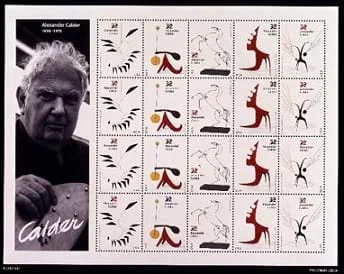 The U.S. Postal Service issued stamps commemorating the art of Alexander Calder (1898-1976), a modern artist and engineer who used forces in his artwork. He bent and twisted wire and steel to make 3D sculptures and created mobiles that move and balance.Copyright U.S. Postal Service, http://www.usps.com/images/stamps/98/calder.htm, 1998.
Students learn how forces are used in the creation of art. They come to understand that it is not just bridge and airplane designers who are concerned about how forces interact with objects, but artists as well. As "paper engineers," students use the associated activities to create their own mobiles and pop-up books, and identify and use the forces (air currents, gravity, hand movement) acting upon them.
One of the jobs of an engineer is to learn how to use forces in ways that benefit society. Examples of situations in which forces are important in engineering are designing bridges that can withstand the force of high winds and countless semi-trailer trucks, designing roofs that do not collapse under the load of heavy snow, making music players that work flawlessly while a person is running, or creating airplane wings that harness wind forces to enable flight.
After this lesson, students should be able to:
- Identify several different types of forces used by both artists and engineers.
- Describe how physical forces are used in the creation of art.
- Use elements of art, principles of design and styles of art to communicate their understanding of forces.
- Experiment with materials, tools, techniques and processes that enhance communication of ideas through art.
- Predict and evaluate the movement of an object by examining the forces applied to it
Grade 8
Do you agree with this alignment?
- STEL-1L Explain how technology and engineering are closely linked to creativity, which can result in both intended and unintended innovations.
Grades 6-8
Do you agree with this alignment? - STEL-3G Explain how knowledge gained from other content areas affects the development of technological products and systems.
Grades 6-8
Do you agree with this alignment?
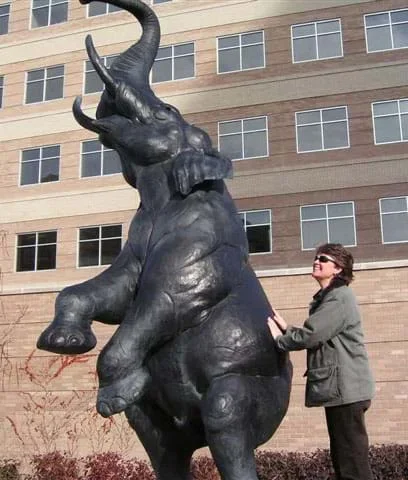 Figure 2. Elephant and Mouse by Daniel Ostermiller, Museum of Outdoor Art, Greenwood Plaza, CO.Copyright Charles M. Carlson, November 2004. Used with permission.
A force is a push or a pull on an object. Gravity is one of the most common forces we encounter every day. Have students illustrate the effect of such forces with the hands-on activity Mobile Forces. It is always pushing us towards the center of the Earth. In outer space, we are very far away from the center of the Earth and therefore the gravitational forces are much smaller. This is why astronauts appear to be floating.
Some sculptures look as if they would topple over at any minute. Are they actually defying gravity? Well, no. The sculpture is balanced on its center of mass (see Figure 2). The center of mass of an object is the point at which all of an object's mass may be considered to be concentrated. This means that the object can balance on a point as long as that point is directly below the object's center of mass. The artists of these sculptures carefully design their work so that the center of mass of the object is supported. We carefully align our own center of mass when walking on tightrope or a balance beam by putting our hands out to our sides.
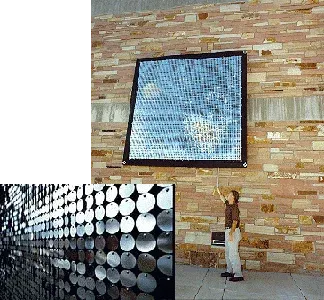 Figure 3. Slice of Wind by Ned Kahn, Boulder, CO. This wind-driven, kinetic sculpture measures 10 x 10 feet and features 10,000 Mylar disks that move freely on rivets, allowing the wind to generate an infinite number of patterns on the sculpture's face. Visitors can use the handle to create their own modal vibration patterns.Copyright ITL Program, College of Engineering, University of Colorado at Boulder, 1997.
The wind also creates forces. On blustery days you can see the wind move the leaves on a tree. Wind forces also push sailboats through water. Similar forces cause movement in outdoor sculptures (see Figure 3), such as wind chimes or mobiles. Wind currents are created by hot air rising and cool air settling. Hot air rises because it is less dense than cool air. This same principal works both outside and inside buildings, although the outside currents tend to be a lot stronger. These convection currents are what cause wind chimes to sing and mobiles to rotate.
Not all forces occur naturally. For example, people can create forces using energy from the food they eat. This happens when we push someone on a swing, move a chair across a room or play tug of war. Refer to the engineering design activity Engineering Pop-Up Books to have students investigate this phenomena. When we read pop-up books, we apply very small forces to tabs and flaps to make them move. When we rotate a flap, it is called a torque. A centripetal force is also created when an ice-skater turns or we spin in a chair.
 Figure 1. Golden Gate Bridge in San Francisco, CA. Engineers and artists consider natural and manmade forces in their designs.Copyright Charles M. Carlson, August 2004. Used with permission.
Have you ever wondered how ink pens work, why mobiles move, or why we do not float off into space? This is because of forces exerted by gravity and the wind. What happens when these forces do not exist? Well, in space, astronauts write with special pens because the gravity forces that normally push the ink out of your pen (on Earth) do not exist in space. Sculptures, such as mobiles and wind chimes, would not move or make sounds without wind forces.
One of the jobs of an engineer is to learn how to use forces to design and create things, such as making special pens for use in space. Knowing what forces affect an object is a primary concern for an engineer. A force is any push or pull on an object. One force that we all know is gravity, which pulls us towards the center of the Earth. Other natural forces also cause a push or pull, such as wind and water.
People can also create forces by pushing or pulling on something, like a wagon. Engineers always take the forces of gravity and wind into account when they design and construct buildings, airplanes or bridges, such as the Golden Gate Bridge in San Francisco (see Figure 1). Artists also consider these forces when they design decorative or dramatic buildings, landscapes or artwork. Some artists pay close attention to forces when they create moving sculptures, such as mobiles, or design pop-up-books. Engineers and artists are a lot alike when they study the effects of forces on something they are designing. Often engineers and artists work together to design and build some of the greatest structures on Earth!
Forces are all around us. Every time we push or pull something, we are applying a force. What are some common forces? (Possible answers: Gravity, wind, friction.) Engineers consider forces when they design almost everything, including buildings, airplanes, bridges and dams. Can you think of which forces are affecting these things? (Possible answers: Roof, people moving, air pressure, wind, traffic, snow, water, etc.) Artists also think about the same forces as engineers when designing sculptures, mobiles and even pop up books! Today we learned about how both artists and engineers need to know about forces when they design and create.
- center of mass
- The point at which all of an object's mass may be considered to be concentrated.
- centripetal force
- A force that makes a body follow a curved path.
- convective current
- Air movement caused by the rising of low density hot air and the sinking of high density cold air.
- energy
- The ability to do work.
- force
- A push or a pull on an object.
- gravity
- A force that pushes objects towards the center of the Earth.
- kinetic
- Of, relating to, or produced by motion.
- mobile
- Artwork that moves with air currents.
- work
- The use of energy.
Pre-Lesson Assessment
Discussion Questions: Ask the students and discuss as a class:
- What is a force? (Answer: A force is a push or a pull on an object.)
- What creates forces (Answer: Gravity, wind, people, water, etc.)
- What are different forces you have seen? (Answer: Apples falling from trees due to gravity, wind blowing on leaves, people pushing a shopping cart, person pulling another's hand, etc.)
Post-Introduction Assessment
Voting: Ask true/false questions and have students vote by holding thumbs up for true and thumbs down for false. Tally the votes and write the number on the board. Give the right answer.
- True or False: Engineers always take the forces of gravity and wind into account when they design bridges, buildings or airplanes. (Answer: True)
- True or False: Engineers and artists rarely work together to build structures. (Answer: False)
Lesson Summary Assessment
Word Puzzle: Have the students complete the attached Sculpture Vocabulary Crossword Puzzle to reinforce the vocabulary terms. Remind students that engineers need to know the vocabulary associated with a project to explain their design to their audience. For younger or ESL students, use the easier worksheet version (it provides a list of words).
Homework
May the Force Be with You: Have students identify all the different forces they see on the way home from school. They should each be able to come up with 10 examples (such as wind-blowing trash, motor pushing a bus forward, kids kicking a ball, etc.). Select one of the forces and come up with a way an artist may use that force (such as putting a motor on a sculpture to make it move, creating a mobile that catches the wind to cause movement, etc.). Have a class discussion about the homework during the next class period.
Have the students identify other art forms that are concerned with forces and research the impact of these forces on the discipline, such as ballet (spins and lifts) or theater (rotating stages, levitating actors/actresses and lowering curtains).
Alexander Calder. Calder Foundation. Accessed February 8, 2005. http://www.calder.org
Alexander Calder, Biography. The Collection, National Gallery of Art, Washington, DC. Accessed February 8, 2005. http://www.nga.gov/cgi-bin/pbio?55300
- Art in Engineering - Moving Art
Contributors
Natalie Mach; Malinda Schaefer Zarske; Denise W. Carlson
Supporting Program
Integrated Teaching and Learning Program, College of Engineering, University of Colorado Boulder
Acknowledgements
The contents of this digital library curriculum were developed under a grant from the Fund for the Improvement of Postsecondary Education (FIPSE), U.S. Department of Education and National Science Foundation GK-12 grant no. 0338326. However, these contents do not necessarily represent the policies of the Department of Education or National Science Foundation, and you should not assume endorsement by the federal government.
Copyright
2005 by Regents of the University of Colorado.