
Fresh or Salty?
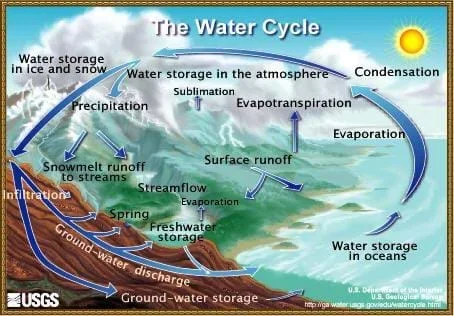 Figure 1. The water cycle.Copyright U.S. Geological Survey http://ga.water.usgs.gov/edu/watercycle.html
More than 70% of the Earth's surface is covered with water and still more water exists in the atmosphere and in underground aquifers. In this lesson, students learn about water bodies on the planet Earth and their various uses and qualities. They learn about several ways that engineers are working to maintain and conserve water sources. They also think about their role in water conservation.
Water is an important resource that all forms of life require for survival. Engineers study the water cycle and the various water bodies that make up the water cycle in order to continually ensure clean water is available. In the U.S., it is easy to take for granted the clean water coming out of our taps, but engineers are the ones who have designed the infrastructure to make sure this clean water is so readily available. They design water treatment plants and distribution systems that bring this resource to our homes. To build a water treatment plant, engineers must thoroughly understand the properties of nearby water bodies, including whether they are a good continual source for water. They also create new technologies and projects, such as tidal turbines and desalination plants to use oceans and their tides for water sources and to create electricity.
After this lesson, students should be able to:
- List the major bodies of water on Earth.
- Describe the Earth's water resources available for humans to use.
- Sketch a personalized water cycle that includes their community's major water resources/bodies and drinking water sources, as well as human treatment.
- Explain several ways that engineers are working to maintain and conserve water sources.
- Create and evaluate models of the flow of nonliving components or resources through an ecosystem
Grade 4
Do you agree with this alignment?
- The use of technology affects the environment in good and bad ways.
Grades 3-5
Do you agree with this alignment? - STEL-2H Identify the resources needed to get a technical job done, such as people, materials, capital, tools, machines, energy, and time.
Grades 3-5
Do you agree with this alignment?
- 5-ESS2-2 Describe and graph the amounts and percentages of water and fresh water in various reservoirs to provide evidence about the distribution of water on Earth.
Grade 5
This resource focuses on the following Three Dimensional Learning aspects of NGSS:
Science & Engineering Practices- Describe and graph quantities such as area and volume to address scientific questions.Do you agree with this alignment?
Disciplinary Core Ideas- Nearly all of Earth's available water is in the ocean. Most fresh water is in glaciers or underground; only a tiny fraction is in streams, lakes, wetlands, and the atmosphere.Do you agree with this alignment?
Crosscutting Concepts- Standard units are used to measure and describe physical quantities such as weight and volume.Do you agree with this alignment?
Do you agree with this alignment? - Describe and graph quantities such as area and volume to address scientific questions.
Plenty of Water or Not Enough?
More than 70% of the Earth's surface is covered with water and even more exists underground in aquifers. It is estimated that the total water supply of the world is 326 million cubic miles. With so much water available on Earth, why are people so concerned with the lack of water? In actuality, very little of the water on Earth is suitable for human consumption. The oceans account for 97.24% of the water on Earth, but it is unfit for human consumption because of its high salt content. To date, desalinization methods are expensive and not widely used. Another 2.14% of the water is tied up in icecaps and glaciers. Of what is left 0.61% is groundwater (meaning it resides under the Earth's surface). Only 0.0091% of the water on Earth resides in rivers and lakes. Of the ground and surface water that is supposedly available for drinking, only 0.3% of this is suitable for human consumption. Refer to the fun and hands-on activity Can You Catch the Water? where students discuss how engineers design structures that impact water collection, as well as systems that clean and distribute water.
Fresh Water Usage
The Earth is a closed system, meaning that matter does not enter or escape. So the water we have on Earth today has always been here. It cycles through in different forms, but at any given point in time, we have the same amount of water on the planet as we have always had.
The average American uses 101.5 gallons per day. Collectively, in the U.S. in 2015, we used ~322 billion gallons per day of surface water, and ~82 billion gallons per day of groundwater. This "used" water then must to be cycled through water and waste treatment plants—and is probably never going to be quite as clean again as it was originally.
Ocean Water and Desalination
Oceans moderate the Earth's temperature by absorbing incoming solar radiation. For years, we have identified four oceans: Pacific, Atlantic, Indian and Arctic. In 2000, the International Hydrographic Organization delimited a new ocean, the Southern Ocean, which surrounds Antarctica and extends to 60 degrees latitude.
Ocean and sea salinity varies throughout the world, but the average salt content is 2.2 pounds of salt for every cubic foot of water. The saltiest seawater is in the Persian Gulf, which is 40% salt; the least saline-rich water is in the polar regions, where the source water is melting ice and heavy precipitation. Refer to the fun and hands-on activity One World Ocean for students to s learn about ocean currents and the difference between salt and fresh water.
Snow Melt
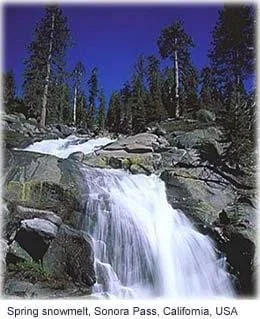 Copyright Cagan Hakki Sekerioglu, U.S. Geological Survey http://ga.water.usgs.gov/edu/watercyclesnowmelt.html naturalphotos.com.
It is estimated that 75% of water used in the western U.S. is from snowmelt. During the winter season, snow falls in rural and mountainous areas, leaving solid, packed snow to freeze in these higher altitudes (often, the snow that falls in rural areas melts within days or even hours). This hard, often very deep, snow freezes month after month, developing a good base for skiing and other winter recreational activities. But, more importantly, this snowpack is a major source of water as part of our planet's water cycle.
Residents of warmer regions (such as Florida) do not directly benefit from the snowmelt in colder regions, but they are indirectly impacted since the water eventually enters the Earth's water cycle. Residents of colder regions, where snow builds up, directly benefit from snow melt, as upon melting, the water immediately enter streams, rivers and reservoirs in local communities and is sometimes the only water source.
Engineers need to know a great deal about snowmelt, which is a vital water resource for our planet. Engineers at the U.S. Geological Survey monitor snow runoff in order to prevent low-elevation flooding—a very real threat during spring runoff. Students can conduct a hands-on activity Snow vs. Water to investigate using snowmelt as a water source for communities.
Why is water important? For what purposes do we need water? Do you need water to survive? Does your food need water to grow? What would the world do without water? These are questions we ask when learning about the value of water.
If you are thirsty and need a glass of water, do you want a glass of dirty water or clean water to drink? Probably clean—or fresh—water is what you want! Finding fresh water, however, is becoming more and more difficult as the world's population grows. With more people around, the demand for fresh drinking water is increasing while the amount of fresh and clean water is becoming more scarce. Where do we get our drinking water? We turn on our faucets at home, but how do we know where that water originates? Did it come from the river running through the field behind your backyard, was it pumped out of the ground somewhere, or is it water from the ocean from which salt was removed? Well, it might be from any of these sources, depending on where you live. Engineers are responsible for making sure we have clean drinking water. They learn about the water properties, water sources, water quality, and how to clean up unclean water. Engineers design the steps for water treatment, devising ways to clean up water from natural sources, like streams and snow pack, and they even develop systems that clean up water we have used and flushed down our toilets and drains! As you know from the water cycle, water is endlessly used, over and over again.
Roughly 71% of the Earth's surface is covered in water. Where is the Earth's water located? Well, water on the Earth is found in oceans, rivers, lakes, the atmosphere, and in underground aquifers. Oceans are the largest water source, containing 97% of the Earth's water. Unfortunately, we cannot use this water for drinking because it is too salty. Engineers have devised many ways to remove the salt from ocean water so it is usable for drinking, but the methods are typically expensive and not used very often. Very little of the Earth's water is suitable to be used for drinking water. In fact, less than one percent of our water is in rivers, lakes and groundwater. We get most of our drinking water from these types of surface waters. (Refer to the activity Break the Tension to teach students basic properties of water surface tension as related to harvesting the natural resource.) Another way to get drinking water is from the atmosphere, such as rain and snow. But, what happens if you count on snow for water and the weather becomes too warm? Well, snowmelt in the spring and summer provides a great source of fresh water for many communities. It is estimated that 75% of water used in the western U.S. is from stored-up snowmelt.
Humans use a lot of water! Think of all the ways that you use water during the day. You most likely use water to drink, brush your teeth, take a shower or bath, cook, flush the toilet and wash your dishes. These are just a few ways we use water. Now think about this: do you leave the water running while you brush your teeth or wash your hands? Well, most of us waste a lot of water somehow. The average American uses 101.5 gallons of water per day! We are using up our water fast. Some engineers are focused on finding ways to help us save some of this valuable fresh water. They design low-flush toilets and shower heads that use less water. Can you think of some things that you can do to ensure that clean water remains for the people/animals/plants of tomorrow?
Who can name a major source of water? Our water comes from oceans, rivers, lakes, the atmosphere and groundwater/aquifers. Which water body has the greatest amount of water? (Answer: The oceans contain 97% of the Earth's water.) Where do we get most of our drinking water? (Answer: We get most of our drinking water from surface water.) Why is ocean/sea water not used for us to drink? (Answer: It is too salty.) What are some things you think we should do to ensure that clean water is available in the future for people/animals/plants? [Answer: We can conserve water by being frugal about how much we use daily: turn off faucets, take shorter showers, water lawns less and when the weather is cooler (to minimize water loss due to evaporation), etc.] How do engineers help us get clean drinking water? (Answer: Engineers design water treatment and wastewater treatment plants to clean and help conserve water for daily use.)
- aquifer
- An underground bed or layer of earth, gravel, or porous stone that yields water.
- groundwater
- Water that exists underground.
- salinity
- Containing salt.
Pre-Lesson Assessment
Discussion Question: Ask a discussion question to get students thinking about the upcoming lesson. After soliciting answers, explain that these questions will be answered during the lesson.
- What are the major types of water on Earth? (Answer: Oceans/seas, lakes, rivers, groundwater, aquifers, glaciers/snowpack).
- Which of these bodies of water represent the most quantity of water on Earth? (Have student rank from most to least.)
Post-Introduction Assessment
Question/Answer: Ask students questions and have them raise their hands to respond. Write their answers on the classroom board.
- From where does our drinking water come? (Answer: Out of the tap! But originally, most of it comes from surface water.)
- Why are water engineers concerned with snow pack? (Answer: It is a good source for drinking water.)
- Can you drink water from the ocean/sea? (Answer: No, it is too salty.)
Lesson Summary Assessment
Drawing & Pie Chart: Write the following percentages on the board: oceans 97.24%, icecaps/glaciers 2.14%, groundwater 0.61%, rivers/lakes 0.0091%. Assign students to make drawings of each of these major water bodies and label each with its respective percentage of the Earth's total available water. Have them identify on their drawings where their community's drinking water comes from by circling it; for some students, this may be groundwater/aquifer, while for others, it may be mountain snow that melts and is stored in a nearby reservoir. For extra credit, have students make a pie chart proportioned to the four percentages.
Journal Reflection: Assign students to write a few sentences in their STEM journal or on a sheet of paper about how they use water daily and what they can do to conserve water. Have them include a sentence on ways engineers help us to conserve and clean water.
Homework (optional)
Making It Personal: Civil, sanitary, chemical and environmental engineers work together to design water and wastewater treatment plants so that we have clean water. As homework, ask students to each draw a picture of the water cycle, personalized with their community's drinking water source(s) and the major water bodies present in their state or region. Expect students to be able to show with words and pictures how these water bodies are part of the water cycle and how they do/do not provide water for their houses/schools, etc. Ask them to integrate water/waste treatment plants into the cycle, which shows their understanding that water for human consumption goes through treatment steps before it is provided at the tap and after it leaves our homes and schools.
U.S. Department of the Interior, U.S. Geological Survey, Water Science for Schools, "The Water Cycle," May 10, 2006. Accessed June 24, 2006. Originally found at http://ga.water.usgs.gov/edu/watercycle.html
U.S. Department of the Interior, U.S. Geological Survey, Water Science for Schools, "The Water Cycle: Snowmelt Runoff to Streams," May 10, 2006. Accessed June 24, 2006. Originally found at http://ga.water.usgs.gov/edu/watercyclesnowmelt.html
Contributors
Sara Born; Malinda Schaefer Zarske; Janet Yowell
Supporting Program
Integrated Teaching and Learning Program, College of Engineering, University of Colorado Boulder
Acknowledgements
The contents of this digital library curriculum were developed under grants from the Fund for the Improvement of Postsecondary Education (FIPSE), U.S. Department of Education and National Science Foundation (GK-12 grant no. 0338326). However, these contents do not necessarily represent the policies of the Department of Education or National Science Foundation, and you should not assume endorsement by the federal government.
Copyright
2006 by Regents of the University of Colorado