
Naturally Speaking
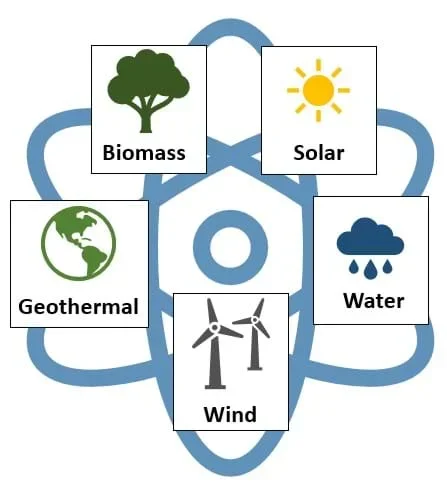 Figure 1. The five sources of renewable energy.Copyright 2020 Sabina Schill
In this lesson, students identify the Earth's natural resources and classify them as renewable or non-renewable. They simulate the distribution of resources and discuss the fairness and effectiveness of the distribution. Students identify ways that they use — and waste — natural resources, and they explore ways that engineers interact with natural resources.
The development of new resource technologies and innovative clean-up methods for waste are common research areas for environmental engineers. When designing products or systems, engineers may use renewable resources, nonrenewable resources, or both. Some engineers invent new technologies that use renewable resources; however, it is the responsibility of all engineers to conserve non-renewable resources in everything they design for society. Other engineers work to clean up the water and air pollution that is created by coal and oil systems.
After this lesson, students should be able to:
- Understand the importance and consequences of use, preservation and conservation of the Earth's natural resources.
- Classify resources as either renewable or non-renewable.
- Develop an understanding for the ways natural resources are distributed.
- Understand how engineers interact with and use our natural resources.
- Analyze and interpret a variety of data to understand the origin, utilization, and concerns associated with natural resources
Grade 5
Do you agree with this alignment?
- STEL-4I Explain why responsible use of technology requires sustainable management of resources.
Grades 3-5
Do you agree with this alignment?
- 4-ESS3-1 Obtain and combine information to describe that energy and fuels are derived from natural resources and their uses affect the environment.
Grade 4
This resource focuses on the following Three Dimensional Learning aspects of NGSS:
Science & Engineering Practices- Obtain and combine information from books and other reliable media to explain phenomena.Do you agree with this alignment?
Disciplinary Core Ideas- Energy and fuels that humans use are derived from natural sources, and their use affects the environment in multiple ways. Some resources are renewable over time, and others are not.Do you agree with this alignment?
Crosscutting Concepts- Cause and effect relationships are routinely identified and used to explain change.Do you agree with this alignment?
- Knowledge of relevant scientific concepts and research findings is important in engineering.Do you agree with this alignment?
- Over time, people's needs and wants change, as do their demands for new and improved technologies.Do you agree with this alignment?
Do you agree with this alignment? - Obtain and combine information from books and other reliable media to explain phenomena.
There were many types of energy resources that early humans used. Wood was the main source of many activities for humans, including heat, travel and shelter. Our ancestors also used the energy from the sun and wind to help them work, travel or even stay safe and warm. As humans continued to develop early technologies, they learned to use wind and water to help them grind grain for food.
In the 1600s, coal became a more popular source of heat than wood and people continued to develop additional uses for coal. Next, the invention of steam engines increased the demand for coal in the world. Now, coal and oil are the primary resource used for electricity, which powers most everything we use in our homes. In the US, 63% of electricity is generated from fossil fuels, and most of our public transportation and cars are gas-powered.
Both renewable and non-renewable energy resources are very important to our daily lives. Without even being aware of it, we use both of these types of resources everyday through many activities that we do (from taking a bath/shower in the morning to driving to school to cooking dinner to reading beside a lamp before bed).
To take the concept of resources a step further, natural resources are things that are found in nature and can be either a renewable or a non-renewable resource. Following is a list of natural resources:
- Plants – Plants recycle oxygen/carbon dioxide in our atmosphere. They can be renewable as long as they are replanted as they are used up.
- Water – Water is a renewable resource as long as it is used wisely. A shower uses about 3 gallons of water a minute, a bath uses about 30 gallons of water, and each flush of the toilet sends about 3 gallons of water through the pipes.
- Land – Although land is not an infinite resource, there is a lot of land in the world. We need to keep it from eroding unnecessarily (but, natural erosion is okay). Land can be made renewable by adding fertilizer to enrich the soil; but fertilizers in turn can pollute water sources and then become harmful — and even pose a great threat — to animals, and in some cases, even humans.
- Air – Air can be renewable as long as we can keep it clean.
- Minerals – If minerals are mined (which they typically are), they are non-renewable. Minerals are often used for jewelry and industrial applications. Mining often leads to land erosion.
- Fossil Fuels – Fossil fuels formed from the remains of plants and animals that were buried under layers of mud and silt millions of years ago. Heat and pressure eventually transformed the remains into concentrated chemical energy. The most common forms of fossil fuels are coal, oil and natural gas. These are non-renewable resources.
Coal – Coal is the cheapest and most abundant of the fossil fuels in the U.S. Mining coal destroys the Earth's surface environment. Also, drainage from the mines pollutes the water, and burning coal produces large amounts of sulfur and carbon dioxide in our atmosphere.
Oil – Oil is the major source of liquid fuels (like gasoline) used for transportation and heat. Production, transportation and burning of oil pollute the air (carbon dioxide, sulfur and other gases), the land and the water, especially if an oil spill occurs.
Natural Gas – Natural gas generates less air pollution when burned than other fossil fuels. It is also a fairly efficient fuel.
Currently, we use fossil fuels for most of our energy needs because they are relatively easy to obtain and to transport. Fossil fuels are often burned so that pressurized water can be heated and thus create steam (which then turns a turbine and provides mechanical energy). Unfortunately, the burning of fossil fuels causes air pollution.
Due to our success as a species, the human population has risen beyond its natural limits and is increasing rapidly. Our current population is nearly 8 billion. It is estimated that four babies are born every second. This population explosion is putting an enormous strain on our natural resources. Engineers, therefore, devote considerable time designing new and improved methods to conserve our natural resources to ensure the livelihood of future generations.
The National Academy of Engineers ranks petroleum and gas technologies as number 17 of the 20 greatest engineering achievements of the 20th century. Such advanced technologies have created many conveniences and luxuries for our society, but we must all remember that many of our resources are in short supply, and it is to our benefit to use them wisely.
What is a resource? Where have you heard that word before? Have you heard it used when the environment was being discussed? A resource is something that is a source of supply or support. Oftentimes a resource is described in terms of money, energy or people for support. Natural resources are things that are found in nature.
When discussing the environment, resources are listed into different categories. Things that we can use over and over again are labeled renewable resources; things that we can only use once before they are gone are labeled non-renewable resources. Can you think of some resources that might be renewable? (Answer: wind, water from rivers or oceans, sun, geothermal and biomass.) How about resources that are non-renewable? (Answer: fossil fuels (coal, oil and natural gas), uranium, paper, wood and metal.) It is important to understand that non-renewable resources can be used up. Let's think about a pie. Once a piece of pie is eaten, you cannot get it back; the food itself is broken down and used by our body for energy.
[Refer to the associated activity Is That Natural? where students will brainstorm ways that they use (and waste) natural resources.]
As the number of people who want to have a piece of the pie increases, then the amount of pie (size of each piece) that each person gets is smaller, and subsequently, the pie gets eaten faster. Would you rather share you pie with just one friend or the whole class? Would you get more or less pie if sharing with the whole class? Once a particular pie is eaten — just like when non-renewable resources are used up — there is none of that pie left. Resources like coal and oil are similar to a pie: once they get used up there is no more left for energy. Also, as more people want to use the coal and oil — just like the more people who want a piece of the pie — it gets used up faster.
[Students can further associate the impacts of a growing population with the hands-on associated activity The Great Divide. Follow-up with the associated activity I Feel Renewed! Earth Resources Distribution & Population Impact for students to further investigate the effects of population growth on even distribution of resources such as food!]
Engineers use both renewable and nonrenewable resources to help benefit humans. They work on technologies to help us conserve non-renewable resources as well as invent new technologies that create renewable resources that will keep us as comfortable as we are now. Engineers also work very hard to clean up the waste from coal and oil systems that might be present in the water, air or even in your home. The development of new technologies for waste clean-up is a very important area to which environmental engineers devote their time.
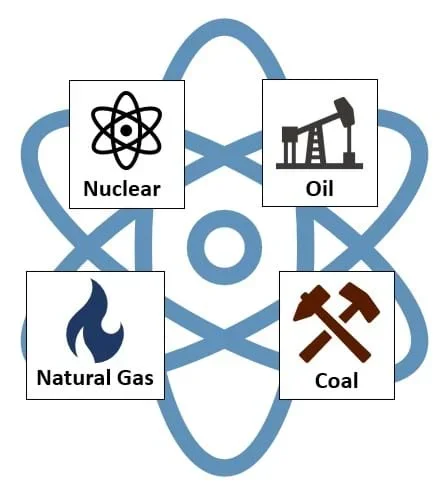 Figure 2. The four sources of non-renewable energy.Copyright 2020 Sabina Schill
What is the difference between a renewable and a non-renewable resource? (Answer: Non-renewable resources can be used up.) What is an example of these two types of resource that we discussed today? (Answer: Renewable: wind, water, solar, biomass, geothermal or variations of each of these; non-renewable: fossil fuels [coal, oil and natural gas], uranium, paper, wood and metal.) Humans have always used nature as a source of energy, protection and food. As the population of humans increase which type of resource, renewable or non-renewable is in danger? (Answer: Non-renewable) Engineers are working every day to help us understand and use our natural resources wisely. When you go home tonight, look around your house and think about all the things you have there. How many of them are renewable or use renewable resources? What can you do to help conserve the environment's resources?
- natural resource
- These are objects that are found in nature and used by living things. Examples include: water, air, sunlight, trees, iron, etc.
- renewable resource
- These are resources that can be replaced by natural processes in 100 years or less.
- non-renewable resource
- These are resources that cannot be replaced by natural processes in 100 years or less.
- fossil fuel
- Includes non-renewable fuel resources formed hundreds of millions of years ago from the remains of dead plants and animals. The three main types of fossil fuels are coal, oil and natural gas. Most of the world's energy comes from these sources.
- hydrocarbon
- These are substances that contain elements of hydrogen and carbon.
- petrochemical
- Useful substances derived from oil or natural gas. They are often used to make things like plastics, fabrics, medicines and building materials.
Pre-Lesson Assessment
Brainstorming/Discussion: As a class, have the students engage in open discussion. Solicit, integrate and summarize student responses. Give clues if necessary. Remind students that in brainstorming, no idea or suggestion is "silly." All ideas should be respectfully heard. Take an uncritical position, encourage wild ideas and discourage criticism of ideas. Have them raise their hands to respond. Record their ideas on the board. Ask the students:
- What is the definition of natural resources?
- What are some examples of renewable and non-renewable resources?
Post-Introduction Assessment
The Earth's Resources Worksheet: Ask all students to complete the Earth's Resources attachment. Go over the answers as a class.
Lesson Summary Assessment
Table: Ask students to make a table (on a piece of paper or in their science journals) with six columns.
- Students should label the columns: Plastic, Paper, Glass, Metal, Wood and Other.
- Ask students to think of things they use everyday that are made of each material. They should list as many items as they can think of in each column (some items may even belong in more than one column). Give students about 5 minutes to complete the table. You may also do this as a whole class, instead of individually.
- Ask students the following questions:
- Which column had the longest list? (Answer: It will very likely be plastic.)
- Which category do you think you depend on most? Why? (Answers will vary.)
- Where do you think these items come from? (Answer: Everything at some point comes from our natural resources. Paper and wood come from trees, plastics are made from oil, glass is made from sand, and metal is made from ore, etc.)
- Which resources are renewable? Which are nonrenewable? (Answers will vary.)
Homework
Have students choose one of the following activities for homework and turn in during a later class period.
- Develop a poster describing resources. On one half, show a picture of how you are currently wasting a precious non-renewable resource, and on the other half show a picture of the changes you will make to reduce your wastefulness.
- Create a trivia game or a board game containing a set of questions and answers related to the Earth's resources and their uses. (For example: why is it important for new trees to be planted to replace those cut down? Give a positive and a negative example of how modern technology has influenced the use of natural resources.)
- Develop a checklist that could be used to figure out how responsible your classmates are being about protecting the Earth's natural resources.
Read the historical information on petroleum at: www.greatachievements.org Discuss the many uses for petroleum.
Write an article for the school newspaper explaining why it is important for people your age to pay attention to our natural resources. Explain how the Earth's natural resources help people satisfy both wants and needs.
Forte, Imogene and Schurr, Sandra. Integrating Instruction in Science: Strategies Activities Projects Tools and Techniques (Kids' Stuff), Nashville, TN: Incentive Publications, Inc. 1996.
Kerrod, Robin and Evans, Ted. The Environment (Let's Investigate Science), New York: Benchmark Books, 1993.
The American Society for Engineering Education's K-12 engineering resource website: teachers.egfi-k12.org
Energy Kid's Page, Energy Information Administration: www.eia.gov/kids/energy.cfm?page=renewable_home-basics
Energy Kid's Page, Energy Information Administration: www.eia.gov/kids/energy.cfm?page=nonrenewable_home-basics
The National Academy of Engineer's ranking of the 20 best engineering achievements of the 20th century: www.greatachievements.org
U.S. Department of Agriculture – Natural Resources Conservation Service: www.nrcs.usda.gov
World Resources Institute: www.wri.org
US Energy Information Admniistration - Electricity Generation FAQ: https://www.eia.gov/tools/faqs/faq.php?id=427&t=3
Contributors
Amy Kolenbrander; Jessica Todd; Malinda Schaefer Zarske; Janet Yowell
Supporting Program
Integrated Teaching and Learning Program, College of Engineering, University of Colorado Boulder
Acknowledgements
The contents of this digital library curriculum were developed under a grant from the Fund for the Improvement of Postsecondary Education (FIPSE), U.S. Department of Education and National Science Foundation GK-12 grant no. 0338326. However, these contents do not necessarily represent the policies of the Department of Education or National Science Foundation, and you should not assume endorsement by the federal government.
Copyright
2005 by Regents of the University of Colorado.