
Light Up Your Life
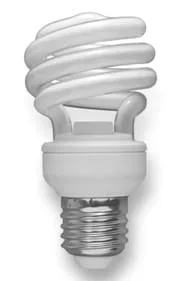 Figure 1. Self-ballast compact fluorescent lamps (CFL), such as this spiral or "ice-cream cone" type are often used to save energy.Copyright Indiana Utility Regulatory Commission http://www.in.gov/iurc/2340.htm
Students are introduced to the correct technical vocabulary for lighting, which is different than layperson's terms. They learn about lamp (light bulb) technology and how to identify the various types of lighting in their spaces. They are also introduced to lighting controls as a means for saving energy- reducing costs, human energy consumption, and greenhouse gas emissions on the environment. Using an accompanying worksheet, students embark on a guided audit in which they survey the lighting in their classroom and identify the potential savings from using controls.
Illuminating engineering is a subset of the field of architectural engineering that is focused on the engineering of lighting systems and their controls. These engineers design the various types of lamps (light bulbs) that are sold for consumer use, the light fixtures they go into, the systems that light various spaces, and the control systems that save energy and provide maximum flexibility for users. Illuminating engineering is a mix of art and science since it is linked so strongly to subjective personal experience, perception and engineering issues. Without artificial lighting, our world would be far less interesting and even less safe. Thanks to engineers, we do not have to worry about altering our lives due to darkness. You might say that engineers help light up our lives!
After this lesson, students should be able to:
- Identify the different types of lamps (light bulbs) that are typically used.
- Describe how those lamps (light bulbs) generate light.
- Calculate energy savings from lighting controls.
- CCSS.Math.Content.6.NS.B.2 Fluently divide multi-digit numbers using the standard algorithm.
Grade 6
Do you agree with this alignment? - CCSS.Math.Content.6.NS.B.3 Fluently add, subtract, multiply, and divide multi-digit decimals using the standard algorithm for each operation.
Grade 6
Do you agree with this alignment? - CCSS.Math.Content.6.RP.A.3b Solve unit rate problems including those involving unit pricing and constant speed.
Grade 6
Do you agree with this alignment? - CCSS.Math.Content.HSN-Q.A.1 Use units as a way to understand problems and to guide the solution of multi-step problems; choose and interpret units consistently in formulas; choose and interpret the scale and the origin in graphs and data displays.
Grades 9-12
Do you agree with this alignment?
- STEL-1J Develop innovative products and systems that solve problems and extend capabilities based on individual or collective needs and wants.
Grades 6-8
Do you agree with this alignment? - STEL-4R Assess a technology that minimizes resource use and resulting waste to achieve a goal.
Grades 9-12
Do you agree with this alignment? - STEL-7I Apply the technology and engineering design process.
Grades 3-5
Do you agree with this alignment?
- MS-ESS3-3 Apply scientific principles to design a method for monitoring and minimizing a human impact on the environment.
Grades 6-8
This resource focuses on the following Three Dimensional Learning aspects of NGSS:
Science & Engineering Practices- Apply scientific principles to design an object, tool, process or system.Do you agree with this alignment?
Disciplinary Core Ideas- Human activities have significantly altered the biosphere, sometimes damaging or destroying natural habitats and causing the extinction of other species. But changes to Earth's environments can have different impacts (negative and positive) for different living things.Do you agree with this alignment?
Crosscutting Concepts- The uses of technologies and any limitations on their use are driven by individual or societal needs, desires, and values; by the findings of scientific research; and by differences in such factors as climate, natural resources, and economic conditions. Thus technology use varies from region to region and over time.Do you agree with this alignment?
- Relationships can be classified as causal or correlational, and correlation does not necessarily imply causation.Do you agree with this alignment?
Do you agree with this alignment? - Apply scientific principles to design an object, tool, process or system.
Visible Light
Visible light is a part of the electromagnetic spectrum. The term used to describe a certain type of energy that interacts with our eyes. The electromagnetic spectrum describes the range of energy wavelengths, which determines what they are called and how they are used. The shortest waves are called gamma rays, and have a wavelength of around 0.01 nanometers (nm). The longest waves on the electromagnetic spectrum are radio waves, which have a wavelength of 1 m to 1 km. Visible light lies near the center of the spectrum, with wavelengths from 400 to 700 nm (see Figure 2). Light with shorter wavelengths, closer to 400 nm, is perceived by our eyes as violet. Light with longer wavelengths, closer to 700 nm, is perceived by our eyes as red.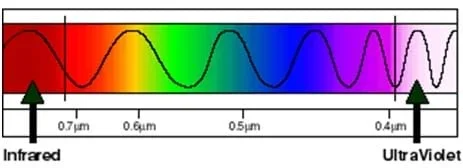 Figure 2. Visible light is a section of the electromagnetic spectrum, with wavelengths from 400 to 700nm.Copyright National Aeronautics and Space Administration http://science.hq.nasa.gov/kids/imagers/ems/visible.html
The way that colors of light mix is the opposite of the way colors of paint mix. The way that paint mixes is called subtractive mixing, which means that to get white paint, you subtract all other colors. The way that light mixes is called additive mixing, which means that to get white light, you add all of the colors of the rainbow (or, visible spectrum) together. So when we perceive daylight or electric light as "white" light, it means that we are actually seeing all colors of the rainbow together.
When light reflects off of a surface or material, we "see" that material. For example, think about a red apple on a green tree outside during the day. The sun makes "white" light, which is light containing all colors of the rainbow. The red apple is seen as red because the red parts of the white light are bounced back (or reflected) to our eyes. The green leaves are seen as green because the green parts of the white light are reflected to our eyes. In both cases, all of the parts of the rainbow in white light that we do not see are absorbed by the object, which makes it hotter. Ever notice that a black t-shirt feels much hotter in the sun than a white t-shirt? That is because the white t-shirt reflects the entire rainbow of visible energy back to your eyes and absorbs very little. The black t-shirt absorbs all of the energy, making it appear black and making it feel hotter.
Light Source Technology
Electricity can be used a few different ways to make electric light. The most basic and common way is known as incandescence. Incandescent light is generated when electricity is passed through a wire or other resistor (see Figure 3), and it heats up to the point that it glows. If you have ever seen a burner on an electric stove or coils of portable heater, you have seen a form of incandescence. In this case, the energy coming from the burner or heater is a short wavelength and is considered to be in the Infrared (IR) section of the electromagnetic spectrum. This is due to the fact that the heating element gets hot (picture the red glowing rings of a burner), but not hot enough to generate white light. As the heating element, or filament, in an incandescent lamp gets hotter, the color it glows gets more and more blue. At its hottest, the filament appears blue, but emits all visible colors up to blue, which means it emits the entire visible spectrum. This is how an incandescent lamp generates white light.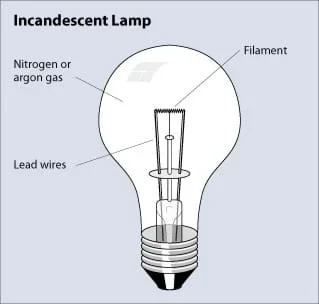 Figure 3. Incandescent lamps provide light when electricity flows through a filament that gets hot and glows.Copyright U.S. Department of Energy, Energy Efficiency & Renewable Energy http://www.energysavers.gov
Another very common way that light is created from electricity is known as fluorescence, which is a more efficient way of generating light since it makes very little heat. A typical fluorescent lamp is tube-shaped (see Figure 4), and can be found in classrooms, offices and often spaces such as garages, closets and laundry rooms. Fluorescent lamps are slightly more complicated than incandescent lamps. The tube, or bulb, of a fluorescent lamp is filled with a mix of inert gases, along with a small amount of mercury. When electricity passes through the mercury, it heats up and emits ultraviolet radiation. Remember that ultraviolet radiation is outside of the visible portion of the electromagnetic spectrum, so it must be converted to visible light for us to use it. The inside glass of the lamp's bulb is coated with a substance called phosphor, which is a type of mineral extracted from the Earth. Phosphors are unique in how they interact with energy. In this instance, the phosphors absorb the ultraviolet energy created by the heated mercury-gas mixture. That energy is then emitted as visible light by the phosphors. Therefore, the white glow that is put out by a fluorescent lamp involves two steps using two important elements, mercury and phosphor, which together produce a much more energy-efficient method to solve our lighting needs because they generate much less heat.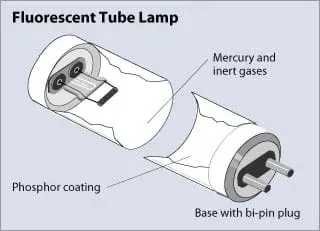 Figure 4. Fluorescent lamps provide light when a mercury/gas mixture is heated by an electrical current to generate UV radiation, which is absorbed by the phosphor coating on the glass and re-emitted as visible light.Copyright U.S. Department of Energy, Energy Efficiency & Renewable Energy http://www.energysavers.gov
Unlike incandescent lamps, fluorescent lamps cannot simply be plugged into our electrical system, since they require electricity at special voltages and frequencies. Instead, they require special electronics, known as ballasts, to make them work, and which are typically contained within the lighting fixture itself. Ballasts have a few functions, but most importantly the newer electronic ballasts keep the fluorescent lamp from flickering (a common problem during the early days of fluorescent lighting technology) by increasing the electrical frequency from 60 Hz to around 20 kHz.
The long tube-shaped fluorescent lamps are most often used in commercial spaces, such as retail stores and offices. However, this long, tubular lamp shape does not always work well in houses, where most lighting comes from small light fixtures on tables, ceilings or walls. To make this energy-efficient technology more effectively adapted to homes, engineers invented what are called CFLs, or compact fluorescent lamps (see Figures 1 and 5). CFLs generate light in the same way as the original tube-shaped lamps, but instead of using a long straight tube, the lighting tube is curled into smaller shapes, like spirals or loops (some look like swirled ice cream cones). And, instead of needing separate ballasts, the electronics are integrated into the lamp itself. This innovation enables CFLs to be used as direct replacements for lighting sources that once could use only incandescent lamps (such as wall- and ceiling-mounted fixtures and table-top lamps, among others).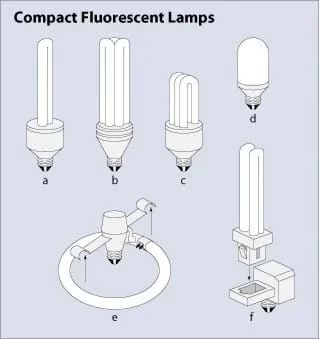 Figure 5. Compact fluorescent lamps can be installed in incandescent fixtures, consuming one-third less energy. Images a-e show CFLs that are used as a direct replacement for incandescent lamps. Image f shows how a commercial CFL, which does not have its own ballast integrated, can be adapted to use as a direct replacement.Copyright U.S. Department of Energy, Energy Efficiency & Renewable Energy http://www.energysavers.gov
The newest light source technology is known as LEDs, or light-emitting diodes. Diodes are a part of almost all electronic devices, such as TVs and computers. LEDs are special in that they emit light when electricity is passed through them. This technology has been used for decades in digital displays, TVs and cars, but they were almost always monochromatic, emitting only one wavelength of light instead of the full spectrum of visible light. Within the past decade or so, engineers have figured out how to make LEDs that produce white light (remember, this is all of the colors of the rainbow combined together). Currently, LEDs, which have a very long life, are the most efficient way we have to generate white light. In essence, this means that LEDs are a great way to save electricity and reduce the amount of waste that ends up in our landfills.
Lighting Controls
With the newer types of lamp technologies available, engineers can design lighting systems to be as efficient as possible. But, to really save energy, we need a way to make sure the lights are turned off when they are not in use. Conservation is the best way to save energy.
First, it is important to understand the difference between power and energy when considering energy efficiency. Power is the way in which most lamps are rated and is usually in units of Watts (W). Power is an instantaneous measurement and describes how much it takes at each second to make the lamp emit light. When a lamp functions for more than one second, we have to take into account the time that it operates. Energy is how we evaluate how a power system works over time. Energy is typically given in units of kilowatt-hours (kWh), where one kilowatt equals 1,000 Watts. Power is supplied by a local utility company that generates it and provides it to consumers. When consumers use the power for a certain amount of time, they are billed for the energy that they used in a monthly utility bill. Some commercial customers are billed for the amount of energy they use each month, and they are also charged for the maximum power that they required at any time during that month, called a demand charge.
So engineers do what they can to reduce the power needed for lighting systems by selecting efficient light sources and light fixtures, and providing the right amount of light for specific lighting needs. To truly maximize energy savings, we must take advantage of the time that a lighting system can be turned off— typically done through the use of lighting controls. Many different lighting controls exist, from those that involve interaction with people to those that operate automatically without requiring any human intervention. Lighting controls can be separated into two major categories: occupancy controls and daylighting controls.
Occupancy controls are used to minimize energy waste by ensuring the lights are not left on when no one is present in a room. Occupancy controls can be time-based, in which the lights are automatically switched off at the end of the day. Or they can be sensor-based, in which the lights are switched off when a sensor detects no one in the room (or to put it another way, when the sensor does not detect movement).
Two main types of occupancy sensors are used to detect whether a room is occupied. The first is called a passive infrared, or PIR, sensor. These sensors look for the heat of a body moving in front of a cooler (or hotter) background—for example, the heat of a human moving in front of a cold wall. The second is called an ultrasonic sensor, and these use sound reflections to "see" any movement in the space. Ultrasonic sensors emit an inaudible sound, or a sound that we cannot hear, hence, the name ultra (above) sonic (sound). The sensors listen to the sound reflections and if nothing is moving, the sound is reflected back at the same frequency. If something is moving, it changes the frequency of the sound that bounces back, known as the Doppler effect. An object moving toward the sensor increases the frequency of the sound, making the sensor hear it as a higher note. An object moving away from the sensor decreases the frequency of the sound, making the sensor hear it as a lower note. Both types of sensors are challenged to "see" someone who is sitting very still, and both have issues with blind spots, areas where they cannot "see" because some object blocks their "views." The associated Beating the Motion Sensor activity explores this further.
Finally, daylighting controls are a great way to ensure lights can be automatically turned off in a room—if enough sunlight enters the room. But, we must be careful with daylighting, since the sun is so bright at times that too much light inside can cause pain in our eyes (called disability glare). Daylighting controls can adjust the electric lighting, dimming or turn-off when enough daylighting is present. They can also be integrated with blinds or window shades, which can alter a room so not too much daylight enters.
Lighting controls can be combined together to maximize energy savings. They can also be tied into the controls that regulate other building systems, such as heating and cooling, security and renewable energy sources, to create truly "smart" buildings.
Artificial lighting is a part of our everyday lives—found inside nearly all buildings and homes as well as outside to help us see during the nighttime. Nationwide, lighting is responsible for nearly one-third of our electricity use—an overwhelming amount spent to light up our lives!
Have you ever wondered how light appears when you flick a switch on the wall or turn a switch on a table or floor lamp? Like magic, light just appears and pleasantly illuminates a room with very little effort on our part. In reality, no magic is involved—but a lot of engineering is required. From the electrical circuits that supply energy to the lamp (light bulb) itself, engineers are involved in the process of artificial lighting. Why does a light bulb glow? Why are there different types of light bulbs?
All of these questions can be answered through understanding the role that illuminating engineers play in the process of lighting. Illuminating engineering is a subset of the field of architectural engineering. It is the process of engineering lighting, and covers the technology level (the design of the lighting devices) to the systems level (how to control when electric light is present).
Before electricity, buildings were designed to let daylight in, since it was our only real source of light. Fire (often in the form of candles) provided light when we did not have access to the sun (imagine your great, great, great grandmother cooking by torch or firelight on cold winter days when the sun disappeared in the late afternoon). However, fire was dangerous in these times (and was the cause of many historic fires that devastated cities across the globe), was not very efficient, and made light that was not very white (it appeared more orange). Candle burning was eventually replaced in the early 19th century with the innovation of electricity. (Although electricity was researched long before the 19th century, it was not widely available until the mid - to late-1800s).
Most people who are alive today have never known life without electricity. Few read by candlelight or torch (unless on a camping trip or going through survival training). Now that we have electricity, we use that technology to make light inside, called electric light. Light is generated from electricity by what is known as a lamp, the technical term for a light bulb. The bulb itself is the glass part of the lamp. There are many differences in the lighting terms we hear on a regular basis (called layperson's terms; light bulb is an example) and the technical terms (lamp is an example of a technical term).
So the next time you flip a switch to turn on a light, think about how much easier your life is that you can illuminate a room with ease. Imagine our ancestors who worked and studied by firelight and candlelight and consider how important it is to save electricity. Let's learn about some of the ways in which we can maximize our energy savings when it comes to lighting.
Lighting is a part of our daily lives, from our bedrooms to schools to offices to streets. Illuminating engineers design lighting systems from the technology level to the systems level, and have the opportunity to save energy while making sure that we can see wherever and whenever the need exists. When we are aware of our lighting and how it consumes energy, we can also be more aware of what we can do to save energy to reduce greenhouse gas emissions, save money, and create a healthier environment.
- daylight
- Light coming from the sun, but also from the sky and reflected from the ground.
- efficiency
- How well a resource is used. For lighting, efficiency is a way to look at how much light we get for the amount of power we have to use.
- electric light
- Light from electric light sources.
- energy
- The amount of power used over a certain time.
- lamp
- The technical term for a light bulb.
- luminaire
- The technical term for the light fixture. Lamps are put into luminaires.
- nominal
- A number used to describe something when your description only needs to be close, and not exact.
- wattage
- The amount of power that it takes to make each lamp work.
Worksheet/Survey: Have students complete the attached Lighting in My Classroom Survey (PDF). Review their answers to gauge their mastery of the subject matter.
The field of Illuminating Engineering encompasses the ideas and solutions behind lighting technology. It is relatively small, compared to other engineering disciplines, and as such only limited technical resources exist. For more information, ask students to conduct an internet search of the following:
- US Department of Energy: Energy Efficiency and Renewable Energy
- Illuminating Engineering Society
- US Department of Energy
- GE Lighting
- Osram Sylvania Lighting
- Philips Lighting
US Department of Energy, Energy Efficiency & Renewable Energy. http://www.engergysaver.gov.
- Light Up Your Life
On the attached survey form, students are asked to calculate the cost of the lighting energy used in their classroom. Provide them with the local electricity rate, which can be found at the U.S. Energy Information Administration website (www.eia.gov). Navigate to the top to "Sources & Uses > Electricity." Select "Sales (consumption), revenue, prices and customers." Look at the "Average Retail Price of Electricity to Ultimate Customers" tables for actual electricity costs.
Contributors
Darcie Chinnis; Janet Yowell
Supporting Program
Integrated Teaching and Learning Program, College of Engineering, University of Colorado Boulder
Acknowledgements
The contents of this digital library curriculum were developed under a grant from the Fund for the Improvement of Postsecondary Education (FIPSE), U.S. Department of Education and National Science Foundation GK-12 grant no. 0338326. However, these contents do not necessarily represent the policies of the Department of Education or National Science Foundation, and you should not assume endorsement by the federal government.
Copyright
2011 by Regents of the University of Colorado.