
Discovering Relationships between Side Length and Area
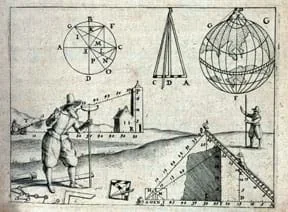 Surveying uses many geometric concepts.Copyright 1620 In: "Practijck des Landmetens...." by Johannes Sems; archival photograph by Sean Linehan, Treasures of the NOAA Library Collection http://www.photolib.noaa.gov/htmls/libr0050.htm
Through this lesson and its two associated activities, students are introduced to the use of geometry in engineering design, and conclude by making scale models of objects of their choice. The practice of developing scale models is often used in engineering design to analyze the effectiveness of proposed design solutions. In this lesson, students complete fencing (square) and fire pit (circle) word problems on two worksheets—which involves side and radius dimensions, perimeters, circumferences and areas—guiding them to discover the relationships between the side length of a square and its area, and the radius of a circle and its area. They also think of real-world engineering applications of the geometry concepts.
Relationships and patterns are extremely important in engineering. To understand how different pieces of a system work together and relate, engineers routinely test for patterns by changing parameters during experiments and tests. They figure out the relationships between different variables in a system, and then use this understanding to optimize system performance. In vehicle design, engineers employ this strategy to determine the ideal engine air/fuel mixing ratios, while other engineers use the same strategy to meet requirements and minimize costs during construction projects. Engineers also need to understand the concepts of area and volume as they design products. For example, a container that maximizes volume and minimizes surface area reduces costs and can increases production efficiency, which are important consideration for engineers who design product packaging such as beverage cartons and aluminum cans.
After this lesson, students should be able to:
- State the relationship between the side length and area of a square.
- State the relationship between the radius and area of a circle.
- Describe examples of how area, perimeter and circumference are used in engineering.
- HS.4.4.b Visualize relationships between two-dimensional and three-dimensional objects.
Grades 9-12
Do you agree with this alignment? - HS.4.5.a.iii Apply geometric methods to solve design problems.
Grades 9-12
Do you agree with this alignment? - HS.4.4 Attributes of two- and three-dimensional objects are measurable and can be quantified.
Grades 9-12
Do you agree with this alignment?
- CCSS.Math.Content.HSG-GMD.B Visualize relationships between two-dimensional and three-dimensional objects
Grades 9-12
Do you agree with this alignment? - CCSS.Math.Content.HSG-MG.A.3 Apply geometric methods to solve design problems (e.g., designing an object or structure to satisfy physical constraints or minimize cost; working with typographic grid systems based on ratios).
Grades 9-12
Do you agree with this alignment?
- Students will develop an understanding of the attributes of design.
Grades K-12
Do you agree with this alignment? - Students will develop an understanding of engineering design.
Grades K-12
Do you agree with this alignment? - Students will develop an understanding of the role of troubleshooting, research and development, invention and innovation, and experimentation in problem solving.
Grades K-12
Do you agree with this alignment?
- Corral Fencing Worksheet (docx)
- Corral Fencing Worksheet (pdf)
- Corral Fencing Worksheet Answer Key (docx)
- Corral Fencing Worksheet Answer Key (pdf)
- Fire Pit Homework Worksheet (docx)
- Fire Pit Homework Worksheet (pdf)
- Fire Pit Homework Worksheet Answer Key (docx)
- Fire Pit Homework Worksheet Answer Key (pdf)
- How to calculate the area and perimeter of a square.
- How to calculate the area of a circle.
- The circumference of a circle is 2πr.
- How to solve for the radius of a circle given its circumference.
The area of a shape is simply the squared dimension inside of the perimeter of the shape. We regularly use area when we talk about the “square footage” of property or space. This value is simply the area of the floor space in square feet or ft2. Figure 1 shows a graphical representation of this concept using square units to represent a rectangular shape.
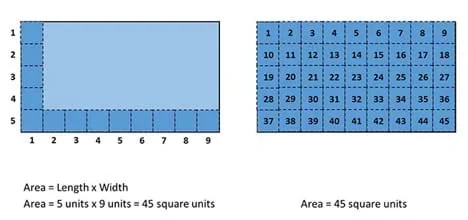 Figure 1. (left) A rectangle with its side dimensions marked in unit lengths. (right) The same rectangle with the area expressed in square units.Copyright 2016 Aaron Lamplugh, ITL Program, College of Engineering, University of Colorado Boulder
Looking at the left rectangle in Figure 1, we see the rectangular shape is exactly 5 units long by 9 units wide. If we apply the equation for the area of a rectangle, we find that the area of this rectangle should be 45 square units. The right rectangle in Figure 1 has been completely filled in by square units, so we can clearly see that exactly 45 square units fit within the rectangle. This illustrates the concept of area, and demonstrates how area formulae can be applied to quickly determine the area within a given shape.
Different area formulae must be used for shapes of different geometries. Rectangles, triangles and circles all have unique equations to calculate their areas. Figure 2 shows the equations to calculate the areas of circles and rectangles.
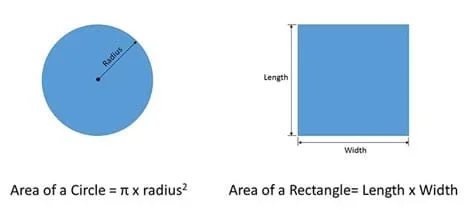 Figure 2. The equations to calculate the areas of circles and rectangles.Copyright 2016 Aaron Lamplugh, ITL Program, College of Engineering, University of Colorado Boulder
One can see that the more complex geometry of the circle results in a more complex area equation. This formula contains both a squared term for the radius and the mathematical constant pi (π).
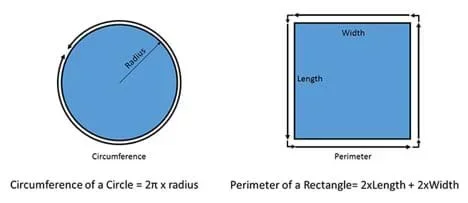 Figure 3. The equations to calculate the circumference of circles and the perimeters of rectangles.Copyright 2016 Aaron Lamplugh, ITL Program, College of Engineering, University of Colorado Boulder
A circle’s radius is also related to its circumference, which is the distance around the circle. Figure 3 illustrates this relationship, and provides the equations for calculating the circumference from a circle’s radius.
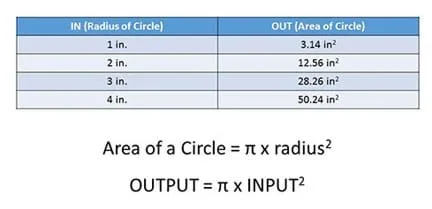 Figure 4. An example in-out table containing values for the radii and areas of four circles.Copyright 2016 Aaron Lamplugh, ITL Program, College of Engineering, University of Colorado Boulder
Using an in-out table can help students to “see” the mathematical relationships. For example, as shown in the table in Figure 4, the values in the in column undergo a specific process to obtain the value that goes in the out column. In this case, that involves inserting the in column value (radius of a circle) into the area equation to obtain the out column value (area of a circle).
(In advance, make copies of the Corral Fencing Worksheet (PDF), one per student.)
Today we are going to work on finding some patterns for squares and circles. The patterns that we discover today will be very helpful to us in our final project. Why is it important to be able to discover and know the patterns between the dimensions and areas of geometric objects? Well it is important to engineers. They need to understand patterns like the ones we will explore today to help them design and build almost everything, including building structures, products, factory assembly lines and rockets.
(Hand out the worksheets. Divide the class into groups of three or four students each.)
Work within your groups to complete this worksheet. You have 30 minutes. After that, we will discuss the worksheet problems as a class, and some of you will share your work on the board.
(On the worksheet, students are presented with a ranching scenario and asked to calculate the areas that would result from building square horse corrals with 300, 600 and then 900 feet of fencing. Students make in-out tables to assist them in noticing patterns and generalizing the mathematical relationships. Expect students to discover that area increases proportionally to the square of how much the side length increases.)
(Circulate and help students as needed. Before answering any student questions, make sure that they cannot be answered by any other member of the group. This ensures that students work together and ask each other for help. After 25 minutes, have groups share their solutions with the rest of the class, either verbally or on the classroom board. Then go over the problems as a class. Refer to the Assessment section for discussion prompts and a follow-up problem for the class.)
Today, we solved problems that would be helpful in designing horse corrals for a ranch, and in a similar way, engineers apply their understanding of areas and volume when they design products. For example, a container that maximizes volume and minimizes surface area reduces manufacturing materials costs and can increase production efficiency. Understanding the relationship between length and area helps us in many ways—such as to furnish a classroom to hold the right number of desks or tables, or to create blueprints for new buildings.
What are some other examples in which the corral problem could be used in engineering? (Possible answers: To survey property lines, to fence an area of land, to construct roads and parking lots, to design a building or a swimming pool, etc). Using the associated activities, Volume & Data: Build the Biggest Box Using One Piece of Paper and Math Relationships: Scale Model Building Project, students can investigate real world examples with hands-on investigations.
Today, we learned that an understanding of the concepts of area and volume are important to the efficient design of many kinds of products and structures. We also observed how an object’s dimensions are related to its area, and saw this pattern by using an in-out table. Engineers often use these same problem-solving methods when determining property lines, drawing street layouts, and performing other city planning tasks. We are going to continue to learn about how engineers use geometry in design when we work on our scale model projects!
- area
- A quantity that expresses the extent of a two-dimensional figure or shape.
- circumference
- The linear distance (or path) around the edge of a circle.
- perimeter
- The linear distance (or path) around a two-dimensional shape. The measurement of the distance around the outer edge of a shape or area.
- radius
- A straight line from the center to the circumference of a circle or sphere.
Pre-Lesson Assessment
Questions: Before starting the lesson, lead a class discussion to gauge student understanding of the concepts of area and patterns, as well as some real-world examples. Ask the students:
- What is “area”?
- How is it used in the real world? (Possible answers: A way to describe the size of buildings and land, such as square footage, buying carpet, how much paint to buy, making sure a sofa fits in your living room, city planning, etc.)
- What are some engineering applications in which knowing area, circumference or perimeter are important to solve problems? (Possible answer: Designing highways or parking lots that are sized to work for the expected traffic, vehicles and people, designing keyboards that accommodates the size of peoples’ fingers; surveying property; making zoning regions for city planning.)
- What are some patterns that you are aware of? How can patterns be used to make predictions that can in turn be used to solve problems?
Post-Introduction Assessment
Rectangle Problems: As part of the Introduction/Motivation content, students work in groups to fill out the Corral Fencing Worksheet (PDF). Given 300, 600 and 900 feet of fencing, students calculate perimeters and areas for the construction of square horse corrals. They use in-out tables to help them elicit the mathematical patterns. Direct groups to confer on their answers and make sure all members of the group understand and agree upon the answers, so they are prepared and comfortable presenting their solution to the class.
Lesson Summary Assessment
Discussion: As a class, discuss student’s answers to the Corral Fencing Worksheet (PDF). Ask groups to share their work (either verbally or on the classroom board). The groups chosen do not necessarily need to have the correct answer. After each group presents, see if anyone from the class has any comments. If a group is incorrect, see if another class member is able to correct them and explain any mistakes.
Suggested prompt questions:
- Do you agree with this group’s solution/explanation?
- Did anyone else get a different answer?
- Did someone solve this problem a different way?
Once all problems have been presented, check for understanding. To verify that students understand that area increases proportionally to the square of the factor the length is changed by, ask students: What would the area of a square corral be using 1,200 feet of fencing? Tell them to use the generalization rather than an equation to solve for the area. (Answer = 90,000 sq. ft.) Give students a few minutes to work on this with their groups and then regroup as a class and discuss.
Homework
Circle Problems: As homework, assign students to complete the Fire Pit Homework Worksheet (PDF). Similar to how students investigated squares during the lesson, the worksheet problems guide them to investigate the relationship between the radius of a circle and its area. Review their answers to assess their comprehension of the concepts.
Have students look at similar patterns for 3D shapes. For example, challenge them to scale up and scale down the side dimensions of a cereal box and see how that affects surface area and volume of the box. To increase the challenge have them investigate the relationship between side length and surface area and volume of a rectangular prism.
Fendel, Daniel M., Diane Resek, Lynne Alper, and Sherry Fraser. "Homework 17: More Fencing, Bigger Corrals." Interactive Mathematics Program: Integrated High School Mathematics, Year 2. Berkeley, CA: Key Curriculum, 1998. 242. Print.
- Discovering Relationships between Side Length and Area
Contributors
Andi Vicksman; Malinda Zarske; Russell Anderson; Ryan Sullivan; Nathan Coyle; Maia Vadeen; Aaron Lamplugh
Supporting Program
CU Teach Engineering (a STEM licensure pathway), Engineering Plus Degree Program, University of Colorado Boulder
Acknowledgements
This activity was developed by CU Teach Engineering, a pathway to STEM licensure through the Engineering Plus degree program in the College of Engineering and Applied Science at the University of Colorado Boulder.
Copyright
2016 by Regents of the University of Colorado