
Riding the Radio Waves
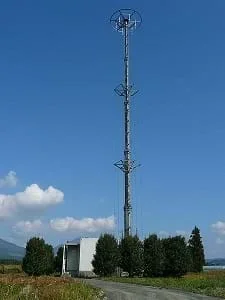 Students learn how AM radios workCopyright Wikimedia Commons https://commons.wikimedia.org/wiki/File:JOGK_Minamiaso_AM_Radio_Repeater.JPG
Students learn how AM radios work through basic concepts about waves and magnetic fields. Waves are first introduced by establishing the difference between transverse and longitudinal waves, as well as identifying the amplitude and frequency of given waveforms. Then students learn general concepts about magnetic fields, leading into how radio waves are created and transmitted. Several demonstrations are performed to help students better understand these concepts. This prepares students to be able to comprehend the functioning of the AM radios they will build during the associated activity.
Understanding how waves and magnetic fields work are basic concepts of electricity and magnetism that all engineers must know. It is also the task of engineers to take the concepts learned in school or other types of training and find practical uses and applications for this knowledge, such as AM radios.
After completing this lesson, students should be able to:
- Identify transverse and longitudinal waves.
- Determine the amplitude and frequency of a waveform.
- Describe how electromagnetic waves propagate.
- Explain the process by which AM radios work.
- STEL-2R Compare how different technologies involve different sets of processes.
Grades 6-8
Do you agree with this alignment?
- MS-PS2-5 Conduct an investigation and evaluate the experimental design to provide evidence that fields exist between objects exerting forces on each other even though the objects are not in contact.
Grades 6-8
This resource focuses on the following Three Dimensional Learning aspects of NGSS:
Science & Engineering Practices- Conduct an investigation and evaluate the experimental design to produce data to serve as the basis for evidence that can meet the goals of the investigation.Do you agree with this alignment?
Disciplinary Core Ideas- Forces that act at a distance (electric, magnetic, and gravitational) can be explained by fields that extend through space and can be mapped by their effect on a test object (a charged object, or a ball, respectively).Do you agree with this alignment?
Crosscutting Concepts- Cause and effect relationships may be used to predict phenomena in natural or designed systems.Do you agree with this alignment?
Do you agree with this alignment? - Conduct an investigation and evaluate the experimental design to produce data to serve as the basis for evidence that can meet the goals of the investigation.
- Phy.2.3.5 Analyze systems with multiple potential differences and resistors connected in series and parallel circuits, both conceptually and mathematically, in terms of voltage, current and resistance.
Grades 9-12
Do you agree with this alignment?
A basic understanding of electricity, voltage, resistance and power is helpful.
About Waves
- First introduce students to the concepts of different types of waves and important features of waves. Upon understanding fundamental concepts about waves, discuss electromagnetic and radio waves more specifically.
- Introduce students to transverse and longitudinal waves, the two primary types of waves. Particles in longitudinal waves are displaced in the same direction of wave propagation. Thus, if a wave is propagating horizontally, then wave particles are moving back and forth horizontally in the same direction as the entire wave. A good visual for this can be found at www.kettering.edu/~drussell/Demos/waves/wavemotion.html. Ask students to follow the motion of a single particle so they can see that the particle oscillates in the same direction as the wave.
- Next show students a transverse wave, which can be drawn as the commonly seen sinusoidal wave. Individual wave particles for this type of wave move in a direction perpendicular to the direction of wave propagation. Thus, if a wave is propagating horizontally, the particle will be displaced vertically, moving up and down. A visual of this can be found on the same website as the visual for the longitudinal waves.
- Continue to explore transverse waves since this waveform is used in radio signal transmission. Draw a sinusoidal waveform on the board and identify the two major components: the signal's amplitude and the frequency. The amplitude of the wave is defined as the distance from the midpoint of the vertical component of the wave to its peak, or half the distance form its maximum and minimum values (see Figure 2).
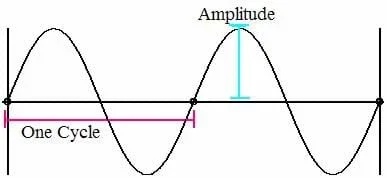 Figure 2. Wave components.
- Another important component of the wave is its frequency. Frequency is defined as the number of cycles a wave completes per second; it has units of hertz (Hz), where one Hz is equivalent to a second-1. One cycle of a wave is the distance the wave travels until it reaches the same vertical position as where it started (see Figure 2).
- Next, explain electromagnetic waves and their relationship to AM radios. As shown with the nail demonstration, current through the wire wrapped around the nail generates a magnetic field around the nail. The same is true for antennas used to broadcast radio signals. As current enters the antenna, a magnetic field is created around the antenna. Magnetic fields also induce an electric field in an antenna or wire placed close to the first wire, also shown by the nail demo. When no wire coil is close to a radio wave transmitter, the magnetic field around the antenna induces an electrical field in the open space surrounding it. In turn, this electric field creates another magnetic field in the space surrounding it. This change between electrical and magnetic fields propagates the wave through space, creating an electromagnetic wave. A radio wave is just a type of electromagnetic wave, having a large wavelength and high frequency.
- A sound that is to be transmitted is created and converted into an electrical signal. Since this signal is not very strong, the signal is amplified with an amplifier. The signal now has a greater amplitude, making it stronger. This observation can also be correlated with the use of the oscilloscope. A wave is generated and then a modulator changes the amplitude of the carrier signal (the signal being broadcast via radio waves) mimicking changes in the original sound's amplitude. The signal then travels to the antenna.
- Once the electromagnetic wave is emitted from the antenna, (known as the transmitter), it is received by the antenna of the radio. This consists of a wire or metal stick (as was used in the AM radio kits for the AM I on the Radio? activity). The specific station on the AM radio denotes the frequency a wave must have in order to be played by the radio. The frequency is specified with a tuner; the antenna receives waves of many different frequencies, so the tuner finds the signal of the desired frequency. Again, the signal is very weak and must be amplified, via an amplifier. Then a demodulator is used to cut the radio signal in half, as both halves provide the same information. This is carried out with a diode (students should be familiar with this circuit component from the previous circuits lesson). The carrier wave originally assigned to the wave in order to transmit it is removed by a filter, producing the original electrical signal, which is then transferred to the speaker, creating the original sound.
- Visuals help greatly for the explanation of how an AM radio works. Two websites with good visuals are at How Stuff Works and PBS.
To introduce this lesson, have students pretend that they are human wave particles. Have all students line up, standing in a straight line, one behind the other with their hands resting on the shoulders of the person in front of them. The instructor, at the front of the line, creates an initial disturbance of the first particle, by pulling the student forward slightly, so that his/her motion is transferred back through the line of students. This illustrates how the wave moves, as the waveform is merely individual particles displacing one another, the individual particles do not actually travel along the waveform, but rather oscillate back and forth. This example shows longitudinal waves, since the direction of displacement is in the same direction of wave propagation. To illustrate transverse wave forms, line up the students side by side, beginning in a squatting position, holding hands. The wave begins to travel as the first student stands up and then crouches back down, causing the student next to him/her to do the same. The wave travels down the line transversely (similar to "the wave" at a sporting event), because particle displacement occurs perpendicular to the direction of wave propagation. Again, point out that they are doing no more than oscillating up and down, yet their motion is traveling down the line of students.
Carry out the following two activities once students have been presented with the lesson information since these activities serve to provide examples of wave and magnetism concepts. Refer to the associated activity Creating Working Radios from Kits: AM I on the Radio? for more instructions.
The next activity demonstrates that information can be conveyed in an electromagnetic wave in a simple manner. It also provides a link between electricity and magnetism. Refer to Figure 1. The demo requires a 9V battery, 2 iron nails, thin gauge wire or magnet wire, an AM/FM radio or Walkman, a tape deck with a speaker that can be played without a tape but with the cassette door open (most old school style cassette players work for this), wire strippers, and a male headphone jack that has been connected to a small coiled wire around an iron nail or bolt. Cut the cable of an old headphone set and strip the ends of the two wires, or buy an 1/8 inch male stereo plug from an electronics store. (Most of these items can be found, the others can be purchased at Radio Shack for a few dollars.) Wrap one of the nails with the thin wire and demonstrate that it has no magnetic properties. Loop the wire at least 10 times in one direction only. Next, attach the wire to the battery and show that it now has become magnetized by holding it close to a small metal object. Explain that the electric current from the wire around the nail has generated a magnetic field. Wrap the other nail 5 times and attach it to the stripped ends of the male headphone jack.
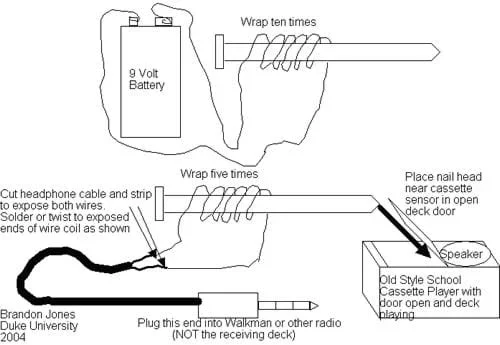 Figure 1. Diagram of the teacher demo.Copyright 2004 Brandon Jones, Duke University
Next, play the radio or Walkman through its speaker or headphones. Remove the headphones and replace it with the modified headphone jack just constructed. With the cassette door open, place the tip of the nail close to the playing cassette driver head and listen to the signal from the other radio! This works because cassette tapes have a magnetic sensor that pulls information from the magnetized tape. As the tape moves by the sensor, the magnetic field varies and a signal is received. The same thing happens when you stick your small transmitting antenna next to the deck. Even a simplified approach to explaining radio frequency transmission through electromagnetic waves is difficult conceptually without showing students the process. When presenting the initial demonstration described above, ask students to guess or come up with as many of the explanations for what is observed as possible, and then explain in full once a correct suggestion has been volunteered. If students have not been exposed to previous lessons, this will be a stretch. Mention that the nail has to be close to the "receiver" of the tape deck because it is a low power signal, and because the frequency is too low to travel very far. If a person yells at the top of his lungs, it cannot be heard a mile away, but a radio wave with a higher frequency can be detected for miles. Voice is low frequency, and radio broadcast is at a higher frequency.
- longitudinal wave
- Wave particles displaced in the same direction as wave propagation.
- transverse wave
- Wave particle displaced in a perpendicular direction to wave propagation.
- amplitude
- The distance from a wave's mean position to one of its extremes.
- frequency
- The number of cycles per second for a signal; higher frequency signals travel farther generally than lower frequency signals, so AM radio waves, which have a frequency in the range of a few hundred thousand cycles per second, go farther than sound waves, which are in the 20-20,000 cycles per second range.
- electromagnetic wave
- Radiation consisting of waves of energy associated with electric and magnetic fields resulting from the acceleration of an electric charge.
- modulator
- A device that varies the frequency, amplitude, phase or other characteristic of an electromagnetic wave.
- demodulator
- A device that extracts modulation from a radio carrier wave.
- filter
- An electrical device used to reject signals of certain frequencies while allowing others to pass.
- amplifier
- A device that increases the signal power, voltage or current of an electrical signal.
Post-Introduction Assessment:
- Have students find the amplitude and frequency of different waves.
- Have students diagram the process by which radio waves are transmitted and received.
Lesson Summary Assessment:
- Verify that students can identify the difference between transverse and longitudinal waves, as well as which type is used in AM radio transmission.
- If given a sinusoidal wave, make sure that students are able to determine the amplitude and frequency of the signal.
- Ask students to explain the process by which AM radio waves are transmitted.
Integrate more knowledge of circuit components into the discussion of how radios work (that is, diode used as demodulator, components that comprise a filer, etc.) to help students understand why they are soldering each component in their AM radio kits.
PBS radio transmission activity. Accessed June 23, 2004. http://www.pbs.org/wgbh/aso/tryit/radio/#
How Radio Works. How Stuff Works. http://electronics.howstuffworks.com/radio.htm
Russell, Dan. Acoustics Animations. Kettering University Applied Physics http://www.kettering.edu/~drussell/Demos/waves/wavemotion.html
- Riding the Radio Waves
Contributors
Emily Spataro; Lisa Burton; Lara Oliver
Supporting Program
Techtronics Program, Pratt School of Engineering, Duke University
Acknowledgements
This content was developed by the MUSIC (Math Understanding through Science Integrated with Curriculum) Program in the Pratt School of Engineering at Duke University under National Science Foundation GK-12 grant no. DGE 0338262. However, these contents do not necessarily represent the policies of the NSF, and you should not assume endorsement by the federal government.
Copyright
2013 by Regents of the University of Colorado; original © 2004 Duke University