
Boxed In and Wrapped Up
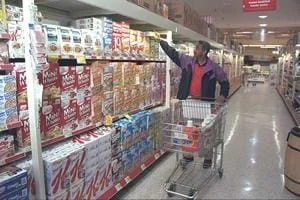 We're all familiar with cereal boxes like these, but are they the best way to package the products inside?Copyright USDA
Students review how to determine the surface area and volume of a rectangular prism, that all dimensions are equal in cubes so the volume of cubes are the length of any side raised to the third power, or cubed. This prepares them for two associated activities. First, students find the volumes and surface areas of rectangular boxes such as cereal boxes and then figure out how to convert their boxes into a new, cubical boxes having the same volume as the original. As they construct the new, cube-shaped boxes from the original box material, students discover that the cubical box has less surface area than the original, and thus, a cube is a more efficient way to package items. Students consider why consumer goods are generally not packaged in cube-shaped boxes, even though this would require fewer materials and ultimately, less waste. Then, to display their findings, each student designs and constructs a mobile that contains a duplicate of his or her original box, the new cube-shaped box of the same volume, the scraps that are left over from the original box, and pertinent calculations of the volumes and surface areas involved. The activities involved provide valuable experience in problem solving with spatial-visual relationships.
Students learn to think like packaging engineers while considering ways in which consumer goods are boxed. They consider not only the most-efficient designs, but also how those designs will be used by the customers.
After completing this lesson, students should be able to:
- Determine the dimensions of a cube when given its volume.
- Assert that a cube has less surface area than a rectangular prism of the same volume, and then prove this assertion with examples.
- CCSS.Math.Content.6.G.A Solve real-world and mathematical problems involving area, surface area, and volume.
Grade 6
Do you agree with this alignment? - CCSS.Math.Content.6.NS.B.3 Fluently add, subtract, multiply, and divide multi-digit decimals using the standard algorithm for each operation.
Grade 6
Do you agree with this alignment? - CCSS.Math.Content.7.G.B.6 Solve real-world and mathematical problems involving area, volume and surface area of two- and three-dimensional objects composed of triangles, quadrilaterals, polygons, cubes, and right prisms.
Grade 7
Do you agree with this alignment?
- The selection of designs for structures is based on factors such as building laws and codes, style, convenience, cost, climate, and function.
Grades 6-8
Do you agree with this alignment? - STEL-8L Interpret the accuracy of information collected.
Grades 6-8
Do you agree with this alignment?
- MS-ETS1-2 Evaluate competing design solutions using a systematic process to determine how well they meet the criteria and constraints of the problem.
Grades 6-8
This resource focuses on the following Three Dimensional Learning aspects of NGSS:
Science & Engineering Practices- Evaluate competing design solutions based on jointly developed and agreed-upon design criteria.Do you agree with this alignment?
Disciplinary Core Ideas- There are systematic processes for evaluating solutions with respect to how well they meet the criteria and constraints of a problem.Do you agree with this alignment?
Do you agree with this alignment? - Evaluate competing design solutions based on jointly developed and agreed-upon design criteria.
- CCSS.Math.Content.6.G.A Solve real-world and mathematical problems involving area, surface area, and volume.
Grade 6
Do you agree with this alignment? - CCSS.Math.Content.6.NS.B.3 Fluently add, subtract, multiply, and divide multi-digit decimals using the standard algorithm for each operation.
Grade 6
Do you agree with this alignment? - CCSS.Math.Content.7.G.B.6 Solve real-world and mathematical problems involving area, volume and surface area of two- and three-dimensional objects composed of triangles, quadrilaterals, polygons, cubes, and right prisms.
Grade 7
Do you agree with this alignment?
Students should know how to determine the surface area and volume of a rectangular prism.
Volume-to-surface area ratios are important aspects of many phenomena in the physical and natural sciences. For example, radiators are devices designed to contain lots of surface area over which to dissipate heat, using a relatively small volume of hot fluid flowing through the radiator. Similarly, a long, narrow ranch-style house costs more to heat in a cold climate than a more cube-shaped Cape Cod-style house having the same volume and wall insulation. The ranch house has more wall and roof areas through which the interior heat can escape than the Cape Cod house. Likewise, the ranch house has more area exposed to the radiant heat of the sun in the summer, and costs more to keep cool by air conditioning than will the Cape Cod house.
In our own bodies, materials move in and out of our cells continuously, passing through the cell membranes primarily by the slow process of diffusion. The surface area of the cell determines how much material can be moved back and forth, and the smaller the cell, the greater the relative amount of surface area it contains. That is why cells are generally very small, with 10 microns (one one-hundredth of a millimeter) in diameter being a fairly typical cell size. Very large cells are rare, because without special mechanisms they cannot take in enough nutrients and rid themselves of wastes fast enough to support the activities going on inside those large volumes. One-celled organisms are thus small and their life processes are fairly simple. More complicated organisms, such as ourselves, are multi-celled. By keeping our cells small, they can be specialized to do different jobs and yet still be maintained by the available nutrients and waste removal systems.
(About two weeks before conducting this lesson, ask students to each bring in from home two identical boxes to use in an upcoming activity. Have them take home a Letter for Parents (PDF), which explains the kinds of boxes needed. Students will be curious to know what they are going to do with the boxes, and you can help maintain this curiosity by merely answering with something vague such as, "They're for a geometry activity.")
(Present the following content to verify that students know how to determine the surface area and volume of a rectangular prism. They should also have a clear understanding of cubes: in a cube, all the dimensions are equal, so the volume of a cube is the length of any side raised to the third power, or cubed.)
(Introduce the activity.) Today, you are going to take one of your two, identical boxes, and cut it up and tapeit back together to make a cube-shaped box that has the same volume as the original, rectangular box. In order to create a cube-shaped box from a rectangular box, you will have to work backwards. For a cube of known volume, you need to be able to figure out how to find its dimensions. If the volume of a cube is equal to its length cubed, the length of any side of a cube is equal to the cube root of its volume. (Work through some simple examples to help illustrate this.) For example, what would the dimensions be for a box with a volume of 8 cubic cm, or for a box with a volume of 27 cubic inches?
(Move on to some harder examples.) What if the volume of a box was 21 cubic inches? (If students have graphing calculators such as TI-82 or TI-83, they can find cube roots easily using the MATH function key. If not, they will get some good practice with estimation and trial-and-error as they determine that the cube root of 21 is about 2.76. When students make their own cube-shaped boxes, they will work in cm and mm, so cube roots need not be taken out beyond the nearest hundredth.)
(Once students are clear on how to work these types of surface area and volume problems, they are ready to conduct the two associated activities, New Boxes from Old and The Boxes Go Mobile: Balancing Hanging Boxes with Levers.)
After students have conducted both associated activities, lead a class discussion. Begin by asking students to share with the class their answers to the last question on the New Boxes from Old student pages. While the total areas of their scraps should equal the differences in surface areas of their two boxes, it is unlikely that they will actually be very close. Measurement inaccuracies, rounding, and the difficulties of cutting straight lines and right angles all combine to make their answers not as closely matched as they ought to be.
Since we are all concerned about preserving natural resources, ask the class which type of packaging would use the least paper: selling pasta, cereal, crackers and cake mixes, etc., in rectangular boxes, or in cube-shaped boxes. Expect students to notice by now that rectangular boxes can be downright wasteful. Ask them to look around at all the mobiles and note which types of boxes generated the most scraps relative to the sizes of the boxes. Expect them to be able to notice that long, thin boxes, such as spaghetti boxes or toothpaste boxes, had more scraps left over than boxes that had some faces that were square or nearly square, such as a diskette box. See if they can summarize their observations in mathematical terms, for example, "When the length-to-width and length-to-height ratios are close to 1, there are fewer scraps than when one or both of these ratios is much greater (or less) than 1."
Since a cube-shaped box uses less material, why don't companies sell cereal and other foods this way? Ask students to share their thoughts about this question. If they need help, ask them to imagine how they would arrange many boxes of food in the same cabinet. Wouldn't lots of items have to be two or three rows back in the cabinet, and wouldn't items be stacked in at least two layers? What if they wanted the box of cereal that was all the way in the back and on the bottom layer?
Then ask them to think about picking up that cube-shaped box and pouring some cereal out of it. Would they have to hold the box with two hands because the box is so wide? Would this be awkward? And would the box now need a special pouring spout in order to get the cereal into a bowl instead of all over the counter? (Occasionally, cereal companies experiment with milk carton-shaped packages.)
Students might also realize that when people walk down the cereal aisle of grocery stores, each cereal company wants the consumer to buy its type(s) of cereal. Thus, the companies want nice, big areas on their boxes so they can attract the customer's attention and advertise what's inside. A cube-shaped box, with its smaller area facing the consumer, might not be as eye-catching as a rectangular box.
Some foods, because of their particular shapes, require rectangular packages. Spaghetti and lasagna noodles, for example, would have to be cut short to fit into a one-pound, cube-shaped box. Otherwise, a cube-shaped box containing standard-length noodles (~26 cm) would be quite large. Just for fun, have students determine the number of spaghetti noodles such a box would hold, if its dimensions were equal to the length of a typical noodle. (The answer depends on whether the box is filled with thick or thin spaghetti. One group of students counted 812 noodles in a one-pound box of thin spaghetti, which means there would be about 23,500 noodles in the cube-shaped box. Of course, there would be fewer noodles in a box of thick spaghetti noodles.) It is also interesting to note how heavy such a cubical box of noodles would be (29 pounds) and to speculate on whether or not the thin cardboard used in pasta boxes would be strong enough to support this weight (not likely).
Have students complete the attached assessment to help ensure that they are comfortable finding the volumes and surface areas of cubes and rectangular prisms. The assessment also requires them to systematically compare the two different shapes of packaging and identify pros and cons of each.
Use the attached Boxed In and Wrapped Up Assessment (PDF) to evaluate your students' understandings of the lesson material. The assessment asks them to:
- Identify the equations used to calculate the volumes and surfaces of cubes and rectangular prisms.
- Determine the difference in surface areas of a rectangular box of given dimensions, and a cube-shaped box having the same volume as the rectangular box.
- Sketch a cube-shaped box, including its dimensions, that has the same volume as a provided rectangular box.
- Identify realistic criteria and constraints that should be considered in packaging design.
- Write a paragraph explaining why consumer goods packaged in cube-shaped boxes would use less packaging material than rectangular boxes containing the same product volumes. Require each student to provide an example, including sketches of the boxes and their dimensions, to substantiate his or her explanation and identify why more cube-shaped boxes aren't used.
Arrange for a field trip to a nearby packaging factory. Students and teachers alike will be amazed to see all the steps involved in designing, printing, cutting and assembling the boxes used to hold a wide range of consumer products.
- Boxed In and Wrapped Up
Contributors
Mary R. Hebrank
Supporting Program
Engineering K-PhD Program, Pratt School of Engineering, Duke University
Acknowledgements
This content was developed by the MUSIC (Math Understanding through Science Integrated with Curriculum) Program in the Pratt School of Engineering at Duke University under National Science Foundation GK-12 grant no. DGE 0338262. However, these contents do not necessarily represent the policies of the NSF, and you should not assume endorsement by the federal government.
This lesson and its associated activities were originally published, in slightly modified form, by Duke University's Center for Inquiry Based Learning (CIBL). Please visit http://ciblearning.org/ for information about CIBL and other resources for K-12 science and math teachers.
Copyright
2013 by Regents of the University of Colorado; original © 2004 Duke University