
Mathematical Modeling- Linear Approximations
Students investigate the idea of linear approximation. Students apply mathematical modeling, specifically linear approximation, to an already collected data set to make a prediction. In this lesson, students first engage in a warm-up that is not a perfectly linear data set, being exposed to this for the first time. Students take on the role as a packaging engineer to learn the process to apply linear approximation modeling: collecting data, creating a graph, drawing a line-of-fit, creating a model in the form of an equation, defining the model’s variables, and evaluating with the model. Students ultimately use their linear model to predict the net weight of cereal in grams contained by 260 square inches of cardboard packaging.
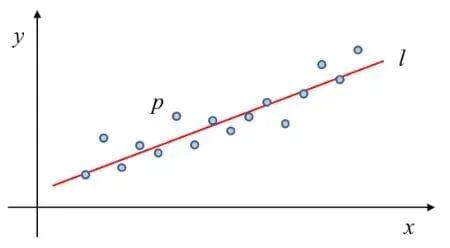 Often in the real-world, situations are not perfect and require a model, such as the linear model shown, to make a prediction.Copyright Algebraic & Geometric Error. (2014, September 13). Retrieved June 27, 2018, from http://darkpgmr.tistory.com/143
Engineers deal with real-world problems, and often in real-world problems, numbers and data do not follow a perfect model like they often do in a mathematics classroom. To accommodate for this, engineers use mathematical modeling to investigate the relationship between variables, which allows them to make an accurate prediction of situational outcomes. Engineers follow the engineering design process while they work, and throughout this lesson, the process of collecting data, creating a model, testing the model, and making necessary amendments to the model post-testing are applicable to the engineering design process. In this lesson, students more specifically explore how packaging engineers apply mathematical modeling to help determine packaging variations for cereal and even offer a suggestion of linear approximation model to Battle Creek Cereal’s executive team that can be used to create skews of packaging based on square inches of cardboard packaging used and the net weight of the cereal in grams.
After this lesson, students should be able to:
- Investigate relationships between quantities by using points on scatter plots.
- Model an approximately linear situation.
- Apply lines of fit to make and evaluate predictions.
- CCSS.Math.Content.HSA-CED.A Create equations that describe numbers or relationships
Grades 9-12
Do you agree with this alignment? - CCSS.Math.Content.HSA-CED.A.2 Create equations in two or more variables to represent relationships between quantities; graph equations on coordinate axes with labels and scales.
Grades 9-12
Do you agree with this alignment? - CCSS.Math.Content.HSF-BF.A Build a function that models a relationship between two quantities
Grades 9-12
Do you agree with this alignment? - CCSS.Math.Content.HSF-BF.A.1 Write a function that describes a relationship between two quantities
Grades 9-12
Do you agree with this alignment? - CCSS.Math.Practice.MP4 Model with mathematics.
Grades K-12
Do you agree with this alignment?
- Students will develop an understanding of the characteristics and scope of technology.
Grades K-12
Do you agree with this alignment?
- CCSS.Math.Content.HSA-CED.A Create equations that describe numbers or relationships
Grades 9-12
Do you agree with this alignment? - CCSS.Math.Content.HSA-CED.A.2 Create equations in two or more variables to represent relationships between quantities; graph equations on coordinate axes with labels and scales.
Grades 9-12
Do you agree with this alignment? - CCSS.Math.Content.HSF-BF.A Build a function that models a relationship between two quantities
Grades 9-12
Do you agree with this alignment? - CCSS.Math.Content.HSF-BF.A.1 Write a function that describes a relationship between two quantities
Grades 9-12
Do you agree with this alignment? - CCSS.Math.Practice.MP4 Model with mathematics.
Grades K-12
Do you agree with this alignment?
- SEP.12.9-12.2 Use mathematical representations of phenomena to describe explanations.
Grades 9-12
Do you agree with this alignment? - SEP.6.9-12.3 Communicate technical information or ideas (e.g. about phenomena and/or the process of development and the design and performance of a proposed process or system) in multiple formats (including orally, graphically, textually, and mathematically).
Grades 9-12
Do you agree with this alignment?
An understanding of linear functions - graphing, writing equations, and slope. An understanding of representing data as a table and scatter plot. An understanding of how to use a ruler.
For this lesson, the students will mathematically model a situation using a line-of-fit. For more advanced classes or for an extension, a conversation about finding the ‘best’ line-of-fit can be had. My method of choice to minimize the variance between the data points and regression line is the Least Squares Method (See http://www.statisticshowto.com/least-squares-regression-line/ if more information is desired). For my purposes, this lesson is going to be implemented into a lower-level Algebra class and we will simply use judgement when drawing in an acceptable line-of-fit for our data.
For the first step in the process, data collection, make sure students are aware of the variables in which a relationship exists. Students may ask how the variables should be arranged in the table, and this comes down to which variable is the independent variable and which variable is the dependent variable. In general, independent variables are the values that can be changed or controlled in a given model or equation. They provide the input, which is modified by the model to change the output. Likewise, dependent variables are the values that result from the independent variables. For graphing the scatter plot, the independent variable should go on the x-axis (horizontal) and the dependent variable should go on the y-axis (vertical). The scaling of the axes are important in order to get a nice visual, so importance should be placed on this aspect. For creating a model from the drawn line-of-fit, students use their two points of interest to first find the slope of their line-of-fit by doing the change in y-values divided by the change in x-values. Next, students use their slope, one point of interest, and the general slope-intercept form equation (y = mx + b) to solve for the b-value, or y-intercept. Now that the students have a slope and b-value, they can write their final equation that represents their line-of-fit. For the last step of evaluating, students are given a random input value and should apply the order of operations [PE(MD)(AS)] to evaluate and come to one final output value prediction.
(This should take place after the students have had time to work on their warm-up problem and share out ideas). Now that you all have had a chance to hear some ideas, I want to start our lesson today with this video (play What is Math Modeling? Video Series Trailer --https://www.youtube.com/watch?v=_1BFNNvg2ec).
The world around us is filled with important and unanswered questions. Mathematical modeling provides qualitative and quantitative understanding of these problems and can even predict future behavior. Who has ever had to make a prediction about something? How did you make your prediction? (educated guess, past experience, copied other predictions.) Making a guess at a family reunion for how much candy is in a jar might be fine, but in most occasions, a guess is not precise enough. Before we start today, I want you to get a quick insight into what math modeling is (play What is Math Modeling? Video Series Part 1: What is Math Modeling?, -- https://www.youtube.com/watch?v=xHtsuOB-TPw).
(Have students follow along on their Mathematical Modeling Linear Approximations Handout (PDF)). Today you will investigate the idea of linear approximations. Often times in math class, the situations from a textbook follow a trend perfectly. Real-life mathematics often do not do this and require users to apply models that ‘fit’ a data set in order to make predictions about future data. This mathematical modeling is often used in engineering, such as by packaging engineers.
Your Task: Battle Creek Cereal has a variety of packaging sizes for their Crispy Puffs cereal. You have a list of six current packages. Though they like their current packaging sizes, they want to expand their options. They need your help to create a model that they can use to create more packaging options.
After today’s lesson, I want you all to think in your head and tell yourself how well you understand the following learning objectives for today’s lesson:
- Investigate relationships between quantities by using points on scatter plots.
- Model an approximately linear situation.
- Apply lines of fit to make and evaluate predictions.
Our lesson plays a key role in mathematics outside of the classroom and the idea of mathematical modeling will help you make a prediction in our next activity, called Judgement with Jelly Beans, where you all will take on the role of being a packaging engineer, and even have the chance to be paid! To be successful, you will need to apply the linear approximation process. Can somebody recap the steps of that process that we used today? (Answer: data collection, graph a scatter plot, draw a line-of-fit, create a model, define the variables of the model, evaluate with the model to make a prediction.) As you leave class, try to think of other situations where it might be helpful to create a model in order to make a prediction and we will pick-up there for the activity.
- evaluate
- To evaluate an algebraic expression, you have to substitute a number for each variable and perform the arithmetic operations.
- line-of-fit
- A line-of-fit (or "trend" line) is a straight line that best represents the data on a scatter plot.
- linear approximation
- Linear approximation attempts to model the relationship between two variables by fitting a linear equation to observed data. One variable is considered to be an explanatory variable (independent variable), and the other is considered to be a scalar response (dependent variable).
- manufacturer
- A person or company that makes goods for sale.
Pre-Lesson Assessment
Warm-up Problem: In the Mathematical Modeling Linear Approximations Handout (PDF), students are introduced to a scenario of labor productivity that logistics engineers deal with. This may be the first time students work with data that is not a perfectly linear situation. Allow five minutes for students to work individually or with a partner on the warm-up questions. Make sure students understand that there are no wrong answers and that this is merely to get their gears turning about how to deal with an approximately linear situation. Also make sure students pay attention to the table headings of hours worked per week and value of goods purchased in US dollars. Spend a couple minutes to allow students to verbally share their answers with the rest of the class so they can hear others’ ideas.
Lesson Summary Assessment
Wrapping-up Problem: Students will revisit the warm-up problem. This will allow students to now apply the learned linear approximation process to an approximately linear situation that they already have seen and thought about in the beginning of the class. Allow students eight to ten minutes to work on this individually or with the same partner that they worked with during the warm-up. Allow students some time to verbally share their answers and allow some students to display their work on a document camera. Ask students how their thought process and ideas changed from the warm-up to the wrapping-up problem. Some potential discussion questions:
- Why is it important to graph the data? (To get a visual of the trend of the data and so a line-of-fit can be added to it)
- What is a line-of-fit and why is it important? (It is a line that best represents the trend of the data and it is important so that predictions can be made about data that is not represented or future data)
- Why do we need to define our variables in our model? (If you do not define your variables, the model will not have any meaning other than it being an equation of variables, numbers, and symbols. It is important to know what each variable represents so you know where values go when making a prediction)
If students are really understanding the concepts, pose the question “Is there a ‘best’ line of fit to model approximately linear situations? If so, how do you find it?” For higher grades or more advanced algebra classes, students could learn how to calculate total-squared-error and apply the Least Square Method to find the best line of fit.
SIAM Connects. What Is Math Modeling? Video Series Part 1: What Is Math Modeling? Last modified July 8, 2016. YouTube. Accessed August 1, 2018. https://www.youtube.com/watch?v=xHtsuOB-TPw.
SIAM Connects. What is Math Modeling? Video Series Trailer. Last modified July 8, 2016. YouTube. Accessed August 1, 2018. https://www.youtube.com/watch?time_continue=106&v=_1BFNNvg2ec.
Statistics How To. Least Squares Regression Line: Ordinary and Partial. Last modified June 25, 2018. Accessed August 1, 2018. http://www.statisticshowto.com/least-squares-regression-line/.
- Mathematical Modeling- Linear Approximations
Contributors
William Harnica; Leyf Starling
Supporting Program
RET Program, College of Engineering, Michigan State University
Acknowledgements
This lesson was created due to funding from the National Science Foundation and Research Experience for Teachers program at Michigan State University in East Lansing, Michigan. NSF Site Research Experience for Teachers, College of Engineering, Michigan State University RET Grant#1609339.
Any opinions, findings, and conclusions or recommendations expressed in this material are those of the author and do not necessarily reflect the views of the National Science Foundation.
Copyright
2020 by Regents of the University of Colorado; original © 2019 Michigan State University