
3D Printed Strain Sensors
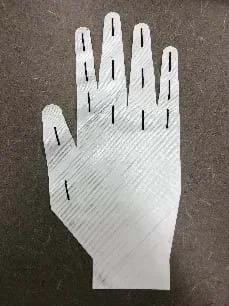 Prototype of a 3D printed glove with 3D printed sensors.Copyright 2020 Jeff Parks, Michigan State University RET
3D printed sensors are a novel design that can be customized in wearable technology. In this lesson, students are introduced to the concepts of electrical resistance and how it relates to sensors. They also learn about how 3D printing works when it comes to building sensors, including what are they, how do they work, and how can they be useful to us in measuring and taking data on a variety of concepts.
Electrical engineers utilize the concepts of electrical resistance to build sensors and electrical systems. Computer engineers and robotic engineers integrate sensors into the majority of their projects and sometimes have to custom build them. 3D printing allows engineers to make custom items quickly and makes prototyping very easy, and can be used to combine the efforts of several types of engineers in order to produce a particular product.
After this lesson, students should be able to:
- Explain the basics of electrical resistance.
- List the advantages of 3D printed strain sensors.
- Explain the societal uses of 3D printed strain sensors.
- Students will develop an understanding of the role of society in the development and use of technology.
Grades K-12
Do you agree with this alignment? - Students will develop an understanding of the characteristics and scope of technology.
Grades K-12
Do you agree with this alignment?
- SEP.6.9-12.3 Communicate technical information or ideas (e.g. about phenomena and/or the process of development and the design and performance of a proposed process or system) in multiple formats (including orally, graphically, textually, and mathematically).
Grades 9-12
Do you agree with this alignment?
Electrical resistance is how difficult it is for electricity to pass through a substance. Electrical resistance is related to the other variables of electricity through Ohm’s law. The website Rapid Tables details electrical resistance and Ohm’s law if you are unfamiliar.
A strain sensor is a sensor that works by measuring electrical resistance as a sensor is put through strains that deform the sensor. Also called a strain gauge, the most common type consists of an insulating flexible backing which supports a metallic foil pattern. The gauge is attached to the object by a suitable adhesive and as the object is deformed, the foil is deformed, causing its electrical resistance to change.
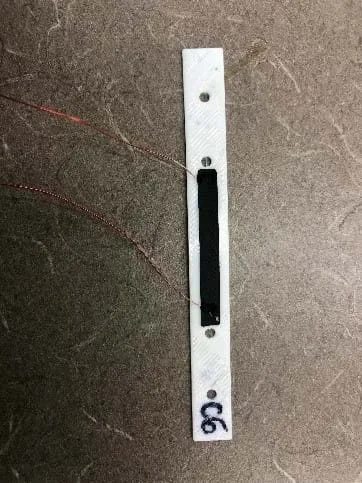 A 3D printed strain sensor.Copyright 2020 Jeff Parks, Michigan State University RET
Let us start this lesson with a question: why might it be better to 3D print a technology if it is possible to do so? (Give the students a few minutes to write down possible answers.) 3D printing is a technology that is rapidly accelerating as a novel way to manufacture products. Did you guess any of the following answers to the question? For starters, 3D printing is highly customizable; designers can print objects and customize them, practically on the fly by tweaking code. 3D printing also allows designers to quick print lightweight products. Also, the nature of 3D printing means it is easy to share a design with other engineers and manufacturers.
Let’s take a look at a technology that is easily produces because of 3D printers the strain sensor. (Lead students through 3D Printed Strain Sensors Lesson PowerPoint (PPTX)).
Are there any questions? We will now take a quick quiz about 3D printed strain sensors.
- 3d printing
- The act of creating something using a 3D printer, which works by creating a product by adding material (such as a filament) to a base using a program until the product is finished. 3D printing is the opposite of machining, in which an object is carved out of piece of raw material.
- electrical resistance
- The measurement of how well electrons flow through a substance.
- resolution
- The level of detail in a print.
- strain sensor
- A sensor that detects differences of movement or deformation through changes in electrical resistance; also known as a strain gauge.
Pre-Lesson Assessment:
Question: Have students answer this question in writing: “Why can it be better to 3D print a technology if it is possible?”
Introduction Assessment:
Discussion: Lead a classroom discussion about what the students have written from the Pre-Assessment and about what students know about 3D printing.
Lesson Summary Assessment:
Quiz: Have students take the 3D Printed Strain Sensor Quiz (PDF) individually. Check student answers using the 3D Printed Strain Sensor Quiz Answer Key (PDF).
RapidTables.com. Electrical Resistance. Accessed July 23, 2019. https://www.rapidtables.com/electric/Resistance.html
- 3D Printed Strain Sensors
Contributors
Jeff Parks
Supporting Program
RET Program, College of Engineering, Michigan State University
Acknowledgements
This material is based upon work supported by the National Science Foundation under grant no. CNS-1854985—a Research Experience for Teachers program titled “Multidisciplinary Computational Solutions to Smart Sensors and Sensing Systems” at Michigan State University. Any opinions, findings, and conclusions or recommendations expressed in this material are those of the author and do not necessarily reflect the views of the National Science Foundation.
Copyright
2020 by Regents of the University of Colorado; original © 2019 Michigan State University