
These Eyes! Technologies to Measure Eye Pressure
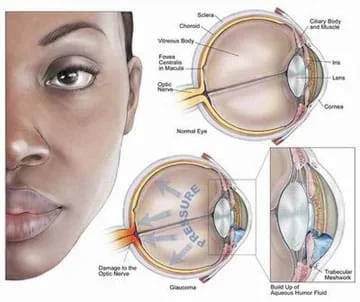 For people with glaucoma, pressure inside the eye can damage the optic nerve.Copyright 2012 Daniel Laroche. Used with permission. http://www.advancedeyecareny.com/overview/
Students learn about glaucoma—its causes, how it affects individuals and how biomedical engineers can identify factors that trigger or cause this eye disease, specifically the increase of pressure in the eye. Students also learn how RFID technologies transfer energy through waves and how engineers apply their scientific understanding of waves, energy and sensors to develop devices that measure the pressure in the eyes of people with glaucoma. Students conclude by sketching their own designs for a pressure-measuring eye device, preparing them to conduct the associated activity in which they revise, prototype and evaluate their device designs made tangible with a 3D printer.
To develop microscopic sensors that wirelessly transmit information, engineers must have a solid understanding of the transfer of energy through waves. Specifically, when engineers design pressure sensors to measure pressure differences within the eyes of people with glaucoma, they must apply their understanding of standing waves in order to develop these sensors. Additionally, creating and applying radio-frequency identification (RFID) technologies is essential for engineers to successfully incorporate pressure sensors into medical devices. Current research in neural systems engineering aims to design pressure sensors to monitor and ultimately prevent optic nerve damage associated with glaucoma.
After this lesson, students should be able to:
- Identify examples of waves.
- Explain how understanding electromagnetic waves is essential to creating wireless technologies.
- Explain the positive effects of wireless devices in biomedical applications.
- STEL-2M Differentiate between inputs, processes, outputs, and feedback in technological systems.
Grades 6-8
Do you agree with this alignment? - STEL-2N Illustrate how systems thinking involves considering relationships between every part, as well as how the system interacts with the environment in which it is used.
Grades 6-8
Do you agree with this alignment? - STEL-3F Apply a product, system, or process developed for one setting to another setting.
Grades 6-8
Do you agree with this alignment? - STEL-3G Explain how knowledge gained from other content areas affects the development of technological products and systems.
Grades 6-8
Do you agree with this alignment?
- P.EN.07.31 Identify examples of waves, including sound waves, seismic waves, and waves on water.
Grade 7
Do you agree with this alignment? - P.EN.07.32 Describe how waves are produced by vibrations in matter.
Grade 7
Do you agree with this alignment? - S.RS.06.18 Describe what science and technology can and cannot reasonably contribute to society.
Grade 6
Do you agree with this alignment?
- MS-ETS1-1 Define the criteria and constraints of a design problem with sufficient precision to ensure a successful solution, taking into account relevant scientific principles and potential impacts on people and the natural environment that may limit possible solutions.
Grades 6-8
This resource focuses on the following Three Dimensional Learning aspects of NGSS:
Science & Engineering Practices- Define a design problem that can be solved through the development of an object, tool, process or system and includes multiple criteria and constraints, including scientific knowledge that may limit possible solutions.Do you agree with this alignment?
Disciplinary Core Ideas- The more precisely a design task's criteria and constraints can be defined, the more likely it is that the designed solution will be successful. Specification of constraints includes consideration of scientific principles and other relevant knowledge that is likely to limit possible solutions.Do you agree with this alignment?
Crosscutting Concepts- The uses of technologies and any limitations on their use are driven by individual or societal needs, desires, and values; by the findings of scientific research; and by differences in such factors as climate, natural resources, and economic conditions.Do you agree with this alignment?
- All human activity draws on natural resources and has both short and long-term consequences, positive as well as negative, for the health of people and the natural environment.Do you agree with this alignment?
Do you agree with this alignment? - Define a design problem that can be solved through the development of an object, tool, process or system and includes multiple criteria and constraints, including scientific knowledge that may limit possible solutions.
- MS-PS4-3 Integrate qualitative scientific and technical information to support the claim that digitized signals (sent as wave pulses) are a more reliable way to encode and transmit information.
Grades 6-8
This resource focuses on the following Three Dimensional Learning aspects of NGSS:
Science & Engineering Practices- Integrate qualitative scientific and technical information in written text with that contained in media and visual displays to clarify claims and findings.Do you agree with this alignment?
Disciplinary Core Ideas- Digitized signals (sent as wave pulses) are a more reliable way to encode and transmit information.Do you agree with this alignment?
Crosscutting Concepts- Structures can be designed to serve particular functions.Do you agree with this alignment?
- Technologies extend the measurement, exploration, modeling, and computational capacity of scientific investigations.Do you agree with this alignment?
- Advances in technology influence the progress of science and science has influenced advances in technology.Do you agree with this alignment?
Do you agree with this alignment? - Integrate qualitative scientific and technical information in written text with that contained in media and visual displays to clarify claims and findings.
- Personal Glaucoma Story: Article and Discussion Questions (docx)
- Personal Glaucoma Story: Article and Discussion Questions (pdf)
- Personal Glaucoma Story Answer Key (docx)
- Personal Glaucoma Story Answer Key (pdf)
- Eye Anatomy Diagram (docx)
- Eye Anatomy Diagram (pdf)
- Components of RFID Technology Diagram (docx)
- Components of RFID Technology Diagram (pdf)
- Checking Your Understanding (docx)
- Checking Your Understanding (pdf)
- Checking Your Understanding Answer Key (docx)
- Checking Your Understanding Answer Key (pdf)
- Understanding Glaucoma Reference Material (docx)
- Understanding Glaucoma Reference Material (pdf)
An understanding that different types of waves exist, that waves transmit energy and how waves travel and change direction. An understanding of wave properties, including frequency, amplitude, wavelength and speed. Specifically, be able to apply all of this to radio waves.
Advance Preparation: Before presenting the Introduction/Motivation content, consider how you will pair students into groups of two for completing the discussion and mini-activities of this lesson. Make copies of the Personal Glaucoma Story: Article and Discussion Questions (PDF) and Checking Your Understanding (PDF), one each per student. Also make available for the entire class to see the Eye Anatomy Diagram (PDF)and Components of RFID Technology Diagram (PDF), perhaps projected in the front of the classroom. Have handy pencils, blank paper and graph paper for student use.
Suggested Day 1 Time Allotment: 30 minutes
Day 1 Tasks:
- Read and discuss the article.
- Discuss glaucoma using the eye diagram.
Day 1 Background Information for Teachers
Glaucoma is a disease that damages the optic nerve, often due to an increased amount of pressure within the eye(s). The most common of various types of glaucoma is open-angle glaucoma. Controlling and monitoring pressure within the eye is essential in preventing excessive damage to the optic nerve from increased intraocular pressure. For more information, refer to the Understanding Glaucoma Reference Material (PDF). A picture depicting what a person with glaucoma may see if damage occurs to the optic nerveCopyright National Eye Institute, National Institutes of Health, U.S. Department of Health and Human Services https://www.nei.nih.gov/health/glaucoma/glaucoma_facts.asp
Suggested Day 2 Time Allotment: 40 minutes
Day 2 Tasks:
- Discuss what engineers can do to monitor pressure within the eyes of people with glaucoma.
- Discuss RFID technology.
- Students complete section 1 of Checking Your Understanding.
Day 2 Background Information for Teachers
Radio-frequency identification (RFID) technology is becoming more common in everyday lives. Another well-known RFID example, besides the dog tag application mentioned in the lesson, is the use of electronic passes for toll road and toll bridge systems. In this application, tags are placed within the vehicles and readers are positioned over the roadway. When a vehicle passes under the reader, the information within the tag, which typically includes the car owner name, billing address and payment information, is analyzed and the software charges the owner of that vehicle for its passage.
Biomedical engineers utilize RFID in pressure sensors because this technology enables the fabrication of small, lightweight devices that do not require batteries. In many instances, the RFID tag within an intraocular pressure sensor is actually categorized as the frequency being returned to the external antenna. For more information about RFID and intraocular pressure sensors, refer to the Chipless RFID: Barcode of the Future article listed in the References section.
Suggested Day 3 Time Allotment: 40 minutes
Day 3 Tasks:
- Review wave properties.
- Discuss electromagnetic waves.
- Connect electromagnetic waves with radio waves.
- Students complete Section 2 of Checking Your Understanding.
- Close lesson and assign homework. The homework will be used in the associated activity.
Day 3 Background Information for Teachers
Two main categories of waves exist: mechanical and electromagnetic. Mechanical waves carry energy from one place to another and travel through matter, referred to as a "medium." Electromagnetic waves carry energy from one place to another and require no medium, thus they are able to travel through space. All waves are categorized by the following properties:
- wavelength: the distance between wave crests
- frequency: the number of waves that travel through a given point in a given time; measured in hertz (Hz); the more energy a wave has, the higher the frequency
- amplitude: the distance a medium moves when a wave passes through; the larger the amounts of energy a wave is carrying, the larger the amplitude
- speed: how quickly a wave travels; dependent on the medium
Biomedical engineers often utilize frequency when designing intraocular pressure sensors. The frequency of radio waves being transmitted to the pressure sensor from an external antenna is received by an antenna within the device. Then this energy is transferred through the device and reflected back. Next, the reflected wavelengths are transmitted back to the external antenna. Often, in an intraocular pressure sensor, a specific component of the device responds to pressure differences. Vibrations caused by this component form a different frequency than those being transmitted by the external antenna. Software can analyze the varying frequencies that return, which enables biomedical engineers to determine the frequencies of a given part within the device.
Day 1
Today's lesson begins by reading the personal story of an 11-year-old boy who lives with a disease called glaucoma. (Hand out the article to each student.) As you are reading the article to yourself, think about what you believe glaucoma is and how you think it impacts human life. Once you have finished reading, please individually answer the four questions that follow. The answers you provide will support your participation during our discussion.
(Give students 10-15 minutes to read the article and answer the four questions. Circulate the classroom to monitor and support students.)
(Divide the class into student pairs. Direct the groups to designate amongst themselves who is Partner A and who is Partner B.)
Now that you have read Christopher's story and had some time to reflect on the reading by answering the questions, I would like you and your partner to share each of your responses. To start, Partner A, read aloud question 2 and your answer to Partner B. Partner B, as you are listening, tell Partner A whether you agree or disagree with his or her response and why. Let's take two minutes to have all Partner As in the room share their responses. Partner Bs, listen and then explain whether you agree or disagree and why.
(Circulate the classroom listening for a partnership that has 1] accurately responded to the assigned question, and 2] presented a strong position statement to Partner A's responses. Make a mental note of this partnership to select it for the next step.)
We are now going to listen in on one of our classmates' discussions. (Insert the names of your selected partnership), would you please summarize for the rest of the class the answer provided for the question and the claims made by Partner B?
Now, let's switch partnership roles. This time, Partner B provides his/her answer to question 4. Partner A listens and then explains whether s/he agrees or disagrees with the answer and why.
(Circulate the classroom listening for a partnership that has 1] accurately responded to the assigned question, and 2] presented a strong position statement to Partner B's responses. Make a mental note of this partnership to select it for the next step.)
Again, let's listen in on one of our classmates' discussions. (Insert the names of your selected partnership), would you please summarize for the rest of the class the answer provided for the question and the claims made by Partner A?
As we discussed and read the article, we learned about Christopher, who has glaucoma. We learned that glaucoma can cause an individual to lose his or her vision. To understand how this occurs, we must first understand glaucoma.
Glaucoma is a disease that affects the eyes. Specifically, it affects the optic nerve of the eye. (Refer to a cutaway eye anatomy diagram with the optic nerve, retina and anterior chamber identified, such as the Eye Anatomy Diagram (PDF).) In this diagram, we see an eye. (Point to the optic nerve) Here is the optic nerve. The function of the optic nerve is to send messages from the retina to the brain. (Point to the retina.) Here is the retina. The retina is made of specialized cells that respond to light. When these cells respond to light, they send specific messages about shape, color and movement through the optic nerve to the brain. The brain interprets these messages and is able to form a "picture" of what is being seen by a person.
Glaucoma can damage the optic nerve, which results in blindness because the messages from the retina cannot reach the brain due to increased pressure in the eye. This pressure increase is most often caused by an increased amount of fluid that builds up in the anterior chamber. (Point to the anterior chamber on the eye diagram.) When this fluid accumulates, the increased pressure in the eye can damage the optic nerve.
Day 2
Now, let's think about how engineers could help Christopher Wilmoth immediately know when the pressure in his eyes has changed, which could help to reduce the amount of damage that could occur to the optic nerve. On a blank sheet of paper, write down any ideas you have that would help Christopher. (Pause to give students some time to record their ideas.)
With your partners, discuss each of your ideas and be prepared to report back to the rest of the class on some of your ideas. (Give students some time to discuss ideas. Circulate among the students to listen in on their discussions.)
Now, let's hear some of your ideas. When I call your name, please share one or two ideas. (Expected possible student responses: We need to make a device that measures the pressure. We could make something that is like a blood pressure reader at the pharmacy, but made for eyes.) I am hearing that we need to make something that can measure the pressure in the eyes. I agree with this idea. Let's work together to think of a sensor we could make to determine the pressure in eyes.
Think about what features you would like this pressure sensor to have. You might consider the size of the sensor, the way it sends messages about pressure or the way it is powered. Let's share some of your ideas with the rest of the class. (Encourage students to contribute their ideas. Expected possible student ideas: It must be smaller than the eye. It has to have a battery. It would have to be wireless. It has to have a very low mass.)
When biomedical engineers design medical devices, they do just what you have done—determine and define what is needed for a successful solution. Engineers call these requirements and features "criteria and constraints of the design problem." They take into consideration the relevant scientific principles, technologies and impacts on people and the natural environment.
I heard it mentioned that the pressure sensor needs to be wireless. This means that we need to understand how information is transmitted wirelessly. I also heard that you think it would be good if the sensor had a battery and a lower mass. Think about the batteries in remote controls, cell phones and other devices. Do you think that having a battery would lower the mass of our sensor or increase the mass? (Listen to student responses. The presence of a battery would increase the mass.) So, if we do not want to increase the mass, we also need to understand how we can create a device that can wirelessly transmit information without the use of a battery. It sounds like we need our sensor to use RFID technology. Let's spend some time understanding this technology in order to apply our understanding to the development of our sensor.
What does RFID mean? (See if any students know.) RFID stands for radio-frequency identification. This form of technology enables devices to communicate wirelessly with no need for a battery or physical contact. Two components are needed in order for information to be transferred: a tag and a RFID reader. The tag stores the required information and the RFID reader reads the information in the tag. To understand this technology in more detail, let's look at an example that already exists today. (Display the Components of RFID Technology Diagram (PDF) to the entire class).
In this diagram, you see Fido who likes to run away from home (point to the picture of the dog). When Fido is picked up by animal control (point to the man with the net), he is taken to the humane society. The veterinarian at the human society (point to veterinarian) knows how much Fido is loved, so she uses an RFID reader (point to reader) to see if Fido has an RFID tag. RFID tags, located inside microchips (point to the microchip, which is seen in an x-ray image), contain information about an object, in this case Fido. The microchip also contains an antenna, which transmits information from the tag to the reader through radio waves. In this case, the RFID tag contains information about the dog and its owners. Once the veterinarian uses the RFID reader, Fido can be returned to his home.
Before we continue on, I would like you to reflect on this information. (Hand out the Checking Your Understanding (PDF) student assessment document, one per student.) Please complete section 1. Once you are finished, turn your paper over to indicate that you are ready to move on.
Day 3
Now that we have identified the form of technology that will best support the development of our pressure sensors, let's identify how we will measure the pressure within the eye. It seems as if we need some part of our pressure sensor to measure pressure and transfer that information back to our RFID reader. To design these parts of our pressure sensor, we need to have an understanding of the properties of radio waves and how they function. Refer to the associated activity Intraocular Pressure Sensor Design Challenge for instructions on a hands-on design challenge for students.
First, let's quickly review waves. What do we know about waves? (See what students know.) Waves carry energy from one place to another. Waves travel through all types of matter and they also travel through space. Often the matter in which a wave travels is called a "medium." Waves have specific properties, such as wavelength, frequency, amplitude and speed.
RFID technology transmits information through radio waves. Radio waves are the electromagnetic spectrum, meaning they are electromagnetic waves. You use electromagnetic waves whenever you listen to the radio, send a text message or warm food in the microwave. Electromagnetic waves require no medium to be transferred, but in order for humans to detect these waves, a device must be used. For example, to detect radio waves, a radio must have an antenna to receive the radio waves and it must also have speakers that vibrate from the energy of the radio waves. The vibrations in the speakers cause sound waves to form, which enables us to hear music from the radio. (For more information, see NASA's Mission: Scienc e page in the References section, which describes the electromagnetic spectrum in more detail.)
Let's think about this in more detail. When you listen to music on the radio, you use a radio dial that tunes the radio to your chosen station. Each radio station has a specific frequency that corresponds to a specific wavelength. Your radio is designed to take the information encoded in the frequency and play it through the speakers. The energy within the wavelength causes the speakers to vibrate, which produces sound waves. Your hears hear the sound waves so you can enjoy the music. (For more information, see the Schnickel website in the References section, which describes how radios work.)
Before the speakers can vibrate, the radio must detect the radio waves. Remember, radio waves are electromagnetic waves, which we can only detect through a device. This means that your radio must have a specific part that detects the differing frequencies associated with radio waves. Every radio is equipped with an antenna. Some antennas are large and some are small, but they have the same function, which is to convert radio waves into electric power. The antenna on your radio receives the radio waves, converts them into electric power that your radio uses to transport that energy to the speakers.
(Proceed to the Lesson Closure section.)
In closing, if we were to develop a pressure sensor to help Christopher monitor the pressure in his eyes, what components would we need to include? (Listen to student responses.) We would need an RFID reader to receive information about the pressure in the eyes, an RFID tag that contains information about pressure in the eye and an antenna to transmit this information and receive the radio waves. Biomedical engineers rely on all of the information you learned about in this lesson to develop such a device.
Next time we meet, you are going to play the role of biomedical engineers challenged to design a pressure sensor that can be implanted into Christopher's eye so that his eye pressure can be monitored. By monitoring this pressure, we can help limit the amount of damage that could occur to the optic nerve.
Right now, please complete section 2 of Checking Your Understanding. Once finished, begin to work on your homework, which is to think ahead by designing an RFID pressure sensor for Christopher. Sketch your design, include all of the structures you think are needed to make his pressure sensor and describe the functions of each structure on your diagram.
- antenna
- In an RFID system, sends and receives signals between the reader and the tag.
- constraint
- A limitation or restriction. For engineers, constraints are the limitations and requirements that must be considered when designing a workable solution to a problem.
- criteria
- In engineering design, the objectives and requirements that a final design solution is required to meet.
- electromagnetic wave
- A wave that can travel through space and matter. Examples include light waves, radio waves, microwaves, x-rays, etc.
- frequency
- The number of times something is repeated in a given time.
- glaucoma
- A disease that causes damage to the optic nerve, often due to an increased amount of pressure within the eye(s); can lead to vision loss.
- medium
- A substance in which a force acts or waves move through.
- optic nerve
- A nerve that transmits visual information (impulses) to the brain from the retina at the back of the eye.
- pressure sensor
- A device that measures the amount of pressure.
- rfid
- Acronym for radio-frequency identification. RFID technology enables devices to communicate wirelessly with no battery or physical contact.
- rfid reader
- A device that sends signals to the tag.
- rfid tag
- Contains an identification code; for example, a specific frequency.
- rfid technology
- A wireless data capturing technique that uses radio-frequency waves to identify objects.
Pre-Lesson Assessment
Reading and Questions: Review student responses to questions 2 and 4 in the Personal Glaucoma Story: Article and Discussion Questions (PDF). Refer to the Personal Glaucoma Story Answer Key (PDF) for example answers.
- Question #2: The fifth paragraph states, "...that the pressure in Christopher's eyes was quite elevated." Based on the information in this paragraph, do you believe a connection exists between pressure and glaucoma? Why or why not?
- Question #4: The last paragraph describes the hope that the Wilmoths have for Christopher's future. What do you think could be done to keep Christopher's disease from getting worse?
Post-Introduction Assessment
Write It Out! On blank sheets of paper, have students write down all ideas they have that would help Dennis and Christopher reduce the amount of damage that could occur to their optic nerves. Expect students to write that some sort of device needs to be invented to measure the pressure within the eyes. Further, ask students to elaborate on what specific features would be important aspects of the device, just like engineers define a design problem's criteria and constraints. Students' ideas reveal their depth of comprehension of the lesson concepts.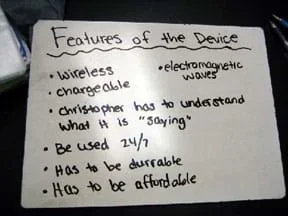 A student example of ideas generated for a biomedical device.Copyright 2014 Janelle Orange, Michigan State University
Lesson Summary Assessment
Understanding Check: At two points in the lesson (Day 2 and Day 3-Lesson Closure), assign students to individually complete section 1 and then section 2 of the Checking Your Understanding (PDF) assessment. Through 11 multiple choice and short answer questions, students verify their understanding of RFID technology and its effectiveness, and electromagnetic waves, and apply the components of RFID to the development of a pressure sensor. Review their answers to assess their mastery of the lesson topics.
Homework
Thinking Ahead: My Potential Design: On graph paper, have students sketch their designs for pressure sensors they would like to create to assist people with glaucoma. Require each design component and structure to be labeled with a description of its function. This assignment prepares students to conduct the associated activity, during which they will revise and build prototypes of their designs. Review their designs to gauge their depth of comprehension of the lesson topics and their readiness to conduct the activity. Expect student designs to include the following structures: antenna, RFID reader and RFID tag. Also expect students to describe, in their own words, the following functions for the structures:
- The antenna receives and transmits frequency signals.
- The RFID reader interprets and analyzes information about the eye pressure.
- The RFID tag stores information about the eye pressure.
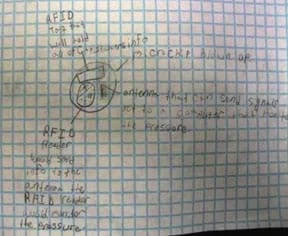 A student example design sketch for an eye pressure sensor device.Copyright 2014 Janelle Orange, Michigan State University
After conducting the associated activity, show students photographs of real-life biomedical inventions by searching online for "intraocular pressure sensor."
Introduction to the Electromagnetic Spectrum. 2011. NASA: Mission: Science, NASA's Science Mission Directorate. Accessed July 20, 2014. http://missionscience.nasa.gov/ems/01_intro.html
Normal Eye Anatomy. New York State Optometric Association. Accessed July 3, 2014. http://www.nysoa.org/page/normal-eye-anatomy-54.html
Personal Story: Christopher Wilmoth. March 28, 2014. Glaucoma Research Foundation. Accessed July 2, 2014. http://www.glaucoma.org/personal-stories/personal-story-christopher-wilmoth.php#
Preradovic, S. and Karmakar, N. 2010. Chipless RFID: Bar Code of the Future. IEEE Microwave Magazine, 11(7), 87-97
Schnickel, Andrew. 2012. Catch a Wave: Radio Waves and How They Work. Illumin: A review of engineering in everyday life. Accessed July 20, 2014. http://illumin.usc.edu/printer/114/catch-a-wave-radio-waves-and-how-they-work/
- These Eyes! Technologies to Measure Eye Pressure
Contributors
Janelle Orange
Supporting Program
Robotics Engineering for Better Life and Sustainable Future RET, College of Engineering, Michigan State University
Acknowledgements
The contents of this digital library curriculum were developed through the Robotics Engineering for Better Life and Sustainable Future research experience for teachers under National Science Foundation RET grant number CNS 1300794. However, these contents do not necessarily represent the policies of the NSF and you should not assume endorsement by the federal government.
Copyright
2015 by Regents of the University of Colorado; original © 2014 Michigan State University