
Pharmaceutical Research Design Problem
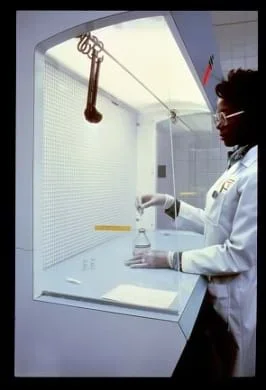 Laboratory research is critical in the field of biomedical engineering.Copyright National Institutes of Health http://www.media.nih.gov/imagebank/display_search.aspx?id=14
Through this lesson and its associated activity, students explore the role of biomedical engineers working for pharmaceutical companies. First, students gain background knowledge about what biomedical engineers do, how to become a biomedical engineer, and the steps of the engineering design process. The goal is to introduce biomedical engineering as medical problem solving as well as highlight the importance of maintaining normal body chemistry. Students participate in the research phase of the design process as it relates to improving the design of a new prescription medication. During the research phase, engineers learn about topics by reading scholarly articles written by others, and students experience this process. Students draw on their research findings to participate in discussion and draw conclusions about the impact of medications on the human body.
Biomedical engineers follow the steps of the design process to solve medical problems such as designing new medications, implants and prosthetics. One phase of the design is the research step during which scholarly articles are reviewed to learn what information has already been researched and developed on a particular topic. Research is a very important stage as it helps engineers learn what knowledge already exists so they do not waste time and expense duplicating research.
After this lesson, students should be able to:
- List job prospects for the biomedical engineering field.
- Describe the importance of research in technological advancements.
- Explain the importance of maintaining body chemistry homeostasis.
- Technological problems must be researched before they can be solved.
Grades 9-12
Do you agree with this alignment? - Biotechnology has applications in such areas as agriculture, pharmaceuticals, food and beverages, medicine, energy, the environment, and genetic engineering.
Grades 9-12
Do you agree with this alignment? - STEL-4T Evaluate how technologies alter human health and capabilities.
Grades 9-12
Do you agree with this alignment? - STEL-7AA Illustrate principles, elements, and factors of design.
Grades 9-12
Do you agree with this alignment? - STEL-7X Document trade-offs in the technology and engineering design process to produce the optimal design.
Grades 9-12
Do you agree with this alignment? - STEL-8Q Synthesize data and analyze trends to make decisions about technological products, systems, or processes.
Grades 9-12
Do you agree with this alignment?
- Identify, research, and summarize current, topical advances in biomedical research and healthcare areas. (Suggested areas of initial focus including fetal tissue research, legalization of drugs, drug abuse, euthanasia, research fraud, use of non-human animals in research, genetic engineering, and universal health care. DOK 4
- Biomedical science areas of personal interest
- Key areas of human physiology towards which a major commitment of United States federal funding of biomedical research is applied
Grades 9-12
Do you agree with this alignment?
- Pharmaceutical Research Presentation (ppt)
- Pharmaceutical Research Presentation (pdf)
- Osteopontin Research Activity Worksheet (docx)
- Osteopontin Research Activity Worksheet (pdf)
- Osteopontin Scholarly Article (pdf)
- Osteopontin Research Activity Worksheet Answers (docx)
- Osteopontin Research Activity Worksheet Answers (pdf)
Biomedical Engineering
In advance of the lesson, become familiar with the role of biomedical engineers in today's world so as to be able to answer basic questions from students about what they do, how much they make, how long it takes to earn a degree for this program, and what universities offer biomedical engineering programs. Typically, biomedical engineering jobs require master's or doctoral degrees, while several universities offer bachelor's degree programs for this area of study. You may want to check your state universities in order to be able to offer more specific information regarding which schools offer biomedical engineering degrees. Biomedical engineers can expect to make $60,000 to $90,000 per year, starting at a $45,000 per year salary. Many offshoots of the field, such as biochemical engineering (body chemistry engineering) and biomechanical engineering (the study of mechanical forces on the body) are continuously evolving.
Some biomedical engineers design medical implants for use in humans, such as replacement joints, pins and plates for injury repair, synthetic tissues for burn victims, and organ development for transplants. Others focus on the development of new pharmaceutical drugs that provide symptom relief or cures for modern diseases. Jobs in this field require great knowledge of biochemical pathways in the body, as well as lab experience. Many other types of engineers participate in biomedical engineering through the design of supporting equipment and tools. Some diagnostic medical equipment, such as MRI and CT imaging and x-rays, were developed for other uses and then made their way into the medical industry to help ailing people. Fine tuning this technology for civilian use and maintaining it is a career all its own.
For more information about current biomedical engineering research projects, see the University of Delaware's Center for Biomedical Engineering Research website, as provided in the References section.
Engineering Design Process
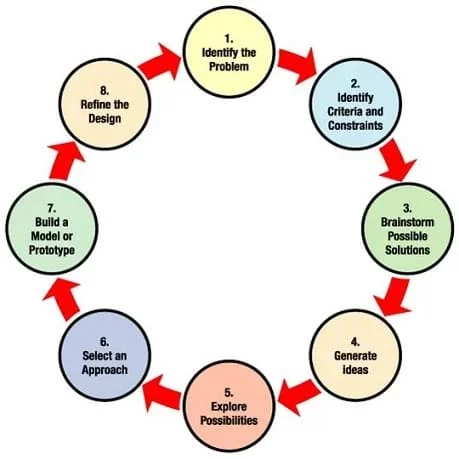 Figure 1. The steps of the engineering design process.Copyright NASA http://www.nasa.gov/audience/foreducators/plantgrowth/reference/Eng_Design_5-12.html
In advance of the lesson, become familiar with the steps of the engineering design process, which is a powerful classroom tool to help students solve everyday problems and promotes group learning. The cyclical design process follows eight basic steps (see Figure 1) although different sources may describe the process in more or fewer steps, depending on the depth of the description. The essential steps include: problem and constraint identification, idea brainstorming, idea synthesis, idea selection, idea exploration, approach selection, prototype creation, testing and design refinement. Reiteration at each step is key for success. Projects that use all the steps of the design process for completion can be very fun and rewarding for students, but are not required in order to learn the process. Although not every classroom activity will use every step, if you point out throughout the year various examples of these design steps and where they fall within the bigger engineering design process, it helps students gain a better understanding of the entire problem solving process. See the NASA website listed in the References section for more information about the design process, including tips and examples.
For this particular activity, tests show that our drug "Outstandix" is working beautifully in animal trials, but seems to lower the amounts of a protein called Osteopontin in the body. The constraints of our design are the limitation of this protein in the body. Due to the fact that we know nothing about this particular protein, we cannot generate possible solutions without more knowledge, and so we embark on research to learn more.
(Be prepared to show students the first nine slides of the Pharmaceutical Research Presentation (PPT) PowerPoint file as a guide to move through the lesson. The 15 slides summarize important lesson and activity information for students. Make copies of the Osteopontin Research Activity Worksheet (PDF) and the Osteopontin Scholarly Article (PDF), one each per student.)
(Slide 2) Today we are going to explore biomedical engineering. Can anyone tell me what biomedical engineers do and why they are important? (Listen to volunteer answers.) I would describe biomedical engineers as medical problem solvers. Biomedical engineers work in hospitals, research facilities, in teaching, and for the government.
(Slide 3) Biomedical engineers use the engineering design process to solve medical problems. To do this, they apply knowledge from biology, chemistry and physics to solve problems involving the human body. They are employed to design medical implants, develop new pharmaceutical drugs, identify and develop cures for diseases, and engineer synthetic tissues and organs for transplant.
(Hand out the worksheets. students complete the first worksheet page during this lesson and the second worksheet page during the associated activity, If You're Not Part of the Solution, You're Part of the Precipitate!)
(Slide 4) In today's activity, we are going to explore the role of a biomedical engineer by stepping into the shoes of a biomedical engineer and participating in the decision making and research necessary to develop a new drug. (Read the information from the slide about a hypothetical new medication called Outstandix.)
(Show and read slides 5 and 6. Distribute the article to students. Direct them to read pages 288–295, beginning with the "Potential Functions" section and ending after the "Summary" section. Encourage students to highlight and underline important information in the article.)
(Organize students into small groups to discuss what they learned from the article as well as their experiences while reading, such as anything that frustrated them during the reading. Allow five minutes for this discussion. At this point, share scholarly reading tips such as: "read the summary first" or "eliminate information that you do not need." Also show them your highlighted copy of the article as an example.)
(As a class) How many of you thought reading that article was hard? (Ask for a show of hands.) How many of you have read a scholarly article like this before (Ask for a show of hands.)
(optional; Use an overhead projector to show the class the Anatomy of a Scholarly Article from a website listed in the References section.)
One tip for sorting out information in this type of article is to read the summary. Also, in order to really understand, sometimes you must look up words in the dictionary. Take a moment to re-read the summary and raise your hand if you come up with another function for Osteopontin. (Have a few students share their answers.)
(Show and read slides 7, 8 and 9. Show slides10-15 at end of the associated activity.)
Now that we have reviewed and practiced some of the things that biomedical engineers do, I would like you to answer the following exit questions and hand them in before you leave class. On a separate sheet of paper, list three possible employment opportunities for a person with a degree in biomedical engineering. Also, please the importance of research in technological advancements. And, describe an example of how a change in body chemistry can affect overall health. You will receive a grade for answering these exit questions, and we will use your answers to begin tomorrow's activity.
- apoptosis
- A genetically determined process of cell self-destruction.
- biomedical engineering
- The application of science, math and engineering principles to problem solving design that involves medicine and biology.
- bone mineralization
- Deposition of calcium salts into a bony matrix to form solid bone.
- calcium crystals
- A homogenous solid form of calcium with a natural geometric form.
- double replacement
- A chemical reaction between two compounds in which the positive ion of one compound is exchanged with the positive ion of another compound.
- electrolyte
- Any substance that dissociates into ions when dissolved in a suitable medium.
- engineering design process
- A series of steps used by engineering teams to guide them as they develop new solutions, products or systems.
- homeostasis
- The ability of the body or a cell to seek and maintain a condition of equilibrium or stability within its internal environment.
- precipitate
- To separate (a substance) in solid form from a solution.
- pulmonary embolism
- Blockage of the pulmonary artery by foreign matter or a blood clot.
- solution
- A homogeneous, molecular mixture of two or more substances.
- vascular calcification
- Deposition of calcium into the blood vessel structures.
Worksheet: As students read the Osteopontin Scholarly Article (PDF), have them use page 1 of the Osteopontin Research Activity Worksheet (PDF) to take notes. (They will later use page 2 to record their observations and conclusions during the associated activity.) Review their research-gathering notes to gauge their comprehension.
Written Exit Questions: At lesson end, assign students to individually answer the following three questions before leaving class, as presented in the Lesson Closure section. The next day, prior to the activity, review typical responses and the correct responses to clarify any misconceptions.
- List three employment opportunities for a degree in biomedical engineering. (Answers: Developing new drugs, designing human implants, researching diseases, creating tools and equipment, etc.)
- Describe the importance of research in technological advancements. (Answer: Researching is important to make sure you do not waste time studying a problem someone else has solved, or to learn what is already known about a subject, which is information needed to continue with the design process.)
- Give an example of how a change in body chemistry can affect overall health. (Example answer: Excessive sweating in high heat can result in an electrolyte imbalance. Excessive sweating causes the body to lose salts, sugars and potassium. Without replacement, this may lead to heat stroke, heart palpitations, diarrhea, stomach cramps and in serious cases, coma.)
Center for Biomedical Engineering Research. Updated 2012. CBER, College of Engineering, University of Delaware. Accessed July 30, 2012. http://www.cber.udel.edu/research.html
Engineering Design Challenge. Last updated February 22, 2008. NASA Lunar Plant Growth Chamber. Accessed July 10, 2012 (Source of definitions, images and other information.) http://www.nasa.gov/audience/foreducators/plantgrowth/reference/Eng_Design_5-12.html
Orphanides, Andreas. Anatomy of a Scholarly Article. Last updated July 13, 2009. North Carolina State University Libraries. Accessed July 25, 2012. (Source of information about scholarly articles.) http://www.lib.ncsu.edu/tutorials/scholarly-articles/
Sodek, J., B. Ganss and M.D. McKee. 2000. Osteopontin. Critical Reviews in Oral Biology & Medicine, Sage Journals. Vol. 11, no. 3, pp. 279-303. Accessed July 25, 2012. http://cro.sagepub.com/content/11/3/279
- Pharmaceutical Research Design Problem
Contributors
Angela D. Kolonich
Supporting Program
Bio-Inspired Technology and Systems (BITS) RET, College of Engineering, Michigan State University
Acknowledgements
The curricular material was supported by a National Science Foundation (NSF) CAREER award (grant no. CMMI 1150376) and an NSF RET program (grant no. EEG 0908810) at Michigan State University. However, these contents do not necessarily represent the policies of the National Science Foundation and you should not assume endorsement by the federal government.
Copyright
2013 by Regents of the University of Colorado; original © 2011 Michigan State University