
What Is an IR Sensor?
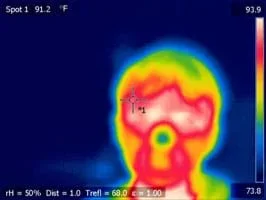 The human face seen through an infrared camera.Copyright 2014 Jarek Tuszynski, CC-BY-SA-3.0, Wikimedia Commons https://commons.wikimedia.org/wiki/File%3AThermal_image_-_face_-_2.jpg
Students learn about infrared energy and how it is used to sense the surrounding environment. They review where infrared falls on the electromagnetic spectrum and learn how infrared sensors work, as well as various ways engineers and scientists create and apply infrared technology to study science and collect information for security, communications, medical, research and other purposes. Pre/post-quizzes and a take-home assignment are provided. Learning the concepts prepares students to conduct the associated activity in which they design and program Arduino-controlled robots that use IR sensors to follow a line and make designated stops, much like the automated guided vehicles used in industry and commerce.
Engineers design products that use infrared (IR) sensors to "sense" the surrounding environment such as by detecting the heat of an object or its motion. Some IR sensors detect objects' temperatures by measuring the amount of infrared radiation that is naturally emitted by the objects. Other devices detect the presence of objects by emitting their own IR radiation forward and then measuring the amount reflected back. Engineers incorporate IR sensors into a variety of consumer products such as security cameras, remote control devices, night vision equipment, chemical analysis instruments, as well as other technology that collects data about the universe.
After this lesson, students should be able to:
- Describe what infrared waves are and identify their wavelengths.
- List ways infrared is used by scientists and engineers in various products to study science and collect information.
- Explain how an infrared sensor works.
- Explain how to use an infrared sensor to detect the presence of an object.
- Technological innovation often results when ideas, knowledge, or skills are shared within a technology, among technologies, or across other fields.
Grades 9-12
Do you agree with this alignment? - Students will develop an understanding of the relationships among technologies and the connections between technology and other fields of study.
Grades K-12
Do you agree with this alignment?
- HS-PS4-5 Communicate technical information about how some technological devices use the principles of wave behavior and wave interactions with matter to transmit and capture information and energy.
Grades 9-12
Do you agree with this alignment?
- 9-12.TC.4 describe uses of various existing or emerging technology resources (e.g., podcasting, webcasting, videoconferencing, online file sharing, global positioning software)
Grades 9-12
Do you agree with this alignment? - 9-12.TC.5 identify an example of an assistive technology and describe its potential purpose and use
Grades 9-12
Do you agree with this alignment? - 9-12.TC.9 participate in experiences associated with technology-related careers
Grades 9-12
Do you agree with this alignment?
- HS-PS4-5 Communicate technical information about how some technological devices use the principles of wave behavior and wave interactions with matter to transmit and capture information and energy.
Grades 9-12
This resource focuses on the following Three Dimensional Learning aspects of NGSS:
Science & Engineering Practices- Apply scientific principles and evidence to provide an explanation of phenomena and solve design problems, taking into account possible unanticipated effects.Do you agree with this alignment?
Disciplinary Core Ideas- Information can be digitized (e.g., a picture stored as the values of an array of pixels); in this form, it can be stored reliably in computer memory and sent over long distances as a series of wave pulses.Do you agree with this alignment?
- Multiple technologies based on the understanding of waves and their interactions with matter are part of everyday experiences in the modern world (e.g., medical imaging, communications, scanners) and in scientific research. They are essential tools for producing, transmitting, and capturing signals and for storing and interpreting the information contained in them.Do you agree with this alignment?
Crosscutting Concepts- Systems can be designed to cause a desired effect.Do you agree with this alignment?
- Modern civilization depends on major technological systems.Do you agree with this alignment?
Do you agree with this alignment? - Apply scientific principles and evidence to provide an explanation of phenomena and solve design problems, taking into account possible unanticipated effects.
- You Can Run but You Can't Hide Pre-Quiz (docx)
- You Can Run but You Can't Hide Pre-Quiz (pdf)
- You Can Run but You Can't Hide Pre-Quiz Answer Key (docx)
- You Can Run but You Can't Hide Pre-Quiz Answer Key (pdf)
- I Now Know I Can't Hide Post-Quiz (docx)
- I Now Know I Can't Hide Post-Quiz (pdf)
- I Now Know I Can't Hide Post-Quiz Answer Key (docx)
- I Now Know I Can't Hide Post-Quiz Answer Key (pdf)
- Come Follow Me Homework Handout (docx)
- Come Follow Me Homework Handout (pdf)
- Come Follow Me Homework Handout Answer Key (docx)
- Come Follow Me Homework Handout Answer Key (pdf)
Students should understand:
- That different types of waves exist, including mechanical waves and electromagnetic waves.
- The various properties of waves, including wavelength, frequency and reflection.
- Circuits and have a familiarity with circuit diagrams.
Before presenting the Introduction/Motivation content to the class, prepare the following:
- Make copies of the You Can Run but You Can't Hide Pre-Quiz (PDF), I Now Know I Can't Hide Post-Quiz (PDF) and Come Follow Me Homework Handout (PDF), one each per student.
- Have ready a projector with access to the Internet to show students a short video clip, some diagrams, photographs and images. You may want to find all these items and have them ready to show in different browser tabs; refer to the list in the Additional Multimedia Support section.
- Turn on the projector using the remote control device and draw students' attention to the remote; you will refer to it again later as an example IR application.
- While optional, it is recommended, that you acquire the following circuit to show students at the end of this lesson: SparkFun RedBot Line Follower Sensor, part # SEN-11769, for $2.95 at https://www.sparkfun.com/products/11769. This same sensor is on the Materials List for the associated activity.
- See the Additional Multimedia Support section for suggestions of additional background information resources for teachers and students.
(See the preparation suggestions in the Lesson Background section. To begin, divide the class into groups of two students each.)
In today's lesson we are going to learn about technology used to sense our environment. Let's watch this short video and then I would like you to individually answer several questions. (Show the following four-minute video of police using forward looking infrared camera technology to track and apprehend two burglary suspects: https://www.youtube.com/watch?v=rvqd3yVTkDE.)
Let's take a couple of minutes to answer some questions. (Hand out the pre-quiz.) Now that you've had some time to answer the questions, I would like you and your partner to discuss your answers with each other and refine your answers. (Circulate the classroom; look at and listen to student answers.)
Who can tell us how the police were able to "see" the burglars? (Select a group to answer.) Yes, the police were able to "see the heat." (Using the projector, show the class Figure 1, a diagram that compares wavelength, frequency and energy for the electromagnetic spectrum as found on the following web page under Measuring Electromagnetic Radiation: https://imagine.gsfc.nasa.gov/science/toolbox/emspectrum1.html. Point to the infrared section.)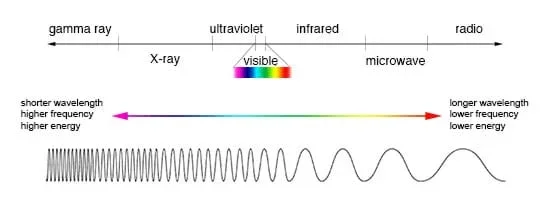 Figure 1. Comparison of wavelength, frequency and energy for the electromagnetic spectrum.Copyright NASA's Imagine the Universe http://imagine.gsfc.nasa.gov/science/toolbox/emspectrum1.html
Students, please take notes during this discussion! This chart shows various wavelengths of the electromagnetic spectrum. As you may recall from your previous science courses, unlike water waves or sound waves, these types of waves do not need a medium to pass through; electromagnetic waves pass through space. (Point to the visible spectrum.) The visible spectrum is what the human eye can see. Just beyond the visible spectrum is the infrared spectrum. What happens to the wavelengths and frequency as we go beyond visible light? (Wait for a student to answer.) That's correct, the wavelengths get longer and the frequency gets smaller. Infrared, known as IR, is beyond the red edge of visible light and extends from a wavelength of 740 nm (0.00003 inches) with a frequency of 400 THz to a wavelength of about 30 cm (12 inches) with a frequency of 3 GHz. Infrared is invisible to human eyes, but people can feel it as heat.
The IR spectrum is useful for purposes of sensing and detecting. All objects, both living and nonliving, give off heat and therefore give off infrared radiation. Why? (Give students a chance to answer.) All objects have temperatures above absolute zero—a temperature scientists have never be able to reach. Infrared radiation can be detected by electronic circuits.
(Go to the following Wired magazine website: https://www.wired.com/2014/04/the-world-looks-different-when-you-see-in-infrared/. Show students some of the photographs, pointing out the human face and the laptop power supply radiating energy.) Here are examples of both living and nonliving objects giving off IR. Night vision cameras, such as those in the police video, use special electronic imagining circuits that are sensitive to IR, which was emitted by the burglars' (and dog's) warm bodies. These warm objects showed up as white in the video.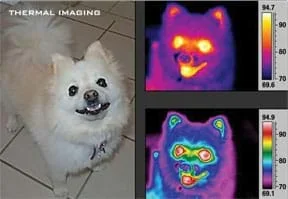 Figure 2. Thermal imaging technology detects infrared waves that are invisible to human eyes.Copyright NASA/JPL – Caltech, NASA Science Mission Directorate https://science.nasa.gov/science-news/science-at-nasa/2009/19nov_sofia
IR has many applications. (Show the class Figure 2, which are IR images of a dog from NASA's Science Mission Directorate website at: https://science.nasa.gov/science-news/science-at-nasa/2009/19nov_sofia.) Look at these images and think about your answer to this question: How might IR be used by doctors in the medical field? (Then listen to some student answers.) Some illnesses cause changes in skin surface temperatures, which can be detected by IR. For example, tumors are characterized by areas of increased blood flow and metabolism, resulting in areas of temperature increases, making them detectable by IR. A technology called thermal imaging uses IR to measure body temperatures and has been used to detect diabetes, vascular diseases and cancer.
(On the same Mission: Science web page, scroll down and show the two images of the Carina Nebula.) Look at these two images of the Carina Nebula taken from the Hubble Space Telescope under different conditions. This nebula is one of the largest in our skies and is composed of interstellar dust and ionized gases. What new information does the infrared image show? (Wait for student responses.) We are able to see new stars (which give off heat) that are hidden behind the dense gas clouds. (On the same web page, scroll down and show the image of forest fires in northern California.) Why is IR technology being used here? (Wait for students to answer.) Sources of forest fires are not visible behind thick clouds of smoke, but the heat emitted by them can be directly pinpointed with IR technology to help fight fires.
At the start of class, I used a remote control device to turn on the projector. Did you see a beam of light shining between the remote and the projector? (Expect students to say no; no light was visible.) That's right, what kind of light is it? (Expect students to say IR.) Yes, it's infrared. And, can we see IR? (No, it's invisible to human eyes.) That's right, the human eye cannot see IR.
So how does the remote control device work? Discuss your answer with your partner. (Wait for students to discuss in pairs; then call on a student to answer. Then expand with the following.) The signal generated by the device is a set of unique pulses that are recognized by the projector and cause it to turn on. Why do we use coded pulses? (Wait for students to answer.) We do not want to turn on every device, just the one associated with this remote. So sometimes, rather than directly measuring IR emitted by an object, engineers create devices that emit IR in a series of pulses to control a device such as a TV or VCR. (On the same Mission: Science web page, scroll up to the top of the page and show the photograph of a hand holding a remote control device. Read the caption below the image.) A typical television remote control uses infrared energy at a wavelength around 940 nanometers.
(Go to Carnegie Mellon's Robotics Academy website about how IR sensors operate: http://education.rec.ri.cmu.edu/content/electronics/boe/ir_sensor/1.html. Under the Principles of Operation section, point to the top diagram.) Here is a way that engineers use IR to detect the presence of objects. The concept uses an LED, a light emitting diode, to produce IR light. (Point to the next diagram, below the first.) Then a light sensor measures the amount of IR light reflected off a surface.
We are going to answer some questions about what we learned today and then apply the concepts to an engineering challenge (Refer to the associated activity The Lunch-Bot for more instructions). Imagine that the curbside garbage container for your home is continually being knocked over, spilling trash all over the street. You are not sure if the container is getting knocked over by kids playing a prank, animals rummaging for food, or the wind, but you are tired of cleaning it up! Your goal is to design a trash alarm by engineering a camera trap that uses IR technology and trips a button on your cell phone to capture an image of the culprit. You can work with your partner to come up with design solutions, but each of you must write them down. (Hand out the post-quiz. Question 5 requires a sketch as part of the answer.) Sketch the components of your system as blocks with lines and arrows connecting them and explain in words how your system works. I will collect your completed quizzes in 15 minutes. (During this time, walk around the room to assist as needed.)
Who will share his/her trash alarm ideas with the class? (Call on two or three teams to explain their ideas. Essentially, expect the systems that students design to consist of an IR LED pointed toward a reflector, which then reflects IR back towards the IR light sensor. If the IR light is interrupted by an object that blocks its path, a signal trips a button on the cell phone to take a picture. Refer to the Post-Quiz Answer Key (PDF).)
Why is IR light better than visible light for your design? Discuss with your partner and come up with at least two reasons. (After a few minutes, call on several students to share their answers. Possible answers: Visible light can be seen, which would give away the trap, whereas IR cannot be seen; changes in ambient light outside might accidentally trip the device; the light sensor only responds to certain wavelengths of light given off by the LED, thus any other stray light will not accidently trip the device; the LED light is directional and can be pointed specifically toward the trash container or reflector.)
(Use the projector to show the class the following circuit diagram: https://cdn.sparkfun.com/datasheets/Sensors/Infrared/RedBot_Line_Sensor.pdf.) Here is a complete circuit that combines an LED and a light sensor together on one circuit board. (If available, hold up the line follower sensor component in your hand.) What is the advantage of putting the LED and light sensor side by side on one circuit board? (List to any student responses.) The components are positioned on this board in alignment with each other so that reflected light bounces back into the light sensor. Also, it is cost effective. We will learn about this circuit in more detail when we use it to guide a robot.
For your homework, you are going to design a system that uses two infrared sensors to steer a robot. (Hand out the homework handout.)
In closing, we learned that infrared (IR) waves are electromagnetic waves just beyond visible light on the electromagnetic spectrum. They have wavelengths from 740 nm to 30 cm. Infrared (IR) technology is a creative invention that enables us to see the "heat" given off by all objects. IR technology has many useful applications. It can be used to measure body temperatures in order to detect and diagnose medical problems. IR can be used to study objects in space or objects on the Earth's surface that cannot be seen visibly, but that give off heat and can be visualized through thermal imaging. The technology can also be used to control electronic devices, act in guidance systems, and serve as a trigger in alarm systems. We also learned that engineers created a circuit that combines an infrared LED and a light sensor side-by-side in one package, and this sensor setup can be used to detect IR reflections off objects in order to sense the presence of objects.
- electromagnetic spectrum
- The range of all possible wavelengths and frequencies of electromagnetic waves.
- electromagnetic wave
- Waves that need no medium to transport energy (unlike mechanical waves).
- frequency
- The number of complete cycles (repetitions) per second of a wave.
- infrared
- Invisible radiant energy; electromagnetic waves with wavelengths longer than those of visible light; wavelengths from 740 nm to 30 cm. Abbreviated as IR.
- light-emitting diode
- An electronic device (semiconductor) designed to give off light of specific wavelengths. Abbreviated as LED.
- night vision camera
- A device used in darkness that can "see" objects by detection of the IR energy or heat that they give off.
- wave
- An oscillation that transfers energy through space or matter.
- wavelength
- The distance between successive peaks (crests) of a wave.
Pre-Lesson Assessment
Pre-Quiz: After showing students a four-minute video clip at the beginning of the Introduction/Motivation section, administer the You Can Run but You Can't Hide Pre-Quiz (PDF) to gauge their familiarity with and understanding of IR technology and its uses.
Lesson Summary Assessment
Post-Quiz: Checking Understanding: Near the end of the Introduction/Motivation section, students are given an engineering challenge to imagine using IR technology to solve a home problem. They sketch and describe their design solutions to this challenge on the I Now Know I Can't Hide Post-Quiz (PDF), as well as answer a few other questions. Review their answers to assess their learning progress.
Homework
Handout: After the lesson, assign students to complete the Come Follow Me Homework Handout (PDF). They are asked to design a system that uses two infrared sensors to steer a robot. Review their sketches and explanations to gauge their depth of comprehension and preparedness for the associated activity.
During the Introduction/Motivation section, show students the following:
- Burglary Suspects Chased Down by K9! video (3:58 minutes) at: https://www.youtube.com/watch?v=rvqd3yVTkDE
- A diagram that compares wavelength, frequency and energy for the electromagnetic spectrum at NASA's Imagine the Universe website: https://imagine.gsfc.nasa.gov/science/toolbox/emspectrum1.html
- Some IR camera images from this Wired magazine website, The World Looks Different through an Infrared Camera at: https://www.wired.com/2014/04/the-world-looks-different-when-you-see-in-infrared/
- Numerous images on NASA's Science Mission Directorate website at: https://science.nasa.gov/science-news/science-at-nasa/2009/19nov_sofia
- Diagrams that show how IR sensors work with LEDs to detect the presence of object at Carnegie Mellon's Robotics Academy website at: http://education.rec.ri.cmu.edu/content/electronics/boe/ir_sensor/1.html
Additional resources for teacher background or to show students:
- Infrared camera technology (and IR applications) with the Intro to Thermal Imaging and Infrared Technology with FLIR One video (2:56 minutes) at: https://www.youtube.com/watch?v=wgSouRUqbc4
- A lost hiker video (IR application), Searchers Use Infrared Technology to Search for Missing Hiker video (2:11 minutes) at: https://www.youtube.com/watch?v=zF9lf7Ys0W4
- Infrared (IR) technology is used to see "heat" given off by all objects. IR waves are part of the electromagnetic spectrum and are just beyond visible light. A good resource on this topic is NASA's The Electromagnetic Spectrum web page at: http://imagine.gsfc.nasa.gov/science/toolbox/emspectrum1.html
- IR technology can be used to control electronic devices, act in guidance systems, and serve as triggers in alarm systems. Good background information about this technology and its applications is available at Maureen Kaine-Krolack's An Introduction to Infrared Technology: Applications in the Home, Classroom, Workplace and Beyond website at: http://trace.wisc.edu/docs/ir_intro/ir_intro.htm
The Electromagnetic Spectrum. Last updated March 2013. Imagine the Universe, Astronomer's Toolbox, Goddard Space Flight Center, NASA. Accessed July 21, 2015. http://imagine.gsfc.nasa.gov/science/toolbox/emspectrum1.html
Hord, M. RedBot_Line_sensor data sheet circuit drawing. Created 6/12/2013. Accessed July 21, 2015. SparkFun Electronics. Released under the Creative Commons Attribution Share-Alike 3.0 license. https://cdn.sparkfun.com/datasheets/Sensors/Infrared/RedBot_Line_Sensor.pdf
Infrared Waves. Posted 2010. Science Mission Directorate, NASA. Accessed July 21, 2015. https://science.nasa.gov/science-news/science-at-nasa/2009/19nov_sofia
Lucas, Jim. Reference: What Is Infrared? Posted March 26, 2015. Live Science. Accessed July 21, 2015. http://www.livescience.com/50260-infrared-radiation.html
Mammograms and Other Breast Imaging Tests. Last revised 04/09/2015. American Cancer Society, Inc. Accessed September 25, 2015. http://www.cancer.org/treatment/understandingyourdiagnosis/examsandtestdescriptions/mammogramsandotherbreastimagingprocedures/mammograms-and-other-breast-imaging-procedures-newer-br-imaging-tests
What is an IR sensor? Principles of Operation. Electronics, BOE Shield-Bot, IR Sensor, Robotics Academy, Carnegie Mellon University. Accessed July 21, 2015. URL updated February 25, 2016. http://education.rec.ri.cmu.edu/content/electronics/boe/ir_sensor/1.html
- What Is an IR Sensor?
Contributors
Mark Supal
Supporting Program
Robotics Engineering for Better Life and Sustainable Future RET, College of Engineering, Michigan State University
Acknowledgements
The contents of this digital library curriculum were developed through the Robotics Engineering for Better Life and Sustainable Future research experience for teachers under National Science Foundation RET grant number CNS 1300794. However, these contents do not necessarily represent the policies of the NSF and you should not assume endorsement by the federal government.
Copyright
2016 by Regents of the University of Colorado; original © 2015 Michigan State University