
Nuclear Energy through a Virtual Field Trip
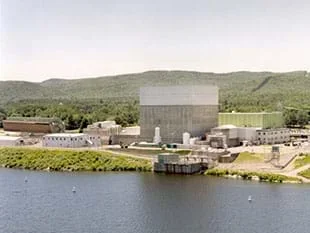 The Vermont Yankee Nuclear Power Plant along the Connecticut River.Copyright 2010 U.S. Nuclear Regulatory Commission, Wikimedia Commons https://commons.wikimedia.org/wiki/File:Vermont_Yankee_Nuclear_Power_Plant.jpg
Students learn about nuclear energy generation through a nuclear power plant virtual field trip that includes visiting four websites and watching a short video taken inside a nuclear power plant. They are guided by a handout that provides the URLs and questions to answer from their readings. They conclude with a class discussion to share their findings and reflections. It is recommended that students complete the associated activity, Chernobyl Empathy, before conducting this lesson; doing this assists students in gaining an understanding of how devastating nuclear meltdowns can be, which underscores the importance of careful engineering.
Engineers often must analyze complicated problems. Developing a full understanding of the intricacies of complex systems and structures helps engineers uncover the root causes of problems, which is necessary in order to develop optimal solutions with fewer unintended consequences. It is important for engineers—as well as students pursuing engineering career paths—to be able to research complicated systems and then synthesize that information to gain a thorough understanding in order to resolve problems within the systems.
After this lesson, students should be able to identify and discuss many aspects of nuclear energy generation, such as:
- Steam turbine process
- Nuclear fission
- Fuel type(s) and safe use/disposal
- Nuclear power plant structure and facilities
- Safety procedures and issues
- Benefits/drawbacks of nuclear-generated electricity compared to the benefits/drawbacks of other forms of electricity generation
- Students will develop an understanding of the relationships among technologies and the connections between technology and other fields of study.
Grades K-12
Do you agree with this alignment?
- EEn.2.2.1 Explain the consequences of human activities on the lithosphere (such as mining, deforestation, agriculture, overgrazing, urbanization, and land use) past and present.
Grades 9-12
Do you agree with this alignment? - EEn.2.2.2 Compare the various methods humans use to acquire traditional energy sources (such as peat, coal, oil, natural gas, nuclear fission, and wood).
Grades 9-12
Do you agree with this alignment? - EEn.2.8.1 Evaluate alternative energy technologies for use in North Carolina.
Grades 9-12
Do you agree with this alignment?
Humans have invented all sorts of ways to generate electric power, including capturing wind in turbines and by electro-chemical processes in photovoltaic cells. But what other methods do we have? Looking to the future, we want to explore any other forms of energy generation that are convenient, easy to acquire and dispatchable.
Pros and Cons: Nuclear power generators work the same as traditional steam turbine electric power generators except that they use atomic fission to generate heat rather than the combustion of fossil fuels. While not a renewable energy source, nuclear power generation does not create the carbon by-products that pollute the atmosphere like from burning fossil fuels to generate electricity. However, nuclear fuels have their own pollution issue—the radiation by-products of atomic fission. Containment of both the direct radiation and the contaminated cooling water are major concerns. If an accident occurs that causes a containment system breach, such as what happened at Chernobyl in 1986, the damage to habitat and life is long lasting. Further, storing the spent fuel rods, which remain radioactive and super-heated for decades, is not unlike the challenge of storing the toxic residue from burning fossil fuels.
As a final note about the Vermont Yankee Nuclear Power Plant—the topic of the journalist’s plant tour story in the Site 2 URL on the handout—four years after that story was written, the power plant was closed (in 2014) after running for 42 years.
(It is recommended that the Chernobyl Empathy associated activity be conducted in advance of this lesson so students gain an understanding of how devastating nuclear meltdowns can be and the importance of responsible engineering, especially with complex and potentially dangerous projects. Then in this lesson, students complete a virtual field trip [by visiting four websites] that focuses on how nuclear power works, nuclear power plant components and safety procedures, and pro/con debate issues. In advance of conducting the lesson:
- Determine the nuclear power plant closest to where you live and find out how far away it is [or look it up online as a class]; see the interactive map at Nuclear Energy Institute’s Map of US Nuclear Plants website at https://www.nei.org/resources/map-of-us-nuclear-plants.
- Make copies of the Virtual Field Trip Handout (PDF), one per student.
- Prepare for students to have access to computers with internet access—individually or in pairs. The one-minute video at site 2 requires Adobe Flash Player.)
Have you ever wondered what happens inside a nuclear power plant? How is electricity generated by radioactive elements? Today, we will go on a virtual tour of the nuclear power generation process, so be sure to look and listen so that you can make observations and inferences about the processes involved. We will draw some overall conclusions at the end of the lesson.
The U.S. has about 100 functioning nuclear power plants. Which plant is closest to where we live? (Tell students the power plant name and its distance away, or look it up online as a class.)
We all completed the Chernobyl Empathy activity, looking at photographs from before and after the 1986 disaster. From that experience, what are some observations you can make about nuclear accidents? (Listen to student responses.) How likely do you think the plant closest to us is to experience a meltdown like Chernobyl? Well, let’s learn more about how nuclear power plants work.
(Pass out the handouts. Give students an overview of the “field trip” before they work on their own, guided by the handout.) We start our field trip at Site 1 with a link that provides information about the conversion of fuel sources to energy using nuclear fission. Here, you’ll learn about chain reactions, how the path of a nuclear reaction generates significant heat and energy that can be harnessed as an energy resource. This site also explains why uranium is a desired fuel source for nuclear reactions and how the enrichment process occurs.
Next you’ll learn more about the Vermont Yankee Nuclear Power Plant in a story that describes step-by-step what reporters saw and heard in their tour of the power plant. This includes a one-minute video that shows some areas inside the plant, which not many people ever get to see. Finally, you will consider some of the major concepts and issues surrounding nuclear power as you learn about its history and future.
Use the handout to guide you on the “field trip,” and answer the handout questions as you go. Let me know if you have questions and when you are done.
- nuclear fission
- The splitting atoms to release energy.
- steam turbine
- A device that generates power via high pressure steam spinning a turbine blade.
Pre-Lesson Assessment
Prior Knowledge: During the initial discussion, ask students:
- From doing the associated activity (Chernobyl Empathy) and looking at all those photographs and their captions, what are some observations you can make about nuclear accidents?
- What else do you know about or wonder about nuclear energy and nuclear power generation?
Post-Introduction Assessment
Observe: As students progress through the Virtual Field Trip Handout (PDF), pause at strategic points to walk around and answer any questions. Monitor student progress through each stage of the nuclear energy process. Ask questions to see if they understand the process—how fission generates electricity.
Lesson Summary Assessment
Field Trip Reflection: As a class, ask students to share their answers to the Virtual Field Trip Handout (PDF)’s guided questions. Refer to the Virtual Field Trip Handout Answer Key (PDF). Gauge whether every student understands the nuclear power generation process. Fill in knowledge gaps, as necessary.
 Copyright 2017 Dense W. Carlson, ITL Program, College of Engineering and Applied Science, University of Colorado Boulder
Websites accessed for virtual tour:
- Urenco’s About Nuclear Energy website: https://www.learnwithrichie.com//ks3/about-nuclear-energy
- A Tour Inside Vermont Yankee Nuclear Power Plant video: https://www.youtube.com/watch?v=9irnL0Y25bY
- Wikipedia’s Nuclear Power Plant and Nuclear Power web pages: https://en.wikipedia.org/wiki/Nuclear_power
- Nuclear Energy through a Virtual Field Trip
Contributors
Hannah Brooks; Ashley Martin; Dale Gaddis; Shay Marceau; Lazar Trifunovic
Supporting Program
RET Program, College of Engineering, North Carolina State University, and CORE Lab, University of North Carolina at Charlotte
Acknowledgements
This curricular unit was developed based upon work supported by the National Science Foundation under grant no. EEC 1542377—Grand Challenges for Engineering Focused RET with Stratified Teams, a collaboration of the College of Engineering at North Carolina State University, and the Control Optimization for Renewable Energies (CORE) Lab at the University of North Carolina at Charlotte. Any opinions, findings, and conclusions or recommendations expressed in this material are those of the authors and do not necessarily reflect the views of the National Science Foundation.
Copyright
2017 by Regents of the University of Colorado; original © 2016 North Carolina State University