
Fluid Power Basics
 Figure 1. Students using the Portable Fluid Power Demonstrator (PFPD) during a workshop at Purdue University. Once they understand how the system operates and put it together, they use it to try to move specific pieces of material.Copyright 2009 Center for Compact and Efficient Fluid Power, Purdue University
Students learn about the fundamental concepts important to fluid power, which includes both pneumatic (gas) and hydraulic (liquid) systems. Both systems contain four basic components: reservoir/receiver, pump/compressor, valve, cylinder. Students learn background information about fluid power—both pneumatic and hydraulic systems—including everyday applications in our world (bulldozers, front-end loaders, excavators, chair height lever adjustors, door closer dampers, dental drills, vehicle brakes) and related natural laws. After a few simple teacher demos, they learn about the four components in all fluid power systems, watch two 26-minute online videos about fluid power, complete a crossword puzzle of fluid power terms, and conduct a task card exercise. This prepares them to conduct the associated hands-on activity, using the Portable Fluid Power Demonstrator (teacher-prepared kits) to learn more about the properties of gases and liquids in addition to how forces are transmitted and multiplied within these systems.
Engineers use fluid power to impact such areas as lowering fuel consumption in the transportation industries to improving patient care in the medical industries. Fluid power can improve our quality of life when engineers and researchers investigate how to use this technology to become more efficient, compact and cost effective.
After this lesson, students should be able to:
- Identify devices that utilize fluid power.
- Identify and explain basic components and functions of fluid power devices.
- Differentiate between the characteristics of pneumatic and hydraulic systems.
- Calculate values in a fluid power system utilizing Pascal's law.
- Calculate flow rate, flow velocity and mechanical advantage in a hydraulic system.
- CCSS.Math.Content.6.EE.C.9 Use variables to represent two quantities in a real-world problem that change in relationship to one another; write an equation to express one quantity, thought of as the dependent variable, in terms of the other quantity, thought of as the independent variable. Analyze the relationship between the dependent and independent variables using graphs and tables, and relate these to the equation.
Grade 6
Do you agree with this alignment? - CCSS.Math.Content.6.NS.B.2 Fluently divide multi-digit numbers using the standard algorithm.
Grade 6
Do you agree with this alignment? - CCSS.Math.Content.6.NS.B.3 Fluently add, subtract, multiply, and divide multi-digit decimals using the standard algorithm for each operation.
Grade 6
Do you agree with this alignment? - CCSS.Math.Content.6.RP.A.3d Use ratio reasoning to convert measurement units; manipulate and transform units appropriately when multiplying or dividing quantities.
Grade 6
Do you agree with this alignment?
- Test and evaluate how well the solution meets the goal.
Grades 3-8
Do you agree with this alignment?
- Transportation vehicles are made up of subsystems, such as structural propulsion, suspension, guidance, control, and support, that must function together for a system to work effectively.
Grades 6-8
Do you agree with this alignment? - Power is the rate at which energy is converted from one form to another or transferred from one place to another, or the rate at which work is done.
Grades 6-8
Do you agree with this alignment?
- Fluid Power Crossword Puzzle and Answers (doc)
- Fluid Power Crossword Puzzle and Answers (pdf)
- PFPD Assembly Manual 07 2009 (doc)
- PFPD Assembly Manual 07 2009 (pdf)
- Fluid Power Task Cards (ppt)
- Fluid Power Task Cards (pdf)
- Task Card 1 (doc)
- Task Card 1 (pdf)
- Worksheet 1: What is Fluid Flow? (doc)
- Worksheet 1: What is Fluid Flow? (pdf)
- Worksheet 2: Pascal's Law (doc)
- Worksheet 2: Pascal's Law (pdf)
- Worksheet 3: Moments and Mechanical Advantage (doc)
- Worksheet 3: Moments and Mechanical Advantage (pdf)
- Worksheet 4: Fluid Power Capabilities (doc)
- Worksheet 4: Fluid Power Capabilities (pdf)
- Worksheet 5: Bernoulli's Equation (doc)
- Worksheet 5: Bernoulli's Equation (pdf)
- Worksheet 6: Energy Storage (doc)
- Worksheet 6: Energy Storage (pdf)
- U.S. Navy Fluid Power Training Manual (pdf)
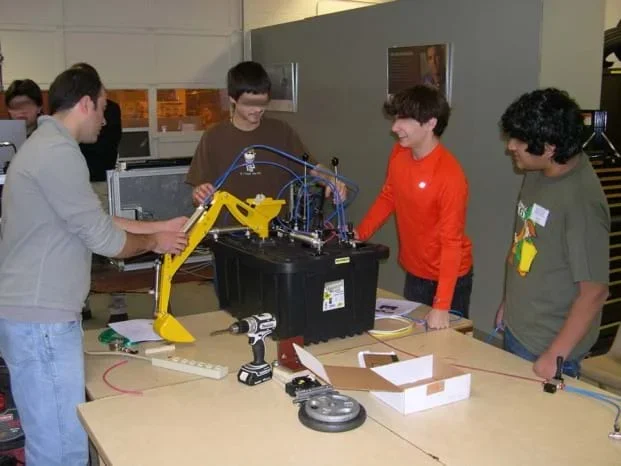 By getting their hands involved, such as in the associated activity, students' minds become involved as well.Copyright 2009 Center for Compact and Efficient Fluid Power, Purdue University
Fluid power incorporates the generation, control and application of smooth, effective power of pumped or compressed fluids, gas or liquid, when this power is used to provide force and motion to mechanisms. This force and motion may be in the form of pushing, pulling, rotating, regulating or driving. If the compressed fluid is a gas, it is called pneumatics, while if the compressed fluid is a liquid, it is called hydraulics.
The word hydraulics is a derivative of the Greek words hydro (meaning water) and aulis (meaning tube or pipe). Originally, the science of hydraulics covered the physical behavior of water at rest and in motion. This dates back several thousand years to when water wheels, dams and sluice gates were first used to control the flow of water for domestic use and irrigation. Use has broadened its meaning to include that area of hydraulics in which confined liquids are used under controlled pressure to do work. Hydraulics can be defined as the engineering science that pertains to liquid pressure and flow. This study includes the manner in which liquids act in tanks and pipes, dealing with their properties and with ways of utilizing these properties. It includes the laws of floating bodies and the behavior of liquids under various conditions, and ways of directing this flow to useful ends, as well as many other related subjects and applications.
Several other terms are used to more precisely describe the behavior of liquids at rest and in motion. These terms are generally considered separate branches of science and include: hydrostatics, the branch of science pertaining to the energy of liquid flow and pressure; and hydrokinetics, which pertains to motions of liquids or the forces that produce or affect such motions.
Why should fluid power be used? Fluid power systems provide many benefits to users, including:
- Multiplication and variation of force: Linear or rotary force can be multiplied from a fraction of an ounce to several hundred tons of output.
- Easy, accurate control: You can start, stop, accelerate, decelerate, reverse or position large forces with great accuracy. Analog (infinitely variable) and digital (on/off) control are possible. Instantly reversible motion, within less than half a revolution, can be achieved.
- Multi-function control: A single hydraulic pump or air compressor can provide power and control for numerous machines or machine functions when combined with fluid power manifolds and valves.
- High horsepower / low weight ratio: Pneumatic components are compact and lightweight. You can hold a 5 horsepower hydraulic motor in the palm of your hand.
- Low speed torque: Unlike electric motors, air or hydraulic motors can produce large amounts of torque (twisting force) while operating at low speeds. Some hydraulic and air motors can even maintain torque at zero speed without overheating.
- Constant force or torque: This is a unique fluid power attribute.
- Safe in hazardous environments: Fluid power can be used in mines, chemical plants, near explosives and in paint applications because it is inherently spark-free and can tolerate high temperatures.
- Established standards and engineering: The fluid power industry has established design and performance standards for hydraulic and pneumatic products through NFPA, the National Fluid Power Association; ANSI, the American National Standards Institute; and ISO, the International Organization for Standardization.
- Source: NFPA's What Is Fluid Power? http://www.nfpa.com/fluidpower/whatisfluidpower.aspx
Fluid Power Applications
- Mobile: Fluid power is used to transport, excavate and lift materials as well as control or power mobile equipment. End use industries include construction, agriculture, marine and the military. Applications include backhoes, graders, tractors, truck brakes and suspensions, spreaders and highway maintenance vehicles.
- Industrial: Fluid power is used to provide power transmission and motion control for industrial machinery. End use industries range from plastics working to paper production. Applications include metalworking equipment, controllers, automated manipulators, material handling and assembly equipment.
- Aerospace: Fluid power is used for both commercial and military aircraft, spacecraft and related support equipment. Applications include landing gear, brakes, flight controls, motor controls and cargo loading equipment.
- Source: NFPA's What Is Fluid Power? http://www.nfpa.com/fluidpower/whatisfluidpower.aspx
Fluid power systems consist of four basic components: reservoir/receiver (fluid storage); pump/compressor (converts mechanical power to fluid power); valve (controls direction and amount of flow); and actuators (converts fluid power to mechanical power, that is, cylinder and pistons). The connectors for these components consist of pipe, tube or hoses so the fluid can flow to/from the components.
Pascal's law : if a confined fluid is at rest, pressure is transmitted undiminished in all directions and exerts equal force on all areas, in addition to right angles to them.
p = F / A
p = pressure (lbs/in2 or N/m2); F = force (lbs or N); A= πr2 = area (in2 or m2)
Boyle's law: The volume of gas at constant temperature varies inversely with the pressure exerted on it.
p1(V1) = p2(V2)
V = volume (in3 or m3); p = pressure (lbs or N)
Charles' law: The volume of gas increases or decreases as the temperature increases or decreases, provided the amount of gas and pressure remain constant.
V1/ T1) = V2/ T2
V = volume (in3 or m3); T = absolute temperature (°R)
Gay-Lussac's law: The absolute pressure of a gas increases or decreases as the temperature increases or decreases, provided the amount of gas and the volume remain constant.
p1/ T1) = p2/ T2
p = absolute pressure (lbs/in2 or N/m2); T = absolute temperature (°R)
Flow is what operates the actuators in the cylinders. Flow rates, which determine actuator speed, are measured in in3 per sec or gallons per minute, and are generated by a pump. When flow is given, the actuator volume displacement directly affects actuator speed. The less volume to displace in the cylinder leads to faster actuators. In general, pressure is the resistance to flow. Pumps produce flow, not pressure!
Q = VA
Q = volumetric flow rate (in3/sec); V = velocity (in/sec); A = area (in2)
Torque is a twisting force that is found by multiplying the force times the distance. It is measured in foot pounds. Hydraulic and pneumatic pumps produce work to be used within the fluid power system. Given a specific motor torque and motor RPM, specifies energy usage or horsepower requirement.
Fluid power is all about moving energy from one location to another. Energy is the ability to do work. Energy transfer is the energy moving from the prime mover, or input source, to an actuator, an output device. Work is defined as force multiplied by distance. This is measured in foot-pounds. Power is the rate of doing work. It is found by dividing work over time (in seconds). Horsepower, a unit measurement of energy, is a common term used to measure power. Horsepower can be calculated by the following:
flow (gallons per minute) X pressure (lbs/in2)
1714 (which is always constant)
The law of conservation of energy states that energy can neither be destroyed nor created but may change forms. Any energy that is not transferred to work takes the form of heat energy.
For additional background resources, see the Additional Multimedia Support section for links to an excellent fluid power training manual, a suggested teaching website and a schematic symbols chart.
About the Associated Activity
After concluding the lesson, students are ready to conduct the associated activity, The Portable Fluid Power Demonstrator (PFPD). The activity requires PFPD kits that are not available for sale. They were designed using common parts that can be ordered or found locally and can be put together by teachers and/or their support organizations. See the PFPD Assembly Manual (PDF) for a parts list, bill of materials, assembly instructions and safety instructions. The bill of materials includes suggested sources and part numbers. Some teachers have used local grants to secure the funding to purchase parts and then engaged higher ability students to build the kits for use in other classes. For additional questions, refer to the following CCEFP websites: http://www.ccefp.org/get-involved/k-12-teachers/teaching-and-learning-resources and http://ccefp.org/-13.
The demonstrator can be used with either water (for hydraulic power) or compressed air (for pneumatic power) and it is up to the teacher to decide which works best for their classroom. Introduce the PFPD to students and ask them questions about the four basic components of all fluid power systems (reservoir, pump or compressor, valve, and cylinder). Have students identify those parts on the PFPD. You may also demonstrate the power of fluid power by separating one of the smaller cylinders off of the PFPD frame (while keeping the hoses connected!) and placing a small barbell weight on the end and to demonstrate how easily the cylinder lifts the weight. Point out that very little air pressure (or fluid pressure) was needed (roughly 10-15 psi).
Depending on how many PFPDs are available in the classroom, it is recommended that groups of 2-3 students work on each demonstrator. Start with a challenge task to use the provided PFPD schematic (Figure 4) and place all of the connection hoses in the correct locations so the PFPD operates as it is designed on the plan. Then have students answer the handout questions and do a quick write-up of their findings during this exercise.
Depending on students' ability levels and time availability, eight worksheets associated with using the PFPD are provided for classroom use on the following topics: fluid flow, Pascal's law, moments and mechanical advantage, fluid power capabilities, Bernoulli's equation, energy storage, linkages, and hydraulic symbols. See the Attachments section.
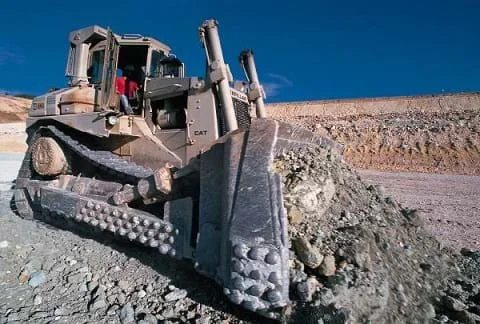 Figure 2. The use of fluid power, such as the hydraulics in this bulldozer, helps people do jobs more quickly, safely and economically.Copyright 2004 Microsoft Corporation, One Microsoft Way, Redmond, WA 98052-6399 USA. All rights reserved.
(Have ready two balloons, a bottle, water and two matchsticks for simple teacher demonstrations. Also be ready to show the class one or two 26-minute online videos.)
Have you ever seen a bulldozer or excavator move a lot of dirt where a new project is being built (see Figure 2)? Have you been in a chair that you could raise or lower by pushing a lever? Did you ever open a screen door and notice it closes smoothly and by itself? Did a dentist ever use a drill on your teeth? When you are riding in a car or truck and the driver pushes the brake pedal, do you start to slow down? These are all examples of how fluid power is used in our everyday lives.
Fluid power use either a gas (pneumatics) or a liquid (hydraulics). Do you know what the previous examples used? Most people do not even realize that fluid power is helping people to perform jobs more quickly, efficiently, accurately and powerfully than ever before. Can you imagine if we didn't have fluid power and someone had to move a bunch of dirt without bulldozers that use hydraulics? How long would it take to move it another way? How much energy would be needed? Years ago, a chair that today uses pneumatics to move up and down easily with the push of a lever was raised or lowered by spinning it around over and over – very time consuming! Before dentists had the precision and control of pneumatic drills, they worked with much less precise and controlled drills, which were less comfortable for patients. Going to the dentist today is really not so bad compared to what people went through years ago. What about the brakes in your car or truck? How did people stop their vehicles before we had hydraulic braking systems? How effective were those systems? How safe were those older systems? These examples are just a few of the many ways fluid power improves our everyday lives.
What do you think makes up a fluid power system? Think of some of the examples we just talked about . What can you recall about how these devices and machines look? How do the pieces move in relation to one another? (Have students demonstrate to the class what fluid power devices look like and how they operate using the classroom board or in another form.) How do you think a front-end loader can lift so much dirt (note the bucket size in Figure 3) so easily? How much power is needed to lift something that large? The power is generated through the use of fluid power.
 Figure 3. Heavy machinery such as this front-end loader use hydraulic power to move heavy material. Fluid power is ideal for high speed, high force and high power applications such as this.Copyright 2004 Microsoft Corporation, One Microsoft Way, Redmond, WA 98052-6399 USA. All rights reserved.
Before going on further, let's learn about where the concept of fluid power began. Many years ago, in the 1600s, a French scientist and mathematician named Blaise Pascal (pas KALZ or PAS kulz) stated a physical law that describes the effect of applying pressure on a fluid (whether gas or liquid) in a closed container. Pascal's law states that pressure applied to an enclosed fluid is transmitted with equal force throughout the container. So what does that really mean to you?
Do you think you have ever seen Pascal's law in action? How many of you have ever tried to step onto a balloon? I need a volunteer (inflate a balloon to demonstrate the following). This volunteer will step on the balloon while we observe the effects of their actions. What do you think will happen when they step on the balloon? Why do you think it would do that? (Have the student volunteer step on the balloon and make sure students make observations.) Did the balloon do what you thought it would? Why did it do that? When pressure is placed on the top of the balloon, the air within is dispersed to the rest of the balloon resulting in either a misshapen balloon or one that distorts to the point of failure, and then breaks under the pressure. This proves that Pascal's law is still in effect!
Does Pascal's law work with liquid as well? It was stated earlier that fluid power includes both gases and liquids and Pascal's law also applies to liquids. I need another volunteer (Have ready a bottle, balloon and two matchstick heads to demonstrate the following. Fill the bottle with water nearly to the top and drop the matchstick heads into the water. When at rest, the matchstick heads float at the top of the water. Stretch the neck of an inflated balloon over the bottle, and press a finger onto the balloon, going into the bottle. The matchstick heads will float down into the bottle as the pressure increases on the water.) Why do you think the matchstick heads sunk down when the finger was placed into the bottle? Can someone explain the cause of this? This is another example Pascal's law in effect. Do you think we could use this law to help determine how much power a fluid power system can provide? What other information might we need to find out how much force can be produced by a system?
Now that we know some fluid properties, what must be in place to have a fluid power system? Four components are needed: reservoir or receiver, pump or compressor, valve, and cylinder. As seen in Figure 4, these components are represented graphically in the PFPD schematic. Later, you will learn what some of these symbols represent. Can you guess where the reservoir that holds the air is? (One noted on schematic is reservoir for water. Have students find the one for air.) What symbol might represent the motor that runs the compressor? (Look for the "M," which represents "motor.") Can anyone find all four symbols that represent the four valves (switches)? Where are all four cylinders (things that move on the PFPD) on the schematic?
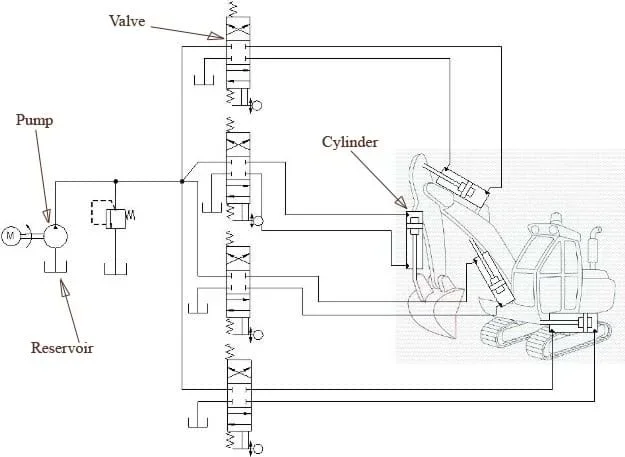 Figure 4. The four components of the PFPD can be seen in the schematic: 1 reservoir, 1 pump, 4 valves, and 4 cylinders.Copyright 2009 Center for Compact and Efficient Fluid Power, Purdue University
How are fluid power systems being designed for use in the future? The Center for Compact and Efficient Fluid Power (CCEFP) is researching four areas that focus on increasing efficiency of fluid power applications, expanding the use in transportation sector to reduce fuel consumption, developing human-scaled fluid power applications, and making fluid power safe, quiet, clean and simple to use. Can you think of any other ways fluid power can be improved or used in a new way? Let's watch a video to find out more!
Let's watch a video to find out more! (Show students a 26-minute video called "Discovering Fluid Power" (https://www.youtube.com/watch?v=7kfDvxH2bcw) and/or the 26-minute video called "Fluid Power - A Force for Change" (https://www.pbs.org/video/tpt-documentaries-fluid-power-force-change/). Then, lead a class discussion about what students learned from the video(s). Next, proceed to conduct the Task Card Exercise, described in the Assessment section. Then conduct the associated activity, The Portable Fluid Power Demonstrator [PFPD].)
Can you think of any uses of fluid power in your communities that were not discussed? Where were they located? How were they being used? Was it a hydraulic or pneumatic device? Why do engineers continue to work to improve fluid power? In what areas are they looking at improving? How are engineers trying to improve fuel economy? What work is being done to use fluid power to improve human life? Can you identify devices or systems that do not use fluid power that might be improved with the use of fluid power?
As you have come to realize by now, fluid power is used in many applications. At the following link you can investigate a number of real-world applications that use fluid power: http://www.nfpa.com/fluidpower/hydraulics-casestudies.aspx
After reading through these case studies, you will understand why fluid power was chosen as the power source and the important role that electronics played in each example. By this point, you should have a complete understanding how fluid power systems operate and why engineers are continuing to work on improving the efficiency of fluid power applications, expanding the use in transportation sector to reduce fuel consumption, develop human-scaled fluid power applications, and making fluid power safe, quiet, clean and simple to use.
- absolute pressure
- The total pressure exerted on a system, including atmospheric pressure.
- atmospheric pressure
- The pressure exerted by the weight of the atmosphere above the point of measurement.
- boyle's law
- The volume of a gas at constant temperature varies inversely with the pressure exerted on it.
- charles' law
- The volume of a confined gas is proportional to its temperature, provided its pressure remains constant.
- check valve
- A valve that allows flow in one direction but prevents flow in the opposite direction.
- compressor
- An air pump that compresses air into a receiver tank.
- crank
- A part of an axle or shaft bent out at right angles, for converting reciprocal to circular motion and vice versa.
- cylinder
- A device used to convert fluid power into mechanical power in the form of linear motion.
- directional-cntrol valve
- Used to control which path fluid takes in a circuit.
- double-acting cylinder
- A cylinder that can act under pressure in both directions (extend and retract) to move a load.
- filter
- A device used to remove contamination from a fluid.
- flow meter
- A device used to measure flow rate.
- flow rate
- The volume of fluid that moves through a system in a given period of time.
- flow velocity
- The distance the fluid travels through a system in a given period of time.
- flow-control valve
- Used to start and stop flow in a circuit.
- fluid power
- The use of a fluid (liquid or gas) to transmit power from one location to another.
- gay-lussac's law
- The absolute pressure of a confined gas is proportional to its temperature, provided its volume stays constant.
- hydraulics
- The use of a liquid flowing under pressure to transmit power from one location to another.
- lubricator
- A device used to spray an oil mist into the stream of a pneumatic system.
- pascal's law
- Pressure exerted by a confined fluid acts undiminished equally in all directions.
- piston
- A sliding piece moved by or moving against fluid pressure, which usually consists of a short cylindrical body fitting within a cylindrical chamber or vessel along which it moves back and forth.
- pneumatics
- The use of gas flowing under pressure to transmit power from one location to another.
- pressure
- The force per unit area exerted by a fluid against a surface.
- pressure regulator
- A type of pneumatic pressure control valve that controls the maximum pressure in a branch of a circuit.
- pressure relief valve
- A type of pressure control valve that limits the maximum pressure in a hydraulic or pneumatic circuit.
- pump
- A device used to create flow in a hydraulic system.
- receiver tank
- A device that holds the compressed air in a pneumatic system.
- reservoir
- The tank that holds the fluid in a hydraulic system.
- single-acting cylinder
- A cylinder that acts under pressure in one direction only and returns automatically when the pressure is released.
- solenoid
- A switching device that uses the magnetic field generated by an electrical current for actuation.
- transmission lines
- Used to transport fluid in a circuit.
- valve
- Any device that controls, either automatically or manually, the flow of a fluid.
- viscosity
- A measure of a fluid's thickness or resistance to flow.
- volume
- The amount or quantity of something.The amount or quantity of something.
Pre-Lesson Assessment
Discussion Questions: To start the Introduction/Motivation section, ask students the following questions and discuss as a class these everyday examples of how fluid power helps us:
- Have you ever seen a bulldozer or excavator move a lot of dirt where a new project is being built?
- Have you ever been in a chair that is raised or lowered by pushing or pulling a lever?
- Did you ever open a screen door and notice it closes smoothly and by itself?
- Has a dentist ever used a drill to remove tooth decay in your mouth?
- When you are riding in a car or truck and the driver pushes the brake pedal, do you start to slow down?
Post-Introduction Assessment
Class Discussion Video Summary: After students have viewed the fluid power video(s), lead a class discussion about what they discovered. What was the message(s) of the video? What is the future of fluid power? Were you surprised to see some of the applications and if so, why? Why did you find certain parts of the video interesting? How do all of these things you saw relate to your lives?
Crossword Puzzle: Hand out copies of the blank Fluid Power Crossword Puzzle (PDF) for students to complete individually. Doing this reinforces students' familiarity with the fluid power terms and definitions.
Lesson Summary Assessment
Fluid Power Task Card Exercise: To continue the process of getting students in the right mindset, have each student take a random task card (use the Fluid Power Task Cards (PDF) PowerPoint® file and follow the instructions on the first two slides, which includes a materials list. Make sure you have all the supplies you need, depending on the number of students in the class.) Have students perform their "tasks" and report their findings in their notebooks. Alternatively, them do a short write-up to turn in for a grade rather than checking notebooks. Have students share with their classmates what they discovered during their tasks. Since some students did the same tasks as others, discuss why some students had similar or different thoughts during the same task. Students who conducted different tasks gain insight on what the other students learned.
As part of the Introduction/Motivation content presentation, show students a 26-minute video called "Discovering Fluid Power" (https://www.youtube.com/watch?v=7kfDvxH2bcw) and/or the 26-minute video called "Fluid Power: A Force for Change" (https://www.pbs.org/video/tpt-documentaries-fluid-power-force-change).
A good background resource for teachers is the U.S. Navy's personnel fluid power training manual, which provides extensive fluid power background knowledge on the fundamentals of hydraulics and pneumatics in 200 pages. Available at http://www.metalwebnews.org/ftp/fluid-power.pdf, it is provided as a PDF attachment to this lesson.
This Nucleus Learning website is helpful for how to teach fluid power to children, at http://www.nucleuslearning.com/lessonplan/teaching-hydraulics-and-pneumatics-unit-children.
Refer to the following website to learn the meaning of symbols in fluid power system schematics: http://www.hydraulicsupermarket.com/upload/db_documents_doc_19.pdf.
Beasley, Jr., MWC Albert. Fluid Power Training Manual. July 1990 edition. NAVEDTRA 12964, Metal Web News, Naval Education and Training Program Management Support Activity, U.S. Navy, U.S. Government Printing Office, Washington DC. Stock ordering #: 0502-LP-213-2300. Accessed July 12, 2009. http://www.metalwebnews.org/ftp/fluid-power.pdf
Bogusia, "Teaching the Hydraulics and Pneumatics Unit to Children." Nucleus Learning. 9 Oct. 2008. Accessed 8 July 2009. http://www.nucleuslearning.com/lessonplan/teaching-hydraulics-and-pneumatics-unit-children
Bordessa, Kris. "Super Science Experiments for Kids - A Collection of Gooey, Explosive & Easy Projects to Do at Home." Albermarle Family. 2009 Ivy Publications, LLC. Accessed 22 July 2009. http://www.albemarlefamily.com/vpage.htm?pageid=194
"D&T Online pneumatics information." D&T Online. 1997 D&T Online. Accessed 18 June 2009. http://www.dtonline.org/apps/infopage/app.exe?3&5&1&0&1&0
Figueras, Antonio. "Graphical Symbols for Hydraulic Circuits." Roquet. March, 2004. Accessed 24 July 2009. http://www.hydraulic-gear-pumps.com/pdf/Hydraulic%20Symbols.pdf
"Fluid Power eBooks." Hydraulics & Pneumatics. 2009 Penton Media, Inc. Accessed 23 July 2009. http://www.hydraulicspneumatics.com/200/eBooks/
"Fluid Power Systems." 2009. Lesson Plans, Thirteen Ed Online, Educational Broadcasting Corporation. Accessed 20 July 2009. http://www.thirteen.org/edonline/lessons/fluid/index.html
"Grades 9-12 Technology – Engineering – Design – Fluids - Hydraulics – Pneumatics." K12 Station. Accessed 22 July 2009. http://www.k12station.com/k12link_library.html?subject=NST&sub_cat=105398&final=105405
"Intro to Forces of Fluid Power 110." ToolinguU. 2009 Tooling University. Accessed18 July 2009. http://www.toolingu.com/class_cla ss_desc.aspx?class_ID=570110
"ISO / CETOP HYDRAULIC SYMBOLS." Hydraulic Supermarket. Accessed 25 July 2009. http://www.hydraulicsupermarket.com/upload/db_documents_doc_19.pdf
"Linkage mechanism simulator." Accessed 22 July 2009. http://www.hydraulicsupermarket.com/upload/db_documents_doc_19.pdf
Nave, C.R. "Pascal's Principle." HyperPhysics. 2005. Accessed 22 July 2009. http://hyperphysics.phy-astr.gsu.edu/Hbase/pasc.html#pp
"NFPA Fluid Power Applications." National Fluid Power Asscociation. Accessed 26 July 2009. http://www.nfpa.com/OurIndustry/OurInd_AboutFP_FluidPowerApplications_pdfs.asp
"NFPA Careers Menu Page." National Fluid Power Asscociation. Accessed 22 July 2009.
"NFPA Online Store." National Fluid Power Association. Accessed 10 July 2009.
"Special Focus: Fluid Power/Power Transmission." Design News. Accessed 19 July 2009. http://www.designnews.com/channel/Fluid_Power_and_Power_Transmission.php
Van den Brink, R. "Hydraulics." 23 July 2009. Accessed 24 July 2009. http://home.wxs.nl/~brink494/frm_e.htm
- Fluid Power Basics
Contributors
Brian Bettag; Jose Garcia; Phong Pham; Nicki Schrank; John H. Lumkes
Supporting Program
Center for Compact and Efficient Fluid Power, College of Agriculture and Biological Engineering, Purdue University
Acknowledgements
The contents of this digital library curriculum were developed under National Science Foundation grant no. EEC 0540834. However, these contents do not necessarily represent the policies of the National Science Foundation, and you should not assume endorsement by the federal government.
Copyright
2013 by Regents of the University of Colorado; original © 2009 Purdue University