
Algae: Tiny Plants with Big Energy Potential
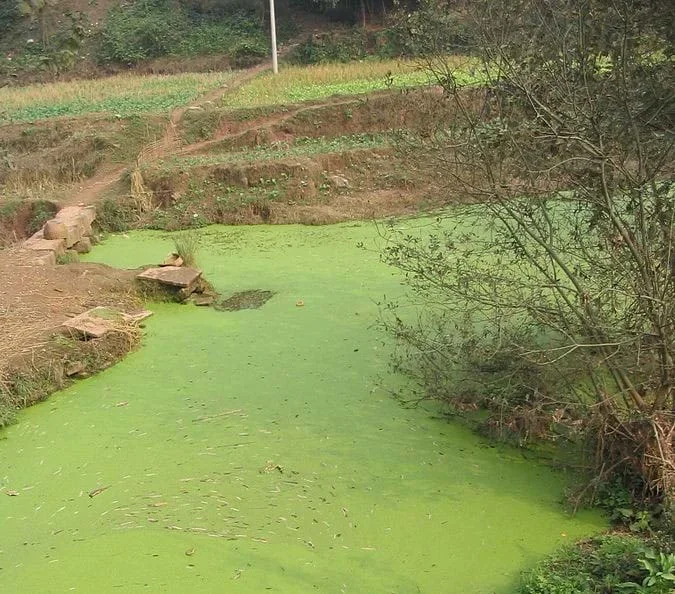 Algal bloom in a village river in China.Copyright 2005 Felix Andrews (Floybix), Wikimedia Commons https://commons.wikimedia.org/wiki/File:River_algae_Sichuan.jpg
Students are introduced to biofuels, biological engineers, algae and how they grow (photosynthesis), and what parts of algae can be used for biofuel (biomass from oils, starches, cell wall sugars). Through this lesson, plants—and specifically algae—are presented as an energy solution. Students learn that breaking apart algal cell walls enables access to oil, starch, and cell wall sugars for biofuel production. Students compare/contrast biofuels and fossil fuels. They learn about the field of biological engineering, including what biological engineers do. A 20-slide PowerPoint® presentation is provided that supports students taking notes in the Cornell format. Short pre- and post-quizzes are provided. This lesson prepares students to conduct the associated activity in which they make and then eat edible algal cell models.
Biological engineers apply their skills in and knowledge of math, biology, chemistry, mechanics and physics, and electronics to improve methods of agriculture, human and animal health, and energy production. Some biological engineers aim to reduce the use of fossil fuels by creating low-impact fuels from plants such as algae.
After this lesson, students should be able to:
- Discuss similarities and differences between biofuels and fossil fuels.
- Explain that algae are plants that engineers can use to make biofuels, and that breaking apart algal cell walls enables access to oil, starch, and cell wall sugars for biofuel production.
- 5-LS1-1 Support an argument that plants get the materials they need for growth chiefly from air and water.
Grade 5
Do you agree with this alignment? - MS-LS1-2 Develop and use a model to describe the function of a cell as a whole and ways parts of cells contribute to the function.
Grades 6-8
Do you agree with this alignment?
- Students will develop an understanding of the cultural, social, economic, and political effects of technology.
Grades K-12
Do you agree with this alignment? - Students will develop an understanding of the effects of technology on the environment.
Grades K-12
Do you agree with this alignment? - Students will develop an understanding of the relationships among technologies and the connections between technology and other fields of study.
Grades K-12
Do you agree with this alignment? - STEL-3G Explain how knowledge gained from other content areas affects the development of technological products and systems.
Grades 6-8
Do you agree with this alignment?
- 5-LS1-1 Support an argument that plants get the materials they need for growth chiefly from air and water.
Grade 5
This resource focuses on the following Three Dimensional Learning aspects of NGSS:
Science & Engineering Practices- Support an argument with evidence, data, or a model.Do you agree with this alignment?
Disciplinary Core Ideas- Plants acquire their material for growth chiefly from air and water.Do you agree with this alignment?
Crosscutting Concepts- Matter is transported into, out of, and within systems.Do you agree with this alignment?
Do you agree with this alignment? - Support an argument with evidence, data, or a model.
- MS-LS1-2 Develop and use a model to describe the function of a cell as a whole and ways parts of cells contribute to the function.
Grades 6-8
This resource focuses on the following Three Dimensional Learning aspects of NGSS:
Science & Engineering Practices- Develop and use a model to describe phenomena.Do you agree with this alignment?
Disciplinary Core Ideas- Within cells, special structures are responsible for particular functions, and the cell membrane forms the boundary that controls what enters and leaves the cell.Do you agree with this alignment?
Crosscutting Concepts- Complex and microscopic structures and systems can be visualized, modeled, and used to describe how their function depends on the relationships among its parts, therefore complex natural structures/systems can be analyzed to determine how they function.Do you agree with this alignment?
Do you agree with this alignment? - Develop and use a model to describe phenomena.
- Algae: Tiny Plants with Big Potential Presentation (pptx)
- Algae: Tiny Plants with Big Potential Presentation (pdf)
- Algae Pre-Quiz (docx)
- Algae Pre-Quiz (pdf)
- Algae Pre-Quiz Answer Key (docx)
- Algae Pre-Quiz Answer Key (pdf)
- Algae Post-Quiz (docx)
- Algae Post-Quiz (pdf)
- Algae Post-Quiz Answer Key (docx)
- Algae Post-Quiz Answer Key (pdf)
Students should know about the different forms of energy, global warming, fossil fuels and their consequences, renewable energy, and have some basic biology knowledge. Students should also understand that engineers apply their understanding of scientific concepts to find solutions to human and environmental problems.
(Slide 2) Algae are very small—some are too small to see without a microscope, such as in this high-magnification photograph. But since they grow so fast in many different biomes, we can use them to make a renewable energy source called biofuel.
(Slide 3) Learning objectives. During the course of today’s lesson, these are the questions that we will explore. By the end of the lesson, you will know the answers. (For instructor reference, the questions and answers are provided below.)
- What are the similarities and differences between biofuels and fossil fuels? (Answer: Both biofuels and fossil fuels come from plants or other living things. The difference between them is that biofuels can be made in hours or days, while fossil fuels take millions of years to be created.)
- What are algae and what can biological engineers make out of algae? (Answer: Algae are very small plants that live in water. Biological engineers use them to make biofuels for three reasons: 1) they have three parts that can be made into biofuel, 2) they grow very fast, and 3) using them for fuel does not waste food since people do not usually eat this type of algae. Note that seaweed is a type of algae and people DO eat seaweed.)
- Why is breaking the algal cell wall important for biological engineers? (Answer: Biological engineers need to break down the cell wall to get to the starch and oil inside the cells. The broken-down cell walls can also be made into biofuel.)
(Slide 4) Please write down in your notebooks the definition of biofuels. (click to reveal definition) Biofuels are chemicals from plants that we can use for energy (chemical energy). The bus in this photograph is designed to use biofuel from soybeans (a plant) to run instead of fossil fuels (like petroleum oil, gasoline, diesel, natural gas) like many buses and cars.
(Click to reveal question) What is another source of chemical energy? (Answers: Fossil fuels, batteries, food, firewood.)
(click to reveal question) How are petroleum oil, coal and natural gas different than biofuels? (Answer: Biofuels are different from fossil fuels because they can be made in hours or days, not millions of years like fossil fuels.)
(Slide 5) (click to reveal definition) Biological engineers are experts in biology but also use math, physics, chemistry, mechanical systems, and computer technology to solve problems. These photos show biological engineers at work growing algae for biofuels and examining different types of plants and compost for improving soil for farming.
(click to reveal question) Name a problem that biological engineers might be able to help you with. (Correct answers include: new watering techniques to help plants survive droughts, to develop a medicine for a new type of illness, a certain kind of food contains harmful bacteria and new processing or quality control methods are needed, to develop a biofuel to replace the use of fossil fuel, and picking strawberries requires crouching in uncomfortable positions for a long time.)
(Slide 6) This photograph shows a blue-green algae bloom in Lake Erie. You may have seen algae growing like this in natural waterways or pools. (click to bring up two additional pictures) What do you think we’re looking at in the photo to the right? (It might take them a bit to guess that it is a human hair.) These microscopic photos, both at 400x magnification, show how small algal cells are compared to human hair.
(Slide 7) Record this definition of algae in your notebooks. “Algae” is plural and “alga” is singular. (click to reveal the definition) Very small plants. (click) Live in water in many places around the world. (click) They grow fast. Have you ever seen a pond that looks like this (left photo), with algae covering the water surface? And here’s (right photo) what algae look like under high magnification.
(Slide 8) Algae grow very fast. The types of algae that many engineers use for biofuel grow twice their size in a day! (Expect students to be able to follow the number sequence on the slide to calculate the weight of the growing algae for the days of the week.) Compared to human growth, it would be like: On Monday, you weigh 50 pounds. (click to show Tuesday) Tuesday you weigh 100 pounds. (click to show Wednesday) How much would you weigh on Wednesday? (Answer: 200 pounds.) On Thursday (Answer: 400 pounds.) (click to show Friday) By Friday, you would weigh 800 pounds! (click to show next question) From where does the alga growth come? (Answer: Plants grow through photosynthesis. This is a transitional leading question, although some students may already be familiar with photosynthesis.)
(Slide 9) Look at the parts of the word “photosynthesis” to understand its meaning. (click to show) Photo means light and (click) synthesize means to make, usually a chemical. Plants use light to make chemicals—most importantly, carbohydrates/sugars. Plants use the sugar for energy.
Plant roots absorb water and their leaves take in carbon dioxide from the air and light from the sun. Then plants use these ingredients to make sugar. Plants use the sugar they make for energy, similar to how we eat food (and sugar) for energy. The difference is that plants make their own sugar from sunlight, water and carbon dioxide.
To recap, what is the story of photosynthesis? (Answer: Plants use sunlight, water and carbon dioxide to make sugars for energy.)
(Slide 10) In groups, think of reasons why biological engineers want to use algae for biofuels.
Reasons that we have talked about so far are: 1) they grow very fast and 2) they grow in many different places around the world. (click to reveal these two answers on the slide)
In addition, algae are good plants to make into biofuels because we don’t eat them. We don’t want to take away food for people in order to make fuel. (click to show that reason)
Algae make oil and sugars inside their cells. We remove those oils and sugars to make into fuels that are renewable. We can also make fuel out of algal cell walls. (click to show that reason)
(Slide 11) Three parts of algae can be turned into energy. Look at this cartoon sketch of a plant cell. (click to advance animation) If we ignore the organelles of the cell, we see this simplified view of the plant cell. The parts of the algae we can use to make into fuel are (click) oil, (click) starch and (click) the cell wall. For this lesson, we are going to focus on the cell wall. To get to the oils and starch, we need to break apart the cell wall. And, we can use the broken-down cell wall for fuel, too. (Teacher note: The depicted plant cell is shown with adjacent cells; algae can be single-celled or multicellular.)
(Slide 12) Add the following to your notes about algae: (click to show) “People don’t usually eat algae” and (click) “Composed of oil, starch and cell walls.”
(Slide 13) As an analogy, think about the algal cell wall like a box made of LEGO® pieces. How would you open this LEGO container? (Expect students to say that they would take apart the box, piece by piece, using their fingers.) I agree that it is better to take apart the LEGO container piece by piece so that we can reuse the pieces for other projects and because it would take less effort than, say, smashing it with a hammer or heating it in an oven until the pieces melted. Raise your hand if you think it would be ridiculous to smash or melt the LEGO orb. I agree with you. It would be silly to use energy-intensive or wasteful methods to open the LEGO box.
Biological engineers face a similar challenge with cell walls. Right now, engineers only know how to open the cell wall with energy-intensive methods like using the hammer to smash or the oven to melt. But, if we knew more about the LEGO bricks—which represent the sugars present in the cell walls—we could open the cell walls using less energy and reuse the sugar for biofuels. So the research continues.
(Slide 14) The definition of the algal cell wall is: (click to reveal answer) a structure made of sugar that surrounds and protects the cell, and (click) the sugars can be used to make more biofuel. Biological engineers study algae to find ways that we can more easily make biofuel by opening the cell walls to get to the oil and starch, and by recycling the sugars of the cell wall into biofuel.
(Slides 15-16) (Review slides: click to reveal questions and answers.) Why are algae good for biofuels? What parts of algae can be made into biofuels? Why do we want to know about the sugars of the cell wall?
(Slides 17-20 are optional lesson extension slides for further enrichment.) How do people grow algae for biofuel?
(Slide 17) We’ve talked a lot about how we can use algae for biofuels and how fast algae grow, but we have not talked much about ways to grow algae. Let’s learn about a few different ways.
(Slide 18) Raceway ponds are a (click to reveal) way to grow very large quantities of algae. (click) Farmers use raceway ponds because they are inexpensive to build for the quantity of algae they can produce.
(Slide 19) Photobioreactors. First, let’s break down the word. A reactor is a place where a reaction happens so a photobioreactor is a place where a light-life reaction takes place. Can you think of a process that living things do that uses light? (Answer: Photosynthesis.) Yes! Photosynthesis is happening in these tubes, which are designed to give the algae lots of light. (click to reveal) Photobioreactors can grow small to large amounts of algae but cost more than raceway ponds to build and maintain. (click) Biological engineers and farmers use photobioreactors. Why do you think photobioreactors are more expensive than raceway ponds? (Answer: They require more materials [glass or plastic for tubing, metal for stands] than the raceway ponds and the more complex equipment requires trained people to maintain it.)
(Slide 20) Petri dishes are used to grow (click to reveal) small amounts of algae for testing and experimentation. (click) Biological engineers use petri dishes, which have a thin layer of gel at the bottom, to examine algae during experiments.
(Be ready to show the class the 20-slide Algae: Tiny Plants with Big Potential Presentation (PPTX), a PowerPoint® file; the last four slides are optional/extension content. The slides are set up for students to take Cornell notes through the use of yellow-lined boxes with a vocabulary word on the left side and its definition and key information on the right side. The slides are animated, so a keyboard or mouse click brings up the next text or slide. A suggested slide-by-slide script is provided below, as well as in the slide notes. You may want to use the critical thinking questions provided throughout the slides as whiteboard questions or exit ticket questions.)
(Slide 1) We’re going to start today’s lesson with a challenge question: What plant grows the most abundantly on Earth?
In groups, talk about which plant grows the most and agree on an answer. (Then listen to the answers from all groups. Expect answers such as “trees.”) The correct answer is algae—which are very small plants that grow in such huge numbers that they provide nearly half of the air we breathe—which they produce while they are making their own food. [Boyce, 2014]
Recall that biomass means mass generated by living things, in this case, plants. Algae also produce the most biomass on the planet. [Boyce, 2014] Because plants such as algae create so much biomass by growing very quickly, engineers have the great idea to use them for energy. Prepare students to test their understanding of the main parts of algae used for biofuels with the Edible Algae Models activity. Today we are going to talk about algae and how we can use them for energy.
(Continue on with the slides, referring to the suggested script in the Lesson Background section and in the slide notes.)
Algae are an important source of renewable biofuels because algae grow very quickly, humans do not eat algae, and they have three parts that can be made into biofuels. The parts of algae that can be used as biomass for fuel are oils, starch and cell walls. Algal cell walls must be broken open to get to the oils and starches and those broken cell walls can also be used to make biofuels.
- algae
- Very small plants that live in water in many places around the world. Algae grow very fast but people don’t usually eat them. Algae are composed of oil, starch and cell walls. Algae is plural; alga is singular.
- biofuel
- A fuel made of chemicals from plants (biological raw materials).
- biological engineer
- A type of engineer who applies an understanding of living things to solve problems. Biological engineers work with farmers, doctors and scientists.
- cell wall
- A structure made of sugar that surrounds and protects a cell. Cell wall sugars can be used to make biofuel.
- petri dish
- A shallow, round glass or plastic (transparent) lidded container that provides a way to grow small amounts of bacteria and/or plants, such as algae. Engineers grow algae in petri dishes as part of their lab experiments.
- photobioreactor
- Artificial environment systems that provide water and light as a way to grow small to large amounts of algae. Many different kinds of photobioreactors have been invented; may be indoors or outdoors; used by engineers and farmers.
- raceway pond
- A shallow, artificial pond created as a way to grow a very large quantity of algae outdoors. Farmers use raceway ponds because they are inexpensive to build for the quantity of algae they can produce.
Pre-Lesson Assessment
Pre-Quiz: Administer the five-question Algae Pre-Quiz (PDF) to determine students’ existing knowledge about algae, biological engineers and biofuels. Students are asked to draw stars for unfamiliar terms, so look for those stars when reviewing their answers. Consider assigning the quiz as pre-lesson homework so you can review their answers before beginning the lesson. The post-quiz covers the same content in a different format.
Lesson Summary Assessment or Homework
Post-Quiz: Administer the six-question Algae Post-Quiz (PDF) to gauge students’ comprehension of the lesson material and compare to their pre-lesson knowledge. They are asked about their understanding of algae, biological engineers and biofuels, which were covered in the PowerPoint® presentation. Alternatively, assign the quiz as homework. Review their answers to gauge their depth of understanding before moving on to the associated activity.
Use the optional slides 17-20 (at the end of the PowerPoint® presentation) to introduce methods of growing algae for biomass/biofuel.
Boyce, Daniel G., Michael Dowd, Marlon R. Lewis and Boris Worm. (March 2014) “Estimating Global Chlorophyll Changes in the Past Century,” Progress in Oceanography, Vol. 122, pp. 163-173. http://www.sciencedirect.com/science/article/pii/S0079661114000135
- Algae: Tiny Plants with Big Energy Potential
Contributors
Lauren Jabusch
Supporting Program
RESOURCE GK-12 Program, College of Engineering, University of California Davis
Acknowledgements
The contents of this digital library curriculum were developed by the Renewable Energy Systems Opportunity for Unified Research Collaboration and Education (RESOURCE) project in the College of Engineering under National Science Foundation GK-12 grant no. DGE 0948021. However, these contents do not necessarily represent the policies of the National Science Foundation, and you should not assume endorsement by the federal government.
Thank you to the VanderGheynst Lab for providing lab pictures.
Copyright
2017 by Regents of the University of Colorado; original © 2016 University of California Davis