
Monumental Movements
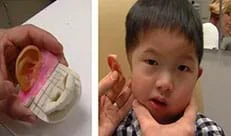 A young patient is fitted with a 3D printed ear.Copyright 2015 3DPrint.com, CC BY-SA-NC, https://3dprint.com/56087/3d-printed-ear/
Students learn some of the implications of 3D printing in the biomedical field. Unlike 3D printers used in a classroom or by consumers, which use a plastic filament to produce a product, 3D printing for medical purposes is often with real living cells. In this lesson, students gain an understanding of how 3D printing is changing lives for the better through a presentation and group discussion. In the corresponding activity, they have the opportunity to participate in a hands-on simulation of a real-world 3D printing task.
Engineers work daily to develop solutions to various problems in multiple fields such as architecture or aerospace, but more recently they have been making significant strides in improving healthcare. Over the past several decades finding a cure for cancer and many other disease and illnesses has always been a top priority. How to most effectively develop medicines and treatments, and how to deliver those to the most necessary parts of the body in the most effective way is a solution that engineers continue to try and solve.
After this lesson, students should be able to:
- Define the role a biomedical engineer plays in the healthcare field.
- Identify the specific benefits 3D printing can provide in the areas of biomedicine.
- SC.35.CS-CS.2.4 Solve real world problems in science and engineering using computational thinking skills.
Grades 3-5
Do you agree with this alignment?
- Students will develop an understanding of the relationships among technologies and the connections between technology and other fields of study.
Grades K-12
Do you agree with this alignment? - Advances and innovations in medical technologies are used to improve healthcare.
Grades 6-8
Do you agree with this alignment? - STEL-1J Develop innovative products and systems that solve problems and extend capabilities based on individual or collective needs and wants.
Grades 6-8
Do you agree with this alignment? - STEL-3F Apply a product, system, or process developed for one setting to another setting.
Grades 6-8
Do you agree with this alignment? - STEL-3G Explain how knowledge gained from other content areas affects the development of technological products and systems.
Grades 6-8
Do you agree with this alignment?
- CCC.8.3-5.6 Engineers improve existing technologies or develop new ones.
Grade 4
Do you agree with this alignment? - DCI.ETS1.C.3-5.2 Different solutions need to be tested in order to determine which of them best solves the problem, given the criteria and the constraints.
Grades 3-5
Do you agree with this alignment?
Students should have an understanding of what an engineer does and the benefit they are to our society. Students should also have a basic understanding of how 3D printing differs from what we know as traditional ink and paper printing.
Teachers will need to have a background knowledge of what a biomedical engineer does and how the work they do benefits society, especially in the field of medicine. A biomedical engineer works in the field of medicine and biology and develops solutions for problems in caring for, healing, and improving the human body. Some of these solutions include developing a more effective medicine or vaccine, creating a replacement joint, or developing more efficient medical devices. Any personal experiences the teacher may have would also be a great addition to this lesson. The teacher should also have an understanding of the 3D printing process. The 3D printing process involves a printer expelling a material to create a product. Unlike a traditional printer which only moves back and forth as the paper moves through the printer; a 3D printer can move along an x-, y-, and z-axis. A traditional printer uses only ink to create words and numbers or a picture on a piece of paper. A 3D printer uses multiple types of ink such as plastic filament, soft materials like gels, even cells. A traditional printer usually prints only one layer of ink. A 3D printer prints layer upon layer as necessary to print a final product.
[Have the Get Moving PowerPoint Presentation (PPTM) displayed while introducing]
At some point in our lives we will all benefit from biomedical engineering. One common product that has been around for some time, and continues to be improved upon, is the use of a prosthetic limb. A prosthetic limb is a human-made limb, such as an arm, leg, hand, or foot, created to help someone who has lost, or was born without one. These professionals are called biomedical engineers because they engineer solutions to help and heal the body.
Slide 2: It’s time to get moving. [Have all students stand up and play video on slide.] The video is of a hip-hop version of the classic kids’ song, Head, Shoulders, Knees and Toes. Some of you may have heard this song, some may not. [You can lead them in the dance movements or allow them to use the lyrics to guide their movements. After the video is over you could also lead them in the traditional Head, Shoulders, Knees and Toes song and movements, getting faster each time.]
[Ask the class this question] “What would it be like or how would you feel if you couldn’t do some of the things we just did?” [Potential answers: Not very good, mad, sad, etc. Give the class about 30 seconds to think, then lead the class in a discussion and give them time to express their thoughts.]
Slide 3: [This slide includes several pictures of biomedical engineers working in different fields. Allow the students about 10 seconds to look at the pictures. Then ask the following questions.] “Who do you think these people are?” “What do you think they are doing?” (Potential answers: scientists, doctors)
Slide 4: A biomedical engineer is someone who designs solutions to various problems in the medical and biological field for the advancement of our healthcare. Some problems that exist are making vaccines for illness and disease, creation of new medicines, new and improved medical tools for surgery.
Slide 5: The final slide includes a video that explains how 3D printing has helped engineers in the healthcare field. Printing does not always use a plastic like ink that melts and hardens. It can also use a soft matter, such as gel and cells. When we are dealing with solutions to problems for the body we use soft materials to simulate the conditions of the body.
Slide 6 includes three questions for the students to consider. [Give them about 3 minutes to talk with a shoulder partner and answer these questions. Then give the students time to share their responses with the class.]
- 3-d printing
- The use of a printer to create a multidimensional, tangible object.
- biomedical engineering
- The application of engineering principles and design concepts to medicine and biology for healthcare purposes to advance health care treatment, including diagnosis, monitoring, and therapy.
Lesson Summary Assessment
Touch Down, Take Off Kagan Strategy: This is a fun assessment of student learning that does not require students to verbalize their answers; instead they answer with their body movements. Ask the students a question and, if they agree with what was said or the statement relates to them, they “take off” (stand up next to their seat). If they do not agree or the statement does not relate to them then they remain seated. Once everyone has answered you instruct the students to “touch down”, which simply means to sit back down. Then you ask another question.
Questions to ask:
- A biomedical engineer designs solutions we can use in the healthcare field. (Answer: true, students should stand up. Not all may however, this is where the assessment comes in as some may not have grasped the concept.)
- 2D printing is the use of a printer to create a multidimensional, tangible object. (Answer: false, students should remain sitting. 3D printing, not 2D printing creates multidimensional objects.)
- 3D printing does not always use filament for the ink. (Answer: true, sometimes they use other substances such as cells. Students should stand up.)
- I would think it’s cool to have a 3D printed body part. (Answers vary, this is an opinion question and can lead to more discussion if you’d like.)
- Monumental Movements
Contributors
Amanda Spotz
Supporting Program
Multidisciplinary Research Experiences for Teachers of Elementary Grades, Herbert Wertheim College of Engineering, University of Florida
Acknowledgements
This curriculum was based upon work supported by the National Science Foundation under RET grant no. EEC 1711543— Engineering for Biology: Multidisciplinary Research Experiences for Teachers in Elementary Grades (MRET) through the College of Engineering at the University of Florida. Any opinions, findings, and conclusions or recommendations expressed in this material are those of the authors and do not necessarily reflect the views of the National Science Foundation.
Copyright
2019 by Regents of the University of Colorado; original © 2018 University of Florida