
Repairing Cracked Steel Structures with Carbon Fiber Patches
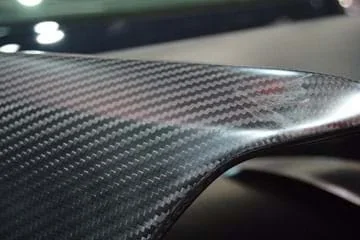 This car part made of carbon-fiber-reinforced polymers is composed of carbon filaments woven to meet the desired application.Copyright 2016 Yahya S., Flickr (CC BY 2.0) https://www.flickr.com/photos/128326674@N06/24322793889 https://creativecommons.org/licenses/by/2.0/
Over several days, students learn about composites, including carbon-fiber-reinforced polymers, and their applications in modern life. This prepares students to be able to put data from an associated statistical analysis activity into context as they conduct meticulous statistical analyses to evaluate/determine the effectiveness of carbon fiber patches to repair steel. This lesson and its associated activity are suitable for use during the last six weeks of an AP Statistics course; see the topics and timing note for details. A PowerPoint® presentation and post-quiz are provided.
Maintenance and rehabilitation of concrete and steel structures is extremely important. A structure failure may lead to tragedies like the I-35W bridge in Minneapolis (August 2007, see Figure 1) or the Alexander Kielland Norwegian North Sea rig disaster (March 1980). Engineers have developed different methods to repair structures: crack welding, binding or cover plates, and stop holes, but these techniques require irreversible modifications to the original structures (see Figure 2). The best rehabilitations are the ones that do not produce irreversible changes in structures.
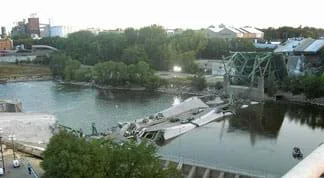 Figure 1. Structures rehabilitation is an extremely important engineering task since structure fatigue failures can have tragic consequences, such as this bridge collapse.Copyright 2007 Mike Wills, Flickr, Wikimedia Commons https://commons.wikimedia.org/wiki/File:I35_Bridge_Collapse_4crop.jpg
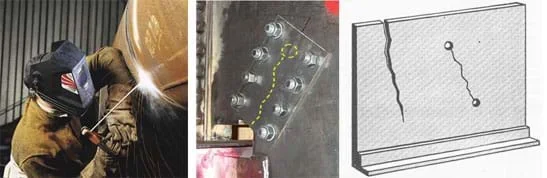 Figure 2. Conventional steel structure crack repair techniques—such as crack welding, crack cover plates and drilling crack stop holes—permanently alter the original structures.Copyright (left) 2006 Mgschuler, Wikimedia Commons; (middle) 2013 Manual for Repair and Retrofit of Fatigue Cracks in Steel Bridges, FHWA publication no. FHWA-IF-13-020 (Figure 26, page 49); and (right) Maritime (no usage restrictions for non-commercial educational purposes) https://commons.wikimedia.org/wiki/File:SMAW.jpg http://www.fhwa.dot.gov/bridge/steel/pubs/hif13020/hif13020.pdf http://www.maritime.org/doc/dc/part8.htm
Composites are mixtures made from two or more constituent materials with significantly different physical or chemical properties that remain separate and distinct within the finished structure, but result in a new material with enhanced properties (see Figure 3). Composites are carefully designed so that desired properties, such as strength, weight, durability, flexibility, conductivity and stability, are improved.
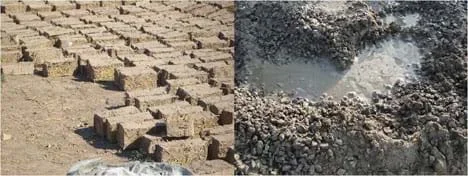 Figure 3. Composites consist of two parts: a matrix (base) and a reinforcement material.Copyright (left) 2007 Vmenkov and (right) 2012 Thamizhpparithi Maari, Wikimedia Commons https://commons.wikimedia.org/wiki/File:Milyanfan-adobe-bricks-8038.jpg https://commons.wikimedia.org/wiki/File:A_close-up_of_concrete_mixture.JPG
In recent years, composites have been widely used to repair or reinforce old concrete and metallic structures; surprisingly, these components have not been combinations of standard construction materials like concrete or steel, but fiber reinforced polymers (FRP) bonded with resins or glues. This combination produces a new material that is stronger than steel or concrete, but lighter and non-corrosive.
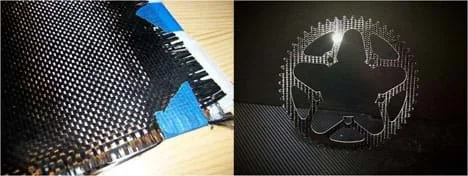 Figure 4. A fabric created by weaving thousands of carbon fibers. Combined with epoxy or resins, this cloth can be molded into different shapes, like this bicycle part.Copyright (left) 2005 Hadhuey, Wikimedia Commons and (right) 2013 Nwben, Flickr https://commons.wikimedia.org/wiki/File:Kohlenstofffasermatte.jpg https://www.flickr.com/photos/nwben/9501941112/in/photostream//?rb=1
One special class of FRP with an incredible strength-to-weight ratio and stiffness is carbon-fiber-reinforced polymers (CFRP; see Figure 4), which have been successfully used to rehabilitate cracked steel structures. CFRP patches provide a solution to avoid the propagation of cracks in steel and concrete structures (see Figure 5). Experimental data indicate that steel mean fatigue life improves substantially using CFRP. The main advantage of CRFP patches over conventional methods is that they require no irreversible modification of the underlying structure.
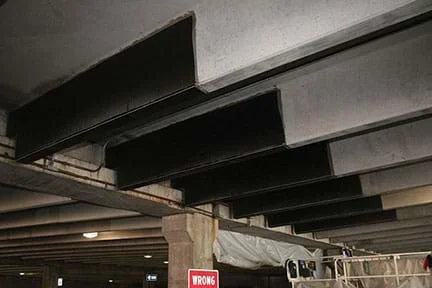 Figure 5. Because of their strength, simple application and corrosion resistance, CFRP composites are used on interior and exterior structural members in almost all types of environments.Copyright 2015 Tarek Alkhrdaji, Structure Magazine. Used with permission. http://www.structuremag.org/?p=8643
With the invention of CFRP, engineers have answered the question: Is there a material as strong as steel, but lighter, corrosion resistant, and simple to work with?
After this lesson, students should be able to:
- Define composites and describe their properties.
- Describe traditional methods of repairing cracked steel.
- Describe carbon-fiber-reinforced polymers and their applications in modern life.
- Describe the implications of cracked steel structures.
- Students will develop an understanding of the cultural, social, economic, and political effects of technology.
Grades K-12
Do you agree with this alignment?
- HS-ETS1-3 Evaluate a solution to a complex real-world problem based on prioritized criteria and trade-offs that account for a range of constraints, including cost, safety, reliability, and aesthetics, as well as possible social, cultural, and environmental impacts.
Grades 9-12
This resource focuses on the following Three Dimensional Learning aspects of NGSS:
Science & Engineering Practices- Evaluate a solution to a complex real-world problem, based on scientific knowledge, student-generated sources of evidence, prioritized criteria, and tradeoff considerations.Do you agree with this alignment?
Disciplinary Core Ideas- When evaluating solutions it is important to take into account a range of constraints including cost, safety, reliability and aesthetics and to consider social, cultural and environmental impacts.Do you agree with this alignment?
Crosscutting Concepts- New technologies can have deep impacts on society and the environment, including some that were not anticipated. Analysis of costs and benefits is a critical aspect of decisions about technology.Do you agree with this alignment?
Do you agree with this alignment? - Evaluate a solution to a complex real-world problem, based on scientific knowledge, student-generated sources of evidence, prioritized criteria, and tradeoff considerations.
- CCC.7.9-12.7 Systems can be designed for greater or lesser stability.
Grades 9-12
Do you agree with this alignment?
Overview
The purpose of this lesson is to arm students with the necessary background information to meaningfully contextualize and perform statistical analyses of experimental data in the associated activity Statistical Analysis of Methods to Repair Cracked Steel, as well as draw conclusions based on their analyses. Students need to understand composites, polymers, carbon fiber, epoxy adhesives, nitinol, and that their combinations result in new and useful composites. With this goal in mind, it is recommended that you follow the suggested sequence (provided below) and use the Patching Steel to Rehabilitate Structures Presentation (PPTX).
About three 50-minute class sessions are recommended to present the lesson content and show the ~30 online YouTube videos and a few web sites linked in the slide presentation. You may also want to assign students to watch some (or all) of the videos as homework.
It is recommended that you watch all these videos before teaching the lesson in order to gain a solid understanding of the lesson’s engineering background. You may also want to conduct additional searches to find new videos and/or other materials to complement the lesson.
Remember to verify YouTube access via school computers since some school districts restrict or completely block YouTube access, causing some of these videos to be unavailable. In this case, download the videos using a tool such as ClipConverter (www.clipconverter.cc).
The suggested sequence to present all the necessary concepts is:
Day 1: Steel Structures Maintenance
- Real-world examples: Collapse of the Minneapolis I-35W Bridge over the Mississippi River, and the Alexander Kielland platform disaster in the Norwegian North Sea (slides 4-5).
- Emphasize the importance of preventive maintenance and the need for procedures to halt crack propagation. Explain that stress on materials produces crack propagation; high concentration of stress on fracture tips breaks the crystal structure. Computer simulations of this process are included to support the explanation (slide 6).
- Traditional ways to repair steel structures: Stop holes, cover plates and repair welding. Brainstorm improvements and other ideas (slides 7-10).
- New repair techniques. Is it possible to repair steel with a Band-Aid (slides 11-13)?
- Composites (slide 14). The linked videos briefly explain:
- What are composites? Brief story of their use since ancient times to the present, and the importance of these new materials in modern life.
- The use of composites in the aerospace industry. How the need for lighter and stronger materials pushed advanced composites materials research.
- What is graphene? Overview of its many applications in modern life.
- What is poltrusion? Fabrication of polymer-reinforced materials.
Day 2. Carbon-Fiber-Reinforced Polymers and Epoxy Adhesives
- Epoxy adhesives (slide 15). The linked videos show:
- Physical strength properties of epoxy adhesives.
- Strength tests for epoxy adhesives compared with traditional riveting and welding.
- Epoxy adhesive advantages compared with traditional bolting, welding and riveting.
- Carbon fiber (slide 16). The linked videos show and explain:
- Why carbon fiber is strong.
- A very simple test of the strength of a carbon-fiber cloth (and epoxy adhesive).
- Carbon-fiber-reinforced polymers + epoxy adhesives applications (slides 17-19). The linked videos in slide 17 show:
- A controlled strength test “carbon fiber vs. steel.”
- The use of carbon fiber-epoxy adhesive composites to repair concrete structures.
- Carbon fiber prosthetics, their high-performance use by athletes.
Day 3. Carbon-Fiber-Reinforced Polymers Patches
- CFRP patching to rehabilitate steel structures (slides 20-22). The video in slide 21 shows a simple strength test of a Portland cement bar reinforced with a carbon fiber band.
- Shape-memory alloys, including nitinol (slide 23). Linked videos show and/or explain:
- What is a shape-memory alloy and specifically, what is nitinol?
- Properties of nitinol under temperature changes, with some simple applications.
- Medical uses of nitinol.
- Composite CFRP-nitinol-epoxy to produce pre-stressed patches (slides 24-25).
(Be ready to show students the 25-slide Patching Steel to Rehabilitate Structures Presentation (PPTX), which includes links to ~30 online videos and a few other web pages. Also make copies of the Post-Introduction Quiz (PDF), one per student. Note: The slides are “animated,” so run the PowerPoint® file as a slide show and click to bring up the next item. To activate the embedded links to YouTube videos or other websites, click on the images and icons mentioned in the slide notes; the URLs are also provided in the slide notes.)
(Slide 2) With this slide that shows Superman—the “man of steel”—conduct a pre-lesson assessment discussion about strong materials, as described in the Assessment section.
(Slide 3; same image as Figure 6) Over the next few days, we will discuss various topics to help put in context the research data you will receive for an upcoming data analysis project. You will learn about state-of-the-art engineering developments and their current applications, which range from aerospace to orthopedics, from athletics to military, and from car racing to orthodontics.
The rehabilitation of cracked steel structures is an important and challenging task. Improving the resiliency, extending the life, and maintaining the integrity of civil infrastructure is a priority in any country and a professional responsibility for engineers. As you will see, failure can have fatal consequences.
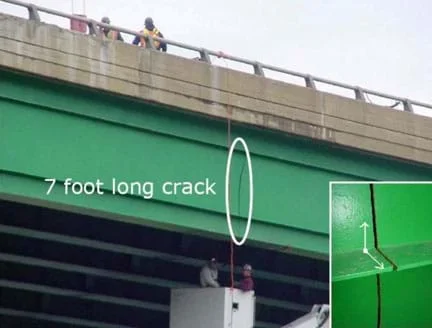 Figure 6. Cracks in one element may compromise the entire structure integrity and lead to fatal consequences. Halting crack propagation at an early stage extends structure life.Copyright Reza Haghani et al., Fatigue-Prone Details in Steel Bridges (Figure 2), MDPI. Used with permission. http://www.mdpi.com/2075-5309/2/4/456/htm
(Using the YouTube links on slides 4 and 5, show students videos about two cases of structural disasters: Collapse of the Minneapolis I-35W Bridge over the Mississippi River and the Alexander Kielland platform disaster in the Norwegian North Sea.)
(Slide 6; explain that cracks in materials propagate under continuous stress.)
Visualize yourselves as the engineers responsible for inspecting and keeping safe the civil infrastructure in your city. In one of the structures you inspect, you notice that a little crack is beginning. You need to report the problem and specify a corresponding repair. How might the necessary repair be made? (Listen to student ideas. Expect their answers to likely include the use of welding points.
(Using slides 7-10, briefly show the traditional repair methods—crack stop holes, cover plates, welding—and mention their drawbacks.)
(After students understand the advantages and disadvantages of the traditional methods, present the first challenge question in this lesson.) Could you repair cracked steel using a different method? (Brainstorm as a class. Some students may jokingly answer: Why not use gorilla tape, super glue, or as an extreme answer, a Band-Aid? These “crazy” answers are an excellent introduction for the next slides.)
(Slides 11-13) Some technological advances require the inspiration to develop new materials and/or new combinations of existing materials. Think about cell phones. In order to develop the capability to scroll with your fingers or zoom in and out of photographs, new materials had to be designed, developed and combined with existing ones. The capabilities of the materials used in cell-phones was “unthinkable” years ago!
Do you think a non-metallic material and a strong adhesive exist that, if combined, could be an incredibly strong “Band-Aid” able to stop crack propagation? (Organize students in a way that is most productive for discussion, such as discussion groups or class brainstorming.)
(After listening and writing students’ suggested answers on the classroom board, show them photographs and linked videos in slides 14-17 to introduce composites, epoxy adhesives and carbon-fiber-reinforced polymers, and their many applications in modern life.) Are you familiar with these materials? And these applications? What other possible applications can you think of? (Write their ideas on the board.)
(Use slides 18-22 to summarize carbon-fiber-reinforced polymers (CFRP) properties. Next, introduce the CFRP patches concept as an alternative to repair cracked steel [slide 20]. Then introduce the engineering finding that pre-stressed patches are more effective at halting crack propagation [slide 21] and show that patch pre-stressing is not a simple task [slide 22].)
(Slides 23-25; finally, introduce shape-memory alloys, specifically nitinol, and some of its applications. Then, introduce the concept of pre-stressed repair patches, composed of CFRP, nitinol and epoxy adhesive. Then ask a question that sets up the associated activity.) A NiTiNb-CFRP patch is simple to pre-stress and apply, but how effective is it?
(Conclude the lesson by administering the post-introduction quiz.)
Now that you have general understanding of composites, carbon fiber, epoxy adhesive, shape-memory alloys, and some of their applications, let your imaginations fly and suggest some other possible uses of these materials. Don’t worry if your ideas sound like science fiction! Years ago, no one imagined that a plastic coated with some glue could be stronger than steel!
- alloy
- Two or more metals, or a metal and a nonmetal, that are mixed or fused for desirable qualities, such as hardness and strength.
- carbon-fiber-reinforced polymer
- A strong yet lightweight fiber-reinforced polymer that contains carbon fibers. Epoxy, polyester, vinyl ester or nylon are used as binding polymers.
- carbon fiber
- A long, thin strand of material mainly composed of carbon atoms. Carbon fibers are corrosion-resistant, 10 times stronger and five times lighter than steel, with superior fatigue properties.
- cold rolling
- A process used to make a metal harder and stronger through plastic deformation.
- crystal structure
- The highly ordered arrangement of atoms, ions or molecules in a crystalline liquid or solid.
- dislocation
- A defect in a crystal structure in which a few ions in a layer are missing.
- elastic deformation
- A temporary shape change that is self-reversing after the force is removed, so that the object returns to its original shape.
- elastic limit
- The limit beyond which a material no longer returns to its original shape after a load is removed.
- epoxy
- A resin capable of forming tight cross-linked polymer structures characterized by toughness and strong adhesion; used especially in surface coatings and adhesives.
- fatigue (material)
- In materials science, the weakening of a material caused by repeatedly applied loads (stress or strain).
- fatigue life
- The number of stress cycles sustained before failure occurs.
- monomer
- A molecule of low molecular weight capable of reacting with identical or different molecules of low molecular weight to form a polymer.
- plastic deformation
- A permanent (irreversible) deformation or change in shape of a solid body without fracture under the action of a sustained force.
- polymer
- A chemical compound made of small molecules arranged in a simple repeating structure to form a larger molecule.
- stainless steel
- A steel alloy with a minimum of 10.5% chromium content by mass. Stainless steel does not readily corrode, rust or stain with water as ordinary steel does.
- steel
- An alloy of iron and other elements. Widely used in construction.
- strain
- The relative change in shape or size of an object due to externally applied forces (strain is dimensionless).
- stress (mechanics)
- The internal force (per unit area, length, etc.) associated with strain.
Pre-Lesson Assessment
Class Discussion: Because it is highly likely that students have no prior knowledge about polymers, carbon fiber, epoxy adhesives or shape-memory alloys, a formal assessment on these topics would not be productive. Instead, introduce the lesson by conducting an informal assessment to determine how much students know about strong materials. Show the class an image of Superman (slide 2) and engage them in a discussion by asking:
- Who this is?
- Why is he so powerful and indestructible? (Answer: Because he is “the man of steel”!)
- Is steel really indestructible?
- If Superman were not the man of steel, what other material—stronger than steel—might he be made of? Must this new material be a metal?
Write student answers on a designated place on the classroom board. After students have watched the linked videos in the Patching Steel to Rehabilitate Structures Presentation (PPTX) (at the end of Days 1 or 3 of the lesson), revisit and evaluate these answers as a class.
Post-Introduction Assessment
Quiz: After presenting the Introduction/Motivation and slide presentation content to the class, administer the Post-Introduction Quiz (PDF). Review students’ answers to verify that they have a basic understanding of composites, carbon fiber, epoxy adhesives and shape-memory alloys before moving on to conduct the associated activity.
Below is a list of online YouTube videos to support the lesson content. During the slide presentation, show students some or all of the ~30 online YouTube videos (and a few web pages) that are linked in the slides. In addition, many of them are also listed below and/or provided in grouped tutorials under the AP Statistics First Semester Project playlist at https://www.sophia.org/playlists/ap-statistics-first-semester-project.
Fiber-Reinforced-Polymers
- Getting to Know Fiber Reinforced Polymers (7:27 min): https://www.youtube.com/watch?v=iqD9hBQXi5Y
- Concrete Bridge Repair w/ Fiber Reinforced Polymers - Carbon Wrap Solutions (4:32 min): https://www.youtube.com/watch?v=NSbpl9f0lO8
- Case Study - FRP Composite Bridges (4:11 min): https://www.youtube.com/watch?v=xS2rgXqy5GE
- Fiber Reinforced Polymer FRP Reinforced Concrete Solutions (4:39 min): https://www.youtube.com/watch?v=TbOkmzQRDcU
Carbon Fiber Composites
- Strong material - carbon fiber composite materials in aircraft (4:32 min): https://www.youtube.com/watch?v=FTUw0OWWMLU
- Steel Shaft vs. Carbon Fiber Shaft (5:31 min): https://www.youtube.com/watch?v=hjErH4_1fks
- Intro to Composites (4:12 min): https://www.youtube.com/watch?v=WYqCnEvTRUQ
- Composite materials intro by JEC (5:16 min): https://www.youtube.com/watch?v=dbywZ4PJ3QA
- Composite Materials 1 (6:57 min): https://www.youtube.com/watch?v=201C6gpu8QU
- Composite Materials 2 (4:59 min): https://www.youtube.com/watch?v=Cje-5EGPUY8
- Composites 101 (Vacuum bagging carbon fiber) (27:05 min): https://www.youtube.com/watch?v=T4ZFj4fItWE
- Carbon composite product process of manufacture (2013 UCHIDA Factory) (7:48 min) https://www.youtube.com/watch?v=7Q5An-X-5yA
- Carbon Fiber for Dummies (34:50 min): https://www.youtube.com/watch?v=qfaW4c-Ourc
Polymers
- GCSE Science Chemistry Unit 1. Lesson 38: Polymers (4:22 min): https://www.youtube.com/watch?v=DXPmBEMsRXI
- GCSE Science Chemistry Unit 1. Lesson 39: Issues around Using Polymers (2:29 min): https://www.youtube.com/watch?v=wyukfA_vZhI
- Polymers - Crash Course Chemistry #45 (10:14 min): https://www.youtube.com/watch?v=rHxxLYzJ8Sw
- Getting to Know Fiber Reinforced Polymers (7:27 min): https://www.youtube.com/watch?v=iqD9hBQXi5Y
- Fiber Reinforced Polymer FRP Reinforced Concrete Solutions (4:40 min): https://www.youtube.com/watch?v=TbOkmzQRDcU
- Case Study - FRP Composite Bridges (4:11 min): https://www.youtube.com/watch?v=xS2rgXqy5GE
Structural Disasters
- Video Captured of 35W Bridge Collapse (41 sec; actual footage): https://www.youtube.com/watch?v=CMdv2wRaqo4
- 35W Bridge Collapse Visualization (5:18 min): https://www.youtube.com/watch?v=O6ommRCUcsg
- Rare Interstate 35W aftermath footage shot by the Minnesota Department of Transportation (7:10 min): https://www.youtube.com/watch?v=LyJxDfEgEjU
- Alexander Kielland Rig Disaster (2:39 min): https://www.youtube.com/watch?v=7QVn3NUW_aQ&feature=player_embedded
- P36 Plataforma que afundou - Parte 1 (8:10 min): https://www.youtube.com/watch?v=yuOoFykbZcs
- P36 Plataforma que afundou - Parte 2 (8:09 min): https://www.youtube.com/watch?v=gUqXA4IMlek
- Show students a photograph of the collapsed Alexander Kielland drilling platform structure, see: Norwegian Oil and Gas Association. Norway’s Petroleum History at https://www.norskoljeoggass.no/no/Faktasider/Oljehistorie/
Brase, Charles H. and Brase, Corrinne P. Understandable Statistics. 8th Edition, Boston, MA: Houghton Mifflin, 2006.
Carbon-fiber-reinforced polymer. Last updated February 2016. Wikipedia, The Free Encyclopedia. Accessed February 2016. https://en.wikipedia.org/wiki/Carbon-fiber-reinforced_polymer
Colombi, Pierluigi, Fava, Giulia and Sonzogni, Lisa. (April 2015) “Fatigue Crack Growth in CFRP-Strengthened Steel Plates.” In Composites: Part B. https://www.researchgate.net/publication/271274747_Fatigue_crack_growth_in_CFRP-strengthened_steel_plates
El-Tahan, M., Dawood, M. and Song, G. (June 2015) “Development of a Self-Stressing NiTiNb Shape Memory Alloy (SMA)/ Fiber Reinforced Polymer (FRP) Patch.” Smart Materials and Structures, Vol. 24, issue 6.
Huawen, Ye, Konig, Christian, Ummenhofer, Thomas, Schizhong, Quing and Plum, Robin. “Fatigue Performance of Tension Steel Plates Strengthened with Prestressed CFRP Laminates.” ASCE Journal of Composites for Construction, Vol. 14, issue 5 (Oct. 2010), pp. 609-615.
Jones, Sean, and Civjan, Scott. “Application of Fiber Reinforced Polymer Overlays to Extend Steel Fatigue Life.” ASCE Journal of Composites for Construction, Vol. 7, issue 4 (Nov. 2003), pp. 331-338.
Liu, Hongbo, Al-Mahadi, Riadh and Zhao, Xiao-Ling: “Experimental Study of Fatigue Crack Growth Behavior in Adhesively Reinforced Steel Structures.” In Composite Structures, Vol. 90, no. 1, August 2009.
Masuelli, Martin Alberto. “Chapter 1: Introduction of Fibre-Reinforced Polymers − Polymers and Composites: Concepts, Properties and Processes.” Fiber Reinforced Polymers – The Technology Applied for Concrete Repair, via INTECH, CC BY 3.0 license, published January 23, 2013. http://www.intechopen.com/books/fiber-reinforced-polymers-the-technology-applied-for-concrete-repair/introduction-of-fibre-reinforced-polymers-polymers-and-composites-concepts-properties-and-processes
Täljsten, Björn, Hansen, Christian Skodborg and Schmidt, Jacob Wittrup. “Strengthening of Old Metallic Structures in Fatigue with Prestressed and Non-Prestressed CFRP Laminates.” Construction and Building Materials, Vol. 23, no. 4, March 2009, pp. 1665-1677.
Tsouvalis, Nicholas G., Mirisiotis, Lazarus S. and Dimou, Dimitris N. “Experimental and Numerical Study of Fatigue Behavior of Composite Patch Reinforced Cracked Steel Plate.” International Journal of Fatigue, Vol. 31, no. 10, pp. 1613-1637, September 2009.
U.S. Department of Transportation. Federal Highway Administration. Manual for Repair and Retrofit of Fatigue Cracks in Steel Bridges. March 2013. FHWA Publication No. FHWA-IF-13-020. http://www.fhwa.dot.gov/bridge/steel/pubs/hif13020/hif13020.pdf
What is carbon fiber? Zoltek Worldwide. http://zoltek.com/carbonfiber/
- Repairing Cracked Steel Structures with Carbon Fiber Patches
AP Statistics topics and timing note: This lesson and its associated activity are intended to be taught during the last six weeks of the school year to address topics covered in the AP Statistics course, including central tendency measurements and five numbers summary. The total time required for the lesson and its associated activity is nine 50-minute sessions. Use the project results presentation grades that students obtain in the associated activity as part of their first semester final test grades.
Because of the complexity of this lesson and activity and the necessity to understand many little details in order to teach it and support students, you are welcome to request assistance from the author, Miguel R. Ramirez, at mramirez2@galenaparkisd.com."
Contributors
Miguel R. Ramirez; Mina Dawood; Botong Zheng
Supporting Program
National Science Foundation GK-12 and Research Experience for Teachers (RET) Programs, University of Houston
Acknowledgements
This digital library content was developed by the University of Houston's College of Engineering under National Science Foundation GK-12 grant number DGE 0840889. However, these contents do not necessarily represent the policies of the NSF and you should not assume endorsement by the federal government.
The author also thanks Fritz Claydon; RET program director, Stuart Long and Debora Rodrigues, RET academic advisors; Mila Taylor, Marjorie Hernandez and Andrea Lee, RET advisors; as well as the National Science Foundation for its funding of the RET program.
Copyright
2016 by Regents of the University of Colorado; original © 2015 University of Houston