
The Pirates of Prosthetics: Peg Legs and Hooks
 Stereotypical images of pirates show old ideas of prosthetic limbs.Copyright 2006 J.J., Wikimedia Commons http://commons.wikimedia.org/wiki/File:Piratey,_vector_version.svg
Students are introduced to prosthetics—history, purpose and benefits, main components, main types, materials, control methods, modern examples—including modern materials used to make replacement body parts and the engineering design considerations to develop prostheses. They learn how engineers and medical doctors work together to improve the lives of people with amputations and the challenges faced when designing new prostheses with functional and cosmetic criteria and constraints. A PowerPoint® presentation and two worksheets are provided.
Human bodies are able to withstand great forces and destroy unwanted foreign bacteria. However, the body can only handle so much. Sometimes, the effects of car accidents, war, animal attacks and bacterial infections cause excessive trauma with the only means of saving a person's life being amputation. Biomedical engineers and doctors work together to continually improve and creatively invent amazing prosthetic devices to enable people to complete daily life tasks efficiently and effectively.
After this lesson, students should be able to:
- List reasons why human body limb amputation may be necessary or may occur.
- Explain factors considered by engineers and medical doctors when designing prostheses.
- Explain why certain materials might be chosen over others for fabricating specific prostheses.
- Explain differences in criteria and constraints when designing replacement limbs for amputations with and without joints.
- STEL-1Q Conduct research to inform intentional inventions and innovations that address specific needs and wants.
Grades 9-12
Do you agree with this alignment? - STEL-2X Cite examples of the criteria and constraints of a product or system and how they affect the final design.
Grades 9-12
Do you agree with this alignment?
- HS-ETS1-1 Analyze a major global challenge to specify qualitative and quantitative criteria and constraints for solutions that account for societal needs and wants.
Grades 9-12
This resource focuses on the following Three Dimensional Learning aspects of NGSS:
Science & Engineering Practices- Analyze complex real-world problems by specifying criteria and constraints for successful solutions.Do you agree with this alignment?
Disciplinary Core Ideas- Criteria and constraints also include satisfying any requirements set by society, such as taking issues of risk mitigation into account, and they should be quantified to the extent possible and stated in such a way that one can tell if a given design meets them.Do you agree with this alignment?
- Humanity faces major global challenges today, such as the need for supplies of clean water and food or for energy sources that minimize pollution, which can be addressed through engineering. These global challenges also may have manifestations in local communities.Do you agree with this alignment?
Crosscutting Concepts- New technologies can have deep impacts on society and the environment, including some that were not anticipated. Analysis of costs and benefits is a critical aspect of decisions about technology.Do you agree with this alignment?
Do you agree with this alignment? - Analyze complex real-world problems by specifying criteria and constraints for successful solutions.
- explain the societal impacts of scientific contributions; and
Grades 9-12
Do you agree with this alignment?
- No More Hooks and Peg Legs Presentation (pptx)
- No More Hooks and Peg Legs Presentation (pdf)
- Prosthetics Worksheet (docx)
- Prosthetics Worksheet (pdf)
- Prosthetics Worksheet Answer Key (docx)
- Prosthetics Worksheet Answer Key (pdf)
- Research Worksheet (docx)
- Research Worksheet (pdf)
- Research Worksheet Answer Key (docx)
- Research Worksheet Answer Key (pdf)
A basic understanding of bones and muscles is useful. Completion of a middle school-level forces and motion unit provides the basic knowledge of forces necessary for this lesson.
The purpose of this lesson is to give students a good background on prosthetics and how prostheses evolved over time into the current offering of prostheses, which are marvelous feats of engineering. As you show students the 10-slide No More Hooks and Peg Legs Presentation (PPTX), a PowerPoint® file, incorporate the following information. Following the powerpoint, refer to the fun and hands-on associated activity A Zombie Got My Leg Challenge: Making Makeshift Legs where students experience the engineering design process as they design and construct lower-leg prostheses in response to a hypothetical zombie apocalypse scenario.
(slide 2) Whether due to car accidents, wars, animal attacks (shark!), birth defects or bacterial infection, sometimes body parts, including major limbs, are damaged, missing or amputated to save peoples' lives. Classic images of prostheses include Captain Hook from Peter Pan and other pirates with peg legs. The history of replacement body parts, or prostheses, can be traced to the ancient Greeks, Romans and Egyptians; for example, 3000-year-old mummies have been found with prosthetic toes and fingers. Before the 1840s, most people did not survive the amputation process due to the side-effects of shock, infection and blood loss. The medicine and tools at the time were limited, and prosthetic supplies were scavenged from whatever was available. Starting in 1842, anesthesia was used during surgery, which enabled more precise surgeries and resulted in better prosthetic fits. The great number of amputees from the two World Wars in the 20th century increased the demand for more and better prosthetic designs.
(slide 3) What is the purpose of prostheses and why are they important? The purpose of a prosthesis is to restore the functionality and capabilities of the lost limb. A prosthesis enables an amputee to reestablish mobility, independently conduct the activities of daily living, and keep a job.
What design challenges do engineers face in creating prostheses? One consideration is the location of the amputation. Does the replacement device need to include a movable joint, such as a knee or elbow? Will the prosthesis be designed to improve appearance only (cosmetic), such as an eye or ear, or does it need to perform some of the lost functions of the original limb, such as vision and hearing? The location on the body determines the necessary functions of the prosthesis so as to enable the person to resume daily life activities. Another consideration is the strength of the prosthesis compared to its weight. The material needs to be strong enough to perform the necessary functions and hold body weight if necessary but light enough to be moved easily. Another consideration is the attachment. How will the prosthesis be attached to the body? How do we keep it from falling off? Another consideration is cost. What materials are available to use? How much do they cost? Is the cost reasonable so that patients can afford the prostheses? These considerations and requirements become what engineers call the design criteria and constraints.
(slide 4) If we examine a simple prosthetic limb, such as one for a leg, we can see it is composed of four basic parts: interface, components, foot and cover. The interface, or socket, is where the prosthetic device meets the remaining part of the limb. This part usually includes a suspension system that uses some kind of attachment method, one of three techniques: 1) a suction valve that forms a seal with the limb, 2) a locking pin, or 3) a belt and harness. Another basic part is the components or pylon, which are the internal working parts of the prosthesis. The third basic part is the foot, which is an attachment that simulates the lost limb and helps with walking and balancing. Of course, for an arm prosthesis, this would be a hand. The fourth basic part is a cover, which is an outer covering to make it look more lifelike.
(slide 5) Let's talk about the four main types of artificial limbs. Transradial is a type that replaces an arm below the elbow including the wrist, hand and fingers. The transhumeral type replaces an arm above the elbow including the elbow, wrist, hand and fingers. The transtibial type replaces a leg below the knee, including the ankle, foot and toes. The transfemural type replaces a leg above the knee, including the knee, ankle, foot and toes. The more joints that are included in a prosthesis, the more complicated the design must be in order to provide the complexity of movements and functions.
(slide 6) One huge prosthetic advancement is the evolution of modern materials, which can make artificial parts stronger, lighter and more realistic in appearance and use. Some of the materials that have improved the designs are advanced plastics, carbon fiber composites and electronic components for control.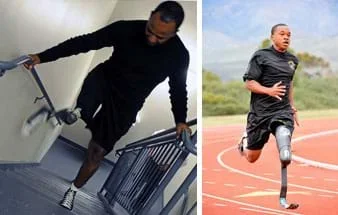 Microprocessor-controlled knee prostheses help people climb stairs (left) and run races (right).Copyright (left) 2009 U.S. Army via Wikimedia Commons; (right) 2009 Tim Hipps, U.S. Army via Wikimedia Commons http://commons.wikimedia.org/wiki/File:Flickr_-_The_U.S._Army_-_Patient_at_Walter_Reed_test_next-generation_prosthesis.jpg http://commons.wikimedia.org/wiki/File:Flickr_-_The_U.S._Army_-_U.S._Army_World_Class_Athlete_Program_Paralympic.jpg
(slide 7) What are different categories or types of modern prostheses? If we examine some examples, we can see the advancement of materials and corresponding increase in possibilities for patients. In specialty prostheses, carbon fiber can be used to enable people to run like they were able to before amputations. The carbon fiber is light enough for the patient to move it quickly and easily, yet strong enough to hold more the than the weight of the person. It also gives the person a slight bounce, just like our feet do. In functional prostheses, electronic systems can be utilized to enable a person to pick up items and catch balls during sports.
(slide 8) Advanced plastics enable cosmetic prostheses to be more lifelike. In some cases, it is not apparent that people have prostheses unless they tell you. For example, look at these eyeballs and hands. These current-day prostheses are the opposite of the cruder types before modern materials (aka peg legs and hooks).
(slide 9) The future of prostheses lies in the level of functional capabilities provided by the inventions and their electronic systems. In the 1950s, cable control systems were often used for people with transradial prostheses. Different body motions—such as a shrug or arm extension—caused the external cable to move, resulting in the hand moving as desired. Today, we use electrodes that are attached or implanted in the residual limb. These electrodes sense the muscles and are able to know how the hand should move as if it were attached. If the residual limb is from a transhumeral amputation, more muscles are needed for the electrodes to understand how the hand should move. Engineers are also working with medical doctors to implant electrodes in the brain to utilize neuron signals to control residual limb muscles. This approach has great potential to result in prostheses that enable people to have fully functional moving limbs again.
(slide 10) To accomplish their goals when designing prostheses, biomedical and mechanical engineers rely on their thorough understanding of a variety of subjects including anatomy, neurology, biomechanics, and sensor motor control. Applying what they know about these subjects enables engineers to design prostheses and other medical devices that can improve body mobility and function for patients.
Thousands of years ago, the first replacement body parts (prostheses) were made by the Egyptians. They were simple wooden, plaster or metal devices to replace lost toes and fingers. As technology improved, prostheses evolved to use composite materials such as polymers and carbon fiber. Early prostheses enabled amputees to maintain their basic daily life activities, while modern day prostheses enable people to pursue more demanding adventure lifestyles as well. Athletes run on carbon fiber prosthetic legs that mimic the capabilities of feet as they push on the ground. Variations in prosthetic feet shapes can mimic swimming, walking and dancing in heels. But are these the limits of prostheses?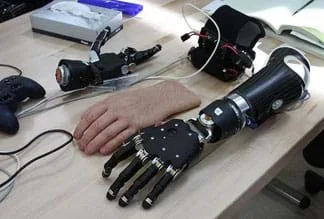 This brain-controlled modular prosthetic limb is controlled by surface electrodes that pick up electric signals generated by the muscles underneath the skin. The electrodes then convert those patterns into a robotic function.Copyright U.S. Navy http://blog.usa.gov/post/18017495812/image-description-this-brain-controlled-modular
In addition to working together to continually enhance the design of replacement body parts—which includes dentures, eyes, facial bones, hips, knee joints, arms and legs—biomedical engineers and medical doctors are creatively innovating radical new ideas for prostheses. For example, they are able to attach muscles to electrodes connect to the prostheses. The muscles send information to the prosthesis, such as contracting or relaxing, and the prosthesis performs the movements, making it seem as though it is a functioning and communicating part of the body. And, this is just the beginning of future prosthetic design—for example, tissue engineering may someday enable us to regenerate entire replacement limbs.
Prostheses have evolved throughout the years from simple pieces of wood to complex designs using composite materials enabling amputees to run or snowboard with no disadvantages. The world is constantly adapting to the knowledge humans gain and the new materials designed. In the future, it is possible that entire new limbs may be regenerated or prostheses will be fully electronically integrated with the body's neurons, giving amputees the use of limbs as if they were never lost.
- amputation
- The removal of an appendage due to trauma, bacterial infection or life-threatening cause. A traumatic amputation occurs when an appendage is removed as a result of the trauma without medical care, such as a bomb.
- amputee
- A person with an amputation.
- components
- The internal working parts of a prosthesis.
- composite
- A material that is a combination of multiple material components, designed to have specific properties, such as carbon fiber.
- constraints
- In engineering design, the limitations and requirements that must be considered when designing a workable solution to a problem.
- cosmetic prosthesis
- A prosthesis that enhances a person's appearance or completeness, but has no functional purpose. For example, a replacement glass eyeball is a cosmetic prosthesis if it does not also restore vision.
- cover
- As relates to prostheses, material used to cover a prosthesis to make it appear more lifelike.
- criteria
- In engineering design, the objectives that a final design solution is required to meet.
- functionality
- As relates to prostheses, the ability of a prosthesis to have a purpose or reason for designing it in a specific way. For example, a wood peg leg has less functionality than a modern prosthetic leg that enables an athlete to run competitively.
- interface
- The point where a prosthetic device meets a residual limb.
- prosthesis
- An artificial device, either external or implanted, that replaces or supplements a missing or defective body part, such as a tooth, eye, facial bone, palate, hip, knee joint, leg, arm, hand, etc. May be designed for functional or cosmetic reasons or both. (plural: prostheses)
- prosthetics
- The surgical, dental and/or engineering specialty concerned with the design, fabrication and fitting of prostheses.
- regenerate
- (biology) To renew or restore a lost, removed or injured part.
- residual limb
- The remaining portion of a body's appendage or limb after amputation.
- tissue engineering
- The use of cells, and biochemical and physiochemical factors to design new biomaterials to replace lost or damaged body materials that have specific biological functions.
- transfemoral
- A prosthesis that replaces the leg from above the knee (includes the knee, angle, foot and toes).
- transhumeral
- A prosthesis that replaces the arm from above the elbow (includes the elbow, wrist, hand and fingers).
- transradial
- A prosthesis that replaces the arm from below the elbow (includes the wrist, hand and fingers).
- transtibial
- A prosthesis that replaces the leg from below the knee (includes the ankle, foot and toes).
- trauma
- An event causing severe damage to the body.
Pre-Lesson Assessment
Group Discussion: Ask students the following questions:
- Who knows someone who has a prosthetic limb? Describe it. What is it made of? How is it attached to the residual limb? (Let a few students describe their first-hand experiences.)
- Have you ever seen anyone on TV with a prosthesis? (Examples: Oscar Pistorius, gold-medalist runner, and Amy Purdy, pro-snowboarder. Both have prostheses for both legs, but are capable of competing in high-impact and high-caliber sports such as track and field and snowboarding.)
- Have you noticed any differences between the prosthetic devices you see used by everyday people and those worn by athletes? (Possible differences: Different functionality? Different robustness? Different materials? Which might cost more?)
Post-Introduction Assessment
Worksheet: While presenting the No More Hooks and Peg Legs Presentation (PPTX), have students complete the Prosthetics Worksheet (PDF) to help them elicit some key content takeaways from the lesson. Review their completed worksheets to gauge their comprehension of the presented material.
Lesson Summary Assessment
Research Worksheet: After presenting the lesson content, assign students to independently conduct internet research on the topics of materials, control methods, old-style and current-day prosthetic lower-leg designs, guided by the prompts on the Research Worksheet (PDF). Review their completed worksheets to gauge whether their background preparation is sufficient for them to proceed to conduct the associated activity. Specifically, make sure students have acquired information to help them design lower-leg prostheses.
Activity Voucher Questions: Incorporated into the associated activity are questions that students must answer in order to obtain materials for their prosthetic design/build projects. The questions are pulled from the information provided in the lesson's PowerPoint® presentation, so students' ability to correctly answer those questions reveals their level of comprehension of the lesson content.
Show students a three-minute video of a man showing the materials and functionality of his nice-looking and highly functional prosthetic leg called How a Prosthetic Leg Works at http://www.youtube.com/watch?v=43WpTnJJuTE.
Show students a two-minute video of a news report called Researchers Walk Out First Mind-Controlled Prosthetic Leg at http://www.youtube.com/watch?v=JRbK6OGIdHk.
Show students a 10-minute video about the making of affordable mechanical fingers using a 3D printer and a simple cable system, called MakerBot and Robohand | 3D Printing Mechanical Hands at https://www.youtube.com/watch?v=WT3772yhr0o.
Show students a story called Ancient Egyptian Fake Toes Earliest Prosthetics by Rossella Lorenzi in Discovery News (includes good images): http://news.discovery.com/history/ancient-egypt/ancient-egypt-wooden-toes-prosthetics-121002.htm.
- The Pirates of Prosthetics: Peg Legs and Hooks
Contributors
Andrea Lee; Megan Ketchum
Supporting Program
National Science Foundation GK-12 and Research Experience for Teachers (RET) Programs, University of Houston
Acknowledgements
This digital library content was developed by the University of Houston's College of Engineering under National Science Foundation GK-12 grant number DGE 0840889. However, these contents do not necessarily represent the policies of the NSF and you should not assume endorsement by the federal government.
Copyright
2015 by Regents of the University of Colorado; original © 2014 University of Houston