
How Dense Are You?
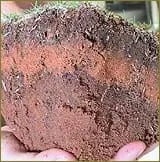 Rich soil sample.Copyright Western Australian State Government http://www.westone.wa.gov.au/toolbox6/hort6/html/resources/depot/hort_file/soil_struct/soil_struct.html
Students learn about geotechnical engineers and their use of physical properties, such as soil density, to determine the ability of various soils to offer support to foundations. In an associated activity, students determine the bulk densities of soil samples, and assess their suitability to support foundations.
Geotechnical engineers are responsible for identifying soil constituents and their characteristics. This information is vital due to the existence of problematic, expansive soils, which can be linked to most of the foundation failures that occur in homes, on roads and in other structures. To avoid these problems, geotechnical engineers commonly use bulk density testing to assess if soil make-up is appropriate to support a stable foundation, or if it needs to be adjusted. Thanks to geotechnical engineers, we avoid many of these problems, and have experts to resolve foundational failures when they arise!
After this lesson, students should be able to:
- Relate the physical properties of soils to foundation failures in streets, homes and other structures.
- Describe how soil constituents affect the foundations of all structures.
- CCSS.Math.Content.HSA-CED.A.4 Rearrange formulas to highlight a quantity of interest, using the same reasoning as in solving equations.
Grades 9-12
Do you agree with this alignment? - CCSS.Math.Content.HSN-Q.A.1 Use units as a way to understand problems and to guide the solution of multi-step problems; choose and interpret units consistently in formulas; choose and interpret the scale and the origin in graphs and data displays.
Grades 9-12
Do you agree with this alignment?
- Students will develop an understanding of the role of troubleshooting, research and development, invention and innovation, and experimentation in problem solving.
Grades K-12
Do you agree with this alignment?
- Science concepts. The student knows the characteristics of matter and can analyze the relationships between chemical and physical changes and properties. The student is expected to:
Grades 10-12
Do you agree with this alignment? - in all fields of science, analyze, evaluate, and critique scientific explanations by using empirical evidence, logical reasoning, and experimental and observational testing, including examining all sides of scientific evidence of those scientific explanations, so as to encourage critical thinking by the student;
Grades 9-10
Do you agree with this alignment?
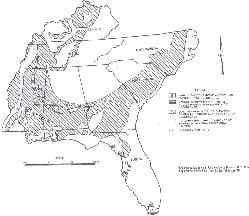 Figure 2. Distribution of potentially expansive materials in southeastern US.Copyright NOAA http://www.ngs.noaa.gov/PUBS_LIB/GeodeticBMs/
In certain areas of the U.S., the soil contains clay materials (see Figure 2). Clays in soil are responsible for most of the foundation failures affecting buildings, streets and other structures because clays can shrink or swell depending on the soil moisture content. This shrinking/swelling of clay-containing soils, referred to as expansive soils, is responsible for many of the observable signs of foundation damage and/or failure. In regions with these clays, geotechnical engineers are employed to determine the constituents of soils before construction projects are initiated.
One of the tests geotechnical engineers use to determine soil constituents is bulk density. Knowing the bulk soil density helps to determine the stability and suitability of a given soil as a foundational support. Bulk density soil measurements are exactly what they sound like: to determine the bulk density of a given soil, a geotechnical engineer calculates the density of the soil. The bulk density of a soil is measured as the mass of the soil per unit volume in g/cm3. Soil texture and structure determines soil bulk density (see Figure 3). Refer to the associated activity How Dense Are You Lab to have students investigate the desity of soils to determine the most suitable soil for a foundational support building. Fine textured soils such as silts and clays have less total pore space and lower bulk density than coarse soils such as sand. In general, the higher the bulk density of a soil the greater the support it provides for a foundation. Sandy soils are very stable and do not heave or consolidate with increased or decreased moisture. Sandy soil has the greatest bulk density of all soil components. Sandy soil with a small quantity of silt provides the greatest structural support for foundations.
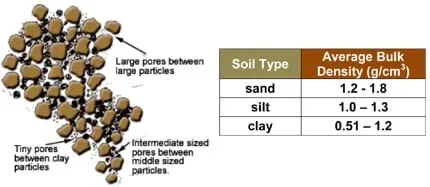 Figure 3. Pore space in clay, silt and sand. Average bulk density for soil types.Copyright (drawing) Western Australian State Government http://www.westone.wa.gov.au/toolbox6/hort6/html/resources/depot/hort_file/soil_struct/soil_struct.html
Texture is one of the first things determined when a soil is examined. Texture can be identified in the field by feeling the sand particles and estimating silt and clay content by flexibility and stickiness. No field mechanical-analysis procedure is as accurate as the fingers of an experienced person. To guide students in identifying soil constituents, refer to the attached Soil Identification Flow Diagram (PDF) to teach texture by the feel analysis. This requires students to perform tests to handfuls of soil, such as adding water, squeezing and rubbing, and then identify the soil type based on answers to questions about the tests performed. Possible soil types include: sand, loamy sand, sandy loam, sandy clay loam, sandy clay, silt loam, silty clay loam, silty clay, loam, clay loam, and clay.
Soils can be treated with lime, lime and concrete, fly ash and other materials to reduce the potential of the soil to heave, shrink, and/or swell. Lime treatment has been demonstrated to increase the stability, strength and reliability of problematic soils. Geotechnical engineers analyze soil materials to determine what percentage of lime is required to eliminate the difficulties observed with clay containing soils. This soil analysis increases observable success in foundation construction.
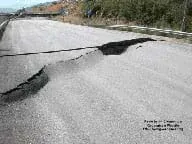 Figure 1. An example of severe pavement failure due to expansive soil.Copyright N. Oikonomidis, US Department of Transportation http://www.fhwa.dot.gov/engineering/geotech/pubs/05037/images/f014.gif
Have you ever seen cracks above a doorway or along the outside of a house? Have you ever tried to open a door or window that seemed to be stuck? Have you ever seen cracks in a concrete floor? Why do you think these problems occur? (Have students brainstorm ideas. Tell students that all of these issues are caused by foundation problems.) (Show students Figure 1.) Have you ever seen parts of a road that are heaved?
All of these issues have a common cause. Can you guess what it might be? (Listen to student ideas.) Each of these situations is most likely caused by poor soil compaction or other soil problems that result in damage to the concrete in a house foundation or to road pavement. As you will see today, geotechnical engineers who are responsible for identifying soil constituents can prevent, identify and repair these problems!
(Introduce students to geotechnical engineering and this lesson with a 10-minute video, an introduction to geotechnical engineering, available at: https://www.youtube.com/watch?v=xZZ2O1fOBVs)
- density
- Mass per unit volume of a substance.
- expansive soil
- Soils that show volumetric changes in response to changes in their moisture content.
- geotechnical engineering
- Branch of civil engineering concerned with the engineering behavior of earth materials; geotechnical engineering includes investigating existing subsurface conditions and materials; determining the physical/mechanical and chemical properties that are relevant to the project considered, assessing risks posed by site conditions; designing earthworks and structure foundations and monitoring site conditions, earthwork and foundation construction.
- mass
- The amount of matter in an object.
- physical property
- A property of a substance that can be measured or perceived without changing its identity.
- silt
- A sedimentary material consisting of particles smaller than sand and larger than clay. Silt is often found at the bottom of bodies of water where it accumulates slowly by settling through the water.
- soil pore space
- The total space not occupied by soil particles in a bulk volume of soil.
- volume
- The amount of space occupied by a three-dimensional object or region of space, expressed in cubic units.
Concluding Discussion: Before proceeding to conduct the associated activity, ask students the following questions to assess their understanding of the lesson:
- What is a common cause of cracked foundations that we talked about today? (Possible answers: Poor soil compaction, soil problems.)
- What type of engineer would help to identify, prevent and resolve foundation problems? (Possible answers: Geotechnical engineer, civil engineer, environmental engineer.)
- What does the term "expansive soil" refer to? (Answer: Soil that shrinks or swells, depending on its moisture content.)
- What soil constituent is most responsible for foundational problems? (Answer: Clay)
- What type of test do engineers often use to determine soil constituents? (Answer: Bulk density testing.)
- What is an example of units that could be used for density? (Possible answers: g/cm3, kg/m3, g/mL, kg/mL)
- What does density measure, and what is the equation for density? (Answer: mass per unit volume, d = m/v)
- What type of soil provides the best foundational support? (Answer: Sandy soil)
Al-Rawas, Amer Ali, A.W. Hago and Hilal Al-Sarmi. (2005) "Effect of lime, cement and sarooj (artificial pozzolan) on the swelling potential of an expansive soil from Oman," Building and Environment 40 (5): pp. 681-687. www.sciencedirect.com/science/article/pii/S036013230400215X
Avery, Timothy and John Hoobs. (2009) Introduction to Geotechnical Engineering for the GCEA. (10-minute video) Available from California Geotechnical Engineers Association, P.O. Box 1693, Placerville, CA 95667-1693.Produced by Hayward Baker. Also available online at https://www.youtube.com/watch?v=xZZ2O1fOBVs.
Basma, A.A. and E.R. Tuncer (1991) Effect of lime on volume change and compressibility of expansive clays," Transportation Research Record ,1295: pp. 52-61.
Birkeland, P.W. Soils and Geomorphology. New York, NY: Oxford University Press, 1984. pp. 14-15.
Blake, G.R. and K.H. Hartge. 1986. Bulk Density, in A. Klute, ed. Methods of Soil Analysis, Part I. Physical and Mineralogical Methods: Agronomy Monograph No. 9. (second edition), pp. 363-375.
Chepil, W.S. 1950. Methods of estimating apparent density of discrete soil grains and aggregates. Soil Science. 70: pp. 351-362.
Holtz, R. and W. Kovacs. An Introduction to Geotechnical Engineering, Prentice-Hall, Inc., 1981. ISBN 0-13-484394-0
Jones, D.E. and W. G. Holtz. (1973) "Expansive Soils – the Hidden Disaster," Civil Engineering, ASCE, 43: pp. 49-51.
Mowafy, Y.M., G.E. Baurer, and F. K. Sakeb. (1985) "Treatment of Expansive Soils: A Laboratory Study," Transportation Research Record1032: pp. 30-34.
Pedarla, A., S. Chi Hoori, A. Puppala, J. Anand, L.R. Hoyos, and S. Saride. (2010) "Influence of lime dosage on stalilizatio effectiveness of montmorrillonite dominant clays" " Geo Florida 2010: Advances in Analysis, Modeling, and Design. (GSP 199) 2010 ACE.
Silt. The American Heritage Science Dictionary. Houghton Mifflin Company. Accessed January 25, 2012. Via Dictionary.com http://dictionary.reference.com/browse/silt
Thien, S.J. 1979. A flow diagram for teaching texture by feel analysis. Journal of Agronomic Education. 8: pp. 54-55. Accessed January 25, 2012. http://soils.usda.gov/education/resources/lessons/texture/
Zhang, J. and C. Xing. (2002) "Stabilization of Expansive Soil by Lime and Fly Ash," Journal of Wuhan University of Technology, 17(4): pp. 73-77.
- How Dense Are You?
Contributors
Sherry L. Wright; Marissa H. Forbes
Supporting Program
Research Experience for Teachers (RET) Program, University of Texas at Arlington
Acknowledgements
The contents of this digital library curriculum were created through the University of Texas at Arlington's College of Engineering NSF RET grant. However, these contents do not necessarily represent the policies of the National Science Foundation, and you should not assume endorsement by the federal government.
Copyright
2013 by Regents of the University of Colorado; original © 2010 University of Texas