
Blood Pressure Basics
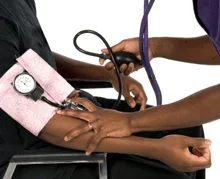 Checking blood pressure is essential in knowing the flow of blood through the heartCopyright U.S. Department of Health and Human Services, National Institutes of Health (NIH)
http://www.nih.gov/researchmatters/august2009/08032009bloodpressure.htm
Checking blood pressure is essential in knowing the flow of blood through the heartCopyright U.S. Department of Health and Human Services, National Institutes of Health (NIH)
http://www.nih.gov/researchmatters/august2009/08032009bloodpressure.htm
Students study how heart valves work and investigate how valves that become faulty over time can be replaced with advancements in engineering and technology. Learning about the flow of blood through the heart, students are able to fully understand how and why the heart is such a powerful organ in our bodies. Students then use their understanding to design and create a model heart valve using the associated activity.
In order to design medical devices, technologies and procedures, biomedical engineers must understand how the human body functions, as well as how disease and disorders affect the body. Once they have a thorough understanding of the unit challenge (as presented in Lesson 1) on which they are working, design solutions and choose the best one that fits their specifications. Then they test and revise their designs as needed in order to generate the best possible solution. Engineers use problem-solving skills every step of the way in designing things to improve our society.
After this lesson, students should be able to:
- Describe what blood pressure is and how high blood pressure can impact the cardiovascular system.
- Explain how heart valves work, as well as how they are related to blood pressure.
- Explain how the engineering design process is used to design, build, test, redesign and retest in order to develop a solution to a problem.
- STEL-1O Assess how similarities and differences among scientific, mathematical, engineering, and technological knowledge and skills contributed to the design of a product or system.
Grades 9-12
Do you agree with this alignment? - STEL-7AA Illustrate principles, elements, and factors of design.
Grades 9-12
Do you agree with this alignment?
- 3251.4.6 Describe the biochemical and physiological events associated with heart contraction, blood pressure, and blood clotting.
Grades 9-12
Do you agree with this alignment? - CLE 3251.4.2 Explore the anatomy of the heart and describe the pathway of blood through this organ.
Grades 9-12
Do you agree with this alignment? - CLE 3295.T/E.4 Describe the dynamic interplay among science, technology, and engineering within living, earth-space, and physical systems.
Grades 9-12
Do you agree with this alignment?
Students should know from the first lesson of this unit, Heart to Heart, how blood flows through the heart, that it leaves the heart under pressure, and that the heart contracts to move this blood through the circulatory system.
Lecture Information – Blood Pressure Basics
Present the Blood Pressure Basics Presentation (PPTX) to the class using the suggested script below:
Slide 1: Title: Blood Pressure Basics
Slide 2: Blood pressure is a useful diagnostic tool to assess health. Each time the heart pumps, blood is pushed into the arterial system with force. Blood pressure is the pressure that your blood exerts against your arteries as it is pumped through your body by the heart. The pressure in the arteries increases when the heart beats and decreases while it is resting. Since many heart diseases can be diagnosed through blood pressure, it is fortunate that it is easy and non-invasive to measure.
Slide 3: To measure blood pressure, two tools are used. One is a sphygmomanometer (blood pressure cuff) that fits over a person's arm and is inflated using an attached bulb. The purpose of the cuff is to temporarily stop blood flow. It also has a dial that measures pressure in the cuff. A valve lets air out of the cuff.
Slide 4: A stethoscope is the other tool used to measure blood pressure. It is an iconic medical tool used to amplify a patient's heartbeat as heard from the heart directly or as the pulse from an artery. When used with a blood pressure cuff, you can hear the blood flowing through the brachial artery (in the arm) in order to measure blood pressure.
Slide 5: To measure blood pressure, make sure the patient is seated comfortably with his/her arm supported at heart level. Wrap the blood pressure cuff around the patient's upper arm, about one inch above the elbow. Place the stethoscope just above the crease of the elbow. Quickly pump up the cuff to around 200 mmHg. While listening with the stethoscope, slowly open the valve to let the pressure fall. When you first hear the blood flow, that number is the systolic pressure. When you stop hearing the blood flow, that number is the diastolic pressure.
Slide 6: Blood pressure is measured in mmHg (millimeters of mercury) and given as a fraction:
systolic pressure / diastolic pressure
The systolic pressure measures the force generated on the arterial walls by the contraction of the ventricles (left ventricle is what is actually being measured). Diastolic pressure measures the time after the ventricles contract and the chambers of the heart are refilling with blood. For most adults, systolic pressure is considered normal when measured below 120, with 120-139 being considered pre-hypertensive and above 140 being considered hypertensive. A diastolic pressure of less than 80 is considered healthy.
Slide 7: Hypertension means abnormally high blood pressure. This includes a systolic pressure greater than 140 and a diastolic pressure of 90 or greater. Usually no symptoms are involved with hypertension, although it can be indicative of other health problems. Hypotension means abnormally low blood pressure. No specific blood pressure values are considered to be "low," but symptoms such as dizziness, blurred vision, nausea and fatigue may signify that a person's blood pressure is too low.
Slide 8: If this force is excessively high, especially for a long period of time, it can lead to health issues. High pressure puts stress on the arteries and increases the chances of an aneurysm forming or rupturing, and increases the chances that a clot or piece of plaque can be pushed into a smaller blood vessel (like a coronary artery) and cause a cerebrovascular accident (stroke) or myocardial infarction (heart attack). Hypertension can also lead to heart valve disease (which we will focus on solving in the upcoming activity). Inadequate exercise, poor diet and smoking can further compound the condition.
Biomedical engineers use the information provided by blood pressure measurements to help determine the forces that are exerted on the walls of arteries, as well as on the valves within and outside of the heart. Understanding these pressures provides a better picture of what is happening on the tissue level in the body, and a better understanding of why some valves become diseased over time.
Lecture Information – Heart Valves
(Note: Students will conduct their own research on artificial heart valves in the upcoming activity, so this information covers biological heart valves.) Human hearts have four valves: mitral valve, tricuspid valve, pulmonary valve and aortic valve. When blood enters or exits one of the four heart chambers, it always does so through a heart valve. The heart valves are one-way valves, meaning they only allow blood to travel in one direction. They open and close with the timing of the heart contractions, forcing blood to move along a given path.
Two main types of heart valve disease are identified. One type is valve stenosis, in which a heart valve can become stiff and calcified, or its leaflets may fuse together. When this happens, the valve will not fully open. The other type of heart valve disease is valve prolapse, in which a valve does not close properly. This could allow blood to leak backwards in the wrong direction through the heart valve. This regurgitation, or leaking, can become worse over time, causing the heart to work harder and harder to compensate for the leaking valve, and less blood may be pumped through the body. These conditions can eventually lead to symptoms such as shortness of breath, dizziness, heart palpitations, swelling of the ankles, feet or abdomen, weight gain and potentially fatal heart failure.
Heart valve disease is most commonly caused by one of the following: congenital valve disease (valves may be the wrong size, have malformed or incorrectly attached leaflets, or the tricuspid valve may be missing a leaflet), rheumatic fever, endocarditis (when bacteria enters the bloodstream and attacks the heart valves), coronary artery disease or a heart attack, cardiomyopathy, syphilis and high blood pressure. Other causes include aortic aneurysms, connective tissue diseases, tumors, some types of drugs and radiation.
(Note: Emphasize the connection between high blood pressure and heart valve disease in order to make a smooth transition from this lesson to its associated activity, Model Heart Valves.)
Lecture Information – Engineering Design Process
For the associated activity, it is important that students are well versed in the steps of the engineering process and understand the reason for each step in the process. See an overview of the engineering design process and an explanation of each step at https://www.teachengineering.org/engrdesignprocess.php.
Legacy Cycle Information
As an engineer, you find yourself in the Research and Revise phase of the legacy cycle, where you specifically explore different topics that may have some bearing on the Grand Challenge presented in Lesson 1. Since blood pressure is such an important component to heart and arterial health, it is beneficial for students to fully understand the principles behind what it is and how it is measured. This information eventually leads into heart valve issues, and ties into the Test Your Mettle phase of the legacy cycle.
(Note: While working on the subsequent activity, Model Heart Valves, students are in the Test Your Mettle phase of the legacy cycle. They may go through multiple design iterations until they come up with a model that functions when tested. Once their design has been tested, teams are expected to create an informational pamphlet advertising the design and testing of their models so that they can Go Public.)
In our previous activity (What's with All the Pressure?), we practiced one way to monitor the pressure exerted on the arteries leading away from the heart by taking blood pressure. We did this using a very simple-looking, yet vitally intricate, device called a sphygmomanometer—also called a blood pressure cuff, or a blood pressure monitor. We also left many questions unanswered, because we did not discuss exactly what we were measuring, what the measurements mean, as well as how blood pressure is related to heart valves and our overall cardiovascular health. Today we will go over information that should answer many of these questions, and we will conduct research to answer any remaining questions.
After researching and learning about the heart anatomy and blood flow through the body, you will investigate possible solutions to the Challenge Question (PDF), which is a problem faced by many people. In the associated activity, you will design, build and test a model heart valve to replace the defective one in our hypothetical "patient." If your first design does not perform as needed, you will redesign and rebuild your model. Once complete and tested, you must inform the world of your innovative design by creating an informational pamphlet explaining the functionality, effectiveness and benefits of your model.
First though, let's research what we need to know about designing an effective heart valve and what that has to do with our blood pressure that we measured in the last activity.
Congratulations! You have been presented with a problem that affects your grandmother, and learned how to research information that is vital to understanding this problem.
Next, you will design a solution to help her out, which means you have gone through a complete cycle of the engineering design process. You are well on your way to becoming a biomedical engineer.
- diastolic
- The period when heart is in relaxation and dilation; the bottom number of a blood pressure reading.
- sphygmomanometer
- A tool used to measure blood pressure (blood pressure cuff).
- stethoscope
- A tool used to listen to heart rate and pulse.
- systolic
- The period when the heart is contracting; the top number of a blood pressure reading.
Pre-Lesson Assessment
Building Motivation: From their memories of the previous activity, What's with All the Pressure?, have students write the procedure for taking blood pressure. Ask them to also write any questions they have about taking blood pressure, what blood pressure really means, and what it tells us about our health. Have each student write one question on the board. Save these questions for use during the lesson smmary assessment.
Lesson Summary Assessment
Working Out the Details: Review the questions students wrote on the board at the start of the class. Ask each question to the class, and call on students to answer the questions based on information they learned in the lesson. If any questions have not been answered, but could be answered with additional research, assign students to answer those questions through research.
Heart Valve Disease. WebMD, LLC. Accessed November 6, 2012. http://www.webmd.com/heart-disease/guide/heart-valve-disease
Horenstein, MN. Design Concepts for Engineers, 4th edition. New York, NY: Prentice Hall, 2010.
Shier, D., Butler, J. and Lewis, R. Hole's Human Anatomy & Physiology, Eleventh Edition. New York, NY: McGraw Hill Higher Education, 2007.
Contributors
Michael Duplessis; Janet Yowell; Carleigh Samson; Victoria Lanaghan
Supporting Program
VU Bioengineering RET Program, School of Engineering, Vanderbilt University
Acknowledgements
The contents of this digital library curriculum were developed under National Science Foundation RET grant nos. 0338092 and 0742871. However, these contents do not necessarily represent the policies of the NSF, and you should not assume endorsement by the federal government.
Copyright
2013 by Regents of the University of Colorado; original © 2011 Vanderbilt University