
Earthquakes Living Lab: Designing for Disaster
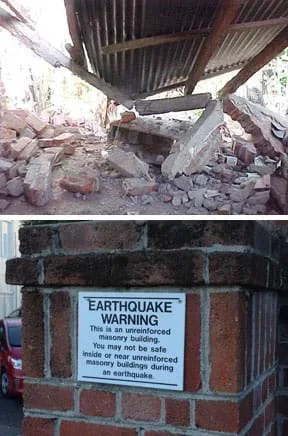 An earthquake caused this school in El Salvador to collapse. This sign on a café in Sausalito, CA, warns of the danger of unreinforced masonry buildings.Copyright (top) 2004 U.S. AID via Wikimedia Commons; (bottom) 2013 Denise W. Carlson. Used with permission. http://commons.wikimedia.org/wiki/File:Egepg1.jpg
Students learn about factors that engineers take into consideration when designing buildings for earthquake-prone regions. Using online resources available through the Earthquakes Living Lab, students explore the consequences of subsurface ground type and building height on seismic destruction. Working in pairs, students think like engineers to apply what they have learned to sketches of their own building designs intended to withstand strong-magnitude earthquakes. A worksheet serves as a student guide for the activity.
Engineers often use data collected from measurement tools to analyze powerful events such as earthquakes. From seismographs, engineers and researchers determine the strength or magnitudes of earthquakes, from which they can make predictions. The magnitude and type of shaking affects how structures respond. Engineers must consider earthquake potential when designing new structures or evaluating the safety of existing structures. Most structures have a foundation, or a method for supporting the structure in the ground. To design adequate foundations, engineers must understand the properties of the materials on which they are building, which includes studying the geology of the Earth. For large construction projects, especially those near faults and coastlines, engineers consider the effects of plate tectonics and the Earth's structure. If one tectonic plate suddenly slips with respect to another plate, it can trigger a massive earthquake and/or tsunami.
Scientists and engineers around the globe gather data through observation and experimentation and use it to describe and understand how the world works. The Earthquakes Living Lab gives students the chance to track earthquakes across the planet and examine where, why and how they are occurring. Using the real-world data in the living lab enables students and teachers to practice analyzing data to solve problems and answer questions, in much the same way that scientists and engineers do every day.
After this activity, students should be able to:
- Describe examples of the types of damage caused by earthquakes.
- Describe how engineers design buildings to resist earthquakes.
- Examine what subsurface materials are most and least likely to result in significant damage from earthquakes.
- Major geologic events such as earthquakes, volcanic eruptions, mid-ocean ridges, and mountain formation are associated with plate boundaries and attributed to plate motions
Grade 7
Do you agree with this alignment? - Gather, analyze, and communicate an evidence-based explanation for the complex interaction between Earth's constructive and destructive forces
Grade 6
Do you agree with this alignment?
- STEL-6D Engage in a research and development process to simulate how inventions and innovations have evolved through systematic tests and refinements.
Grades 6-8
Do you agree with this alignment? - STEL-6E Verify how specialization of function has been at the heart of many technological improvements.
Grades 6-8
Do you agree with this alignment?
- MS-ESS3-2 Analyze and interpret data on natural hazards to forecast future catastrophic events and inform the development of technologies to mitigate their effects.
Grades 6-8
This resource focuses on the following Three Dimensional Learning aspects of NGSS:
Science & Engineering Practices- Construct an oral and written argument supported by empirical evidence and scientific reasoning to support or refute an explanation or a model for a phenomenon or a solution to a problem.Do you agree with this alignment?
Disciplinary Core Ideas- Mapping the history of natural hazards in a region, combined with an understanding of related geologic forces can help forecast the locations and likelihoods of future events.Do you agree with this alignment?
Crosscutting Concepts- The uses of technologies and any limitations on their use are driven by individual or societal needs, desires, and values; by the findings of scientific research; and by differences in such factors as climate, natural resources, and economic conditions. Thus technology use varies from region to region and over time.Do you agree with this alignment?
- Graphs, charts, and images can be used to identify patterns in data.Do you agree with this alignment?
Do you agree with this alignment? - Construct an oral and written argument supported by empirical evidence and scientific reasoning to support or refute an explanation or a model for a phenomenon or a solution to a problem.
Each group needs:
- computer or other device with Internet access
- journal or writing paper for each student
- pen or pencil, one per student
- Designing for Disaster Worksheet (PDF), one per group
What happens when two tectonic plates suddenly slip past one another? (See if students know.) That's right, an earthquake occurs. The slipping causes shaking, or vibration in the form of surface and body waves. The seismic waves travelling through the Earth can damage human-made structures such as roadways, buildings and pipelines. What can we do about it?
For regions that are prone to earthquakes, engineers can design structures to resist or withstand the forces generated by earthquakes. How would you do this? (Listen to student ideas?) Some structures are engineered to be stronger or stiffer, while other structures are engineered to react to earthquake forces by being more flexible and bending.
Engineers also take into consideration the subsurface soil and rock properties when designing the foundations for structures that will be located in areas where earthquakes occur. Some subsurface ground types are more susceptible to shaking from earthquakes than others. Let's learn more about this.
Before the Activity
- Make copies of the Designing for Disaster Worksheet (PDF), one per group. The worksheet serves as a student guide for the activity.
- Make arrangements so that each student group has a computer with Internet access.
- Setup a free account (username and password) in order to access the National Geographic's Forces of Nature interactive simulation (for the Explore section of the worksheet).
- Decide whether to have students work together in one journal or keep individual journals.
With the Students
- Divide the class into student pairs, and have them assemble at their computers with journals/paper and writing instruments.
- Hand out the worksheets to the groups and direct them to read through the instructions.
- Before looking at the Earthquakes Living Lab, have pairs complete the Engage section of the worksheet:
- Look around your classroom. Name one thing that may fail or break during an earthquake.
- Overall, do you think your school is prepared to withstand an earthquake? Explain why or why not.
- Get the teams started by guiding them to the Earthquakes Living Lab via the living lab website at http://www.teachengineering.org/livinglabs/index.php. Have them scroll down to the Earthquakes Living Lab section (see Figure 1). Tell students that this activity is designed around the Earthquakes Living Lab, a resource and online interface that uses real-time, real-world seismic data gathered from around the world.
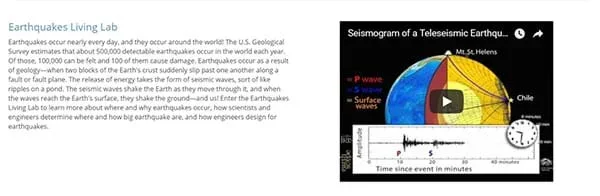 Figure 1. The entry web page for the Earthquakes Living Lab.
 - Have students select the Earthquakes Living Lab hyperlink in the top left in the earthquakes section. On the main page of the Earthquakes Living Lab website (see Figure 2), note the focus on four active seismic areas, each based on historic earthquakes. For this activity, select the fourth option, the "San Francisco" box (see Figure 2).
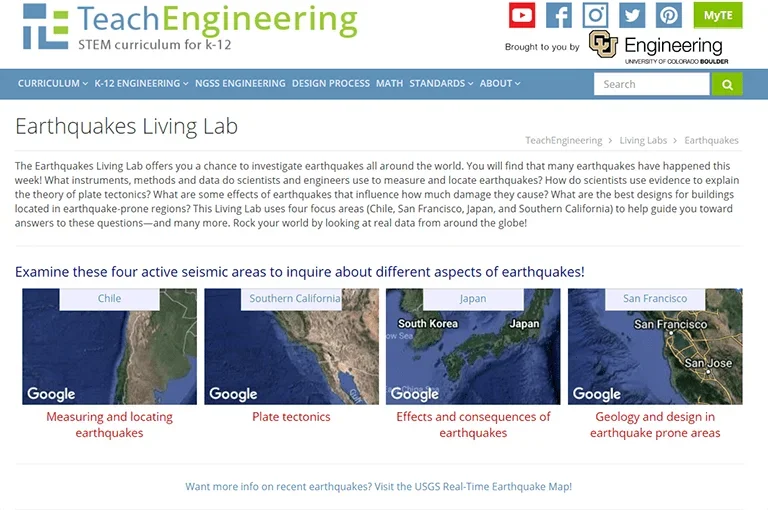 Figure 2. The main page of the Earthquakes Living Lab website. Note the San Francisco box.
 - Guide students to the seventh (last) link on the page, "How do engineers use models and earthquake simulations to test designs for earthquake-resistant buildings and structures?" and have them watch the five-minute video (Video recap: Researchers use the world's largest "shake table" to test new construction methods for buildings in areas prone to earthquakes.)
- From what they learned in the video, have student answer the first question in the Explore section by recording one type of test that researchers conduct and one design component engineers may use in buildings that experience seismic activity.
- Have students move on to get an in-depth look into why earthquakes occur and an earthquake simulation to see a demonstration of different magnitude earthquakes: https://youtu.be/RqqqSnaTfQo
- After watching the video and digesting the information, have students answer the fifth question in the Explore section: Note one thing that failed during an earthquake.
- Direct students to the fourth link on the San Francisco Earthquakes Living Lab page, titled "How do earthquakes affect buildings?" to watch a simulation of how earthquakes affect buildings. Go to the USGS link at https://www.usgs.gov/media/videos/shaking-frontier-building-anchorage-alaska-during-mw71-earthquake-january-24-2016. Have students write down two new details they learned from this video on how earthquakes affect buildings.
- To explore the different effects of a soil type on earthquake damage, direct students to read the following article: https://www1.wsrb.com/blog/the-effects-of-soil-type-on-earthquake-damage. Have them answer the following questions:
- Which type of ground soil would result in the least amount of damage to buildings?
- Name at least 3 other factors that have an effect on an earthquakes’ damage.
- Return to the San Francisco Earthquakes Living Lab page, have students select the sixth link titled, "How do engineers design buildings that withstand the forces of earthquakes?" at https://www.exploratorium.edu/explore/seismic-science/engineering. Have students read the Exploratorium Seismic Engineering article about the importance of design, construction materials and location, especially the "Location, location, location" section, and then briefly compare the impact of seismic waves on structures built on solid rock vs. on softer soils.
- After having read the entire Faultline "Damage Control: Engineering" information about engineering design principles related to earthquakes, have students answer the Explain question: If you were to design a building in an earthquake area, what factors would you consider to result in the least amount of damage?
- Elaborate: To conclude the worksheet, direct students to summarize what they learned about important considerations and how to design buildings in earthquake-prone areas: Thinking as engineers, draw a sketch of a building that could withstand a strong earthquake and explain your key design features.
- earthquake
- A natural destructive event that occurs when two tectonic plates suddenly slip past one another, creating seismic waves.
- seismic wave
- A wave of energy created by an earthquake that travels through the Earth's layers.
- subsurface
- Earth material (such as rock) that is near but not exposed at the surface of the ground.
- tectonic plates
- Large sections of the Earth's crust (lithosphere) that move, float and sometimes fracture and whose interaction causes much of the planet's seismic activity as well as continental drift, earthquakes, volcanoes, mountains and oceanic trenches.
Pre-Activity Assessment
Introduction: For the Engage section of the Designing for Disaster Worksheet (PDF), have students 1) look around the classroom and identify one thing that may be unsafe in an earthquake, and 2) think about whether or not the school building would be safe during an earthquake.
Activity Embedded Assessment
Exploring Earthquake Design: As part of completing the worksheet (PDF), students turn in summaries of their findings about designing earthquake-resistant buildings. Gauge their understanding by leading a class discussion: What ground material is best for building on? What foundations are best? What are some other hazards that must be taken into account? (For example, likelihood of tsunamis, ground susceptibility to liquefaction.)
Post-Activity Assessment
Extra Exploration: To wrap up the worksheet (PDF), students think about their own design ideas and draw their own building sketches for earthquake-proof constructions. Have students share their key design ideas with the class, or grade them individually.
Have students explore the other two regions in the Earthquakes Living Lab (Japan and Chile).
Assign students to explore historical earthquakes or buildings designed specifically for withstanding earthquakes.
Have student pairs build off their research and simulations experience by making their own model structures for testing, as described at the IDEERS Earthquake Engineering Competition website at http://www.ideers.bris.ac.uk/comp/comp_home.html. The instructions specify that models be made from MDF board, paper, glue and string, be four stories high on a limited footprint and be able to carry 7.5 kg or more, but could modified as desired. Click on the rules (materials, structure and vertical load) to get started. The website also includes model-making techniques (construction tips, bracing hints, etc.) Alternatively, have students conduct the Shake It Up! Engineering for Seismic Waves activity, during which they design and build shake tables to test their own model buildings made of toothpicks and mini marshmallows.
- For lower grades, skip the Elaborate worksheet section and/or conduct the activity as a class.
- For upper grades, have students work individually and/or have them include both good and bad earthquake-proof design sketches on their worksheets.
As part of the activity (Explore section of the worksheet), show students the five-minute Science Nation Earthquake Testing video at the Windows to the Universe website at https://www.youtube.com/watch?v=7hoSqazNmfY.
Contributors
Mike Mooney; Minal Parekh; Scott Schankweiler; Jessica Noffsinger; Karen Johnson; Jonathan Knudtsen
Supporting Program
Civil and Environmental Engineering Department, Colorado School of Mines
Acknowledgements
This curriculum was created with the support of National Science Foundation grant no. DUE 0532684. However, these contents do not necessarily represent the policies of the National Science Foundation, and you should not assume endorsement by the federal government.
Copyright
2013 by Regents of the University of Colorado; original 2013 Colorado School of Mines