
Shake It Up! Engineering for Seismic Waves
Students learn about how engineers design and build shake tables to test the ability of buildings to withstand the various types of seismic waves generated by earthquakes. Just like engineers, students design and build shake tables to test their own model buildings made of toothpicks and mini marshmallows. Once students are satisfied with the performance of their buildings, they put them through a one-minute simulated earthquake challenge.
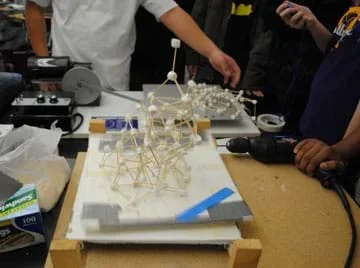 Students, like engineers, use shake tables that simulate the movement of seismic waves to test the resistance of their model building structures to earthquake shaking.
In certain areas of the world, earthquakes are a serious concern. Civil and structural engineers who focus on designing buildings, bridges, roads and other infrastructure for earthquake-prone areas must understand seismic waves and how to construct structures that are able to withstand the forces from the powerful ground motions of the Earth. For testing purposes, engineers design shake tables to simulate (or re-enact) the seismic waves produced by earthquakes and verify the stability and survivability of their structures.
After this activity, students should be able to:
- Explain the four different types of seismic waves produced by earthquakes.
- Describe the purpose of shake tables and how engineers use them.
- 6.1.1.c.iii Solve unit rate problems including those involving unit pricing and constant speed.
Grade 6
Do you agree with this alignment?
- Compare and contrast different types of waves
Grade 8
Do you agree with this alignment?
- CCSS.Math.Content.6.RP.A.3b Solve unit rate problems including those involving unit pricing and constant speed.
Grade 6
Do you agree with this alignment? - CCSS.Math.Practice.MP5 Use appropriate tools strategically.
Grades K-12
Do you agree with this alignment?
- Students will develop an understanding of the attributes of design.
Grades K-12
Do you agree with this alignment? - Students will develop an understanding of engineering design.
Grades K-12
Do you agree with this alignment? - Students will develop abilities to assess the impact of products and systems.
Grades K-12
Do you agree with this alignment? - Requirements for design are made up of criteria and constraints.
Grades 6-8
Do you agree with this alignment? - STEL-7J Evaluate designs based on criteria, constraints, and standards.
Grades 3-5
Do you agree with this alignment? - STEL-7Q Apply the technology and engineering design process.
Grades 6-8
Do you agree with this alignment?
- MS-ETS1-1 Define the criteria and constraints of a design problem with sufficient precision to ensure a successful solution, taking into account relevant scientific principles and potential impacts on people and the natural environment that may limit possible solutions.
Grades 6-8
This resource focuses on the following Three Dimensional Learning aspects of NGSS:
Science & Engineering Practices- Define a design problem that can be solved through the development of an object, tool, process or system and includes multiple criteria and constraints, including scientific knowledge that may limit possible solutions.Do you agree with this alignment?
Disciplinary Core Ideas- The more precisely a design task's criteria and constraints can be defined, the more likely it is that the designed solution will be successful. Specification of constraints includes consideration of scientific principles and other relevant knowledge that is likely to limit possible solutions.Do you agree with this alignment?
Crosscutting Concepts- The uses of technologies and any limitations on their use are driven by individual or societal needs, desires, and values; by the findings of scientific research; and by differences in such factors as climate, natural resources, and economic conditions.Do you agree with this alignment?
- All human activity draws on natural resources and has both short and long-term consequences, positive as well as negative, for the health of people and the natural environment.Do you agree with this alignment?
Do you agree with this alignment? - Define a design problem that can be solved through the development of an object, tool, process or system and includes multiple criteria and constraints, including scientific knowledge that may limit possible solutions.
- MS-ETS1-2 Evaluate competing design solutions using a systematic process to determine how well they meet the criteria and constraints of the problem.
Grades 6-8
This resource focuses on the following Three Dimensional Learning aspects of NGSS:
Science & Engineering Practices- Evaluate competing design solutions based on jointly developed and agreed-upon design criteria.Do you agree with this alignment?
Disciplinary Core Ideas- There are systematic processes for evaluating solutions with respect to how well they meet the criteria and constraints of a problem.Do you agree with this alignment?
Do you agree with this alignment? - Evaluate competing design solutions based on jointly developed and agreed-upon design criteria.
Each group needs:
- 1 shoebox
- 1 wooden board (sized to fit in the bottom of the shoebox with room to move in all directions)
- 10 marbles
- 20 Popsicle sticks
- 10 rubber bands
- string, ~50 cm to 1m in length
- hot glue gun and 3 glue sticks
- 1 sandwich bag of mini marshmallows
- toothpicks, a handful or unlimited, depending on materials limitations imposed by teacher
- Shake It Up! Activity Worksheet (PDF), one per person
To share with the entire class:
- duct tape
- masking tape
- scissors and/or box cutters
- stopwatch
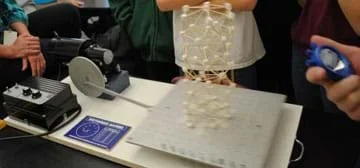 Final model building designs being tested on a drill-powered shaker table.Copyright 2010 Carleigh Samson, ITL Program, University of Colorado Boulder
To build the teacher's shake table (optional):
- Build a drill-powered shake table shake table; follow instructions at https://discovere.org/wp-content/uploads/2021/11/DB_Exhibit_Shake-Table-DCE_022117.pdf
- Alternatively, if you do not want to build the drill-powered shake table, you can construct a simpler one following instructions at https://pbskids.org/designsquad/build/seismic-shake-up/. Or, have the class select the best shake table from all the groups and use that one for the one-minute earthquake challenge testing.
- Alternatively, the engineering colleges at some universities make available their shake tables for use by outside student groups for academic purposes.
Students should be able to measure length with a ruler, and have an understanding of seismic waves (as provided in the associated lesson).
How many different kinds of waves can you think of? (Listen to student suggestions and add others. For example, electromagnetic [light, radio], sound, ocean [water], seismic, pressure, compression, standing and sine waves.) No matter what kind of wave, what do they have in common? (Draw a wave on the board and identify its parts.) That's right: amplitude, wavelength, crest, trough, frequency.
What types of waves do we associate with earthquakes? That's right, seismic waves. Seismic waves are waves that move through the Earth, and are typically created by earthquakes. For all seismic waves, the amplitude or intensity of the wave is dependent on three things:
- The depth at which the earthquake took place (the closer to the surface, the greater the amplitude of the wave)
- The intensity of the earthquake (earthquakes with higher Richter scale ratings produce more intense seismic waves)
- The composition of the Earth's crust
The people who work in "earthquake engineering" focus on protecting us and the natural and human-built environments from earthquakes. They want to limit our risk of death and damage from earthquakes. How can we possibly make sure that our school or stadium or a skyscraper or a freeway overpass will not collapse in a big earthquake? Well, engineers create shake tables to test the ability of buildings and other structures to withstand the seismic waves produced by earthquakes. To do this, they carefully design and construct shake tables that can accurately re-enact the ground motion of the Earth during earthquakes. Sometimes they test full-size buildings and sometimes they test small-scale model buildings or components. Some shake tables are large enough to put a real-size building on; others are smaller, even tabletop size. By doing this, engineers can test materials, designs, and construction methods to develop building codes and best practices that provide people living in earthquake-prone areas with safe and survivable surroundings.
Engineers must understand everything about the various seismic waves produced during earthquakes and how they cause the Earth to move. Who can tell me the four types of seismic waves that engineers need to simulate? They are:
- P-waves (or primary waves, a type of body wave)
- S-waves (or secondary waves, a type of body wave)
- Love waves (a type of surface wave)
- Rayleigh waves (a type of surface wave)
What do you know about these different types of seismic waves? How are they different from each other? P-waves and S-waves are body waves, which travel through the body of the Earth. P-waves are the fastest of all the seismic waves and can travel through any medium, although they move through solids faster than through liquids and gases. P-waves vibrate the parallel to Earth or in the direction of their propagation. They are similar to a compression wave moving through a slinky. S-waves are the second fastest type of seismic waves, and they can only move through solids. S-waves are transverse or shear waves and move the Earth perpendicular to the direction of propagation. Both P-waves and S-waves are types of body waves and travel through the interior of the Earth.
Love waves and Rayleigh waves are surface waves, which travel along the surface of the ground. In general, surface waves are slower than body waves—and more destructive. Love waves cause a horizontal shifting of the Earth perpendicular to the wave propagation. Rayleigh waves are a type of sinusoidal wave and move like ocean waves. They are produced by the interaction of P-waves and S-waves. Rayleigh waves are the slowest of all the seismic waves with a speed approximately equal to 3 km/second.
Smart design and testing make buildings resistant to the seismic wave movement of earthquakes. A properly engineered structure does not necessarily have to be extremely strong or expensive, but it must be correctly and intelligently designed to withstand the seismic effects while sustaining an acceptable level of damage. What are your ideas? Let's create our own shaker tables and model buildings to test them.
Before the Activity
- Gather materials and make copies of the Shake It Up! Activity Worksheet (PDF).
- Build the teacher's shake table that uses a variable speed drill to create the shaking movement. Or, if you do not want to build the drill-powered shake table, at the end, have the class select the best shake table from all the groups and use that one for the earthquake challenge.
With the Students
- Show students the available materials. Point out that this project follows the steps of the engineering design process: understand the need (requirements, objective), brainstorm different design solutions, select the most promising design, plan (strategy, drawings, measurements, materials), create and test, and improve to make the best solution possible.
- Identify a few design requirements and constraints:
- For the shake tables, a wooden board must serve as a base that can move around to simulate the ground movement during an earthquake. The goal is to create shake tables that move in ways that resemble the different types of seismic waves. For example, movement could be the back and forth motion of a P-wave or a more destructive rocking type movement representing a surface wave. Also design a way to control the shake table from outside of the box (so your hands are not in the box where the model building will be located).
- The model buildings must be made only from toothpicks and marshmallows, and be at least one-foot (.3 m) tall. (Consider imposing a materials limitation to make the project more challenging.) Its base will be taped to the wooden board for testing.
- Hand out the worksheets to students. Give them time to independently design and draw their shake tables and buildings, as instructed on page 1 of the worksheet. If possible, assign this as homework the night before so students have a chance to develop their own ideas before coming together in teams to determine the most promising designs.
(Note to teacher: If students need more clarification of the movement generated by the four seismic wave types, refer to the PowerPoint presentation in the associated lesson. Tips: It is a challenge to make the student shake tables really replicate all four wave movements; it is easiest to focus on the P-waves and surface waves. To replicate P-waves, students must find ways to move the board back and forth along a horizontal plane. To replicate surface waves, students must find ways to move the board in a more up-and-down, lopsided fashion. Placing marbles under a board enable it to slide back and forth, and using different-sized marbles generates a more "surface wave" type motion. To control the shake tables, it helps to cut access holes in the sides of the box, and/or adhere string or Popsicle sticks to the box and its components.)
- Divide the class into groups of three or four students each.
- Ask students in each group to brainstorm ideas, starting by sharing their individual ideas. Have each team choose one design to construct for its shake table. In the spirit of true brainstorming, encourage teams to combine and compromise their ideas to come up with creative solutions. (Review brainstorming guidelines at http://www.cs.unb.ca/profs/fritz/cs3503/storm35.htm.)
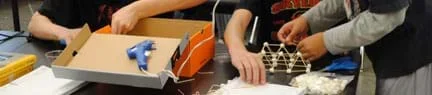 Students learn about the distinctly different movements of various types of seismic waves as they build shake tables from shoeboxes to test the strength of model buildings.Copyright 2010 Carleigh Samson, ITL Program, University of Colorado Boulder
- Provide students with materials and give them time to construct their shake tables—a minimum of 30 minutes for construction is suggested.
- Once shake tables are completed, have groups brainstorm ideas for their model building structures that use only mini marshmallows and toothpicks as the materials. Require that the buildings be at least one-foot (.3 m) tall. Have teams each agree upon a final design that they will construct.
- Give students time to construct their model buildings, and then use their own shake tables to test and modify (improve) the designs. Point out that the testing-improving-testing process is an important part of the bigger engineering design process. That's how weaknesses are discovered and problems solved—before you have an actual earthquake! Emphasize that in the upcoming earthquake challenge they will have only one chance to put their final building designs through a "real earthquake" test to see if they survive, so they must be certain that their buildings are survivable. What works? What doesn't? What could be improved? Test, test, test!
- Earthquake Challenge: Once teams have one-foot tall structures and are satisfied with their stability and robustness, put the structures through a one-minute simulated earthquake challenge in which every team uses the same shaker table—either the teacher's shake table (that uses a variable speed drill to shake the table), or the best of the teams' shake tables, as agreed-upon by the class.
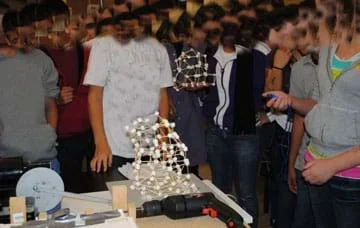 Students testing model buildings on a shake table that simulates the movement of an earthquake.Copyright 2010 Carleigh Samson, ITL Program, University of Colorado Boulder
- Have one student use a stopwatch to time how long each building survives the earthquake simulation. Remind groups to be ready to record the length of time their buildings lasted, the end building heights, as well as observations about how the building structures behaved under the shaking conditions. Have students watch all team tests to gather observations that they will use to finish the worksheet questions.
- Failure: If the building collapses or any part of the building besides its base touches the shake table, consider it failed, and note the time and stop the shake table. The building is not earthquake-safe for people. Once the shake table is off, measure the height of the building.
- Success: If the building survives for a full minute and is still one-foot tall, consider it a success—the group has engineered a solution to the challenge and is "hired" to design real buildings for their community. Record measurements and observations.
- Have students complete the concluding worksheet questions, incorporating what they learned from observing their own and other groups' model building behavior under seismic stress. Have them draw conclusions about the relationship between the appearance of the structure and its building strategies, and its performance. If time permits, lead a class discussion using the concluding questions (see the Investigating Questions section) so students can hear each others' opinions and ideas.
- body wave
- A seismic wave that travels through the Earth rather than across its surface.
- engineering design process
- A series of steps used by engineering teams to guide them as they solve problems: define the problem, come up with ideas (brainstorming), select the most promising design, plan and communicate the design, create and test the design, and evaluate and revise the design. Also called the design-build-test loop.
- love wave
- A surface seismic wave that cause horizontal shifting of the Earth during an earthquake.
- model
- (noun) A representation of something for imitation, comparison or analysis, often on a different scale. (verb) To simulate, make or construct something to help visualize or learn about something else (such as a product, process or system).
- p-wave
- A seismic pressure wave that travel through the body of the Earth. The fastest of all seismic waves.
- rayleigh wave
- A surface seismic wave generated by the interaction of P-waves and S-waves at the surface of the Earth that move with a rolling motion.
- s-wave
- A shear or transverse body seismic wave, with motion perpendicular to the direction of wave propagation.
- seismic wave
- A wave of energy that travels through the Earth as a result of an earthquake.
- shake table
- A device for shaking structural models or building components. The movement simulates the ground motions of earthquakes. Also called a shaking table.
- simulation
- Imitating the behavior of some situation or process, especially for the purpose of study or experimental testing.
- surface wave
- A seismic wave that travels across the surface of the Earth as opposed to through it. Surface waves usually have larger amplitudes and longer wavelengths than body waves, and they travel more slowly than body waves.
Pre-Activity Assessment
Design Section of the Worksheet : As either pre-activity homework or the first task of the activity, assign students to complete their own designs for shake tables and model building structures, including drawings, measurements, material specifications and explanations of how the designs function. Require that students describe which types of seismic waves their shake tables will produce and how those types of seismic waves move the Earth.
Activity Embedded Assessment
Observations and Questioning: During the activity, move around the classroom to observe students and ask them questions about what they are doing to determine how well they understand the activity. Ask individual students to explain what the group is working on, their strategies, what type of seismic waves their shake table creates, etc.
Post-Activity Assessment
Conclusion Section of the Worksheet and Class Discussion: Review students' answers to the Shake It Up! Worksheet (PDF)questions to gain an understanding of why they think certain structures performed better than others. See whether or not students thought the ability of their shake tables to accurately represent seismic waves helped in the evolution of their building designs. Explore the questions in a class discussion format so that students can hear each others' opinions and ideas (see the Investigating Questions section).
- Review safety precautions for using glue guns and box cutters.
Make sure students test, revise and improve the integrity of their structures using their own shake tables. If this is not emphasized, students may just build a shake table and a structure, and move directly to the "real earthquake" without the learning that comes from the testing/redesign cycle.
Now that students have completed their own trial and error experimenting, have them research the real-world design and construction strategies being used to make earthquake-resistant structures. Have students investigate and report back to class on earthquake engineering strategies for both new and existing structures of all types. Start by researching seismic base isolation, seismic vibration control and earthquake-resistant construction.
- For lower grades or younger students, skip the team construction of shake tables altogether. Give students the challenge of building a structure that is at least 1 foot tall with only mini marshmallows and toothpicks, and only have them test on a common shake table provided by the teacher. Allow students to create more than one structure so they have the opportunity to radically alter their designs and recognize building strategies that work best. Also, provide different materials, such as gum drops, pipe cleaners or dry spaghetti, so they can test to see if some materials work better than others.
- For upper grades or older students, offer more advanced materials for the team shake table construction, such as foam core board, wood, saws, drills and drill bits, and drills to power them. If desired, make the objective of the activity to create shake tables that most accurately represent a given seismic wave type or one that proves to be the most destructive . To test which shake table is the most destructive, have students each follow a set of instructions to build the same building. Then time how long it takes for each shake table to destroy the building, with the goal to have the lowest time.
For good descriptions and drawings of seismic waves types, see Michigan Tech's UPSeis web page at http://www.geo.mtu.edu/UPSeis/waves.html
Find more information on earthquakes, earthquake engineering, earthquake shaking table, Love wave, P-wave, Rayleigh wave, S-wave, seismic wave, and wave at https://en.wikipedia.org/wiki/Main_Page
Show students a 43-second video showing a comparative test of two 12-floor model towers under earthquake simulation, one with seismic base isolation in place and one without. See Earthquake Protector: Shake Table Crash Testing at https://www.youtube.com/watch?v=kzVvd4Dk6sw&feature=related
World's Largest Earthquake Shake Table Test in Japan. Simpson Strong-Tie Company, Inc. Accessed April 20, 2011. (Article and a five-minute video show a full-scale seven-story wood-framed condominium tower being tested on world's largest shake table in July 2009, where it survived a 7.5 magnitude earthquake simulation with minor damage) http://www.strongtie.com/about/research/capstone.html?source=hpnav
- Seismic Waves: How Earthquakes Move Through the Earth
- Shake It Up! Engineering for Seismic Waves
Contributors
Carleigh Samson; Stephanie Rivale; Denise W. Carlson
Supporting Program
Integrated Teaching and Learning Program, College of Engineering, University of Colorado Boulder
Acknowledgements
The contents of this digital library curriculum were developed under a grant from the Fund for the Improvement of Postsecondary Education (FIPSE), U.S. Department of Education, and National Science Foundation GK-12 grant no 0338326. However, these contents do not necessarily represent the policies of the Department of Education or National Science Foundation, and you should not assume endorsement by the federal government.
Copyright
2010 by Regents of the University of Colorado.