
Seismic Waves: How Earthquakes Move Through the Earth
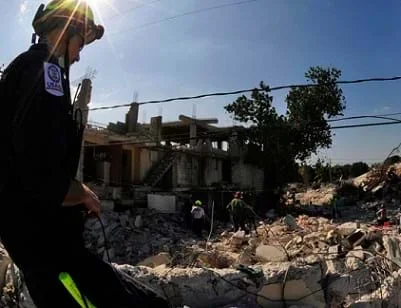 A member of the Virginia Task Force 1 Urban Search and Rescue Team surveys the destruction caused by a 7.0 earthquake in Port-au-Prince in January 2010, before continuing recovery efforts.Copyright 2010 Aaron Shelley, U.S. Navy http://commons.wikimedia.org/wiki/File:US_Navy_011020-N-6006S-083_A_Member_of_the_Virginia_Task_Force_1_Urban_Search_and_Rescue_Team_surveys_the_destruction_caused_by_the_recent_earthquake_in_Port-au-Prince.jpg
Students learn about the types of seismic waves produced by earthquakes and how they move through the Earth. The dangers of earthquakes are presented as well as the necessity for engineers to design structures for earthquake-prone areas that are able to withstand the forces of seismic waves. Students learn how engineers build shake tables that simulate the ground motions of the Earth caused by seismic waves in order to test the seismic performance of buildings.
Earthquake engineering focuses on protecting people and the natural and human-made environments from earthquakes by limiting seismic risk. This involves applying an understanding of seismic waves in order to create and maintain structures and urban infrastructure to perform to expectations when under duress from seismic loading due to seismic waves. A properly engineered structure does not necessarily have to be extremely strong or expensive; it has to be properly designed to withstand the seismic forces while sustaining an acceptable level of damage.
After this lesson, students should be able to:
- Describe waves using appropriate vocabulary: amplitude, crest, trough, wavelength, frequency.
- Describe the relationship between the wavelength and frequency of a wave.
- Explain the different types of seismic waves and how they move through the Earth.
- Explain the role of shake tables for engineers who design structures to withstand the motions caused by seismic waves.
- Describe for various waves the amplitude, frequency, wavelength, and speed
Grade 8
Do you agree with this alignment?
- Students will develop an understanding of the relationships among technologies and the connections between technology and other fields of study.
Grades K-12
Do you agree with this alignment?
- DCI.PS4.A.6-8.4 A simple wave has a repeating pattern with a specific wavelength, frequency, and amplitude.
Grades 6-8
Do you agree with this alignment?
- Engineering & Waves: Seismic Waves Presentation (pptx)
- Engineering & Waves: Seismic Waves Presentation (pdf)
- Engineering & Waves: Seismic Waves PPT Worksheet (doc)
- Engineering & Waves: Seismic Waves PPT Worksheet (pdf)
- Waves, Waves, Waves Quiz (doc)
- Waves, Waves, Waves Quiz (pdf)
- Waves, Waves, Waves Quiz Answers (doc)
- Waves, Waves, Waves Quiz Answers (pdf)
- Earthquake Destruction (48-second video) (wmv)
- Earthquake Waves (2:50-minute video) (wmv)
- Earthquake Shake Table Rocks Building (2:51-minute video) (wmv)
Generally know about the Richter magnitude scale, which indicates the intensity of earthquakes on a 1 to 10 (base-10 logarithmic) scale.
After the introduction, show students the Engineering & Waves: Seismic Waves Presentation (PPTX). The information, animations, photos and videos in its 16 slides cover wave basics, including a definition of a wave, which can be difficult for students to understand. Hand out the attached Engineering & Waves: Seismic Waves PPT Worksheet (PDF) to aid in note-taking and help students be accountable for the information provided in the presentation.
Present students with the following information, aligned to the slides of the attached PowerPoint file.
(slide 1; title slide) Ocean waves and surface waves both propagate from disturbances.
(slide 2; overview) This lesson covers what waves are, how they travel, different types of waves, and how waves relate to engineering. Our focus will be on seismic waves—waves that travel through the Earth, and are most commonly caused by earthquakes.
Wave Basics
(slide 3) Wave definition: One definition of a wave is a disturbance that travels through space or time, usually by the transfer of energy. There are many different types of waves. The illustrations show sine waves, as well as a few different types of waves that can be created by combining sine waves. Sine waves are one of the most familiar types of waves. Ocean waves move like sine waves.
(Note to teacher: This is a good time to mention the "wave" that the students acted out earlier. Mention how they could see the wave move through the classroom [space] over a certain amount of time. You could even point out how each other's energy and enthusiasm transferred from one student to another to carry the wave around the classroom.)
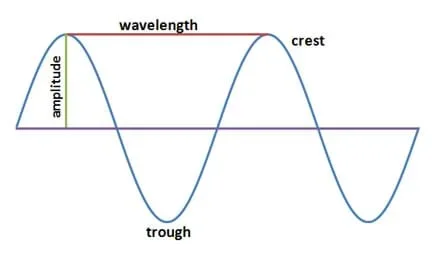 The terminology used to describe waves.Copyright 2011 Carleigh Samson, ITL Program, College of Engineering, University of Colorado Boulder
(slide 4) Review the basic vocabulary terms used in describing waves: wavelength, amplitude, crest, trough, frequency. See the Vocabulary/Definition section.
It is important to understand that wavelength and frequency have a relationship. When a wave has a really long wavelength, the frequency will be really low. When a wave has a really short wavelength, the frequency will be really high. Why do you think that is? (Note to teacher: Have students pair up. Have one student draw a wave [just like the one in the diagram] with a really long wavelength, while the second student draws a wave with a really short wavelength. Ask students to share their drawings and talk about why they think the relationship between frequency and wavelength is as you described. Choose one team to share their drawings on the board and explain their answer.)
(slide 5) Types of waves: Some examples of waves include light waves, sound waves, ocean waves, seismic waves, pressure waves, compression waves, and standing waves. An animation of a standing wave is provided. The nodes on the standing wave are locations where there is no movement. Standing waves can be created by sending two sine waves with the same frequency and amplitude in opposite directions down a string. For example, you could create standing waves by holding one end of a jump rope and having a friend hold the other end and shaking the jump rope up and down with the same frequency and amplitude. The locations where the two waves cancel each other out are the nodes. Standing waves have important applications in musical instruments, such as guitars and violins.
Engineering & Waves: Seismic Waves
(slide 6) Two photographs show examples of the destruction caused by the seismic waves produced during earthquakes. (left) This train was tipped over during the 1906 earthquake in northern California. (right) During the 2004 earthquake in Chūetsu, Japan, these sewer pipes/manholes floated upward and the asphalt road cracked when the soil behaved like a liquid because of the stress of the sudden shaking movement (called soil liquifaction).
(slide 7) A 48-second video called Earthquake Destruction shows clips taken during the 1989 northern California earthquake and after the 1999 Taiwan earthquake. To play this as an embedded video from within the PowerPoint file, you must download the video wmv file and save it in the same folder as the PowerPoint file. Otherwise, click on the attached wmv file or play it directly from the YouTube website at https://www.youtube.com/watch?v=4Y-62Ti5_6s&feature=fvst.
(slide 8) Seismic waves travel through the Earth, and are typically created by earthquakes. The two main categories of seismic waves are body waves and surface waves. Body waves travel through the body of the Earth and are faster than surface waves. The two types of body waves are P-waves (for primary) and S-waves (for secondary). Surface waves travel along the surface of the ground and are slower and more destructive than body waves. Love waves and Rayleigh waves are the two types of surface waves. The surface waves act similar to ocean waves in which the disturbance and movement can be seen along the surface.
(slide 9) P-waves (or primary waves) are the fastest of all seismic waves. P-waves move through the Earth back and forth in the direction the wave is traveling. They can travel through any medium, meaning air, water or the Earth. Some typical speeds: 330 m/s (~ 738 mph) through air (a sound wave!), 1450 m/s (~ 3,244 mph) through water, and 5000 m/s (~ 11,185 mph) through granite.
(slide 10) S-waves (or secondary waves) are another type of body wave, and as the name suggests, are the second fastest type of seismic wave, meaning an S-wave would be the second wave you would feel after an earthquake occurs. In fact, S-waves travel at 60% of the speed of P-waves. S-waves are similar to the sine waves we have seen; the displacement is perpendicular (or 90 degrees) to the movement of the wave. For example, if a wave was traveling to the right, the movement of the ground would be up and down. S-waves can only travel through solids.
(slide 11) Love waves are one type of surface wave. Similar to S-waves, they are transverse waves, but instead of moving the Earth up and down, they move the surface of the ground back and forth perpendicular to the direction the wave is moving. They move slower than P- and S-waves, but faster than Rayleigh waves. These waves were named for A.E.H. Love, the man who predicted this type of seismic wave in 1911.
(slide 12) Rayleigh waves are another type of surface wave. They cause a rolling motion along the surface of the ground, similar to the movement of ocean waves. They are the slowest of all the seismic waves and travel at speeds around 3 km/s (~ 6,711 mph). They are created by the interaction of the P- and S-waves, and therefore are indirectly caused by the actual earthquake. Scientists and engineers have studied Rayleigh waves as a way to characterize the interior of the Earth and to find oil deposits, because the speed and motion of Rayleigh waves are affected by what materials make up the ground they travel through.
(slide 13) For all seismic waves, their intensity depends on the earthquake magnitude, the distance to the earthquake, the depth of the earthquake (how far underground of the epicenter does the earthquake occur), and the geological structure of the Earth (for example, clay, sand, granite, etc.) The amplitude of the seismic waves are smaller if an earthquake occurs far underground. The closer to the surface of the Earth an earthquake occurs, the larger the amplitude. The amplitude also decreases the further the wave travels from the epicenter—this is why people in Colorado cannot feel an earthquake that takes place in California. The seismic waves get smaller and less destructive as they travel.
(slide 14) A 2:50- minute video called Earthquake Waves is a NASA SciFi segment that explores the different types of waves that earthquakes create through the use of animations and a slinky. To play this as an embedded video from within the PowerPoint file, you must download the video wmv file and save it in the same folder as the PowerPoint file. Otherwise, click on the attached wmv file or play it directly from the YouTube website at https://www.youtube.com/watch?v=sZPNjLj8hR8.
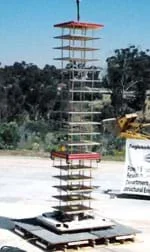 An 18-story building model placed on a new type of seismic base isolation, called "earthquake protectors," stands ready for shake-table testing at a university facility.Copyright 2006 Valentin Shustov http://simple.wikipedia.org/wiki/File:18-story_model_on_earthquake_protectors.jpg
(slide 15) Engineers design buildings, bridges and other infrastructure so they are safe for people even during the extreme forces of earthquakes. To test their designs, engineers develop machines to re-enact (or simulate) the ground movement of seismic waves. To do this, engineers design shake tables that accurately reproduce the motions of the Earth caused by seismic waves. All this is done to provide people living in earthquake-prone areas with stable and survivable human-built environments.
This 2:51-minute video shows the largest shake table in the US designed to reproduce the movement generated by the seismic waves of the 1994 Northridge earthquake in Los Angeles, CA. To play this as an embedded video from within the PowerPoint file, you must download the video wmv file and save it in the same folder as the PowerPoint file. Otherwise, click on the attached wmv file or play it directly from the YouTube website at https://www.youtube.com/watch?v=duzcOkzwpDo
(slide 16) A 2:27-minute video shows the kind of amazing research being done to test earthquake-resistant construction using the world's largest earthquake shake table, located in Japan. This video shows the simulation of a 7.5 magnitude earthquake on a seven-story building. To play this as an embedded video from within the PowerPoint file, you must download the video wmv file and save it in the same folder as the PowerPoint file. Otherwise, click on the attached wmv file or play it directly from the YouTube website at https://www.youtube.com/watch?v=W4nLwwXhEag.
Engineers build shake tables, sometimes life-size (full-size) and sometimes small, model-size, to test the ability of buildings and other structures to withstand the forces of seismic waves generated by earthquakes. To do this, they design and create shake tables that can accurately re-enact the motions of the Earth during known (and seismically recorded) earthquakes. All this is done to determine better building codes (rules) to make structures survivable.
(In advance, prepare a computer projector to show students the attached 16-slide PowerPoint presentation and short videos at the end of this introduction, and make copies of the accompanying note-taking worksheet.)
(optional: Show students videos of the destruction caused during large-magnitude earthquakes, which can be easily found by searching on YouTube.)
Why do you think engineers might be concerned about earthquakes? (Give students a minute to think and write down answers before asking them to share their thoughts.)
Can you think of any big earthquakes that you have heard of in your lifetime? (Possible examples: Japan in March 2011, Chile in February 2010, Haiti in January 2010, China in May 2008; see the US Geological Survey's list of the world's largest earthquakes..)
The earthquakes in Haiti and Chile happened within a month of each other; do you know which one resulted in the most damage and led to the greatest loss of human life? (Students may not know, so give them more information...) Well, the earthquake in Chile rated an 8.8 on the Richter scale, and the earthquake in Haiti was rated 7.0. This means the earthquake in Chile was about 500 times stronger than the earthquake in Haiti. So which earthquake resulted in the most damage to human-made structures and thus, loss of lives? (Listen to student guesses.) Well, reports say about 500 deaths in Chile, and more than 300,000 fatalities in Haiti! That means that the earthquake with the lower intensity caused the most damage. Why do you think this was the case? (Listen to student answers.)
The reason the lower-intensity earthquake had such high numbers of fatalities had to do with the lower quality of buildings and structures in Haiti compared to Chile. In the US, we have strict standards on how buildings must be built for safety reasons. During these earthquakes, some buildings remained intact, while others, including many schools and homes, completely collapsed, trapping and killing people inside. This happened because some buildings were not built to code and were not able to withstand the seismic waves produced by the earthquake.
As an engineer, how would you feel if a building you designed was not safe and put people's lives in jeopardy during a natural hazard, such as an earthquake? An important part of engineering is improving peoples' lives by increasing their safety. With that in mind, if you were going to construct a building in an area prone to earthquakes, would you just design a building and hope it lasted through an earthquake? How do you think you might make sure that your building would survive? (Expect some students to suggest that the building should be tested.) If you want to test how well a building will survive an earthquake, how would you go about it? (Listen to student ideas.) Engineers build shake tables, which are literally tables large enough to construct a building on. To properly test their buildings, engineers make sure that their shake tables accurately represent the shaking of the Earth during an earthquake. As a result, it is very important that engineers understand the different seismic waves produced during earthquakes and exactly how they cause the Earth to move.
(optional; a helpful and physically active way to introduce the concept of a wave) Have you ever been to a sporting event in a stadium, like a baseball or football game, where the crowd "did a wave"? (See how students respond. Expect most to say "yes" and hopefully be excited! Then have all the students do a wave across the classroom, or stand up and make a big circle to do the wave. Point out how you can see the wave move through the students and that they represent the "medium" or material that the wave travels through. For more information on metachronal waves made by large audiences, see https://en.wikipedia.org/wiki/Wave_(audience).)
(Proceed to show students the attached PowerPoint presentation and suggested YouTube videos along with the accompanying worksheet.) Following the lesson, refer to the associated activity Shake It Up! Engineering for Seismic Waves for a fun and hands-on challenge for students to design and build their own shake tables to test and improve model buildings made of toothpicks and marshmallows before the structures undergo a simulated "real" earthquake challenge.
- amplitude
- Looking at a diagram of a sine wave, amplitude is the height measured from the center or rest position.
- body wave
- A seismic wave that travels through the Earth rather than across its surface.
- crest
- Looking at a diagram of a sine wave, the crest is the highest point in each wave cycle.
- engineer
- A person who applies her/his understanding of science and math to creating things for the benefit of humanity and our world.
- epicenter
- The point on the surface of the Earth directly above where an earthquake occurs.
- frequency
- The number of wave cycles in a given amount of time. Frequency is commonly measured in hertz (Hz), which tells how many waves occur in 1 second.
- love wave
- A surface seismic wave that cause horizontal shifting of the Earth during an earthquake.
- p-wave
- A seismic pressure wave that travel through the body of the Earth. The fastest of all seismic waves.
- parallel
- Having the same direction. For example, on a striped shirt, the stripes are parallel.
- perpendicular
- Meeting at a right (90 degree) angle.
- rayleigh wave
- A surface seismic wave generated by the interaction of P-waves and S-waves at the surface of the Earth that move with a rolling motion.
- richter scale
- The Richter magnitude scale provides a measure of the intensity of earthquakes on a 1 to 10 (base-10 logarithmic) scale. An earthquake that measures 5.0 on the Richter scale has a shaking amplitude 10 times larger and corresponds to an energy release of about 32 times greater than one that measures 4.0. Source: http://en.wikipedia.org/wiki/Richter_magnitude_scale
- s-wave
- A shear or transverse body seismic wave, with motion perpendicular to the direction of wave propagation.
- seismic wave
- A wave of energy that travels through the Earth as a result of an earthquake.
- shake table
- A device for shaking structural models or building components. The movement simulates the ground motions of earthquakes. Also called a shaking table.
- surface wave
- A seismic wave that travels across the surface of the Earth as opposed to through it. Surface waves usually have larger amplitudes and longer wavelengths than body waves, and they travel more slowly than body waves.
- trough
- The lowest point in each wave cycle.
- wave
- A disturbance that travels through space or time, usually by the transfer of energy.
- wavelength
- The length of each wave cycle; the distance between one crest and the next crest.
Pre-Lesson Assessment
Getting Started: Have students work in small groups of three or four students each to brainstorm what they know about waves and seismic waves. Tell them to write down any words or thoughts that come to mind. Also, have them brainstorm any way they think engineering or engineers are affected by waves, or specifically, seismic waves. Have groups share their ideas with the class.
Post-Introduction Assessment
Skeleton Notes: While showing the attached 16-slide PowerPoint presentation, have students fill out the Engineering & Waves: Seismic Waves PPT Worksheet (PDF), which serves as a skeleton for note-taking and helps students be accountable for the information presented.
Lesson Summary Assessment
Quiz: After completing the lesson and the PowerPoint presentation, administer to students the Waves, Waves, Waves Quiz (PDF) to assess their content knowledge.
Have students research recent earthquakes to investigate how well structures in those areas were able to withstand the seismic waves. For example, the severe March 2011 earthquakes in Japan impacted many highly-populated areas containing skyscrapers. Assign them to write short reports that include descriptions of the severity of the earthquakes, data on the loss of lives and structures, and any engineering "lessons learned" (what worked, what didn't work, what could be improved).
Earthquake Destruction (48-second video; clips during the 1989 northern California earthquake and after the 1999 Taiwan earthquake): https://www.youtube.com/watch?v=4Y-62Ti5_6s&feature=fvst
Earthquake Waves (2:50-minute video; NASA SciFi segment exploring the different types of waves that earthquakes create; uses animations and slinky): https://www.youtube.com/watch?v=sZPNjLj8hR8
Earthquake Shake Table Rocks Building (2:51-minute video; using the University of California-San Diego shake table, engineers re-create destructive earthquakes to test building designs to help make structures safer and survivable) https://www.youtube.com/watch?v=duzcOkzwpDo
World's Largest Earthquake Shake Table in Japan (2:27- minute video; video shows the simulation of a 7.5 magnitude earthquake on a full-size seven-story building using the world's largest shake table): https://www.youtube.com/watch?v=W4nLwwXhEag
Find more information on earthquakes, earthquake engineering, earthquake shaking table, Love wave, P-wave, Rayleigh wave, Richter magnitude scale, S-wave, seismic wave, and wave at https://en.wikipedia.org/wiki/Main_Page
Kurczy, Stephen, Leigh Montgomery and Elizabeth Ryan. "Chile Earthquake Facts: Chile vs. Haiti, in Numbers: Chile earthquake facts continue to roll in and provide glaring comparisons with the quake that devastated Haiti in January." Published March 2, 2010. The Christian Science Monitor. Accessed October 4, 2011. http://www.csmonitor.com/World/Global-News/2010/0302/Chile-earthquake-facts-Chile-vs.-Haiti-in-numbers
Largest and Deadliest (World) Earthquakes by Year,1990-2011. Last modified April 13, 2011. US Geological Society, US Department of the Interior. Accessed October 4, 2011. https://earthquake.usgs.gov/earthquakes/browse/stats.php
World's Largest Earthquake Shake Table Test in Japan. Simpson Strong-Tie Company, Inc. Accessed April 20, 2011. (Article and a five-minute video show a full-scale seven-story wood-framed condominium tower being tested on world's largest shake table in July 2009, where it survived a 7.5 magnitude earthquake simulation with minor damage) http://www.strongtie.com/about/research/capstone.html?source=hpnav
- Seismic Waves: How Earthquakes Move Through the Earth
Contributors
Carleigh Samson; Stephanie Rivale; Denise W. Carlson
Supporting Program
Integrated Teaching and Learning Program, College of Engineering, University of Colorado Boulder
Acknowledgements
The contents of these digital library curricula were developed by the Integrated Teaching and Learning Program under National Science Foundation GK-12 grant no. 0338326. However, these contents do not necessarily represent the policies of the National Science Foundation, and you should not assume endorsement by the federal government.
Copyright
2010 by Regents of the University of Colorado.