
Renewable Energy Living Lab: Exploring Regional Resources
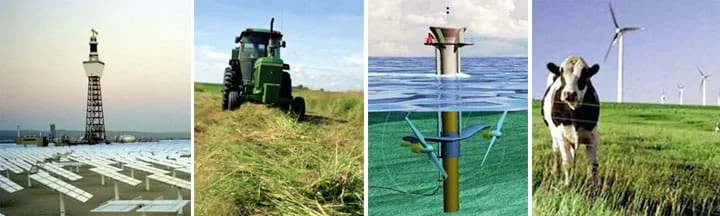 Renewable energy resources are tied to the availability of solar radiation, water and wind movement, biomass supplies, and geothermal activity, so it is helpful to investigate their locational feasibility by viewing data through a map interface.Copyright (left to right) Warren Gretz, NREL; NREL, US Dept. of Energy via Oak Ridge National Laboratory and Center for Transportation Analysis; Pacific Northwest National Laboratory, US Dept. of Energy; US Fish & Wildlife Services
http://www.nrel.gov/data/pix/Jpegs/02156.jpg
http://cta.ornl.gov/bedb/index.shtml
http://mhk.pnnl.gov/wiki/index.php/MHK_(tidal)
http://www.fws.gov/midwest/EastLansing/news/index.html
Renewable energy resources are tied to the availability of solar radiation, water and wind movement, biomass supplies, and geothermal activity, so it is helpful to investigate their locational feasibility by viewing data through a map interface.Copyright (left to right) Warren Gretz, NREL; NREL, US Dept. of Energy via Oak Ridge National Laboratory and Center for Transportation Analysis; Pacific Northwest National Laboratory, US Dept. of Energy; US Fish & Wildlife Services
http://www.nrel.gov/data/pix/Jpegs/02156.jpg
http://cta.ornl.gov/bedb/index.shtml
http://mhk.pnnl.gov/wiki/index.php/MHK_(tidal)
http://www.fws.gov/midwest/EastLansing/news/index.html
Students become familiar with the online Renewable Energy Living Lab interface and access its real-world solar energy data to evaluate the potential for solar generation in various U.S. locations. They become familiar with where the most common sources of renewable energy are distributed across the U.S. Through this activity, students and teachers gain familiarity with the living lab's GIS graphic interface and query functions, and are exposed to the available data in renewable energy databases, learning how to query to find specific information for specific purposes. The activity is intended as a "training" activity prior to conducting activities such as The Bright Idea activity, which includes a definitive and extensive end product (a feasibility plan) for students to create.
The opportunity to practice analyzing NREL/US DOE data (as provided through the Renewable Energy Living Lab) to solve problems and answer questions is much the same as what scientists and engineers do every day. The availability of natural resources used for electricity generation varies widely by region, which greatly impacts their cost-effectiveness and feasibility for use in any given area. Although water, wind, and other renewables may seem free, the cost comes in collecting and transporting the energy to the places where energy is needed, as well as other infrastructure requirements. For example, to utilize energy from water, a dam must be built or tidal turbines installed, together with electric generators and transmission lines.
After this activity, students should be able to:
- Name four renewable energy types.
- Use the Renewable Energy Living Lab to collect data on various energy forms.
- Analyze available potential solar energy data to evaluate solar energy resources in different U.S. locations.
- Explain the factors contributing to renewable energy feasibility.
- Energy exists in many forms such as mechanical, chemical, electrical, radiant, thermal, and nuclear, that can be quantified and experimentally determined
Grades 9-12
Do you agree with this alignment? - When energy changes form, it is neither created not destroyed; however, because some is necessarily lost as heat, the amount of energy available to do work decreases
Grades 9-12
Do you agree with this alignment? - Matter tends to be cycled within an ecosystem, while energy is transformed and eventually exits an ecosystem
Grades 9-12
Do you agree with this alignment? - The size and persistence of populations depend on their interactions with each other and on the abiotic factors in an ecosystem
Grades 9-12
Do you agree with this alignment? - There are costs, benefits, and consequences of exploration, development, and consumption of renewable and nonrenewable resources
Grades 9-12
Do you agree with this alignment?
- Changes caused by the use of technology can range from gradual to rapid and from subtle to obvious.
Grades 9-12
Do you agree with this alignment? - The decision whether to develop a technology is influenced by societal opinions and demands, in addition to corporate cultures.
Grades 9-12
Do you agree with this alignment? - Energy can be grouped into major forms: thermal, radiant, electrical, mechanical, chemical, nuclear, and others.
Grades 9-12
Do you agree with this alignment? - STEL-4P Evaluate ways that technology can impact individuals, society, and the environment.
Grades 9-12
Do you agree with this alignment? - STEL-4Q Critue whether existing and proposed technologies use resources sustainably.
Grades 9-12
Do you agree with this alignment? - STEL-4S Develop a solution to a technological problem that has the least negative environmental and social impact.
Grades 9-12
Do you agree with this alignment?
- HS-ESS3-1 Construct an explanation based on evidence for how the availability of natural resources, occurrence of natural hazards, and changes in climate have influenced human activity.
Grades 9-12
This resource focuses on the following Three Dimensional Learning aspects of NGSS:
Science & Engineering Practices- Construct an explanation based on valid and reliable evidence obtained from a variety of sources (including students' own investigations, models, theories, simulations, peer review) and the assumption that theories and laws that describe the natural world operate today as they did in the past and will continue to do so in the future.Do you agree with this alignment?
Disciplinary Core Ideas- Resource availability has guided the development of human society.Do you agree with this alignment?
- Natural hazards and other geologic events have shaped the course of human history; [they] have significantly altered the sizes of human populations and have driven human migrations.Do you agree with this alignment?
Crosscutting Concepts- Empirical evidence is required to differentiate between cause and correlation and make claims about specific causes and effects.Do you agree with this alignment?
- Modern civilization depends on major technological systems.Do you agree with this alignment?
Do you agree with this alignment? - Construct an explanation based on valid and reliable evidence obtained from a variety of sources (including students' own investigations, models, theories, simulations, peer review) and the assumption that theories and laws that describe the natural world operate today as they did in the past and will continue to do so in the future.
- HS-ETS1-3 Evaluate a solution to a complex real-world problem based on prioritized criteria and trade-offs that account for a range of constraints, including cost, safety, reliability, and aesthetics, as well as possible social, cultural, and environmental impacts.
Grades 9-12
This resource focuses on the following Three Dimensional Learning aspects of NGSS:
Science & Engineering Practices- Evaluate a solution to a complex real-world problem, based on scientific knowledge, student-generated sources of evidence, prioritized criteria, and tradeoff considerations.Do you agree with this alignment?
Disciplinary Core Ideas- When evaluating solutions it is important to take into account a range of constraints including cost, safety, reliability and aesthetics and to consider social, cultural and environmental impacts.Do you agree with this alignment?
Crosscutting Concepts- New technologies can have deep impacts on society and the environment, including some that were not anticipated. Analysis of costs and benefits is a critical aspect of decisions about technology.Do you agree with this alignment?
Do you agree with this alignment? - Evaluate a solution to a complex real-world problem, based on scientific knowledge, student-generated sources of evidence, prioritized criteria, and tradeoff considerations.
Each group needs:
- computer with internet access (or printed or projected renewable energy potential maps as found on the Renewable Energy Living Lab website)
- journal or writing paper, for documenting worksheet data, answers, results and conclusions
- Exploring Regional and Local Resources Worksheet (PDF), one per student
(Ask students the following questions to facilitate a class discussion.)
- Why do we need to generate energy? (Listen to student ideas. Example answers: We need energy to power our industries, to move from place to place, to grow and cook our food, to warm or cool our homes, to communicate over distances.)
- From where do we get our power/electricity currently? (Example answers: Petroleum/oil, coal, solar, wind, hydropower, biomass. Both renewable and non-renewable energy sources are used to generate electricity, power vehicles, and provide heating, cooling and light.)
- What might be some factors that contribute to the feasibility of an energy source? Social? Political? Economic? Environmental? (Example answers: Its cost [to obtain, harness, process, refine, distribute], its regional availability and supply, its environmental impact [access, pollution, renewability], its social acceptance and desirability, its supporting distribution network or infrastructure, its connection [or not] to the existing electrical grid, the strength of competing energy industries [such as political opposition for purposes of protecting established energy sources], its impact on a country's balance of trade and desire for "energy independence," its level of technological sophistication [efficiency, maintenance, dependability], etc.)
Let's consider different sources of energy.
- What does "renewable" mean? (Example answer: Renewable sources are those that will never dwindle or be used up because of use or overuse. Renewable energy comes from natural resources such as wind, plant material, water, geothermal and sunlight, and is naturally replenished.)
- How is "renewable" the same and how is it different from "green energy"? (Points to make: "Green energy" commonly means that no pollution or environmental hazards are created during the energy generation process. All energy sources require energy to generate and have some impact, so the definition of "green" is debatable. For example, solar energy can be collected passively, but energy and materials are required to produce the panels, and that production may generate waste products.)
- To consider whether a renewable energy source is feasible, what questions would you ask? (Listen to student suggestions. Example questions: How does it work? How much power potential exists? How much does it cost? What is its environmental impact? Are our relationships with other countries affected by the energy source? Is the resource available in the area where we need it? Other questions?)
We will learn more about renewable energy potential sources using the Renewable Energy Living Lab website in the next few class periods. We will look at data acquired and presented by the Department of Energy National Laboratories.
Background
This activity is intended to teach students how to interact with the Renewable Energy Living Lab GIS database, perform queries, etc. The student worksheet serves as a guide for the activity. It includes detailed instructions and supporting screenshots. The worksheet questions serve as prompts to help students explore all the database tools.
Great potential exists for differentiated learning in this activity simply by encouraging students to explore their own open-ended questions about renewable energy source types, locations, potential and details.
Before the Activity
- Prepare the computers and make copies of the Exploring Regional and Local Resources Worksheet (PDF).
- Divide the class into small groups of two or three students each.
With the Students
- Hand out the worksheets as a guide for the activity.
- Navigate students to http://www.teachengineering.org/livinglabs/index.php> click to enter the Renewable Energy Living Lab.
- Direct students to complete the worksheet, following its detailed instructions and tips, and answering its questions in their journals or on separate pieces of paper. Encourage them to ask lots of questions while exploring all aspects of the living lab.
- Conclude by leading a class discussion so students can share, compare and discuss their results and findings. Alternatively, make verbal or written assignments from certain worksheet questions, as described in the Assessment section.
- database
- An organized storage location for large amounts of numerical data.
- gis
- Acronym for geographic Information System, which is a database that connects specific data to specific spatial locations in order to help visualize and display information.
- query
- A software tool that enables searching of electronic databases for specific data or data that meets certain parameters.
- renewable energy
- Energy obtained from natural resources that are continually replenished, for example, regardless of how much of the Sun's heat energy is "used" today, more is received by the Earth tomorrow. Examples: Sunlight (solar energy), water (hydropower), geothermal, biomass (the latter is sometimes considered non-renewable, depending on specifics).
- non-renewable energy
- Energy obtained from sources that are not continually replenished, for example oil or gas pumped up from a deep underground well can be "used up," and not replaced by natural processes within the human lifespan (takes millions of years to produce). Examples: Combustion of petroleum, natural gas, coal.
Pre-Activity Assessment
Opening Discussion: Ask students questions to gauge their understanding of society's need for and use of energy and renewable energy, as provided in the Introduction/Motivation section. This also prepared them to see the value in exploring data to better understand a topic.
Activity Embedded Assessment
Observation & Data Checks: Check for understanding through questioning and monitoring of student work while they use the database tools and make queries. As students navigate the website and work through their worksheets, walk around and notice their data and answers. Look to see that students are gaining the ability to navigate the living lab.
Post-Activity Assessment
Class Discussion: As a class, have students share, compare and discuss their results and findings.
Concluding Presentations: Have groups share with the class their results and findings in the form of brief presentations, posters or through other visual media. Example verbal or written assignments:
From the "Elaborate" section of the worksheet: Compare and contrast the two solar energy maps, photovoltaics vs. concentrated solar power (CSP), as described in the worksheet "Elaborate" section:
- If photovoltaics and CSP are both solar power, why are they so different? (Example answer: They differ in the ways that they capture and use solar energy to produce electricity. Photovoltaics convert sunlight directly to electricity using the semiconductor materials in solar panels. Concentrated solar power plants first concentrate the sun's energy with reflective devices and then capture it in a heat-transfer fluid that is used to create steam that drives conventional turbine generators to produce electricity. Unlike photovoltaics, CSP technologies can provide electrical power both day and night because storing the sun's heat in fluid form means it can continually generate electricity even during cloudy weather or at night. Looking at the maps, the potential for photovoltaics is widespread across the country and the potential for CSP is extremely high in regions some areas where photovoltaics is high, mainly in the southwest region. In areas where the potential for photovoltaics drops, such as in the northeast, the potential for CSP is extremely low. The difference in the maps reflects how CSP technologies require much space and infrastructure in addition to a lot of sunlight and intensity.
- What regions of the country are good for both technologies? (Example answer: Areas with high solar potential.)
- Is CSP a good option in your state/town? Why or why not? (Answers will vary. Areas in which CSP is a good option are regions with high energy potential from CSP, including the southwest and most of the western half of the country. Looking at the map with the CSP filter, areas that show a potential for 5.0 kWh/m2/day or greater represent areas in which CSP would be a good option. Areas in which CSP is not a good option are regions with less than 5.0 kWh/m2/day of potential solar power, which is roughly the eastern half of the country.
From the "Evaluate" section of the worksheet, a broader question:
- If you were hired as an engineer to develop a renewable energy resource plan for your local community, on what type(s) of renewable energy would you focus your efforts? Include specific data from the Renewable Energy Living Lab to support your choice(s). (Answers will vary, depending on your location. Example answer: The northeast region of Colorado offers many options for renewable energy. I believe it would be best to focus on solar and wind power, as evidenced by the data provided in the Renewable Energy Living Lab, specifically the concentrated solar power, solar photovoltaic, and wind power onshore data layers. Each of these data layers demonstrates that the northeast region of Colorado has high potential for these types of renewable energy. In addition, the living lab data shows good potential for geothermal energy and hydropower.)
In advance of the activity, it is recommended that the teacher complete the student worksheet so as to become familiar with the living lab database features and tools. Run through items in the FAQs tab (bottom right of the map) to gain more familiarity.
If this is the first experience for students using this type of graphic interface (and for visual learners), it may help to use a computer projector to show the class how to use some of the query tools before students work on their own.
It is easy for inexperienced students to get "lost" in the depths of the graphic interface, so we recommend frequent checks on student progress and guidance tips, as necessary, to help them navigate the system and stay on task.
Have students research local uses of renewable energy, and share their findings with the class.
Have students identify and investigate companies and/or industries that use and promote renewable energy and share their findings with the class.
As an extension, conduct the Renewable Energy Living Lab: The Bright Idea activity, which builds on the content and skills learned in this activity by challenging students with calculations, research and analysis, culminating in the preparation of feasibility reports.
- For lower grades, conduct the similar middle school activity: Renewable Energy Living Lab: Smart Solar activity.
- With this activity as a basic introduction to the living labs, for higher grades, more advanced students or as an activity extension, conduct the more challenging Renewable Energy Living Lab: The Bright Idea activity next.
Teacher resources: http://www.teachengineering.org/livinglabs/renewable_energy/educators.php
This activity is designed around the Renewable Energy Living Lab, a resource of current and real-world scientific data, in this case a culmination of available renewable energy data from across the U.S. The data is available in a database with a graphical interface using a scaling map for viewing of regions as large as the continental U.S. and as small as a town. It is rare that students have access to query such as extensive body of scientific data to support their own inquiry-based questions. Additional background information is provided in the living lab interface including source information used to compile the data.
Contributors
Mike Mooney; Minal Parekh; Scott Schankweiler; Jessica Noffsinger; Karen Johnson; Jonathan Knudtsen
Supporting Program
Civil and Environmental Engineering Department, Colorado School of Mines
Acknowledgements
This curriculum was created with the support of National Science Foundation grant no. DUE 0532684. However, these contents do not necessarily represent the policies of the National Science Foundation, and you should not assume endorsement by the federal government.
Copyright
2013 by Regents of the University of Colorado; original © 2012 Colorado School of Mines