
Air Quality and Weather Connections
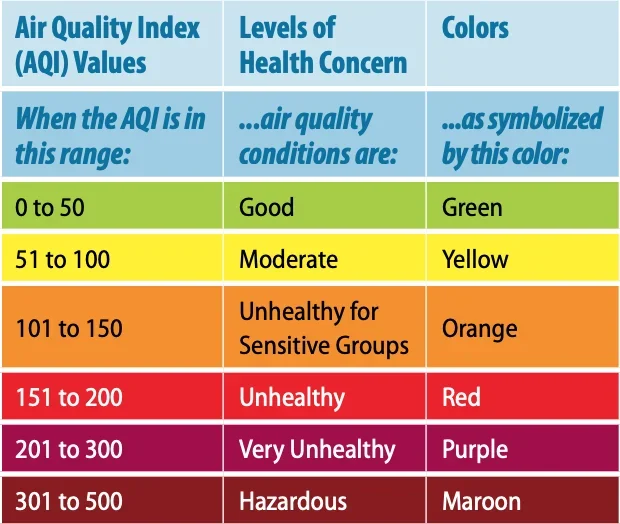 Air Quality Index (AQI) ChartCopyright https://uspirg.org/resources/usp/making-sense-air-quality-index
Students will explore the pattern between air pollution levels and weather conditions in this activity. Students work together to learn about the color-coded Air Quality Index (AQI) chart that describes levels of air pollution for two main transportation-sourced air pollutants—particulate matter (PM) and ozone—and action to take on high pollution days. Student teams design a Wind Streamer, a prototype for collecting particulate matter (PM) particles outdoors. Over a period of 1-week or more, student teams will record daily particulate matter (PM) and ozone levels using AirNow.gov and weather conditions (wind speed, wind direction data, air temperature) using and Weather.gov at their school location (or nearest town or city). When finished collecting data, the class will analyze the data to see if a pattern exists between air pollution levels and weather conditions. They will also compare the relative AREN Wind Streamer data with the AirNow.gov and Weather.gov data. Ways to stay safe on high air pollution days are also presented.
Clean air is essential for everyone and the environment. Air quality engineers are one type of environmental engineer, and they help to monitor, control, and most importantly, reduce air pollution to help improve public health. Like other engineers, air quality engineers perform a variety of tasks as part of their job including:
- Modeling and understanding pollution and its sources
- Monitoring emissions and compliance with applicable regulations
- Designing and implementing air quality improvement solutions
Air quality engineers have natural sciences knowledge and expertise, such as chemistry, biology, physics, and mathematics, to inform their decision-making processes.
After this activity, students should be able to:
- Recall that particulate matter (PM) and ground-level ozone (O3) affect air quality.
- Interpret the Air Quality Index (AQI) levels for healthy and unhealthy air.
- Design-build-test a wind streamer prototype to observe wind conditions.
- Classify place-based AQI levels for particulate matter and ozone air pollution using real-time, place-based air quality data from the AirNow.gov website or app.
- Record concurrent place-based wind speed, wind direction, and air temperature from the National Weather Service Weather.gov website or app.
- Compare and contrast place-based, concurrent particulate matter and ozone AQI data with recorded weather data.
- STEL-7N Practice successful design skills.
Grades 3-5
Do you agree with this alignment?
- 3-5-ETS1-1 Define a simple design problem reflecting a need or a want that includes specified criteria for success and constraints on materials, time, or cost.
Grades 3-5
This resource focuses on the following Three Dimensional Learning aspects of NGSS:
Science & Engineering Practices- Define a simple design problem that can be solved through the development of an object, tool, process, or system and includes several criteria for success and constraints on materials, time, or cost.Do you agree with this alignment?
Disciplinary Core Ideas- Possible solutions to a problem are limited by available materials and resources (constraints). The success of a designed solution is determined by considering the desired features of a solution (criteria). Different proposals for solutions can be compared on the basis of how well each one meets the specified criteria for success or how well each takes the constraints into account.Do you agree with this alignment?
Crosscutting Concepts- People's needs and wants change over time, as do their demands for new and improved technologies.Do you agree with this alignment?
Do you agree with this alignment? - Define a simple design problem that can be solved through the development of an object, tool, process, or system and includes several criteria for success and constraints on materials, time, or cost.
- 3-ESS2-1 Represent data in tables and graphical displays to describe typical weather conditions expected during a particular season.
Grade 3
This resource focuses on the following Three Dimensional Learning aspects of NGSS:
Science & Engineering Practices- Represent data in tables and various graphical displays (bar graphs and pictographs) to reveal patterns that indicate relationships.Do you agree with this alignment?
Disciplinary Core Ideas- Scientists record patterns of the weather across different times and areas so that they can make predictions about what kind of weather might happen next.Do you agree with this alignment?
Crosscutting Concepts- Patterns of change can be used to make predictions.Do you agree with this alignment?
Do you agree with this alignment? - Represent data in tables and various graphical displays (bar graphs and pictographs) to reveal patterns that indicate relationships.
- 4-ESS3-1 Obtain and combine information to describe that energy and fuels are derived from natural resources and their uses affect the environment.
Grade 4
This resource focuses on the following Three Dimensional Learning aspects of NGSS:
Science & Engineering Practices- Obtain and combine information from books and other reliable media to explain phenomena.Do you agree with this alignment?
Disciplinary Core Ideas- Energy and fuels that humans use are derived from natural sources, and their use affects the environment in multiple ways. Some resources are renewable over time, and others are not.Do you agree with this alignment?
Crosscutting Concepts- Cause and effect relationships are routinely identified and used to explain change.Do you agree with this alignment?
- Knowledge of relevant scientific concepts and research findings is important in engineering.Do you agree with this alignment?
- Over time, people's needs and wants change, as do their demands for new and improved technologies.Do you agree with this alignment?
Do you agree with this alignment? - Obtain and combine information from books and other reliable media to explain phenomena.
- 5-ESS3-1 Obtain and combine information about ways individual communities use science ideas to protect the Earth's resources and environment.
Grade 5
This resource focuses on the following Three Dimensional Learning aspects of NGSS:
Science & Engineering Practices- Obtain and combine information from books and/or other reliable media to explain phenomena or solutions to a design problem.Do you agree with this alignment?
Disciplinary Core Ideas- Human activities in agriculture, industry, and everyday life have had major effects on the land, vegetation, streams, ocean, air, and even outer space. But individuals and communities are doing things to help protect Earth's resources and environments.Do you agree with this alignment?
Crosscutting Concepts- A system can be described in terms of its components and their interactions.Do you agree with this alignment?
- Science findings are limited to questions that can be answered with empirical evidence.Do you agree with this alignment?
Do you agree with this alignment? - Obtain and combine information from books and/or other reliable media to explain phenomena or solutions to a design problem.
Per student:
- Air Quality and Weather Connections Datasheet
- Pencil
Per group:
Part 1 Make Wind Streamer (per group):
- Light-weight streamer material (e.g., crepe paper, ribbons, paper strips, etc.) cut into 3’ strips
- Paper plate
- Ruler
- Hole punch (or scissors used by teacher)
- Markers or crayons
- Compass to determine north
Part 2 Make PM Catcher (per group):
- 12”x12” cardboard, heavy cardstock, or plastic folder
- 8”x8” contact paper with the protective backing on
- Hole punch (or scissors used by teacher)
- 12” pieces of string or yarn
- Permanent marker
- Hand lens or magnifying glass
Part 3: Weather and Air Quality Data Collection:
- Pencil
- Datasheet
- Wind Streamer (per team)
- AirNow.gov PM 2.5 daily reading for school location (or nearest area)
Part 4: Analyze PM Data Table & PM Catcher, and Class Reflection
- Weather and Air Quality (datasheet section 2)
- PM Collector Grid Paper (datasheet section 3)
- PM Collector
- Hand lens
- Air Quality and Weather Connections Datasheet (docx)
- Air Quality and Weather Connections Datasheet (pdf)
- Air Quality and Weather Connections Datasheet Answer Key (docx)
- Air Quality and Weather Connections Datasheet Answer Key (pdf)
- What Color is Your Air Today? Activity Worksheet (gr 3-5) (pdf)
- Making Sense Assessment (docx)
- Making Sense Assessment (pdf)
A basic understanding of interpreting simple graphs with keys and numeracy (ones, tens, hundreds, and greater than/less than between values)
Basic knowledge of particulate matter and ozone sources and their effects on health.
Create a particulate matter collector out of common materials and use it to determine the wind’s direction, in this 15-minute activity.
What's the Point?
- Weather on Earth is always changing, but scientists — and children — can watch and use tools to note the different types of weather.
- Scientists use tools to measure wind direction (in addition to wind speed, temperature, and precipitation).
Background
Air Quality is monitored by the U.S. Environmental Protection Agency and communicated through the EPA AirNow.gov website and app, as well as the National Weather Service forecasts.
The two main air pollutants, which come from fossil fuel-burning transportation sources that pose significant human health risks, are ground-level ozone and particulate matter (PM). Ozone is “good up high, bad nearby”. This means the ozone layer, which is high in the atmosphere’s stratosphere, protects us from harmful UV rays from the sun. But, ozone in the lowest troposphere level of the atmosphere where we and other living things live, can cause health and environmental problems.
Ground-level ozone, or O3, is formed when fossil fuels are burned, for example by vehicles and industries, and the emissions that are released into the air combine together in the presence of sunlight and warm temperatures to make ozone. Since sunlight is a key factor, ozone can be a particular problem during the summer months, and during daylight hours. However, ozone pollution can occur any time of the year if the conditions are right.
Breathing ozone causes irritation and damage to the respiratory system. Sensitive groups, which include the young, elderly, active people, and those with respiratory diseases, such as asthma, are even more sensitive to breathing ozone.
PM is formed from natural sources, such as wildfire and volcanic eruptions, and human-made sources when fossil fuels are burned, for example by vehicles and industries, and the emissions that are released into the air.
Breathing PM irritation and damage to the respiratory system. Sensitive groups, which include the young, elderly, active people, and those with respiratory diseases, such as asthma, are even more sensitive to breathing PM. When inhaled PM 2.5, which is 30x smaller than a human hair and not visible to the naked eye, is particularly dangerous since it is small enough to be absorbed into the bloodstream and can affect organs including the heart and lungs. PM 10 are larger particles that can be seen, such as dust, pollen, and ash, that are not healthy to breathe in but are less dangerous than PM 2.5.
The US EPA Air Quality Index (AQI) is a six-stage chart that communicates the level of ozone and PM in the air so people can take appropriate action to stay safe and healthy. When the AQ is below 100 the AQI is green or yellow, which means the air is healthy to breathe. When the AQ is 100 or higher, the AQI is orange, red, purple, or brown, which means the air is increasingly unhealthy to breathe.
When the AQ rating is 100 or higher, it is advised to take the recommended precautions at the relevant level to protect one’s health, such as limiting time outdoors and refraining from strenuous activity.
To prevent ground-level ozone formation, it is advised that people limit the use of fossil-fuel-powered vehicles, such as passenger vehicles, and carpool, take public transportation, bike or walk, especially during daylight hours.
Before the Activity
- Locate the specific location(s) for safely recording wind direction and placing out PM Collectors, preferably, a flat, accessible, open area.
- Collect materials for each group
- Prepare Air Quality and Weather Connections Datasheets for each student
With the Students
Part 1: What is Air Quality (AQ) and the Air Quality Index (AQI)?
- As a warm-up and to review what students learned about particulate matter (PM) in the previous lesson, show students the Wildfires in the West Cause Air Pollution video (show to 1:33). Have a think-pair-share on the discussion questions listed in the first section of the datasheet for this portion.
- Next, introduce students to the concept of air quality (AQ) and the Air Quality Index (AQI) by showing the AirNow Be Smoke Ready: Know the Colors of the Air Quality Index (AQI) video. Have a think-pair-share on the discussion questions listed in the first section of the datasheet for this portion.
Figure 1. Air Quality Index (AQI) ChartCopyright https://uspirg.org/resources/usp/making-sense-air-quality-index
- Tie in concepts from the AirNow video to the AQI chart, review the columns together as a class. In partners, have students complete the grade-level AirNow AQ flag activity sheet referring to the AQI chart on the datasheet. Ask students to volunteer to share their answers to reinforce the connection between AQ colors and the different levels of air health.
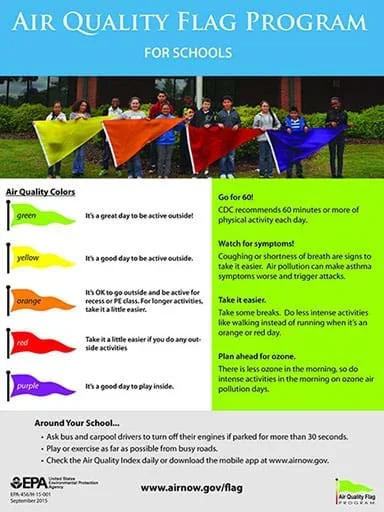 Figure 2. AirNowCopyright Air Quality Flags https://www.airnow.gov/publications/air-quality-flag-program-outreach-materials/flag-program-poster-for-schools/
 - Explain to the class that they will work together as teams of Environmental Engineers to design objects to collect data on wind and air quality around their school. Show examples of the Wind Streamer and PM Collector. Assign students into teams of 2-4 to undertake the challenge.
Part 2: Make a Wind Streamer to determine the wind direction.
- Show students the Wind Streamer video.
- Show the students the materials they will need to build their own Wind Streamer. Hand out all materials except the streamer materials to each group. Guide teams step-by-step as they design and build their Wind Streamer:
- Have students draw a large “+” sign in the middle of the paper plate.
- Next, draw the cardinal compass directions on the board. On their plates, have teams label the top line “N” for north, the right-side line “E” for east, the bottom line “S” for south, and the left-side line “W” for west.
- Students hole punching the edge of the plate at the N, E, S, W labels.
- Show the streamer materials. Tell teams to discuss together and then choose the material they think will work best for blowing the wind but will also be durable to withstand strong winds from the streamer choices. Teams then thread and knot the streamer material through the punched holes on the plate.
- When using the Wind Streamer outdoors, demonstrate to students to face north (teacher or a student volunteer uses a compass to determine direction) and hold their Wind Streamer by the south location and keep it level.
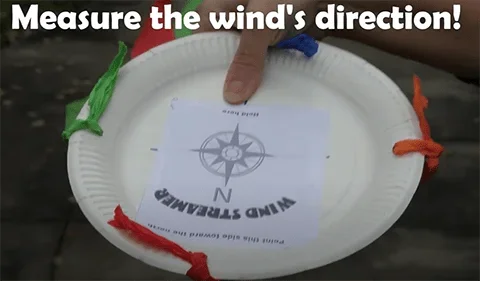 Figure 3. Wind Streamer in action
 - The direction that the streamers are flowing from (not towards) is the wind direction that they will record on their datasheet when collecting data.
Part 3: Make a PM Collector to trap wind-blown particulate matter.
- Ask students what they recall about particulate matter (PM) from the previous lesson. Explain that some particles are too small for our eyes to see (PM 2.5), but other particles are larger (PM 10), which we can see such as dust, pollen, or ash. PM comes from natural and human-made sources. PM can cause health issues if breathed in, especially PM 2.5 since it is so small and can go deep into our lungs. Explain to students that they are going to collect data on the amount of PM 10 in the air around their school.
- Show students a finished PM Collector and explain what the different parts are and how it works to trap PM that is carried through the air by wind.
- Show students the materials that they will need to build their PM Collector.
- Pass out the cardboard or cardstock pieces and contact paper with the protective backing on.
 Figure 4. PM Collector prep
 - Keeping the protective backing on the contact paper, have each team securely tape the piece of contact paper in the center of the cardboard with the sticky side facing up (backing on).
- Pass out the cardboard or cardstock pieces and contact paper with the protective backing on.
- Go outside on the school grounds and design a process to determine the best outdoor locations to put the PM Collectors so they are likely to collect a lot of particulate matter. Suggestions:
- Single location with multiple PM Collectors at each cardinal direction
- Several locations have a few PM Collectors at each cardinal location.
- Flat surface vs sloped surfaces, proximity to buildings and objects, on the ground vs above the ground (e.g., taped on a wall, hanging from a tree, etc.)
- You may have to anchor the PM Collector if it’s windy and double-check that the contact paper is firmly taped to the cardboard.
- Once the PM Collector locations are decided by student teams, remove the protective backing from the contact paper to start collecting PM.
- Leave the PM Collectors outside for 5 days.
Part 4: Record Weather and Air Quality Data
- While the PM Collectors are collecting particulate matter from the air, collect weather and AQ data, as listed on AQ Data Table in the second section of the datasheet, for five days. Model an example first then guide students through the daily data collection process for five days:
- Record the date and head outdoors.
- Use the Wind Streamers to determine the wind direction.
- Ask students to estimate how hazy the sky is and check the corresponding box. Compare how clear objects nearby and faraway compare. There is more haze if objects farther away are obscured.
- Use the Weather.gov website (in class) or smartphone app (outdoors) to look up your location or zip code. Record the day’s wind speed, temperature (you can also compare the wind direction with what students observed with their Wind Streamers).
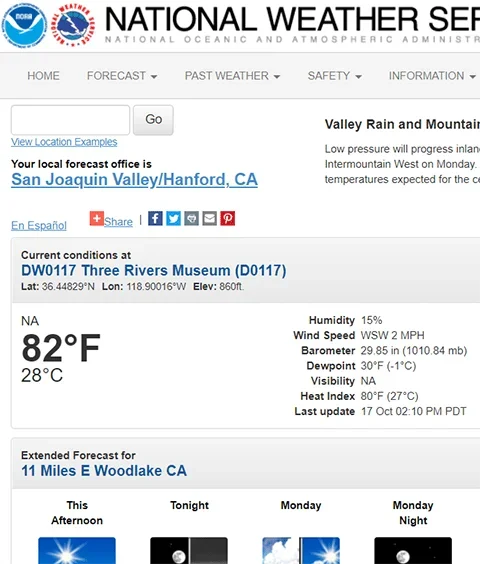 Figure 5. Screenshot of the Weather.gov dashboardCopyright Weather.gov
 - Use the AirNow.gov website (in class) or smartphone app (outdoors) to look up and record the day’s record the PM 2.5 level and the corresponding PM 2.5 air quality color on the datasheet. Repeat this for the ozone level and color. This information is located below the AirNow.gov AQ dial image in the “Current Air Quality” section.
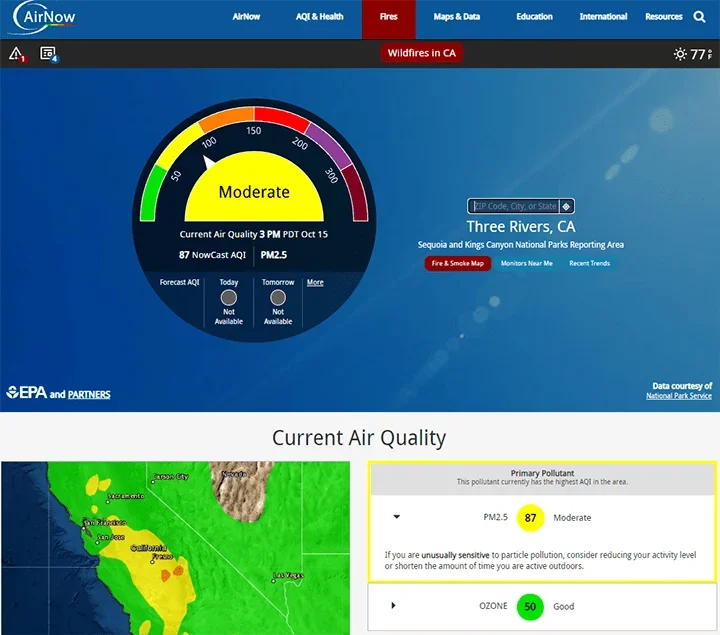 Figure 6. Screenshot of the AirNow.gov dashboardCopyright AirNow.gov
 - Circle whether there is an Air Quality Action Day (AirNow.gov AQ dial is orange, red, purple, or maroon). This represents combined PM and Ozone air quality ratings.
- After 5 days, go back outside and pick up the PM Collectors.
Part 5: Analyze Weather & AQ Data Table, PM Collection, and Class Reflection
- As a class, complete section 4 of the datasheet. Review the Air Quality Index (AQI).
- Guide the class as teams work together on the section questions. Ask teams to share their responses in a class discussion. Lead the class as teams work together on the section questions. Ask teams to share their responses to each question in a class discussion.
- Have teams review their Air Quality data table where they recorded weather conditions, and PM 2.5 and ozone data.
- Ask students if they see any patterns in their data (e.g., high PM and very hazy sky or high temperatures and high ozone or high winds and low PM and ozone, etc.). Look for any patterns that you see between the AQI and PM 2.5 and ozone levels.
- Have students share the results of their PM Collectors.
- Wrap-up the activity with a class reflection by having students share their thoughts on the following discussion questions:
- What is one thing you enjoyed in learning about Air Quality?
- In your words, explain the connection between haze and PM? Do you think the wind affects the amount of PM in the air?
- We collected data for a short time. Do you think air quality changes over a longer time?
- air pollution
- A mixture of solid particles and gases in the air from human-made sources such as car exhaust (emissions), chemicals from factories, and natural sources such as dust, pollen, and mold.
- air quality
- A measure of how clean or dirty the air is.
- air quality index (aqi) chart
- The US Environmental Protection Agency (EPA) index for reporting air quality.
- ground-level ozone (o3)
- Air pollution formed in the air from vehicle and industry exhaust (emissions) in the presence of sunlight and heat.
- haze
- Fine dust, smoke, or mist causing a lack of transparency of the air.
- particles (aerosols)
- Very small solid or liquid droplets, which can be found floating in the air.
- particulate matter (pm)
- Air pollution made of very small particles in the air that come from natural sources (e.g., wildfire smoke, dust) and human-made sources (e.g., vehicle and factory exhaust).
- pollutant
- A chemical or biological substance that harms water, air, or land quality.
Pre-Activity Assessment
Interpreting Data and Numerical Data: Show a sample data table and ask students to explain what information it shows.
Activity Embedded (Formative) Assessment
Worksheet Think-Pair-Share: Scaffold students’ learning by having them work in pairs as they complete the Air Quality and Weather Connections Datasheet, as directed in the Procedure section.
Post-Activity (Summative) Assessment
Problem Solving: In a whole-class discussion, review the datasheet with students to see if any pattern exists between PM and ozone levels, weather conditions, and how clean (healthy) or dirty (unhealthy) the air is.
Making Sense: Have students reflect on the science concepts they explored and/or the science and engineering skills they used, plus questions or ideas they have by completing the Making Sense Assessment (PDF).
When outdoors, be aware of traffic safety concerns, especially if placing PM Collectors near PM pollution sources (e.g., parking lots, bus lanes, etc.)
Check that students observe their Wind Streamers away from structures and trees so that the prevailing wind direction can be observed.
AirNow.gov Air Quality Curriculum and Resources: https://www.airnow.gov/air-quality-flag-program/schools/
AirNow.gov Air Quality Flag Program: https://www.airnow.gov/air-quality-flag-program/
AirNow.gov “For Students” section ages 7-10: https://www.airnow.gov/education/students/
AirNow.gov “For Teachers” section: https://www.airnow.gov/education/teachers/
What’s Up there Besides Air?: https://www.airnow.gov/publications/air-quality-flag-program-classroom-curriculum/whats-up-there-besides-air/
Air Quality Awareness Week resources: https://www.airnow.gov/all-publications/
For grades K-2, see the Air Quality and Particulate Matter activity.
In class bookmark AirNow.gov and Weather.gov to access air quality and weather data for the section 2 data table.
Download AirNow.gov and Weather.gov apps for use outdoors.
Bureau of Labor Statistics. Accessed August 18, 2021. (Source of Engineering Connections)
https://www.bls.gov/green/electric_vehicles/
AirNow.gov. Accessed July 29, 2021. (Source of Activity Guides Publications) https://www.airnow.gov/publications/activity-guides-publications/
AirNow.gov. Accessed July 29, 2021. (Source of Air Quality Index and Air Quality and Health information) https://www.airnow.gov/aqi-and-health/
AirNow.gov. Accessed August 18, 2021. (Source of ways to make the air cleaner and what to do on air quality action days) https://www.airnow.gov/education/what-you-can-do/
Armstrong, Patricia. Bloom’s Taxonomy. 2021. Vanderbilt University Center for Teaching. https://cft.vanderbilt.edu/guides-sub-pages/blooms-taxonomy/
US EPA. Accessed July 2, 2021. (Source of ground-level ozone information) https://www.epa.gov/ground-level-ozone-pollution/ground-level-ozone-basics#wwh
McFadden, Christopher. How Environmental Engineers Help Fight Air Pollution. August 3, 2020. Interesting Engineering. https://interestingengineering.com/how-environmental-engineers-help-fight-air-pollution
Pisupati, Sarma. Ground Level Ozone and Photochemical Smog. 2020.Energy Conservation for Environmental Protection. https://www.e-education.psu.edu/egee102/node/1975
SciJinks.gov. Accessed July 29, 2021. (Source of Air Quality, Ozone, Air Pollutions images) https://scijinks.gov/air-quality/
Weather.gov. Accessed July 29, 2021 (Source of ground-level ozone information, weather impacts on air quality, what to do when air quality is poor, and ways to make air cleaner) https://www.weather.gov/wrn/summer-article-clearing-the-air
- Internal Combustion Engine, Electric Vehicles & Air Quality Connections
- Air Quality and Weather Connections
This activity requires the following resources:
- Warm-Up video: Wildfires in the West Cause Air Pollution
- US EPA Be Smoke Ready: Know the Colors of the Air Quality Index (AQI) also in Spanish.
- AirNow.gov (type in zip code to find school location or nearest area for PM 2.5 air quality data)
- Weather.gov (type in zip code to find school location or nearest area for air temperature, wind direction, and wind speed data)
Contributors
Jennifer Taylor
Supporting Program
Integrated Teaching and Learning Program, Pre-College Engineering Education, University of Colorado Boulder
Acknowledgements
This curriculum was developed under National Science Foundation grant number 1941524. Any opinions, findings, and conclusions, or recommendations expressed in this material are those of the authors and do not necessarily reflect the views of the National Science Foundation.
This curriculum was developed with support from the AEROKATS and ROVER Education Network (AREN) (Henry/NNX16AB95A). AREN is a NASA Science Mission Directorate Science Activation (SciAct) Program.
Copyright
2022 by Regents of the University of Colorado Boulder