
Internal Combustion Engine, Electric Vehicles & Air Quality Connections
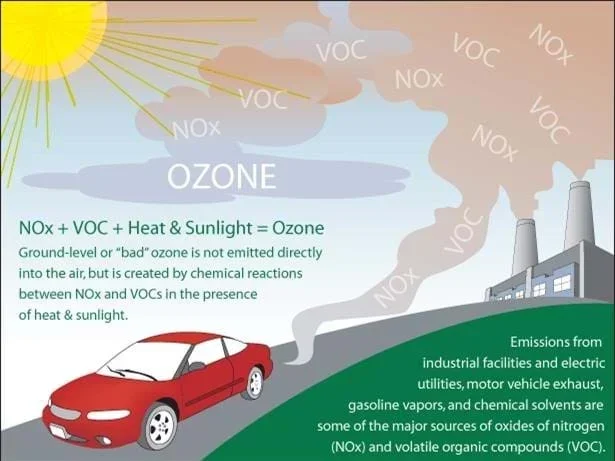 How ground-level ozone formsCopyright https://www.epa.gov/ground-level-ozone-pollution/ground-level-ozone-basics#wwh
This lesson introduces students to the concepts of air pollution from transportation and related health effects, plus vehicle solutions to help reduce air pollution and improve air quality.
First, students watch a video of vehicles in traffic and reflect on what they observed. Next, they learn about particulate matter (PM), a primary air pollutant, and do basic visual air quality and PM health effects assessments. Finally, students compare and contrast gas-powered and electric vehicles in relation to their energy sources and impacts on air quality.
This lesson introduces students to the concepts of air pollution and air quality. Students learn about the basic effects of gas-powered and electric vehicle emissions on air quality. Students work together to learn about the color-coded Air Quality Index chart, and what each chart level means in terms of the level of ground-level ozone pollution and its corresponding air quality rating. The source of ground-level ozone and its effects, and ways to reduce ozone pollution and stay safe on high-level ozone days are also presented.
Developing new technologies that use alternative energy sources is key to designing clean-energy cars, which help improve air quality.
Chemical engineers improve current battery technologies and develop new battery designs.
Electrical engineers design the electrical circuitry to charge the battery and distribute the electricity from the battery to the electric motor.
Many electric vehicles are made of newer materials that are lighter and stronger and may incorporate environmentally-friendly materials, which materials engineers develop, process, and test.
Mechanical engineers design, develop, and test mechanical devices in electric vehicles including electric motors, transmissions, drivetrains, and steering systems.
After this lesson, students should be able to:
- Recall that particulate matter and ground-level ozone affect air quality.
- Recognize ground-level ozone and particulate matter pollution is formed from gas-powered vehicle emissions and not electric-powered vehicles since they do not have any emissions.
- STEL-4F Describe the helpful and harmful effects of technology.
Grades 3-5
Do you agree with this alignment? - STEL-4I Explain why responsible use of technology requires sustainable management of resources.
Grades 3-5
Do you agree with this alignment?
- 4-ESS3-1 Obtain and combine information to describe that energy and fuels are derived from natural resources and their uses affect the environment.
Grade 4
This resource focuses on the following Three Dimensional Learning aspects of NGSS:
Science & Engineering Practices- Obtain and combine information from books and other reliable media to explain phenomena.Do you agree with this alignment?
Disciplinary Core Ideas- Energy and fuels that humans use are derived from natural sources, and their use affects the environment in multiple ways. Some resources are renewable over time, and others are not.Do you agree with this alignment?
Crosscutting Concepts- Cause and effect relationships are routinely identified and used to explain change.Do you agree with this alignment?
- Knowledge of relevant scientific concepts and research findings is important in engineering.Do you agree with this alignment?
- Over time, people's needs and wants change, as do their demands for new and improved technologies.Do you agree with this alignment?
Do you agree with this alignment? - Obtain and combine information from books and other reliable media to explain phenomena.
- 5-ESS3-1 Obtain and combine information about ways individual communities use science ideas to protect the Earth's resources and environment.
Grade 5
This resource focuses on the following Three Dimensional Learning aspects of NGSS:
Science & Engineering Practices- Obtain and combine information from books and/or other reliable media to explain phenomena or solutions to a design problem.Do you agree with this alignment?
Disciplinary Core Ideas- Human activities in agriculture, industry, and everyday life have had major effects on the land, vegetation, streams, ocean, air, and even outer space. But individuals and communities are doing things to help protect Earth's resources and environments.Do you agree with this alignment?
Crosscutting Concepts- A system can be described in terms of its components and their interactions.Do you agree with this alignment?
Do you agree with this alignment? - Obtain and combine information from books and/or other reliable media to explain phenomena or solutions to a design problem.
A basic understanding that clean air is essential for people’s and other living things’ survival, and that internal combustion engine-powered (ICE) vehicles burn fossil fuels for energy.
A basic understanding of how gas-powered combustion engines work compared to how EV battery-powered motors work is helpful.
Gas-powered vehicles burn gasoline, a fossil fuel, for energy, which releases emissions from exhaust tailpipes in vehicles into the air. These emissions contain a variety of air pollutants, including particulate matter, also known as PM. PM poses significant human health risks, especially fine PM 2.5, which can enter the bloodstream and affect various body organs and cause disease. Coarse PM 10 when it accumulates in the atmosphere creates haze and limits visibility. PM pollution affects air quality, also known as AQ. AQ is a measure of how healthy the air is to breathe.
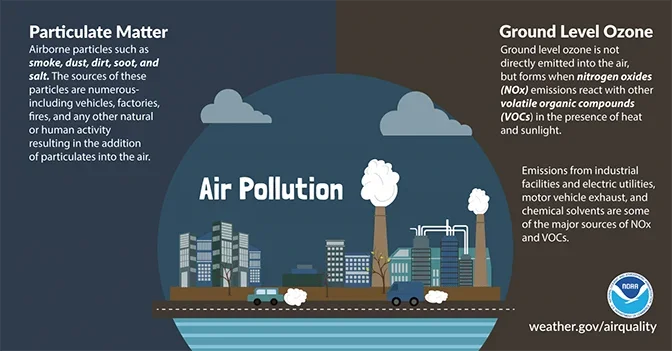 Copyright https://www.cdc.gov/air/images/particle-pollution-4_365.jpg
Ground-level ozone, or O3, is formed when fossil fuels are burned, for example by vehicles and industries, and the emissions that are released into the air combine together in the presence of sunlight and warm temperatures to make ozone. Since sunlight is a key factor, ozone can be a particular problem during the summer months, and during daylight hours. However, ozone pollution can occur any time of the year if the conditions are right. Breathing ozone causes irritation and damage to the respiratory system. Sensitive groups, which include the young, elderly, active people, and those with respiratory diseases, such as asthma, are even more sensitive to breathing ozone.
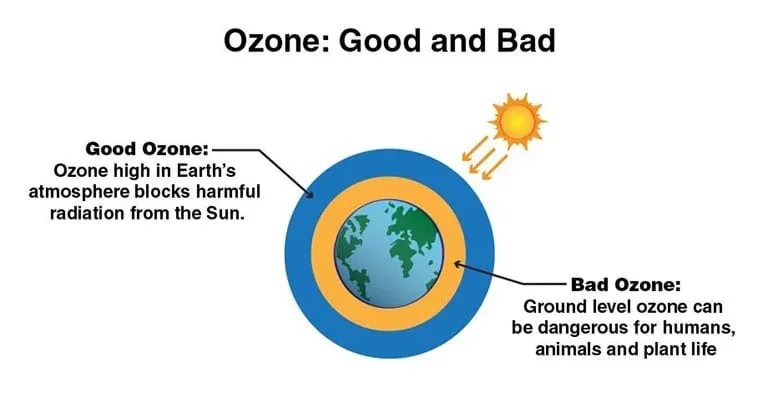 Copyright https://scijinks.gov/air-quality/air-quality2.jpg
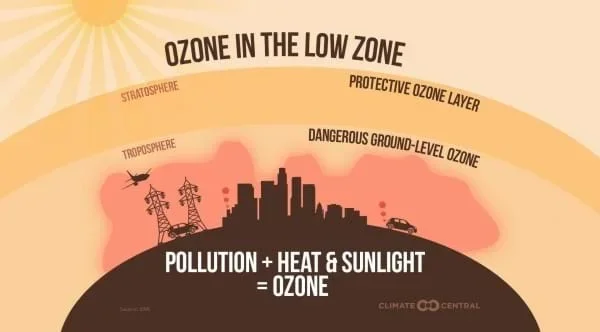 Copyright https://www.climatecentral.org/gallery/graphics/explainer-how-ground-level-ozone-is-formed
EVs, which are powered by batteries, not the burning of fuels, do not release any emissions into the atmosphere. As such, EVs do not create or release any air pollution and are referred to as zero-emission vehicles.
Procedure:
- As a think-pair-share activity, ask students the following pre-lesson assessment questions. Write each question in turn on the whiteboard or smartboard and write students’ responses as they share their thoughts:
- Do you think clean air is important?
- What makes the air dirty?
- Are there ways to keep the air clean or make dirty air clean?
- Share that the focus for today’s lesson is on how vehicles (cars)affect how clean the air is, and if there are transportation solutions to help clean the air.
- Explain to students that they are working in teams of two as environmental engineers to explore how vehicles affect how clean the air is to breathe, which we call air quality, by finding out about transportation-related air pollution. Also, they will compare two different types of cars—ICE (internal combustion engine) and EV (electric vehicle)— to find out if either one helps make our air cleaner and healthier to breathe.
- Assign partners, and hand out the ICE, EV & AQ Connections Worksheet (PDF) to each student.
- Read the Essential Questions on the worksheet aloud to remind the “engineering teams’ what to think about as they observe and complete each step of the worksheet together.
- In section 1 of the worksheet, show the video of cars in traffic to the class. Ask students to draw or write about what they observed. Have a brief class discussion on whether students think cars affect how clean the air is.
- In section 2 of the worksheet, tell students let's find out about one type of air pollution called particulate matter, or PM for short. Show the class the particulate matter video. After watching the video, review key points about PM that are described in the worksheet. Have students work with their partners to observe images and answer the questions that are listed. Review student responses as a class, and ask for volunteers to explain and/or write their responses on the whiteboard or SmartBoard.
- Continuing section 2, tell students let's find out about one type of air pollution called ozone. Show the class the ozone video. After watching the video, review key points about ozone that are described in the worksheet. Have students work with their partners to observe images and answer the questions that are listed. Review student responses as a class, and ask for volunteers to explain and/or write their responses on the whiteboard or SmartBoard.
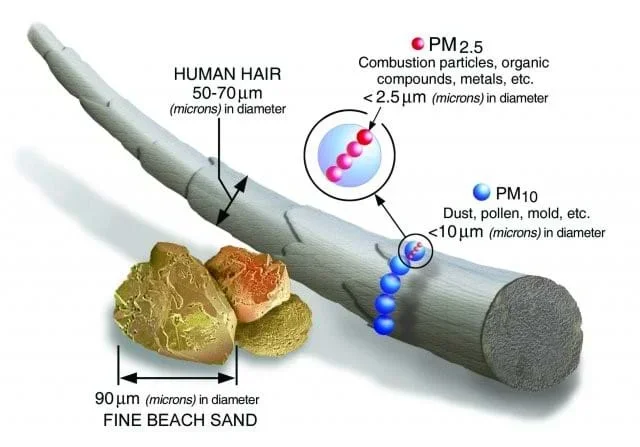 Comparing the different sizes of PMCopyright https://www.epa.gov/pm-pollution/particulate-matter-pm-basics#PM
- In section 3 of the worksheet, ask students to identify different Health impacts from breathing PM air pollution. Again with their engineered partner, have students match each phrase with its corresponding image. Discuss as a class students’ responses and what they notice about the effects of breathing PM air pollution are on people's health.
- In section 4 of the worksheet, tell students that now that they understand more about PM air pollution and its effect on our health, they are going to explore how two different types of cars—gas-powered cars and electric vehicles, also known as EVs—Impact the level of air pollution and our help. Show the video on gas-powered vehicles. Next, show the video on EVs. Ask student teams to discuss how both types of cars are similar by drawing and writing their responses. Then a student teams to discuss how both types of cars are different and draw and write their responses.
- Finally, have a class discussion on the following summative assessment questions:
- Is clean air important? Explain.
- Do gas-powered or electric cars make our air dirtier?
- Do gas-powered or electric cars make our air cleaner?
Today, we will use our sense of observation, which is how we look at things to understand them, to explore two types of cars—internal combustion engine, or ICE cars, and electric vehicles, also known as EVs.
We will first learn about how cars affect air quality, which is a way to measure how clean our air is. We will also learn about a type of transportation produced air pollutant, called particulate matter, or PM for short, which causes air pollution.
Then, we will see how PM affects the air around us. Next, we will look at how PM affects our health if we breathe in air with a lot of PM.
Finally, we will compare and contrast ICE and EVs to see if these vehicles affect the air we breathe and our health.
Lesson-Activity ideas: https://www.airnow.gov/all-publications/
Excellent class! Together we built expertise exploring two different types of cars—ICE cars and electric vehicles, and how each type affects our air and health. Now imagine in the future you are driving your first car, which type of car would you like to drive and why?
- air pollution
- A mixture of solid particles and gases in the air from human-made sources such as car exhaust (emissions), chemicals from factories, and natural sources such as dust, pollen and mold.
- air quality
- A measure of how clean or dirty the air is.
- emissions
- Something that is released or given off (e.g., car exhaust).
- electric vehicle (ev)
- A vehicle with a motor that runs on rechargeable battery power and does not release any exhaust or air pollutants into the air (zero emissions).
- ground-level ozone
- Air pollution that is formed from vehicle and industry exhaust (emissions) in the presence of sunlight and heat.
- internal combustion engine (ice) vehicle
- A vehicle with an engine that runs by burning gas (fossil fuel) and releases exhaust (emissions) that contains air pollutants into the air.
- particulate matter
- Also known as PM and is a mixture of extremely small particles and liquid droplets in the air that are emitted into the air from sources such as forest fires, power plants, industries, and automobiles.
- pollutant
- A chemical or biological substance that harms water, air, or land quality.
Pre-Lesson Assessment
Discussion Questions: Ask the students and discuss as a class:
- Do you think clean air is important? What makes the air dirty? Are there ways to make dirty air clean? Tell students they will find out more about how vehicles (cars) affect how clean the air is in the activity.
Lesson Embedded (Formative) Assessment
Guided Worksheet: Scaffold students’ learning by having them work in pairs as they complete the ICE, EV & AQ Connections Worksheet (PDF) with a partner, as directed in the Procedure section.
Post-Lesson (Summative) Assessment
Class Reflection: Ask students to share one thing they learned or still wonder about regarding the relationship between ICE cars, EVs, air pollution, and health.
Making Sense: Have students reflect on the science concepts they explored and/or the science and engineering skills they used, plus questions or ideas they have by completing a modified Making Sense Assessment (PDF).
AirNow.gov Air Quality Flag Program: https://www.airnow.gov/air-quality-flag-program/
See AirNow.gov “For Students” section ages 7-10: https://www.airnow.gov/education/students/
and “For Teachers” section: https://www.airnow.gov/education/teachers/
AirNow.gov “Ozone: Good Up High Bad Nearby” Interactive: https://www.airnow.gov/publications/air-quality-animations/ozone-good-up-high-bad-nearby/
Energy 101 Electric Vehicles: https://www.youtube.com/watch?v=M69GBL0IDzI
AirNow.gov. Accessed July 29, 2021. (Source of Activity Guides Publications) https://www.airnow.gov/publications/activity-guides-publications/
AirNow.gov. Accessed July 29, 2021. (Source of Air Quality Index and Air Quality and Health information) https://www.airnow.gov/aqi-and-health/
Armstrong, Patricia. Bloom’s Taxonomy. 2021. Vanderbilt University Center for Teaching. https://cft.vanderbilt.edu/guides-sub-pages/blooms-taxonomy/
EPA.gov. Accessed September 30, 2021. (Source of PM Health Effects)
https://www.epa.gov/pm-pollution/health-and-environmental-effects-particulate-matter-pm
EPA.gov. Accessed September 30, 2021. (Source of Ozone Health Effects)
https://www.epa.gov/ground-level-ozone-pollution/health-effects-ozone-pollution
McFadden, Christopher. How Environmental Engineers Help Fight Air Pollution. August 3, 2020. Interesting Engineering. https://interestingengineering.com/how-environmental-engineers-help-fight-air-pollution
Pisupati, Sarma. Ground Level Ozone and Photochemical Smog. 2020.Energy Conservation for Environmental Protection. https://www.e-education.psu.edu/egee102/node/1975
SciJinks.gov. Accessed July 29, 2021. (Source of Air Quality, Ozone, Air Pollutions images) https://scijinks.gov/air-quality/
Weather.gov. Accessed July 29, 2021 (Source of ground-level ozone formation, and weather impacts on air quality) https://www.weather.gov/wrn/summer-article-clearing-the-air
- Internal Combustion Engine, Electric Vehicles & Air Quality Connections
Contributors
Jennifer Taylor
Supporting Program
Pre-College Engineering Education, Integrated Teaching and Learning Program, University of Colorado Boulder
Acknowledgements
This curriculum was developed under National Science Foundation grant number 1941524. Any opinions, findings, and conclusions, or recommendations expressed in this material are those of the authors and do not necessarily reflect the views of the National Science Foundation.
This curriculum was developed with support from the AEROKATS and ROVER Education Network (AREN) (Henry/NNX16AB95A). AREN is a NASA Science Mission Directorate Science Activation (SciAct) Program.
Copyright
2022 by Regents of the University of Colorado Boulder